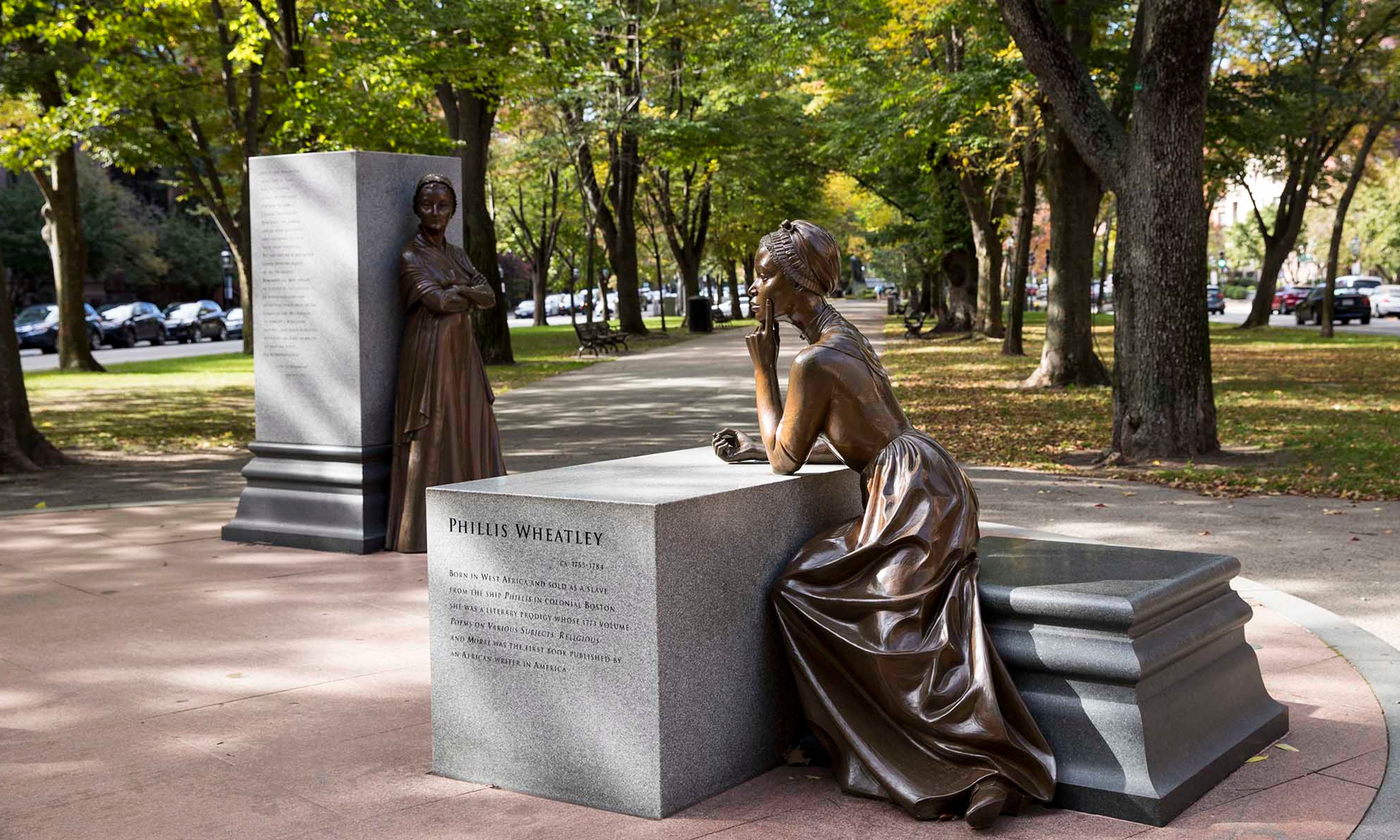
In Black Writers of the Founding Era, an impressive new anthology (Library of America 767 pp., $40) edited by James G. Basker with Nicole Seary, 200 texts are collected from the period 1760 to 1800. They include personal letters, slave narratives, poetry, public petitions, faith testimonies, and freedom suits written by black men and women in all 13 colonies and a handful of territories. Phillis Wheatley is prominently represented — Basker, in his introduction, says she should be known as the “poet laureate of the American Revolution” — but the volume is not primarily a literary collection. It serves to show, as Lincoln held, that African Americans were from the beginning a part of “the body of ‘the people of the United States.’” Black soldiers fought in the Revolution, and some of their letters and other writings are reproduced here. Before and after the war, blacks were active in founding churches, establishing mutual-aid societies, and petitioning government officials, often invoking the principles of the Declaration and Constitution. Basker notes that some white citizens at times supported their aims. (By 1800, seven northern states had abolished slavery or passed gradual emancipation laws.) From this vantage point, Basker writes, the “new birth of freedom” proclaimed by Lincoln can be seen as “the resumption of a project begun in the founding era.”
“The use of American power in war since the Second World War has been too often blundering,” writes Donald Stoker in Purpose and Power: US Grand Strategy from the Revolutionary Era to the Present (Cambridge University Press, 586 pp., $44.99). Stoker, a professor at the National Defense University’s Eisenhower School, thinks the way to guard against future blundering is to study the past and learn to think more clearly about why and how American power has been wielded. This requires discarding failed theories and disentangling political aims from the strategies used to pursue them. Stoker provides a model for the kind of clear-headed analysis he advocates, showing how successive presidential administrations have assessed their aims in relation to American interests and attempted to implement them through diplomatic, military, and economic means — some (e.g., Monroe, Eisenhower, Reagan) more coherently and successfully than others (e.g., Wilson, George W. Bush, Obama). His prose is refreshingly direct and free of academese. Ultimately, he thinks that “What should our grand strategy be?” is the wrong question, because it depends, first, on “constructing rational aims for the US to achieve at home and abroad.” For that, we’ll need political leadership.
Marvin Olasky offers some advice in his new memoir, Pivot Points: Adventures on the Road to Christian Contentment (P&R Publishing, 200 pp., $17.99): “Don’t worry about pivots. Don’t get stuck in one place, looking only one way, out of fear.” His life has contained pivots defined perhaps more sharply than most: As a teenager he turned away from Judaism and toward atheism, then socialism. After graduating from Yale, he became a journalist and a card-carrying Communist. His conversion, as a graduate student, to anti-communism and theism occurred over the course of eight hours of reflection in the library of the University of Michigan: “No drugs, no dreams, just sitting in the chair, hour after hour, suddenly thinking Marxism is wrong.” He came to embrace Evangelical Christianity. In the 1990s, Republican enthusiasm for his book The Tragedy of American Compassion drew him suddenly into politics. He is credited with developing George W. Bush’s “compassionate conservatism,” an idea that, by the end of 2001, he writes, had become a “political punchline.” The final pivot Olasky recounts with sadness but without rancor: For many years, he edited the Christian news magazine World, until in 2021 he resigned over editorial disagreements with the board. (As he tells it, he wanted to focus on reported stories, not opinion; the board worried about losing subscribers over his anti-Trump stance.) In reflecting on all these events, he follows the Puritan preacher Jeremiah Burroughs in making “a good interpretation of God’s ways.”












Comments