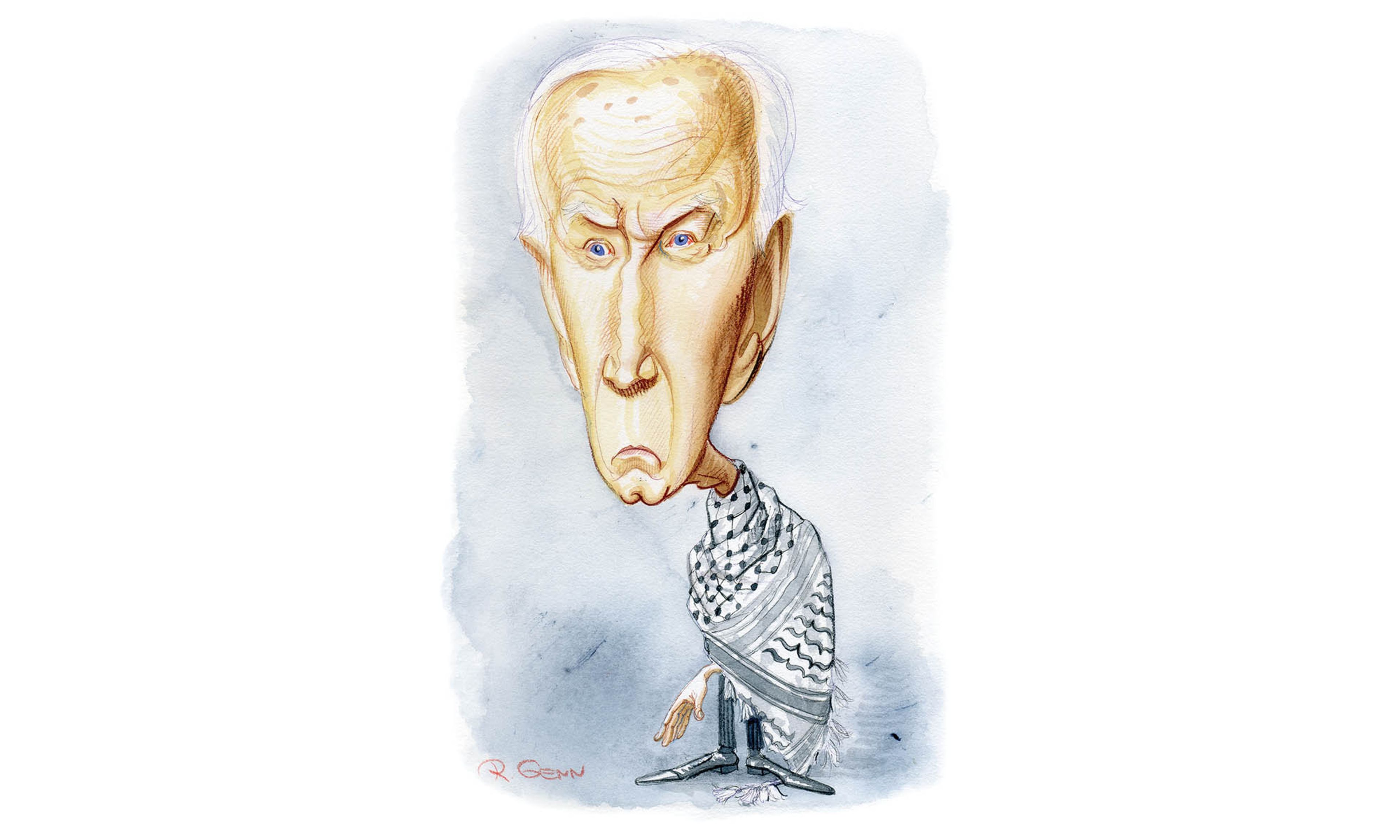
• Cricket lived longer than Kristi Noem’s veep hopes.
• After exchanging taunts online, Joe Biden and Donald Trump agreed to debate in June. Until there is official agreement on all the details — in fact, until the candidates are on the debate stage — any plans could fall through. But a series of presidential debates would be worthwhile. Biden is an elderly individual suffering from noticeable signs of decline, and there are serious doubts as to whether he is fit to serve a full second term. Trump, no spring chicken himself, skipped all the debates during the primaries and has not had to answer many questions about what kinds of policies he would pursue in a second term. Voters deserve to see both men stand up and take questions in an unscripted format in which each can be challenged by his opponent. Barring something extraordinary, either Trump or Biden will be president next year. Let them face each other, as they face the voters.
• Neither the pressure of the hustings nor the stress of the courtroom has thrown former president Trump off his rhetorical stride. At a rally in Schnecksville, Pa., supporters began to chant “Genocide Joe” — the cry of leftists who believe Biden helps Israel oppress Gaza. It was not clear why Trump fans were saying it, but because it was hostile to Biden, Trump approved: “They’re not wrong.” At another rally, in Waukesha, Wis., he said, “We’re going to give our police their power back, and we are going to give them immunity from prosecution.” A bad idea and one hard to pull off, since police respond mostly to state and local, not federal, crimes; but if it sounds sweeping, say it. In Richmond, Va., Trump said he would “not give one penny to any school that has a vaccine mandate.” Aides insisted he was not calling for the return of polio, only inveighing against Covid vaccines (which he himself caused to be produced, at “warp speed”). Finally, in a speech to donors in Palm Beach, Fla., he said concerning his legal travails that the Biden administration was “running a Gestapo administration, . . . and it’s the only way they’re going to win.” Spritzing baseless Nazi comparisons at a time of heightened antisemitism is as gross as it is immoral. The only mitigation of such sentiments — and it isn’t much — is Trump’s frivolousness and inattention. He will utter some new outrage with the next sunrise. What a fine candidate Republican voters have saddled their party with.
• After having previously declared, as a result of his 2020 election-denial monomania, that free and fair elections would be impossible with mail-in ballots, Trump publicly decreed (in all caps) that “ABSENTEE VOTING, EARLY VOTING, AND ELECTION DAY VOTING ARE ALL GOOD OPTIONS.” Trump’s prior efforts to falsely claim voter fraud by tarnishing early voting needlessly disadvantaged the Republican Party by leading it to neglect votes cast before Election Day. Whatever one thinks about pre–Election Day voting — we would like to see improved voter verification and an end to ballot-harvesting — its widespread use is a reality. We’ll see if it is a reality Trump will consistently acknowledge henceforth.
• Trump’s criminal trial in New York is drawing to a quicker-than-expected ending. Prosecutors announced that Michael Cohen, Trump’s former lawyer and bumbling “fixer,” is their final witness. Trump is unlikely to testify in his own defense. Manhattan district attorney Alvin Bragg clearly stripped the case down after porn star Stormy Daniels provided graphic testimony of a sexual encounter she claims to have had with Trump in 2006 — inflammatory evidence that shed no light on the actual charges and had Judge Juan Merchan deriding prosecutors for doing what he had green-lighted. Cohen is a loathsome figure, but that could cut both ways with the jury, loathsomeness being what made him useful to Trump for over a decade. Legally, the case is weak. The falsity of Trump’s business records is debatable, with Bragg betting heavily on the say-so of Cohen, a convicted perjurer. Even if one stipulates that the records are false, Bragg still needs to prove fraudulent intent that includes covering up a second crime — which Bragg suggests is conspiracy to violate federal campaign laws. The proof on those elements is scant, and it is a due-process affront that we’re still guessing on the second crime. Still, juries tend to take their cues from the judge, and Merchan’s pro-prosecution bias is barely contained.
• To judge by Trump’s social-media posts, the former president expects “TOTAL IMMUNITY” from prosecution. His lawyer, arguing before the Supreme Court, was more measured, conceding that former presidents are immune only for their official acts and that special counsel Jack Smith’s federal indictment in the 2020-electors case mostly targets Trump’s private conduct as a candidate. The Court is thus likely to sustain most of the indictment, and if Smith is bent on taking the case to trial before Election Day, he may be able to avoid further delays by dropping other allegations. How the Court rules on the immunity principle is a larger question. The government’s argument was tone-deaf, insisting to the justices that federal prosecutions are never politicized — although even Smith’s lawyer couldn’t claim the same with a straight face about Alvin Bragg and Fani Willis. Immunity finds support in precedent, and there are structural arguments for protecting the presidency, but it’s also nowhere in the Constitution’s text or the contemporaneous debates. Once again, Trump and his adversaries have forced an issue long avoided. As it did not in the ballot-disqualification case, which found it ruling in haste and without its customary rigor, the Court should take the time to get this one right for the long run.
• In 2016, Trump broke with precedent by releasing a list of potential Supreme Court picks. It was key to persuading skeptical conservatives who provided the margin of his victory. It was also a healthy move for democratic transparency in light of the outsized role the Court plays today. It is ultimately the voters who are responsible for preserving our Constitution, and they deserve to know what sort of hands they will be leaving it in. Judicial nominations were perhaps the greatest success story of Trump’s first term, pursued without the chaos that attended other Trump efforts and unifying the disparate factions of the party. Judges were a winning issue for Republican Senate candidates in 2018 and 2020. Yet, throughout the 2024 primaries, Trump and his campaign were oddly quiet about the judiciary, as Trump seemed content to rest on his laurels while rumors swirled that he was breaking with legal conservatives and was dissatisfied that the courts had not been more solicitous of his false election-fraud claims and demands for immunity from prosecution. In mid March, Trump said that he would release another judges list. If he wants to win and govern effectively, he should follow through on the promise.
• Trump has promised to roll back Biden’s Title IX rewrite — which substituted gender identity for biological sex in the anti-discrimination law covering educational institutions — “on Day One” of his administration if he is reelected in November. Betsy DeVos, Trump’s secretary of education, spent four years undoing the damage done by the Obama administration, which had eroded women’s spaces and sports and erected kangaroo courts on campus to adjudicate sexual misconduct without providing anything like due process. Biden then spent four years attempting to inflict new damage. This was a political mistake, as Trump seems to appreciate.
• Whistle up all the famous political dogs: FDR’s Fala, the Nixon girls’ Checkers, LBJ’s ear-pulled beagle, Biden’s biting Major. Englishmen of a certain age will remember Rinka, the Great Dane shot by a hit man hired to kill its owner, an indiscreet ex-boyfriend of Liberal Party leader Jeremy Thorpe; Auberon Waugh, sometime contributor to NR, ran against Thorpe on the Dog Lovers’ ticket. South Dakota governor Kristi Noem adds to this political kennel Cricket, a 14-month-old puppy she shot after it disobeyed her commands on a pheasant hunt, killed a neighbor’s chickens, and tried to bite Noem. One can debate the wisdom of hustling Cricket across the Rainbow Bridge: It is legal in South Dakota to kill threatening domestic animals, although Noem could simply have given her to someone with more patience and ability as a trainer. One cannot debate the stupidity of telling the story in a memoir, No Going Back, and framing it as a tale of tough decisiveness. Populist Republicans accuse elites of being out of touch with the common man. Sixty-five million American households own at least one dog. That’s a lot of people to make think you are a little, well, rabid.
• In this presidential cycle, we hear another dog not barking. We have heard the same dog not barking three presidential cycles in a row. The national debt is not a topic of debate. Neither is the federal budget deficit. Neither, accordingly, is the question of entitlements. The Romney-Ryan ticket, in 2012, was bold on these issues. That boldness did not pay off. Often, people speak of a “uniparty.” On the matter of our fiscal house, we seem to have one — which is too bad, because the matter of our fiscal house is screamingly important and the uniparty does not care.
• Admit it, when you read the New York Times scoop about Robert F. Kennedy Jr. surviving a bout with a parasitic worm that had eaten a portion of his brain, you were both surprised and not surprised. Suddenly Kennedy’s wackier statements didn’t seem quite so wacky. The Times also reported that he had suffered a bout of mercury poisoning. It’s good that Kennedy believes he isn’t having any memory loss or other lingering effects, but it’s not good that his campaign refused to turn over medical records and that no major candidate has released medical records so far this cycle. In February, President Biden released a “summary” of his most recent medical tests but not his records; in November, former president Donald Trump released a three-paragraph letter from his doctor declaring that he was in “excellent health.” In both the 2000 and 2008 cycles, John McCain released his medical records, recognizing that the public needed reassurance given his advanced age. McCain was 71 in 2008. Kennedy turned 70 in January. Trump turns 78 in June, and Biden turns 82 shortly after the election. Jill Stein turns 75 this month, and Cornel West turns 71 in June. All these candidates ought to release their records or, at a minimum, allow a medical correspondent to review and summarize them.
• Representative Marjorie Taylor Greene (R., Ga.) brought a motion to vacate the speakership against Mike Johnson. Unlike the previous effort to oust Kevin McCarthy, this one was to no avail. Only a small group of representatives, mostly the worst members of both parties (the nihilist Right and the socialist Left), voted to remove Johnson. This isn’t the first time Greene has teamed up with the far Left. She also met with the radical activists at Code Pink over their shared opposition to Ukraine aid. Johnson now emerges looking secure in his position, at least through the end of this Congress. The mid-session motion to vacate has been exposed as a tactic of diminishing returns that not only damages the party in power but also impedes the House from functioning at all — which doubtless explains why Democrats grew tired of the spectacle even when it suited some of their short-term interests. We hope that no future speaker will follow McCarthy’s lead in agreeing to let this sword hang over his head as a condition of taking the job.
• Biden’s announcement of new China tariffs is the latest example of two trends in his administration: talking tough on China but not following it up with effective policy, and bending over backward to appease organized labor. The administration estimates the tariffs would affect $18 billion of imports, equivalent to 4 percent of total U.S. imports from China last year. The tariffs are concentrated in industries that are close to government: steel, semiconductors, and automobiles. A 100 percent tariff on electric vehicles is mostly for show, since virtually no Chinese EVs are sold in the U.S. and the sourcing of EV components wouldn’t be such a problem if the federal government and the government of the most populous state weren’t mandating their sale. This from the administration that took more than a year to implement new sanctions on China for violating American airspace with a spy balloon, removed sanctions from an arm of the CCP complicit in the Uyghur genocide in a failed effort to get China to crack down on fentanyl exports, and still believes that China is a partner on climate change. But like other policies from Biden, the tariffs make sense as political favors to labor unions. Effusive in their praise of the announcement were the AFL-CIO, the United Steelworkers, and the BlueGreen Alliance (the last is a coalition of unions and environmentalist groups whose members include the United Auto Workers, the Sierra Club, the American Federation of Teachers, the SEIU, and the Natural Resources Defense Council — it’s all one progressive movement). Biden is protecting politically important industries, not being tough on China.
• Congress passed legislation that would ban the app TikTok in the United States unless its Chinese parent company, ByteDance, sells TikTok to an American firm. TikTok’s lobbyists had prevented this outcome for years, but a recent ham-fisted campaign to persuade TikTok users to call members of Congress only convinced lawmakers that ByteDance could use TikTok for political purposes. A report that the Chinese embassy was lobbying against the bill also helped ensure its passage. But TikTok is now suing the federal government and asking courts to strike down the law, which it says violates the First and Fifth Amendments and unfairly singles it out. While most of the initial national-security concerns about TikTok were voiced by Republicans, including Donald Trump, who sought to ban the app, the former president has since flipped on the issue. TikTok could have a friend in the White House next year.
• The overturning of Roe v. Wade revived long-dormant abortion bans in several states, some of them dating back to the mid 19th century and containing few exceptions. Since its first territorial criminal code in 1864, Arizona has had an absolute ban on abortions, excepting only those necessary to save maternal life. Similar bans triggered a pro-abortion backlash in Michigan and Wisconsin, and a fall referendum in Arizona threatened to focus on the 1864 ban. The law is defensible morally but not, in this climate, politically. Repealing it, as Democrats did with a few GOP votes, gives pro-lifers the opportunity to fight the referendum as a vote on Arizona’s more modest 15-week restriction, signed by Governor Doug Ducey (R.) in 2022. Wars, as Churchill reminded us after Dunkirk, are not won by evacuations. But prudent evacuations can keep the troops alive to fight again on a better day.
• The Biden administration told the Supreme Court that Idaho’s law against abortion has the result of denying women in emergency rooms abortions they need to preserve their health — and that the federal Emergency Medical Treatment and Active Labor Act of 1986 (EMTALA) overrides the state’s law. This is part of the administration’s broader effort to federalize the abortion question by litigation and administrative fiat. Its position is bizarre. EMTALA says nothing about abortion and, indeed, requires emergency treatment for unborn children. It is a condition of state receipt of funding for Medicare, even though that program provides health care for the elderly. Justice Elena Kagan claimed at oral arguments that EMTALA allows the “medical community” to set evolving nationwide standards for emergency care that override the work of state legislatures and medical boards. In her view, then, the mandates of federal law should change over time, without approval even by an agency, let alone by Congress. The breadth of the administration’s theory was revealed when the solicitor general conceded that it would allow Congress, through spending conditions, to pass a national ban on abortion and gender-reassignment surgery. The Court should pause at such sweeping assertions.
• Speaking of the Biden administration’s seizing any opportunity in the law to claim vast authority never contemplated by Congress, the Federal Trade Commission — which, last we checked, is not the primary regulator of terms of employment — has banned most noncompete clauses, covering the contracts of some 30 million workers nationwide. Perhaps most alarmingly, the FTC claims the power to retroactively rewrite millions of existing contracts, a prospect that deprives companies of the benefits of bargains they struck by paying employees to accept such contractual terms. There are fair policy debates over noncompete clauses, which serve the legitimate business purpose of allowing companies to recoup their investment in training employees and providing them with proprietary information but can also restrict the free movement of labor and the formation of new businesses. Common law and the 13th Amendment’s ban on involuntary servitude have long placed outer limits on such agreements, and some states go further. But the FTC has broken from its long-standing case-by-case enforcement policy and busted the limits of its statutory powers, which is why two of the five commissioners voted against the rule, and why the Chamber of Commerce has sued to enjoin it.
• A report by Sharon Otterman in the New York Times was headed “An Inside Look at the Student Takeover of Columbia’s Hamilton Hall.” Its subheading was, “Maintenance workers had a firsthand view of how protesters seized the building, and wondered why the university failed to stop it.” One such worker was Mariano Torres. When masked protesters entered Hamilton Hall, he said, “What the hell is going on?” They said to him, “This is bigger than you.” One of them said that he, the janitor, was not paid enough to deal with the matter. Someone else offered him a “fistful of cash,” said Torres. He told the protester, “I don’t want your money, dude. Just get out of the building.” Torres for Columbia president?
• One school ably upholding free speech while addressing concerns about antisemitism is the University of Florida, run by Ben Sasse, the former U.S. senator. The university communicated to protesters how they could exercise their rights and what crossed the line into disrupting university life for other students, and then it punished those who crossed the line. “This is not complicated: The University of Florida is not a day care, and we do not treat protesters like children — they knew the rules, they broke the rules, and they’ll face the consequences,” the school announced. With many principled conservatives leaving Congress, maybe it’s time for more universities to hire new presidents.
• As protesters sought for the second time to replace Old Glory with the Palestinian flag on the University of North Carolina campus at Chapel Hill, patriotic Pi Kappa Phi brothers stood in their way. Interim chancellor Lee Roberts then had fitting words, spoken to the face of the mob: “This university doesn’t belong to a small group of protesters. It belongs to every citizen of North Carolina. . . . That flag belongs to all of us.” As the crowd tried to drown him out, Roberts refused to stop: “To take down that flag and put up another flag, no matter what other flag it is — that’s antithetical to who we are, what this university stands for, what we have done for 229 years.” Here’s to Chancellor Roberts and the young men of Pike, who honored the flag and what it stands for.
• Governor Ron DeSantis of Florida signed a bill that prohibits the production and sale of lab-grown meat in the Sunshine State. We must ask: Why? DeSantis’s answer is that “Florida is fighting back against the global elite’s plan to force the world to eat meat grown in a petri dish or bugs to achieve their authoritarian goals.” Odd as it may sound, it’s true that the ultimate aim of many of those who champion lab-grown meat is to decree that the people of the world adopt diets that they would never choose on their own. But there is a difference between fighting back against mandates and prohibiting consumer products. The bill’s authors talk of bans, but they just issued one; they fret about mandates, but they just added one. The result has been not an increase in liberty but a reduction, and, as such, it represents an overreach — and worse still: a precedent.
• When New York City’s floating mob of Hamas supporters failed to disrupt a gala at the Metropolitan Museum, thanks to a heavy police presence, they turned to a statue at 67th Street and Fifth Avenue, defacing it with the painted words “GAZA” and “PALESTINE.” The statue commemorates the 107th Infantry, a New York regiment that deployed to France in World War I. The 107th helped repel Germany’s 1918 spring offensive and break the Hindenburg Line that summer. (In the Second Battle of the Somme, all American units together took 11,500 casualties.) Sculptor Karl Illava served as a sergeant in the 107th and told his daughter he wanted his depiction of doughboys, charging and wounded, to capture the “hell of war.” Illava used his own hands to model the soldiers’. In remarks at the statue, Mayor Eric Adams called those who had vandalized it “cowards.” He added: “I want to be extremely clear. I love America, and I’m proud to be a citizen of America. And the reason we are here is because of men and women like the statue behind us. And we cannot remain silent when our symbols of freedom are desecrated by individuals who clearly hate our country and hate our way of life.”
• The Supreme Court handed a modest victory to aggressive civil-forfeiture schemes in Culley v. Marshall, ruling that when the government seizes property in connection with an arrest, the due-process clause requires only a prompt hearing to determine whether the government keeps it — not an additional preliminary hearing to decide whether the government can hold the property pending that hearing. That’s bad news for people like the car owners in Culley, who were without their vehicles for months because friends or family members were busted for drugs while driving them. Justice Brett Kavanaugh’s opinion for the 6–3 majority offered a defensible case under precedent and history for not requiring a preliminary hearing. But the Court’s lineup bodes poorly for often-overzealous forfeiture schemes. Justice Neil Gorsuch, joined by Justice Clarence Thomas, wrote a concurring opinion arguing that the Court should reconsider in a proper case whether modern civil forfeiture truly comports with historical understandings. Justice Sonia Sotomayor, writing for the three liberals in dissent, bristled just as Gorsuch did with hostility at forfeiture abuses driven by revenue-raising incentives that distort law enforcement and burden those least able to fight the government in court. That’s five votes. In the meantime, legislatures should reform these systems without waiting for the Court.
• In a stunning ruling, New York’s highest court reversed sexual-assault convictions of Hollywood mogul Harvey Weinstein. A 4–3 majority held that the trial court had erred in permitting a raft of uncharged sexual-abuse evidence. The majority reasoned that the improper purpose of that evidence was to demonstrate propensity: to suggest that the defendant must have committed the charged crime because he habitually engaged in that type of behavior. The appeals court further ruled that Weinstein may be tried again. For now, he will remain in custody, having been convicted on similar charges in California, where he was sentenced to 16 years’ imprisonment. Still, Weinstein’s New York trial and conviction were a crescendo of the Me Too movement. For now, the conviction has been erased, and a court has reaffirmed the principle that criminal guilt turns on the strength of the evidence of the crime that the grand jury has charged, not on evidence of crimes it has not charged, and not on the passions of a political moment.
• In mid May, Russian forces opened a new front in Ukraine’s north, advancing towards Kharkiv, Ukraine’s second-largest city, which sits just 20 miles from the border. The Russians failed to capture Kharkiv in the opening weeks of the war and were then forced to retreat from the region in the face of a Ukrainian counterattack in the second half of 2022. Now, they’re back: Several border villages were overrun in recent fighting, sending thousands of civilians fleeing westward, as the Ukrainian army worked to rush reinforcements from the south. The war has reached a perilous stage: Vladimir Putin has replaced his close ally and defense minister, Sergei Shoigu, with the technocrat economist Andrei Belousov as the Russian army gears up for a summer push. It is now an uneven contest of attrition until American weapons and aid replenish Ukrainian stockpiles. Meanwhile, Ukrainian authorities announced the arrest of two colonels in its State Protection Department, the agency tasked with the personal protection of Zelensky and other senior government officials. The men were allegedly plotting with the Russian Federal Security Service, the successor to the KGB, against Zelensky and Ukraine’s military-intelligence chief. The war grinds on as the Kremlin lashes out against all who defy its policy of conquest.
• Vladimir Kara-Murza is a Russian journalist, historian, democracy leader, and political prisoner. Twice, agents of the Russian state tried to kill him with poison: once in 2015, once in 2017. He was imprisoned shortly after Russia’s full-scale invasion of Ukraine in 2022. He was sentenced to 25 years. He is in terrible health, and his family and friends worry that he will soon die, as another Russian political prisoner, Alexei Navalny, did in February. In 2017, Kara-Murza started to write columns for the Washington Post. While in prison, he has managed to send some columns through a lawyer — risking worse treatment as a result. He has now won the Pulitzer Prize for commentary. This puts a spotlight on a political prisoner who needs one. But it also rewards an outstanding writer and thinker. President Biden should consider giving him the Presidential Medal of Freedom. There is precedent for this: In 2007, President George W. Bush gave the award to a Cuban political prisoner, Óscar Elías Biscet, in absentia. It perhaps helped keep him alive. Biscet was released in 2011, and he eventually received his medal from Bush, by then an ex-president, in person: a precedent that we should hope will be followed for Kara-Murza.
• The House Select Committee on the CCP unveiled a report finding that the Chinese government directly subsidized fentanyl-precursor companies, heaped praise on them, and stonewalled U.S. officials who were trying to get Beijing to crack down. The report substantiates the allegation that the Chinese government has declined to stop the trafficking of fentanyl precursors, and brings to light new evidence that it is fueling the crisis. This new information undercuts the Biden administration’s argument that seeking détente with China is a prerequisite for stopping the flow of fentanyl into America. The White House had wagered that making a concession to China on U.S. sanctions for the Uyghur genocide would help to resume bilateral dialogue on counternarcotics. But Beijing continues to have other plans.
• Radio Free Asia issued a report: “Whistleblowing Uyghur surgeon speaks truth to horror.” That horror is organ-harvesting. The monstrousness of the Chinese dictatorship knows no bounds.
• Malmö, the city in Sweden, hosted the 2024 Eurovision Song Contest. There was an Israeli participant, Eden Golan, age 20. There were large demonstrations in the streets, protesting her presence. At a press conference, one journalist asked her whether she was endangering other participants, and the public at large, by being in Malmö. She answered coolly — gaily, actually — that she and others had come to sing. In 2009, the Israeli tennis team played a Davis Cup match in an empty arena. That was in Malmö, too. The match could not be held with spectators, owing to the atmosphere of violence in the city. Everywhere they go, Israeli athletes and musicians are harassed. They are singled out for opprobrium. As a rule, this does not happen to athletes and musicians from other countries — even ones with monstrous dictatorships, such as China, Iran, and North Korea. We all know why.
• “We spent more than a year examining the AR-15’s role in America. Here’s what we learned.” So reads the headline of a Washington Post compilation of its multi-stage investigation of the popular rifle. The answer is, apparently, nothing: The series was “scientifically illiterate, error-ridden, propagandistic, and willfully misleading,” as our former colleague Kevin D. Williamson put it. One error is demonstrative: the description of the type of round the AR-15 fires as “uniquely destructive” largely because of its velocity (which the Post confuses with the rate of fire). As Williamson points out, many guns are more powerful than the AR-15, and are more commonly used in mass shootings. None of this mattered to the Pulitzer Prize committee, which recently gave an award to the Post for the series. The committee has misfired before, but this misjudgment makes it especially clear that its priorities are less journalistic than political.
• In her four years at the University of Iowa, Caitlin Clark scored more points than any college basketball player, male or female, in NCAA history. She’s going pro this year and was chosen as the No. 1 pick in the WNBA draft by the Indiana Fever, which will pay her a base salary of . . . $76,535. Why so low? It’s a union pay scale. In a league that makes only $200 million in annual revenue (compared with about $10 billion for the NBA), the union wants to make sure that that relatively small pie is sliced up as evenly as possible for its members. The collective-bargaining agreement also sets maximum salaries, so that no player is permitted to earn more than $241,984 in 2024. Fortunately for Clark, the market will make sure she gets paid plenty. She has signed a shoe deal with Nike for $28 million and has many other endorsements from major companies that will make her millions more. Unions protect mediocrity. Markets reward excellence.
• MIT will no longer require diversity statements from potential faculty hires. To mark the occasion, Sally Kornbluth, last woman standing among the three elite-university presidents who testified before the House last winter about antisemitism on campuses, wrote that “compelled statements impinge on freedom of expression, and they don’t work.” One can only agree, while wondering why they were ever thought to work, or thought to be compatible with freedom of expression, in the first place.
• The Boy Scouts of America was founded 114 years ago by men who were concerned about the disappearance of traditional boyhood and wanted to cultivate masculine virtues even as America rapidly urbanized. Now it is changing its name to “Scouting America.” The president of Scouting America, Roger A. Krone, insists that “our mission remains unchanged” and that “we are committed to teaching young people to be prepared for life.” In reality, the renaming follows revolutions already completed. In the past eleven years, the Boy Scouts ended a ban on gay adult leaders, welcomed girls who identify as boys to enroll in their boys-only program, and settled massive sex-abuse lawsuits. Leaks online show that even a nominal separation of boys and girls in older troops is likely to give way to co-ed arrangements. The transmogrification of the Boy Scouts is the culmination of a long-running war on all-male spaces. It happens in tandem with the transgender movement’s war on female-only spaces. These supposed progressive victories for equality are necessarily Pyrrhic, built upon the untruth that the sexes are interchangeable and have the same developmental and social needs. They now come at the cost of potentially millions of boys, living and yet unborn, who have had their institutional inheritance destroyed before they could receive it.
• United Methodist delegates at the church’s national conference repealed a long-standing prohibition on gay clergy. The move comes as the church has lost about a quarter of its U.S. congregations over the past five years, the vast majority of which made the decision to leave based on the church’s refusal to enforce its rules about the clergy and same-sex marriages, according to the Associated Press. In all, more than 7,600 U.S. churches have left the denomination since 2019. The organization also has about 4.6 million members in countries outside the U.S., with some African delegates excluded from the voting. “We have loved The United Methodist Church. We have been grateful for The United Methodist Church. We have joyfully served The United Methodist Church. But now our hearts are troubled,” read the African Methodists’ statement.
• Speaking at the Bloomberg Tech Summit in San Francisco, Bumble founder and executive chairwoman Whitney Wolfe Herd spoke about the ways in which AI could improve dating apps for women. She suggested the use of an “AI dating concierge” with which one could share one’s insecurities. Another “really out there” idea, she said, is for the dating concierge to “go and date for you” with other users’ dating concierges. “Then you don’t have to talk to 600 people,” she said. “It can scan all of San Francisco for you and say these are the three people you really ought to meet.” Before the 18th century, it was common for parents or professional matchmakers to find one’s spouse. Then followed 200 years or so of romanticism, the high-risk, high-reward world of courtship and dating. And now we’re in an era of online porn and loneliness. If AI can make sense of modern dating, we’ll have to admit it can do something humans can’t.
• A newly deciphered papyrus scroll found in a Roman villa that was buried in a.d. 79 under layers of ash from Mount Vesuvius gives a new account of Plato’s last evening alive. According to the scroll, found in a house thought to have belonged to Julius Caesar’s father-in-law, the feverish and sickly philosopher listened to a Thracian slave girl play the flute and, true to form, critiqued her lack of rhythm. May the vaults and libraries of Herculaneum, long thought inaccessible to us, bring forth new discoveries.
• “I am amazed sometimes to think how old I am,” says the narrator of “Some Women,” a story published in the New Yorker when its author, Alice Munro, was 77. A self-described “plodder” and a tireless editor of her own work, Munro once paid to revise a short story after her publisher had sent it to the printer. In her mid 30s she discarded most of her attempts at fiction. A few years later she published her first book, a collection centered on the lives of girls and women such as she knew in rural Ontario, her home. She made her lean, clean prose the unobtrusive servant of her unsentimental accounts of what moves her characters and, in the telling, her readers. “It is a challenge to find an unessential word or a superfluous phrase,” Peter Englund said in presenting her the Nobel Prize in Literature in 2013. In “The Bear Came Over the Mountain,” she describes the relationship of a man and his wife as she slips into dementia, a condition that claimed her career in her final years, after more than a dozen short-story collections and a mountain of prizes. Dead at 92. R.I.P.
Biden’s Israel Blunder
On the eve of Israel’s push into the town of Rafah on the southern border of Gaza, President Biden told CNN that he had warned he would withhold shipments of certain bombs if such an operation were carried out. Biden’s remarks were both a political and a strategic blunder.
American presidents often pressure America’s allies to make their actions conform to our interests. The pressure can be exerted quietly, or leaked deliberately or accidentally. When a president goes public, he is sending a message.
The message Biden presumably intended to send was political — to bolster his standing at home, and perhaps also to cause cracks in Israel’s coalition government led by Benjamin Netanyahu. Biden wants to appease Arab-American voters in the battleground states of Michigan and Minnesota and to soften complaints from the progressive Left. The posture is very Bidenesque; he always leans in whatever direction his party seems to be heading. It may backfire this time. Support for Israel remains high among most Americans, and Biden has drawn criticism from moderate House Democrats. Republicans are united in opposition. In Israel, Biden’s lectures are as likely to shore Netanyahu up as to tear him down.
Biden’s threat reflects his instincts as a military planner, which are typically bad. He micromanages from afar. His doling out of weapons to Ukraine has hobbled that nation in its efforts to defend itself. His insistence on a quick pullout from Afghanistan guaranteed a swift and inglorious collapse. His latest effort at titrating the struggle for Rafah was the extraordinary offer to reward Israel for holding back by telling it where Hamas bigwigs are hiding — meaning that we have known for who knows how long and given the murder masters a time-out?
None of this relieves Israel of the burden of thinking strategically. The Gaza operation must not become an endless game of Whac-A-Mole. Israel’s long-running policy — a national article of faith — of doing everything possible to retrieve hostages bedevils its efforts to destroy their captors.
On the world stage, the war in Gaza has become a grotesque morality play, with Israel the beast in the French rhyme that is considered mean for defending itself when it is attacked. The U.N. recently cut its estimates of noncombatant casualties in Gaza in half. Could it be that the Hamas-run Gaza Health Ministry had been supplying it with bogus numbers? In such times, statesmen need to show clear heads, not anxious fussing.
The Stat
210% — how much greater Chinese defense spending is than what the Chinese government reports, according to a report by Mackenzie Eaglen of the American Enterprise Institute.
The Chinese government reported defense spending of $229 billion in 2022. That’s small compared with the U.S. defense budget of $742 billion for that year. But the real number for China’s defense spending is over three times greater, putting China roughly at parity with the U.S. The Chinese defense budget is not transparent at all, with only the top-line number for 2022 reported by officials. In 2020, the Chinese government broke down the spending into personnel, training and maintenance, and equipment, and Eaglen uses those proportions to adjust the 2022 data. She adjusts the training-and-maintenance and equipment components by comparing purchasing power and adjusts the personnel component by comparing wages. She finds the actual top-line budget to be $549 billion. But the Chinese defense budget does not include many aspects of China’s defense policy, such as paramilitary organizations, outer space, and research and development. Eaglen’s more inclusive estimate is $711 billion for China’s 2022 defense spending. That money goes farther for China than it would for the U.S. because China has fewer global interests and can concentrate more on Asia, Eaglen argues. Accuracy is elusive, given the unavailability of data, but Eaglen notes that $711 billion might be an underestimate, since she used a conservative guess of R&D spending and did not include forms of civil–military fusion that are part of China’s industrial policies. Regardless, the idea that the U.S. spends far more than China on defense is a fiction.
by Dominic Pino











Comments