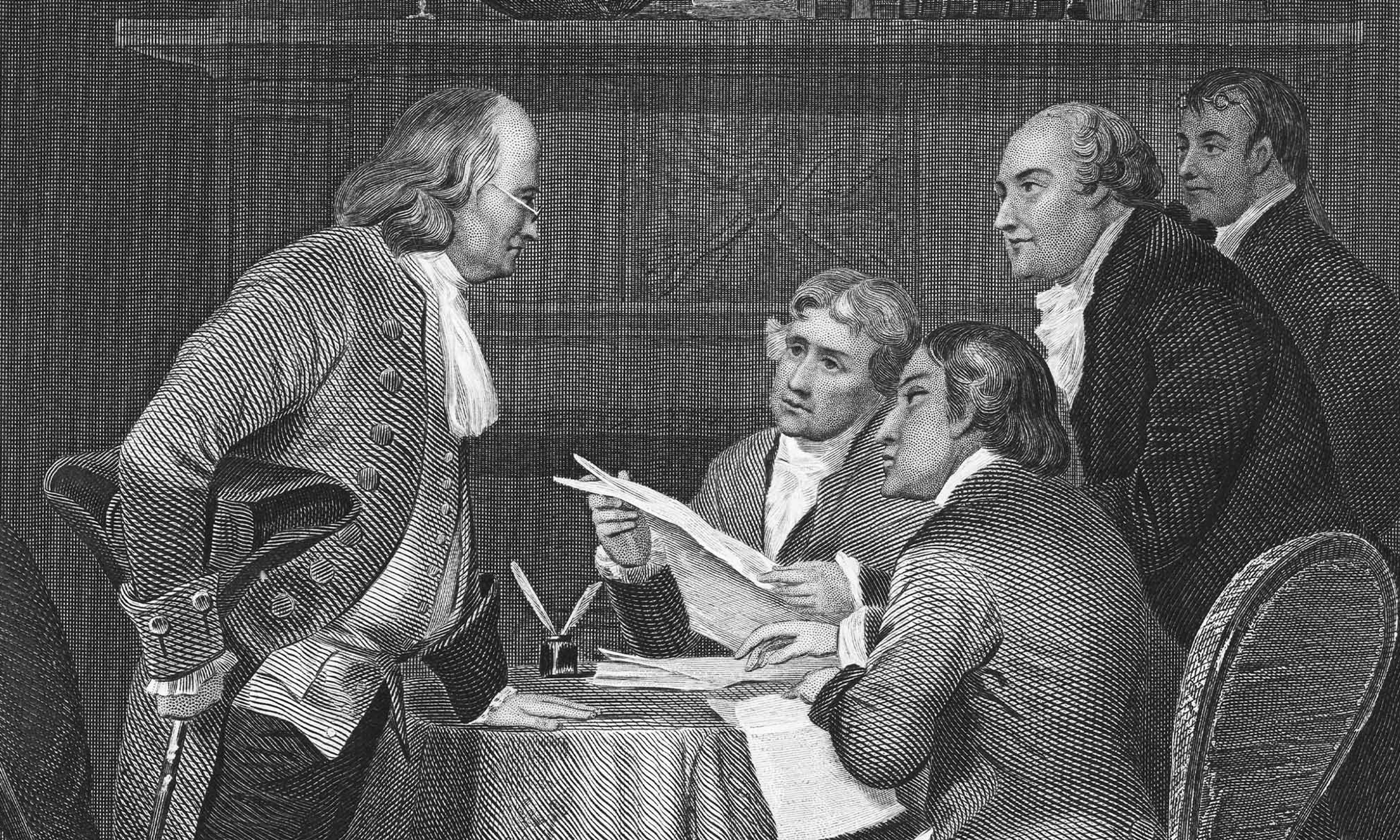
This year, as usual, I gathered with family and friends to celebrate Independence Day. We read aloud the Declaration of Independence. We saluted many of its ideas and toasted many of its signers, especially Benjamin Franklin and John Adams. We praised the exceptional American constitution that grew out of it. But I did not raise a glass to Thomas Jefferson. I’m breaking up with him.
I’m hardly the first. George Washington broke up with Jefferson long ago, and with good reason. At the outset of his presidency, Washington picked the redheaded Virginian as his top cabinet officer. But Jefferson repeatedly betrayed Washington, secretly undermining the president’s policies and then feigning innocence when confronted. He lied to Washington, as he lied to many others — including himself — about many things. In Washington’s final years, the father of our country cut off all communication with his former secretary of state. (After August 1796, Washington sent and received thousands of letters, including dozens to and from his faithful aides Alexander Hamilton and James McHenry, but exchanged not even a single note with Jefferson.)
As a constitutionalist, Jefferson’s decidedly mixed record was far less impressive than that of Washington, Hamilton, and Chief Justice John Marshall — who was in fact Jefferson’s second cousin once removed. (The two men despised each other.)
On the pro side: Jefferson promoted religious freedom both in Virginia and continentally. He championed the idea of public education and pushed hard for a federal bill of rights. He led the charge against the infamous Sedition Act of 1798, which authorized the federal government to punish its political critics. As a young man, Jefferson authored a document, a precursor to the Northwest Ordinance, that would have banned slavery in America’s West on both sides of the Ohio River. As president, he assured America’s survival by doubling its land mass and acquiring the indispensable seaport of New Orleans in the Louisiana Purchase. Throughout his life, he sang the song of democracy and the common man.
Here are the cons: He fathered the false idea that each state could legitimately “nullify” a federal law on its own say-so (as distinct from sounding political alarms against unconstitutional federal actions, filing lawsuits, or doing other things that ultimately relied on national legal and political dispute-resolution mechanisms). He played footsie with the plainly unconstitutional idea that a state could unilaterally secede. (At one point he nonchalantly declared that whether America remained united or instead divided into two parts was “not very important” to American “happiness.” Jefferson Davis was aptly named.) He repeatedly claimed that perfectly valid federal actions, such as a federal bank, were unconstitutional — claims emphatically rejected not just by President Washington but by a unanimous Supreme Court dominated by men whom Jefferson and his allies had themselves chosen. (At one point, his craziness on this issue led him to propose the death penalty for anyone trying to enforce national banking laws.) He came perilously close to urging his backers to march on Washington with guns to bully Congress into handing him the presidency in the contested election of 1800–01. (Shades of January 6!) He undermined judicial independence by depriving validly appointed federal judges of their salaries and commissions. Although he rightly opposed the Sedition Act, he did so for the wrong reasons — states’ rights rather than free expression. Thus, he did not forcefully oppose — and in fact quietly encouraged — state laws targeting the speech of his political enemies. He pushed the Louisiana Purchase even though he (wrongly) thought it was unconstitutional.
This last point is worth pondering. Two of Jefferson’s largest vices — daftness and hypocrisy — often offset each other. He had many truly bad constitutional ideas, but he frequently ignored them when he was in power. Another example: He embraced the goofy notion that a constitution should somehow poof out of existence every 19 years. But 19 years into the U.S. Constitution’s existence, when he was president, he simply disregarded his own theory.
One of Jefferson’s most consequential albeit subtle cheats appears on his gravesite obelisk at Monticello. Its inscription, which he composed with careful forethought, reads in part, “Author of the Declaration of American Independence.”
Jefferson did indeed write the Declaration’s first draft. But he did so with significant input from other members of the Second Continental Congress, especially Franklin and Adams. And as Jefferson himself admitted in his more honest moments, in his draft he merely synthesized countless dozens of precursor texts that had sprouted up across America in the months leading up to independence.
Jefferson did add some great stylistic touches. But the Continental Congress edited him good and hard, eliminating several of his most distinctive — and foolish — elements. The document that Americans celebrate every July 4 is best understood as America’s Declaration — Congress’s Declaration — but not really Jefferson’s.
In language reflecting stunning moral obtuseness and self-deception, Jefferson in the initial draft tried to shift most of the blame for American slavery onto Britain. Congress cut this embarrassing passage, and rightly so. Nothing in British policy had required Jefferson or any man to hold his fellow humans in cruel bondage. Jefferson and countless other American slaveholders had chosen to do so for their own pleasure and profit, and would continue to do so long after 1776. If he and other Americans were willing to refrain from buying black tea, why not black slaves? Nor had the king or Parliament prevented him from freeing his own slaves; Jefferson’s greed and lust had.
Of course, Congress kept much of Jefferson’s draft prose, but as Richard Henry Lee, his fellow signer and fellow Virginian, pointedly noted, Jefferson had lifted some of his best lines straight from English philosopher John Locke.
In a letter sent to James Madison in 1823, Jefferson claimed he never “turned to” Locke in drafting the Declaration. Judge for yourself. Here is Locke’s Second Treatise of Government, first published in the late 1600s and familiar to almost all leading American patriots of the 1770s:
All men are naturally in . . . a state also of . . . equality, . . . there being nothing more evident, than that creatures of the same species and rank, promiscuously born to all the same advantages of nature . . . should also be equal one amongst another. . . . Equality of men by nature [is] evident in itself, and beyond all question. . . . All mankind, . . . being all equal and independent, no one ought to harm another in his life, health, liberty, or possessions.
And here is the language of the Declaration:
We hold these truths to be self-evident, that all men are created equal, that they are endowed by their Creator with certain unalienable Rights, that among these are Life, Liberty and the pursuit of Happiness.
Here are the obvious parallels:
nothing more evident . . . evident in itself, and beyond all question || self-evident
creatures . . . born || created
equality of men by nature . . . all mankind . . . being . . . equal || all men are created equal
life, health, liberty || Life, Liberty and the pursuit of Happiness
In his first draft, Jefferson echoed Locke even more directly. Locke declared “all mankind . . . equal and independent”; Jefferson, that “all men are created equal & independant [sic].” In both Jefferson’s first draft and the final version, another Declaration phrase, “long train of abuses,” is a repetition of Locke verbatim. Also, Locke said that common people “are more disposed to suffer, than right themselves by Resistance.” The Declaration, in both Jefferson’s first draft and the final version, echoed this almost word for word: “Mankind are more disposed to suffer . . . than to right themselves by abolishing.”
To be clear: There was nothing wrong with Jefferson’s borrowing from the best — the best of America in general, the best of Franklin and Adams, or the best of Locke. But there was something wrong when Jefferson claimed far more personal credit than he deserved while denying his true intellectual debts. (He was in general not good at debts — he died deeply in arrears, and slaves had to be sold on auction blocks, families ripped asunder, to satisfy his many creditors.)
And of course we must ask, in an era in which we now celebrate Juneteenth in the same season as the Declaration, whether Jefferson’s life as a whole was even remotely consistent with his soaring statement of Locke’s self-evident truths of human equality and inalienable rights.
Which brings us around, yet again, to slavery. Jefferson knew that slavery was wrong, deeply wrong. “I tremble for my country when I reflect that God is just: that His justice cannot sleep for ever.” As a young utopian, he worked to limit this evil institution, championing the ordinance that would have barred slavery from all western American territory. But as time passed, he sagged. Along with his sidekick James Madison, he founded a national political party based in Virginia and the slaveholding South. When forced to choose, he chose party over principle. (He was no Liz Cheney.) At the end of his life, he championed the idea of “diffusion” — a policy of spreading slavery to the American West, the precise opposite of his earlier plan for free soil in all western land.
Madison, his partner and handpicked successor, went so far as to assert that the federal laws prohibiting slavery in the territories were unconstitutional. This was a preposterous claim, contrary to the clear text and original understanding of the Constitution. But in the worst decision ever made by the Supreme Court, in Dred Scott v. Sandford, a bench dominated by men from the party founded by Jefferson and Madison and re-energized by Andrew Jackson would embrace this absurdity. Abraham Lincoln rightly condemned the case as an “astonisher.” Lincoln fought it and its underlying principles with every ounce of energy he had. And the war came. It grew out of Jefferson’s worst ideas and institutions — his casual attitude toward secession, his embrace of western “diffusion” late in life, and his creation of a national party with a strong southern, and thus pro-slavery, base.
Jefferson’s and Madison’s private vices mirrored their public lapses. Washington freed his slaves on his deathbed. Jefferson and Madison did not. As he aged, Washington improved on the slavery issue, and so did Franklin; Jefferson and Madison decayed.
Today, we call these men and others our founding fathers, and it is fair to focus on fatherhood. Washington sired no heirs (though he did adopt a pair of step-grandchildren from Martha’s first marriage). He became father of all in part because he was father of none. His fellow Americans trusted him with the presidency in large part because he had no dynastic dreams — no George Jr. or George W., no John Quincy or Donald Jr., no Charles III or William V to whom he might seek to transfer his throne. Madison, also, had no heirs.
But Jefferson did sire offspring, both literally and metaphorically. He was emphatic that his gravesite obelisk should describe him not merely as “Author of the Declaration of American Independence” but also as “Father of the University of Virginia.”
He was also the father of several slave children with his slave mistress, Sally Hemings. Perhaps because of America’s prurience about sex, much of the modern discussion about Jefferson’s private life has focused on Sally. Did Jefferson love Sally (who was the half-sister of Jefferson’s dead wife)? Did Sally love Jefferson? Could this love coexist with his power over and ownership of her?
These are all important questions, but here are other questions that America needs to ask itself: What are we to make of a man who enslaved his own children? A man who lied again and again about his true fatherhood — who never openly acknowledged his true offspring, even as many of his slaveholding contemporaries did in fact admit their paternity of mixed-race children?
On July 4, 2026, America will mark the 250th anniversary of the Declaration of Independence. This day will also be the 200th anniversary of Jefferson’s death. I expect I will, when this red-white-and-blue-letter day rolls around, celebrate as usual the Declaration and the Constitution with family and friends. But I will urge that we all pivot away from Jefferson.
Let us instead use this day and all other Independence Days to pay special tribute to more-admirable Founding Fathers such as Benjamin Franklin, George Washington, John Adams, and Alexander Hamilton. And let us not forget America’s great Refounding fathers and mothers, such as Abraham Lincoln, Frederick Douglass, Charles Sumner, Elizabeth Cady Stanton, and Harriet Beecher Stowe — men and women who rejected Jefferson’s worst ideas, embraced his best ideas, and made them better still.












Comments