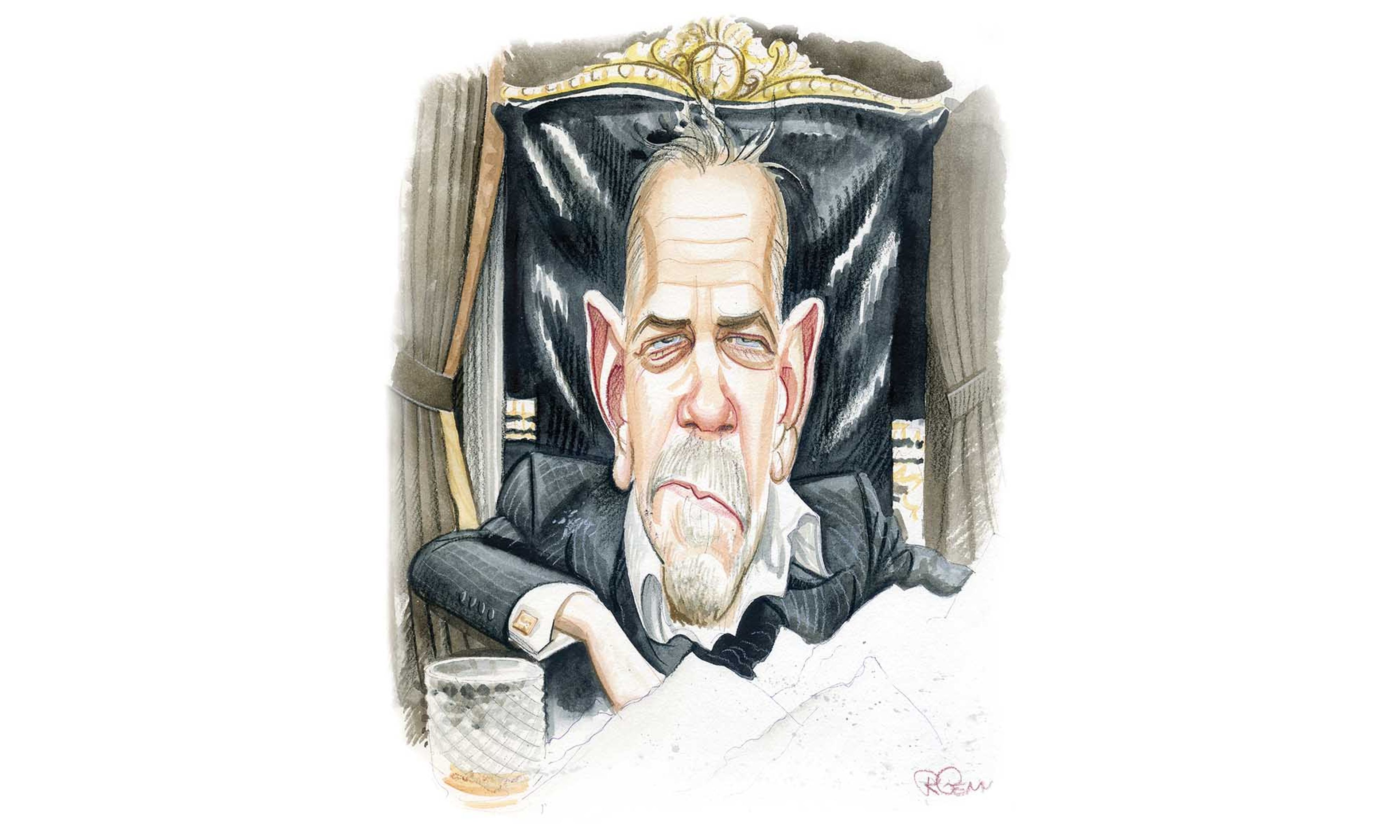
• Say what you want about him, but Trump preferred Diet Coke in the White House.
• The presidential campaign of Ron DeSantis has flexed its energy and organization but has yet to make progress in polls. The candidate and the lavishly funded Never Back Down PAC may be making a strategic error in neglecting moderate conservative voters who are closer to the traditional ideological center of the party and weary of Trump. DeSantis talks incessantly about culture-war issues and has proposed challenging the Supreme Court’s precedents recognizing birthright citizenship. That departs from his successful gubernatorial template, which presented cultural battles in commonsense terms and emphasized his sound leadership. He appears to be chasing voters who think Donald Trump isn’t conservative enough (the Ted Cruz 2016 voters and the very-online New Right) as well as MAGA voters who may think Trump is unelectable or past his prime. The risk for DeSantis is that other candidates may consolidate moderate voters if he seems too hard-edged for a general election while the voters he courts stick with Trump. Presidential primaries are not won on Twitter or by courting solely the most socially conservative voters in Iowa. DeSantis has the record and the resources to be in this for the long game — he should be careful not to write off too many voters.
• Gary Shapley, the Internal Revenue Service supervisory agent who helped oversee the investigation into Hunter Biden’s tax evasion, says the president’s son received special treatment, and that Shapley himself was repeatedly prevented from taking steps he would have considered routine in other cases. Hunter Biden pleaded guilty to two tax misdemeanors; Shapley, a 14-year IRS veteran, told CBS News that a less connected individual would have been charged with a felony. Shapley told the House Ways and Means Committee that Biden-appointed D.C. federal prosecutor Matthew Graves refused to allow charges to be brought against the president’s son and that Delaware U.S. attorney David Weiss told Shapley and others in October 2022, “I’m not the deciding official on whether charges are filed.” Shapley also contends that Department of Justice officials blocked the execution of a search warrant for Hunter Biden properties ahead of the 2020 presidential election. Weiss denies that anyone limited his investigation. Shapley and his accusations are credible and deserve the further investigation that Republicans in Congress are promising.
• When Hunter Biden writes in his memoir that, for a stretch a few years ago, he was “smoking crack every 15 minutes,” and then cocaine is found in a cubby near the White House’s West Executive entrance, people are going to be suspicious. Could someone entirely unrelated to Hunter Biden, perhaps a tourist or even a staffer, have brought the cocaine into the White House? Sure. But White House staffers go through background checks and often have security clearances. Under federal law, moreover, using drugs, particularly a “hard drug” such as cocaine, would trigger an automatic revocation of a security clearance and be grounds for immediate termination. White House staffers’ workplaces are regularly patrolled by bomb- and drug-sniffing dogs. Then again, addicts aren’t known for their good judgment, and we live in an era when a social-media influencer felt compelled to go topless during a White House event, so the phrase “No one would be dumb enough to do that” may not apply. We know, as the New York Times reported, that Hunter Biden “often appears at White House events” and that the names of members of the first family do not appear in the visitor logs. And NBC News reported that President Biden is concerned about his son falling back into self-destructive habits. If only to plug security holes in the White House, it is important to discover the truth.
• “I’m a practicing Catholic. I’m not big on abortion,” said President Joe Biden as part of a political offensive on the anniversary of Dobbs. He added: “But guess what? Roe v. Wade got it right.” How so? “Roe v. Wade cut in a place where the vast majority of religions have reached agreement,” he said, noting that during “the first three months or thereabouts, in all major religions,” abortion is a decision between a woman and her family. And that’s not all, Biden continued: “Next three months is between a woman and her doctor. The last three months have to be negotiated, because you can’t — unless you are in a position where your physical health is at stake — you can’t do it.” Where to begin? “Not big on abortion”! The Biden administration is running a straightforwardly pro-abortion campaign for 2024, and Planned Parenthood Action Fund’s leader calls Biden “an incredibly valuable partner.” As for religious teachings, they are not what guides Court decisions. But Biden was wrong there, too: Roe permits abortion where the major religions explicitly forbid it. Most Islamic countries severely restrict abortion, and Islamic theologians cite the Koran on the matter: “Do not kill your children for fear of poverty. For it is we who shall provide sustenance for you as well as for them” (Surah, Al-An’am, 6:151). Although many modern and progressive Western Buddhists claim their religion has no definitive answer on abortion, the Vinaya monastic code specifically forbids monks and nuns to perform abortions, and traditional Buddhist ethics condemn it as a form of homicide. Shintoism teaches that a woman who aborts her child places her ego above that of the unborn and that aborted children place a curse on their mothers. The reverence for life and hatred of violence in the Hindu concept of ahimsa strongly discourages abortion. And early Hindu Vedas strictly forbid it, holding that abortion is worse than killing one’s parents. The Talmud condemns bloodshed against the child in the womb. The earliest Christian catechism, the Didache, in a teaching reaffirmed across two millennia, commands Christians not to procure an abortion, placing this requirement among prohibitions on murder, infanticide, and child rape. Contrary to his intent, Biden’s comments highlight that Roe was a plain violation not just of the U.S. Constitution but also of the wisdom shared by the major religions of the world.
• In a nine-month period following the enactment of Texas’s six-week limit on abortion, nearly 10,000 more babies were born in the state than would have been expected, according to a statistical analysis published in the Journal of American Medicine. The law took effect in September 2021, and the study looked at births between April 2022 and December 2022. (A law protecting life from conception went into effect in Texas a couple of months after Roe was overturned in June 2022.) The number of births beyond expectations was higher than many analysts had expected, or “hoped,” as one of the researchers rather ghoulishly put it to CNN. Exactly how many of these babies owe their survival to Texas’s pro-life law is a matter of debate, but what is certain is that each one is precious.
• It looked as though Pennsylvania governor Josh Shapiro (D.) might stand up to powerful parts of his own party and enact a form of school choice. The “Lifeline Scholarship” program would be available to students in poorly performing public schools, providing families with state funding that could be used to pay for private education. He said he supported it on the campaign trail, his appointee as education secretary supported it, and he still insists that he supports it — even though he vetoed it. Republicans in control of the state senate passed a budget that included $100 million in funding for the program. Philadelphia Democratic senator Tony Williams joined them in doing so, speaking passionately about how the program would help poor black students in his district. But Democratic leadership in the house said they wouldn’t support it. Democrats have a majority there of only one seat. Shapiro could have used his influence as a popular governor, who just won bipartisan praise for his handling of a bridge collapse, to sway a few Democrats in the house to get school choice over the line. But the state’s labor unions ganged up on him, writing a coalition letter opposing the program. Facing a split within his party, Shapiro had a choice of his own: to side with the better policy or to side with the people who could derail him in a primary election. For a politician, the choice was obvious. For Pennsylvania’s poor students, it was shameful.
• Ohio joined the tax-cut revolution that has swept red states in the past three years. The latest state budget, signed into law by Governor Mike DeWine (R.), replaces three income-tax brackets with two and has a top rate of 3.5 percent. It also eliminates the commercial-activities tax, an especially harmful tax on businesses, for about 90 percent of businesses that currently pay it. Meanwhile, in Wisconsin, Republicans in the legislature passed a budget with similar tax reforms, but Governor Tony Evers (D.) used his line-item-veto powers to gut them. Evers claimed he supported tax cuts for the middle class, but for Wisconsinites in the middle of the income distribution, making between $60,000 and $70,000 per year, Evers’s veto shrank the tax cut from $249 to just $44, according to the legislature’s nonpartisan budget office. Every state has benefited from higher tax collections in recent years. Republican-governed states are making themselves more competitive. Democratic-governed states are holding on to your money.
• California’s reparations task force released its thousand-page final report, which airs a bevy of grievances related to the treatment of black Americans. California was admitted to the Union as a free state, but the report identifies five injustices other than slavery that it says warrant compensation, including “health harms,” which are measured by “the difference in life expectancy between Black non-Hispanics and white non-Hispanics in California.” Adopting every recommendation could cost the state hundreds of billions of dollars. The proposal also includes many standard progressive policy demands, such as an end to cash bail and the death penalty. This agenda is not going to repair anything.
• Los Angeles passed a tax on mansion sales to fund government programs for the homeless. Sounds simple, right? Well, the implementation of the tax is going poorly, for reasons that should have been obvious. The tax is on the sale of homes valued at $5 million or more, and it took effect on April 1 of this year. Naturally, sales of expensive houses soared before April 1 and have fallen since then. Some listings on the market now are priced just a hair under $5 million to avoid the tax. Property owners are splitting their properties into multiple lots valued at under $5 million each. Supporters of the tax hoped it would raise $900 million per year. But the city now estimates it will raise $670 million, and Mayor Karen Bass is counting on only $150 million in her homelessness plan. It actually raised $15.5 million in its first two months. The proceeds of “social justice” inevitably disappoint.
• The Biden administration has proposed taking away a low-cost health-insurance option from consumers. The new rule concerns short-term health-insurance plans, which are not subject to the onerous benefit mandates imposed by Obamacare and instead offer slimmed-down but cheaper alternatives to the plans on the health-care law’s insurance exchanges. The Trump administration, eager to provide consumers with relief from the health-care law, tweaked regulations so as to allow the short-term plans to be offered for one-year terms and to be renewable for up to 36 months. With Obamacare premiums spiking each year, millions of Americans turned to the plans as the only way to find affordable insurance. But Democrats saw the plans, which carry higher deductibles and less generous benefits, as “junk” insurance, and the new Biden rule would now restrict them to a maximum of four months. This means that they will no longer be a viable choice. Assuming the rule is adopted, individuals would be left with one fewer escape hatch from Obamacare — to which they find “junk” preferable.
• The Federal Trade Commission is going after Amazon for allegedly making it too difficult to cancel subscriptions to Amazon Prime. The FTC complaint said it took six clicks to cancel a subscription. Patrick Hedger of the Taxpayers Protection Alliance ran an experiment on Twitter: He found that it takes seven clicks to submit a comment to the FTC complaining about Amazon. The FTC’s website is less user-friendly, using the FTC’s own method of click-counting, than Amazon’s. All of this is trivia. The serious problem is that federal judges, most recently one appointed by Biden, have been trying and failing to cancel the FTC’s hyperactivism.
• No one really expects a federal department’s investigation of itself to reach damning conclusions or recommend serious consequences. In December 2021, Secretary of State Antony Blinken announced that his department would conduct an after-action review of what went wrong in Afghanistan. The report featured 150 interviews with current and former officials. And then State sat on it for a year. The report criticizes logistical and planning failure by both the Trump and Biden administrations. Warnings about the withdrawal of U.S. military forces ahead of the diplomatic personnel were ignored, and premature U.S. departure from Bagram Air Base was a critical mistake. In the blinkered thinking of this administration, the Afghanistan pullout was not what it obviously is: a humiliating failure and a disgrace. The Biden administration was so proud of its Afghanistan withdrawal that it released this report on the Friday afternoon before the Independence Day weekend.
• It’s not often that Washington’s accommodation of Beijing’s wishes takes the form of something approximating an actual kowtow. But a video from Janet Yellen’s recent trip to China shows that she bowed three times as she shook the hand of Vice Premier He Lifeng, who stood straight up. The treasury secretary spent two days there, meeting senior Chinese officials for talks on the bilateral economic relationship. But her overarching goal in making the trip was to continue the administration’s conciliation campaign — an effort to jump-start high-level dialogue abandoned by Beijing over the spy-balloon episode. While Yellen said at the end of her trip that she had discussed China’s crackdown on America’s firms, Chinese firms’ shipping of matériel to the Russian military, and human-rights abuses, her tone was mostly accommodating, and she attempted to address Beijing’s concerns about U.S. sanctions and export controls. Although the White House is unlikely to dismantle those measures, it can blunt, or slow-walk, any further progress if doing so is viewed as helpful in securing meetings with Chinese officials. It has done exactly that this year, and there’s no indication that this campaign is anywhere near over.
• Hong Kong’s slide into despotism reached depressing new lows, with the city’s government, now controlled by Beijing, issuing bounties on eight pro-democracy figures who went into exile overseas. The decision was the latest reminder of how much Hong Kong has changed under Chinese rule. None of the eight lives in a country that has an extradition treaty with China — but they should all keep a watchful eye out for local CCP proxies emboldened by the bounties, in addition to more concerted efforts by the party’s international harassment organizations. The situation is likely to get increasingly ugly. Soon after the bounties were issued, Hong Kong police raided the home of the family of one of the targets. Hong Kong chief executive John Lee compared the eight to “rats in the street.” It’s time for the West to crack down hard on the authoritarian regime of Hong Kong. That should start with barring Lee from setting foot in the U.S. for a summit this fall.
• Nahel Merzouk was 17 and of Algerian descent. When police shot him dead at a traffic stop in Paris, the Muslim minority took it as an example of racial profiling. A wave of violence immediately swept the country, so violent that it calls into question the future of France and beyond it the whole of Europe. Rioting broke out in almost 300 cities, towns, and villages. Buildings — 1,100 of them — were attacked, including schools, churches (29 churches have been set on fire in the last four years), town halls, police stations, an armory in Marseille, a library in Metz, and a sports center in Macon. Some 6,000 vehicles were set ablaze. Forty-five thousand policemen were on duty, and hundreds were injured. The average age of those arrested is 17, and French president Emmanuel Macron thought fit to tell them to stay at home. Economic and social issues are held to be the cause of Muslim discontent, but here violence seems to be a nihilistic form of politics. Seeing themselves as patriots, radical youth movements are mobilizing and, armed only with batons, have held counter-demonstrations in Lyon, Chambéry, and Angers.
• Elliott Abrams has worked in politics and foreign policy for a long time. He worked for two Democratic senators: Henry M. “Scoop” Jackson and Daniel Patrick Moynihan. He worked in the State Department for the eight years of the Reagan administration: as assistant secretary for international organizations, then human rights, then Latin America. He worked in the White House for the eight years of the George W. Bush administration, advising on Middle East policy. And, during the Trump years, he was special envoy for Venezuela and then Iran. President Biden has now nominated Abrams to the U.S. Advisory Commission on Public Diplomacy. Abrams has made enemies in his career, as one does, and they are unhappy about the president’s nomination. It is a nomination to cheer. We know Mr. Abrams well, in part because he has contributed to our pages for decades. And he knows the U.S. interest, and U.S. values, as well as anyone. For once, a Biden personnel decision we can support.
• Ben & Jerry’s celebrated Independence Day by calling for the return of Mount Rushmore and the surrounding Black Hills to the Lakota tribe. Returning land to Native American tribes, the ice-cream company argued, is “about dismantling white supremacy and systems of oppression.” The half-baked argument may have gotten them more than they bargained for, however, with Chief Don Stevens of the Coosuk Abenaki Nation announcing that he looks forward to hearing what the company itself will do to “better benefit Indigenous people”: Ben & Jerry’s headquarters is located in Vermont on the historic territory of the Abenaki tribes. Dessert brand, meet just deserts.
• The 1980s called and wanted their version of baseball back — and got it. The pitch clock has shortened the average length of baseball games by about half an hour and reduced the time of play to what it was in the 1980s. Self-styled baseball traditionalists tended to be resistant to the pitch clock as an innovation in a game that had supposedly attained timeless perfection. This neglected, though, how a new culture of inactivity and delay had grown up over the last several decades, with batters walking around and adjusting their batting gloves between each pitch and pitchers and batters engaging in a cat-and-mouse game over who could do nothing the longest. The pitch clock has eliminated these blank spaces and led to brisker play and a more watchable game. It’s still one, two, three strikes you’re out at the old ballgame, but it needn’t take three and a half hours.
• Is QAnon taking over the summer box office? Not really. Though major organs of progressive opinion and many critics have denounced the movie Sound of Freedom as a sop to right-wing conspiracy theorists, it is the surprise indie-film hit of the summer and temporarily bested The Dial of Destiny, Disney’s big-budget Indiana Jones cash grab. Sound of Freedom portrays the work of anti-child-trafficking activist Timothy Ballard, played by Jim Caviezel (The Thin Red Line, The Passion of the Christ). Rolling Stone denounced the film as a “vigilante fever dream” meant to induct people into the QAnon cult. The Guardian did the same, in much the same language. And it is true that the film’s star, Caviezel, has promoted deranged claims about elites kidnapping children and using their hormones for beauty products. But the film stays grounded in reality, albeit one that is dramatized for the screen. And for that, it has won critical champions outside the conservative and populist press. Variety said that it’s a “genre thriller,” “an urgent and honest one,” in which Caviezel gives “a committed performance” and has “the smoldering aura of a more sensitive Clint Eastwood.” There are dozens of genre thrillers about the drug trade. Surely one film about child-trafficking should exist.
• At the surface, the ocean is a ferocious enough foe; 4,000 meters down, where the wreck of the Titanic still sits, its inhospitableness rivals that of the terrain of Mars. At that depth, the water pressure is 6,000 pounds per square inch — around 400 times as strong as the pressure of the atmosphere at sea level. Successful trips are few and far between because the margin for error is so low; the slightest imperfection in the hull or the joints of a vessel, and it will implode in mere milliseconds, crushing all aboard before they know what has happened. It is frowned upon to speak ill of the dead, but in the case of Stockton Rush, the CEO of OceanGate, whose submersible Titan collapsed in late June while on a voyage to the bottom of the Atlantic to see the Titanic, an exception might be warranted. Rush had been repeatedly warned that his products were not up to scratch and that the likelihood of catastrophe was high. He continued nevertheless, eschewing the advice of experts who wished him well; refusing to have his untested designs certified or even inspected; and, eventually, killing four other people along with himself. It is rare that tragedies yield simple lessons, but the case is different at the bleeding edge. The Titan was a tribute to hubris. Others ought to learn from the mistake.
• Lowell Weicker, heir to the Squibb pharmaceutical fortune, won a U.S. Senate seat from Connecticut in 1970 as a Republican running against two feuding Democrats. A member of the Watergate Committee, he made attacks on Richard Nixon that were borne out by events. Later newsworthy stands — such as opposing the confirmation of Robert Bork to the Supreme Court — marked his steady drift leftward. Apart from politics, there was Weicker’s temperament. Arrogance and pomposity are not the same thing; Weicker had both, though, and in truckloads. Accordingly, his constituent WFB organized BuckPac with the purpose of defeating his bid in 1988 for a fourth term. The Democratic candidate, Joe Lieberman, was relatively moderate. Partisan control of the Senate was not an issue, the GOP having lost it two years earlier. The insurgent campaign saw the elegant Mrs. Buckley handing out Lieberman literature in supermarket parking lots. Weicker lost. He made a comeback two years later, winning the governorship and signing legislation that imposed a state income tax. Dead at 92, R.I.P.
• Like many Cubans, a teenaged Carlos Alberto Montaner hailed the triumph of Fidel Castro’s revolution in 1959. And, like many Cubans, he quickly turned against the new regime. He managed to escape in September 1961. He spent most of his life in Spain, writing. He wrote many novels and much political commentary. He became a vice president of Liberal International and a member of the Miami Herald editorial board. Always, he pushed for freedom, democracy, and human rights. In a 2011 interview, he said, “There is a secret family of victims of totalitarianism, which can be the families in Burma or the victims in North Korea or in Iran or in Cuba. We feel a special bond with them because we belong to the same family.” In 2014, someone asked him whether he would like to return to Cuba one day. “Yes, I would,” he answered. “I am nothing other than Cuban.” Carlos Alberto Montaner was also a splendid man. He has died at 80. R.I.P, and viva Cuba libre.
• The chances that Léon Gautier would live to 100 were not great on June 6, 1944. But he did. He was the last surviving French commando from D-Day. In 2017, he welcomed a great-great-grandson — born on June 6. R.I.P., Monsieur Gautier, and a deep bow to you and your comrades.
• Milan Kundera was a very unusual writer, and a very gifted one. He was born in Brno in 1929. This meant that, when the war ended, he was 16, on the cusp of life. He embraced Communism. Then, like so many, dis-embraced it. In 1967, he wrote a novel, The Joke. Two years later, he had a short-story collection, Laughable Loves. A decade after that, he came out with The Book of Laughter and Forgetting. In 1984, he had his great hit, The Unbearable Lightness of Being, which, four years later, was made into a movie, starring Daniel Day-Lewis. Kundera said that he treated the most serious of subjects with “utmost lightness of form.” He said that any one of his novels could have been titled “The Joke,” “Laughable Loves,” etc. In 1975, he emigrated to France. This did not sit well with many Czechs (and Slovaks). Another writer, Václav Havel, stayed, endured prison, and became president. But people make their choices, and have their own natures, and Kundera alerted a great many, around the world, to the oppression of the Communist system. He has died at 94. R.I.P.
A Supreme Performance
The Supreme Court’s just-concluded term was not a clean sweep for conservatives, but it was close enough to motivate progressives to use strained “ethics” charges to smear the justices even as they were handing down decisions broadly popular with the public.
The 6–3 majority of Republican appointees delivered the biggest victories. Chief Justice John Roberts wrote the two most consequential of these. “Eliminating racial discrimination means eliminating all of it,” he wrote, as the Court conclusively ended racial preferences in college admissions. The “diversity” rationale and the Court’s 2003 waffling about “25 more years” gave way to an unambiguous color-blind rule. Because the Court found the preferences to violate both the 14th Amendment and Title VI of the Civil Rights Act of 1964, its decision will apply to both public and private colleges.
Roberts led the same majority to strike down Joe Biden’s effort to use pandemic emergency powers as an excuse to spend half a trillion dollars on student-loan forgiveness without asking Congress. By rejecting Biden’s effort to craft a rule that nobody would have standing to challenge in court, the majority avoided creating a huge incentive for future presidents to find lawless ways to work around Congress’s power of the purse.
The 6–3 majority also cemented the free-speech rights of religious and other dissenters when it ruled, in an opinion by Justice Neil Gorsuch, that a Christian web designer could decline to create sites celebrating same-sex weddings. It was a rebuke to the Colorado Civil Rights Commission, which had been pursuing a dissenting cake-baker for the past eleven years and stood ready to harass the designer.
Other rulings were even more lopsided. The Court unanimously struck down an overreaching EPA reading of the “waters of the United States” wetlands rule, although it divided 5–4 over how broadly to read the statute, whose uncertain scope has hung like a sword of Damocles over landowners for half a century. It was unanimous, too, in ruling that Minnesota may not take an old woman’s home to pay her tax bill and then keep the profits when the sale is for more than the tax liability. In a case brought by a Sabbath-observing rural letter-carrier, it was unanimous that Title VII of the Civil Rights Act requires employers to show a substantial burden on their business before refusing to accommodate religious observance.
The Court, over the dissent of three conservatives, stepped back from the brink of a broad theory that state legislatures are supreme over state courts and executive agencies in drawing congressional districts and writing laws for federal elections, but Roberts’s opinion retained the power for the Court to step in (as it did in Bush v. Gore) when rogue state courts unreasonably throw out the work of the legislature and replace it with their own. Its other redistricting decision (also by Roberts) created a second majority-black House district in Alabama, strengthening the malign influence of racial gerrymandering. Justice Clarence Thomas remains unable to persuade his colleagues to do for gerrymandering what they did for college admissions; Congress should follow his lead instead. Congress should likewise rethink race-conscious adoption policies that the Court upheld under the Indian Child Welfare Act.
The Court maintained, largely across ideological lines, its skepticism of broadly worded criminal statutes: It trimmed back adventurous theories of public corruption and required strict proof of criminal intent for threats and for inducements to illegal immigration. It was also mostly a good term for business, in which the Court declined to immunize union sabotage of company property, although it expanded the power of states to compel businesses to be sued in unfriendly jurisdictions far from their home base.
The sustained barrage of ethics charges ranged from the tenuous (Thomas once declining to recuse in a certiorari petition indirectly connected to a benefactor) to the preposterous (Gorsuch and Barrett selling their houses, Roberts’s wife working as a legal recruiter after quitting her lawyer job). The activist campaign against the Court and its majority, abetted by leading elected Democrats, is transparently motivated by rage and despair at the Court’s rulings. It aims to destroy the legitimacy of the independent judiciary and give cover to extreme measures such as Court-packing.
This, atop last year’s unprecedented combination of an illegal (and as yet unsolved) leak of a draft opinion, illegal (and as yet unpunished) demonstrations at the justices’ houses, and an armed would-be assassin reaching the home of Justice Brett Kavanaugh, has greatly taxed the fortitude of the justices. It is a tribute to them, and to the institutional strength of the third branch of government, that they have continued to uphold the Constitution and laws of the United States and provide equal justice to all without fear or favor.
Putin’s Quagmire
The rebellion of the Wagner Group, the private army captained by Yevgeny Prigozhin, Vladimir Putin’s caterer, turned out to be barely a snack. Pugachev’s Rebellion, of serfs and Cossacks against Catherine the Great, lasted a year and a half. The Kronstadt Rebellion, of anarchist sailors against Lenin and Trotsky, lasted two and a half weeks. Prigozhin’s lasted a day. Contemptuous of the regular military and angered by what he took to be deliberately meager supplies and onerous battle assignments, Prigozhin on June 23 sent his men north from their positions in occupied Ukraine, captured the city of Rostov-on-Don, and was on the road to Moscow when he called the whole thing off. On June 24, the Wagner Group stood down and was reported to be headed into exile in Belarus, whose dictator, Alexander Lukashenko, is said to have brokered a peace between Prigozhin and his ex-mentor Putin. Whatever the actual terms of the deal — he has been seen in Moscow and St. Petersburg since and allegedly met with Putin himself after the rebellion ended — Prigozhin will do well to avoid upper-story windows and tea.
While Prigozhin was on the march, Western media filled with speculation both alarmed and excited. Suppose units of the regular army joined in? Suppose Putin fled or was toppled? Who would have the codes for Russia’s nukes? In the end, nothing so hopeful or dire occurred. Putin remains in power. A servant grown too ambitious was semi-discarded, faint hearts and potential mutineers flushed out.
The episode does highlight the structural weaknesses of Putin’s rule. The Wagner Group, deployed in Africa and Syria before the Ukraine War, gave Putin a fig leaf of deniability for foreign adventures. But what Soviet leader — Lenin, Stalin, Khrushchev, Brezhnev — would have tolerated or depended on auxiliaries under no firmer control than a personal relation to himself? The disobedience of this one, even for a day, may give others — for there are others, notably Ramzan Kadyrov’s Chechens — ideas of their own. Making things even worse for the Kremlin, Prigozhin publicly called the official justification of the war — that Ukraine required “denazification” — a lie, and said the real motive was to further enrich Russia’s rich and empower its powerful. Chief of Staff Valery Gerasimov and Defense Minister Sergei Shoigu are now in firmer command. But as Prigozhin rightly declared when he first set off, they have been bunglers and incompetents. Loyalty is vital in top brass, but must be accompanied by ability.















Ukrainian servicemen fire with a tank towards Russian troops near a front line in Kharkiv Region, Ukraine, July 6, 2023.
Vyacheslav Madiyevskyy/Reuters
Meanwhile the war in Ukraine grinds on. Rigid concepts have confused two issues. President Biden’s decision to send cluster munitions to Ukraine drew outcries. Such bombs can wreak havoc on civilians and lie in the ground, waiting to be exploded, for years. But Ukrainian forces have no interest in killing the Ukrainians they seek to liberate, and the Russian forces who are their targets are killing Ukrainians, soldiers and civilians, now. Those forces need to be expelled or destroyed. Biden has called Putin a war criminal, a judgment joined by the International Criminal Court at The Hague. No doubt he is. But designating him such makes it harder to reach out to him, formally or even informally, to test his resolve or arrange his exit if the time comes when he might seek one. Names sometimes get in the way of things.
Mike Pence’s surprise meeting with Volodymyr Zelensky in Kyiv was a welcome show of support from a GOP that shamefully includes some isolationists and Russophiles. More presidential hopefuls should follow. Speaking of Russophiles, Erdoğan’s Turkey and Orbán’s Hungary finally dropped their opposition to Sweden’s entry into NATO, having extracted diplomatic concessions along the way. An integrated Nordic–Baltic front is now poised to be complete. Speaking of Zelensky, he announced that there would be no presidential election until the war ends. Britain postponed a parliamentary election due in 1940 because of World War II. But the United States held a presidential election during that war, as well as during the Civil War. Since the U.S. is a greater backer of Ukraine than the U.K. is, invoking the practice of Lincoln and FDR would have made a better impression.
Ukraine’s counteroffensive is drenched in blood and wrapped in fog. Russians crow about their defenses (no hesitation there about bombs in the ground or missiles in apartment buildings). Ukrainians argue they are shredding the invader’s logistics. A quagmire for Putin, and a struggle for existence for Ukraine.











Comments