• Asked whether he was in touch with a prominent former member of his flock, the Rev. Jeremiah Wright said no: “Them Jews ain’t going to let him talk to me.” But them Jews needn’t worry: Obama never hears him anyway, right?
• James von Brunn, an 88-year-old white supremacist and anti-Semite, walked into the Holocaust Memorial Museum in Washington, D.C., with a .22 rifle and killed Stephen Johns, a security guard. Other guards shot and wounded von Brunn before he could commit more mayhem. Sixty-four years after history’s most wicked anti-Semite shot himself, his soulmates still walk the earth. For many years, the locus of American Jew-bashing was, loosely speaking, on the right (e.g., various incarnations of the Klan). Beginning with the Yom Kippur War, it has moved left, stimulated at first by the propaganda of the Soviet Union (which could not tolerate the humiliation of its Arab clients), though long surviving it. The last thing to do now, however, is play a game of gotcha. Hatred has to be fought at every turn, rancor foresworn by all. The federal government does well to monitor groups and individuals like von Brunn, who we hope will spend the rest of his life in jail.
• Two soldiers, Pvt. William Long and Pvt. Quinton Ezeagwula, were shot outside a Little Rock recruiting center; Long died. The man who attacked them was Abdulhakim Mujahid Muhammad (né Carlos Bledsoe), a convert to Islam who was being watched by the FBI after a trip to Yemen. Not watched hard enough, obviously. The domestic jihad has attracted would-be terrorists (the Newburgh four), freelance killers (the Beltway snipers), and penumbral nut jobs (the anthrax mailer). It has foreign well-wishers who want to fan it into insurrection. They are far from succeeding and will surely fail, but this, anno domini 2009, is the main domestic threat we face. N.B.: Private Ezeagwula is recovering, and hopes to become a drill sergeant. “I like defending this country,” he said. Carry on, soldier.
• Judge Sonia Sotomayor’s remark about the special qualities of a “wise Latina woman” was no outlier. Sifting her record shows the trope of “wise woman” or “wise Latina woman” running through her speeches for 15 years. She sees group-think in the texture of American institutions: “There are cultural biases built into testing,” she said in a discussion in the early Nineties. She sees it in the law: A memo she signed in 1981 declared that “capital punishment is associated with evident racism in our society.” She offers herself as a counteracting hand on the scales: “When [Hispanic] litigants see people like myself on the bench,” the system acquires “more of a sense of fairness.” She holds these views, even though they can be condescending to favored groups: During the New Haven firefighters case (Ricci v. DeStefano) she said that no job test can be acceptable if it “is going to always put a certain group at the bottom of the pass rate.” Always? Even if they work as hard as Sonia Sotomayor has all her life? Judge Sotomayor’s opinions, for the most part, show the cautious and consensual quality of appeals-court rulings. But she seems uncomfortable with one of the basic qualities of judging: impartiality. That is why judges wear robes, concealing their forms — a woman’s garment for men, a priestly garment for women. We get personality from legislators and executives. Justice is blind.
Say It!
A couple of years ago, at the dawn of my young daughter’s awareness of such concepts as guile and duplicity, she drew on the wall of her mother’s home office. It was a bunch of swirls with a ballpoint pen, and might have gotten an NEA grant in the early 1990s. Anyway, when confronted, our precious angel, an only child, insisted that it must have been a “bad girl” who’d come in and done it. Now, as nearly all parents are aware, the greater sin is in not admitting the crime. And we spent quite a while trying to elicit a confession from her, albeit in a Sesame Street Torquemada kind of way. “Just admit it and we won’t be angry,” was a frequent refrain.
For years, I’ve been saying that what bothers me about liberal media bias isn’t the bias as such; I’ve made peace with its existence just as I’ve made peace with the inevitability of paper cuts and bowel-stewing intestinal parasites. You have to balance the need to live your life with the desire to minimize your exposure to life’s inevitable hassles. Sometimes you just have to read the New York Times, and sometimes you just have to eat that chimichanga at the Newark Airport food court. In both cases you hope your stomach can take it.
No, what bugs me about liberal media bias is the refusal of its practitioners to admit that they are biased. It is an insult to dissemble about something so self-evident, and a sign of disrespect. Back in my bachelor days I used the analogy of the friend who swears he didn’t drink your last beer. You don’t care about the beer, but you can’t stand his not admitting it. The longer he goes on refusing to ’fess up, the more you turn into Sam Kinison on a coke bender. “You took my beer! Say it!! Say it!!!”
And that’s how I’m feeling these days. To say that the press is in the tank for President Obama is to say something so incandescently obvious that you almost feel a fool for letting the words pass your lips. Yet to make this point, to offer this sky-is-blue, 2+2=4, cats-don’t-make-great-draft-animals remark, invites eye-rolling or — worse — passive-aggressive calumny from the same liberals who honestly believe the “corporate media” were in the tank for George W. Bush. Stop laughing.
Roman catamites showed only slightly more deference to Caesar than Newsweek shows to Obama. As of this writing, ABC News is orchestrating a socialized-medicine infomercial to be filmed from the White House. The president is doing pitch-work for MSNBC like an Oval Office Don Pardo.
And that’s fine. If we are to be like Europe with partisan media, so be it. All I ask is that the partisans admit it. Just say it. Say it!
— JONAH GOLDBERG
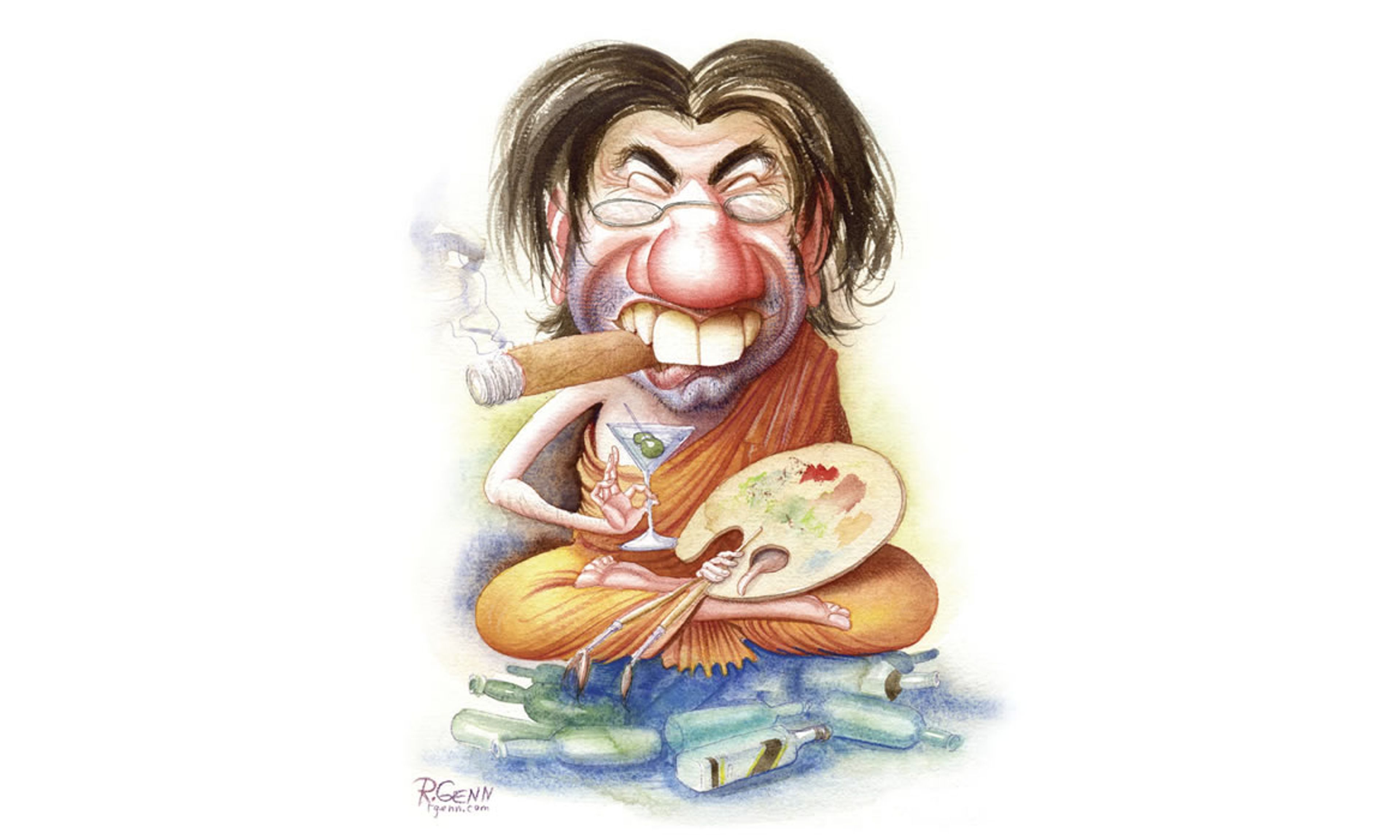
• It took only a few hours for the “Wise Latina” cover of our last issue to be roundly denounced as offensive by lefty bloggers (about a week later, Frank Rich caught up and denounced it too) for reasons they couldn’t quite settle on. Was it that we couldn’t compute the idea of a wise Latina and therefore had to render her as Buddha? Or had we unacceptably stereotyped Asians? It was the most confused attack on an NR cover since an image of Chuck Schumer dressed for the Inquisition was branded simultaneously anti-Semitic and anti-Catholic. Critics focused on artist Roman Genn’s rendering of Sotomayor’s eyes. As a caricaturist, of course, Roman exaggerates his subject’s natural features, and Sotomayor has squinty eyes, especially when she smiles. One cringes at having to explain such things, but so it goes when dealing with people who are willfully dense and humorless.
• David Letterman welcomed Sarah Palin on a visit to New York City by musing on her daughter’s man trouble: Alex Rodriguez had “knocked [her] up” during a Yankees game, and Eliot Spitzer was after her too. The daughter that Sarah Palin was traveling with was 14-year-old Willow, which made Letterman’s lines creepy as well as gross. He apologized twice, with increasing vehemence, if not conviction: first, saying he meant to mock 18-year-old Bristol; then, claiming he had not known that any daughter had been with Palin. It was a ratings stunt tawdry even by the standards of late night, and some liberal arbiters — Howard Kurtz, NOW — called him on it. Palin rapped Letterman too, but then she kept on rapping. She charged him with encouraging the “use and abuse” of minors, and with being a “Hollywood/NY entertainer” out of touch with “the rest of America”; she said she was the victim of a double standard (the Obama girls are not mocked). Some of this is true, some of this is fustian. But if you take an opponent too seriously, you become his peer. Sarah Palin should be taking on the president of the United States, or the president of Iran, not aging TV not-so-comics.
• Leon Panetta, the CIA director, had something to say about Dick Cheney’s criticisms of Obama national-security policies. In fact, Panetta made a shocking charge: “It’s almost, a little bit, gallows politics. When you read behind it, it’s almost as if he’s wishing that this country would be attacked again, in order to make his point. I think that’s dangerous politics.” The Obama administration later interpreted away the plain meaning of Panetta’s words. Panetta’s dangerous politics should have no place at the CIA.
• In 2007, Sen. Arlen Specter supported legislation to get rid of the secret ballot in elections to unionize companies — legislation at the top of the labor movement’s agenda. Facing a Republican primary challenge, he came out against it. Now he is a Democrat, and he has just announced that labor will be “satisfied” with his final vote. Our advice to the union leaders: Schedule the vote before his primary.
• Eamon Javers reports in Politico that President Obama refers in public to Jesus Christ more often than Bush ever did. We don’t object. Neither do most of the people who objected when Bush did it. Their excuse for the double standard is that Obama is not trying to impose his faith on others, as Bush supposedly did by opposing same-sex marriage and abortion. (Obama says he opposes same-sex marriage too, but he gets a pass from liberals who know he is lying.) The planted assumption is that Bush’s positions have no rational basis. It turns out that most of the fulmination about American theocracy that we heard over the last decade reflected nothing more than policy disagreements.
• In their primary for governor, Virginia Democrats rejected a left-wing crusader (Brian Moran) and a Clinton crony who parachuted into the state (Terry McAuliffe) in favor of the candidate endorsed by the Washington Post: Creigh Deeds. The result thus said two good things, and one bad thing, about Virginia Democrats. The general-election match-up is geographically interesting: Deeds is from a rural background, while the Republican candidate, Bob McDonnell, is thought to appeal to the suburbs of northern Virginia. Deeds will try to make “rural” mean moderate, although his record on taxes is liberal and his record on everything else is becoming more so. Deeds is also trying to link McDonnell to President Bush, which does not suggest great respect for the intelligence of the commonwealth’s voters. Republicans have an excellent shot at picking up this governorship — and demonstrating that Virginia is not ready to become deep blue.
• In 2008 Democrats won control of the New York state senate, 32 seats to 30, for the first time since the Sixties. It lasted only six months, however, until two Democrats, Pedro Espada Jr. (Bronx) and Hiram Monserrate (Queens), agreed to vote with the GOP. Espada, who is guilty of numerous campaign derelictions and who seems not even to live in his district, was rewarded with the office of senate president. Monserrate, who has been indicted for slashing his lover’s face with a broken glass, had no public reward, which may be why he announced the following week that he was switching back to supporting his own party, thus creating a 31–31 tie. No one listens to Gov. David Paterson, who succeeded to the office from the lieutenant governorship when the elected governor, Eliot Spitzer, was caught patronizing prostitutes. The budget is billions of dollars in the red, and the population will slip below Florida’s any day now. Why would anyone want to run this place?
• Rick Duncan campaigned for anti-war Democrats in Colorado last year: Hal Bidlack, who lost a race for the fifth congressional district; and Rep. Jared Polis (second district) and Sen. Mark Udall, who won. He was a perfect advocate: a gay Marine captain with three tours of duty in Iraq, wounded by an IED in Fallujah, suing Halliburton for exposing troops to toxic smoke, leader of the Colorado Veterans Alliance. It turns out, however, that Duncan is a perfect fraud: In fact he is Rick Strandlof, a mentally ill drifter and petty criminal who never served in the military. His lies unraveled when he told one too many — asserting that he actually worked for Udall — and a colleague at the Veterans Alliance began to check him out. Case closed. Strandlof, like all con men, was the product not only of his own deceptions, but of his dupes’ desires.
• As part of an effort to sell the American public on the stimulus package, Obama, then the president-elect, commissioned his economic advisers to do a study demonstrating how many jobs would be “created or saved” by his proposal. The study included a graph purporting to show that without the stimulus the unemployment rate would climb to 9 percent by 2010, whereas with the stimulus it would level off at 8 percent before declining rapidly. Unemployment currently stands at 9.4 percent. On the bright side, Tallahassee, Fla., will soon be getting a $3.4 million “eco-passage” to ensure that turtles can cross safely under a busy roadway. Perhaps the administration can commission a study showing us the number of turtles the stimulus has created or saved.
• A handful of large banks are repaying, with interest, the money they received under the Troubled Asset Relief Program (TARP), prompting some to wonder whether the taxpayer might make money on the deal after all. Don’t bet on it. It is important to remember that former Treasury secretary Henry Paulson forced a number of healthy banks to participate in TARP as an insurance policy. With markets in a panicky state, Paulson decided to spread the money around to avoid labeling some banks as problem children. Now we know who the problem children are. AIG, Citigroup, Bank of America, and others still have hundreds of billions of bailout dollars and no exit strategy to speak of. It is good to see healthy banks returning public money they didn’t need in the first place, but we won’t be popping the champagne corks and celebrating a profit for the taxpayer any time soon.
• The price that U.S. Treasury bonds command on the market plunged in recent weeks, meaning that lenders are demanding higher returns in order to loan Washington money with which to finance the sundry mischief Washington does. The “yield curve” — i.e., bond investors’ profit, which naturally moves in the opposite direction of bonds’ prices — is rising and steepening. There are two interpretations of this. The first is that panicked stock-market investors who fled to the relative safety of Treasury bonds are once more sallying out in search of higher returns. The other interpretation is that the relative safety of Treasury bonds is being called into question. Even though inflation is at present almost nonexistent in the U.S. economy, bond traders have seen trillions of dollars pulled like trillions of rabbits out of the Fed’s magic hat to fund bailouts and stimulus, and they recognize this as a probable precursor to inflation, perhaps serious inflation. Even the reliably asleep-at-the-wheel credit-ratings agencies are taking note: Moody’s has warned that U.S. public finances are being overburdened, and SR Rating, a Brazil-based firm, plans to downgrade U.S. bonds from AAA to AA. That’s no cause for panic, but it is a cause for concern, and the markets evidently are feeling it.
• Like an old-fashioned burlesque performer, Timothy Geithner reveals, bit by bit, the administration’s plans for policing Wall Street. We have the familiar feeling that we like some of what we see but are not sure it’s worth the ticket price. On the asset side of the balance sheet are a number of sensible policy updates, some of which this magazine has supported. Most significant is establishing a single regulatory authority with FDIC-style powers to seize and force into resolution insolvent financial firms whose failure would present a systemic risk to the economy. On the liability side are such measures as encumbering derivatives with new regulations and requiring that firms issuing or brokering securitizations remain substantially invested in the instruments that pass through their hands, an idea that is likely to cause as many problems as it solves. (Imagine if your local stockbroker had to hold each stock he sold.) Geithner strikes a delicate balance, touting his ideas to the American public and also to foreign parties heavily invested in the American economy, notably Chinese holders of American government debt. Speaking at Peking University, Geithner declared that “Chinese assets are very safe” in America, and the audience laughed in his face — albeit nervously. Geithner dances, but we’re all exposed.
• Let’s implement pay-as-you-go budgeting (PAYGO), Obama recently said, to keep the deficit from getting bigger. Forget that Obama’s timing is awfully convenient, coming after he already shepherded his $800 billion stimulus bill through Congress. Forget also that PAYGO does not apply to discretionary spending, automatic increases in entitlement spending, or the few tax cuts (Bush’s cuts for the lower income brackets) that Obama wants to keep. The key thing to remember is that it is easier for the majority in Congress to ignore PAYGO rules than it is for an alcoholic to ignore a promise to himself. The Democrats made a big deal about bringing back PAYGO in 2006, and proceeded to suspend it twelve times over the next two years. It will be interesting to see whether they break that record.
• The details remain unclear as we go to press, but President Obama’s firing of Corporation for National and Community Service chairman Gerald Walpin does not smell good. This year, Walpin investigated claims that St. HOPE Academy, a non-profit founded by Sacramento mayor Kevin Johnson, was misusing AmeriCorps money. The organization’s leaders soon confessed, and Johnson (an Obama supporter) was suspended from receiving federal grants. Under a settlement agreement that Walpin opposed, the suspension was lifted, and St. HOPE agreed to pay taxpayers back about half of what was misused. Walpin received word of his termination June 10, and soon thereafter told Byron York of the Washington Examiner that he suspected the investigation, the ensuing controversy, and another investigation (which found that AmeriCorps funds were misused at City University of New York) had led to his firing. So far the administration has offered no alternative explanation.
• Congress passed a measure to regulate cigarettes, and the legislation was filtered through the business interests of tobacco giant Philip Morris. The new bill gives the world’s largest cigarette manufacturer an opportunity to play the do-gooder in public while leaving its competitors gasping for air. As the owner of the market’s most recognized cigarette brands, Philip Morris benefits from restrictions on cigarette advertising that will hinder rivals seeking to expand their market share. Flavored cigarettes are banned with the emphysematous exception of menthols — and guess which firm finds itself increasingly reliant upon menthols for sales in the United States? Menthols are heavily favored by black smokers and, in a show of wheezy solidarity, the Congressional Black Caucus joined Philip Morris in supporting the menthol exemption. President Obama, who inhales Marlboros and exhales nothing but sunshine, will no doubt celebrate the bill as a great advance for public health, but there is a reason Big Tobacco’s alpha dog has 19 different lobbying firms on retainer and has, as we learn from the Examiner’s Tim Carney, just added the regulation-happy Sen. Max Baucus’s former chief of staff to its roster of influence merchants. Safe to say this bill did not pass entirely on its Merits.
• The editors of the Washington Post are spluttering because a bill to give D.C. residents a voting representative in the House has stalled. Republicans sponsored an amendment to protect D.C. citizens’ gun rights, and it passed with the support of many Democrats, including Harry Reid. The Post says the amendment is a ruse by Republicans who are “too gutless or feckless to oppose [the bill] directly.” But most of them do oppose it directly and openly, because it is plainly unconstitutional. The bill is stalled because of liberal Democrats, who must worry that the amendment is contaminating their handiwork with its flagrant constitutionality.
• House Democrats, indebted to the Code Pink wing of their party, have pressed for the publication of photographs documenting the abuse of prisoners by military personnel. The release of the photos to the general public would do nothing to reform military practice or punish the guilty, but it would provide an arsenal of propaganda weapons to enemies of the United States. Appreciating that we cannot afford to give this gift to al-Qaeda, Sen. Joe Lieberman and a few of his more sober Democratic colleagues have resisted the photos’ release, and the Obama administration has indicated that it will support their position. But the upper hand still belongs to Nancy Pelosi, who seeks to stoke the rage to which she owes her speakership. President Obama could declare the photos classified and put this sorry business to an end with a pen stroke, but at this writing has shown no stomach for doing so.
• The Obama Justice Department is giving captured terrorists in Afghanistan Miranda warnings. The resulting hue and cry is understandable, given that President Obama, like Candidate Obama, took umbrage at any suggestion that he regarded terrorists as mere criminals who should be read their rights. But the policy of reciting Miranda warnings to captured terrorists overseas started with President Clinton, who decided to treat the 1998 embassy bombings as a crime rather than an act of war. The practice waned under President Bush, because Miranda is meant to validate confessions for trial, and Bush regarded jihadists as wartime enemies, not criminal defendants. The problem with Obama’s approach is not a matter of Miranda warnings as such, but the turning of the clock back to the failed law-enforcement strategy of the Nineties. The ability to prevent terrorist attacks hinges on acquiring intelligence. If terrorists are told that they have a right not to speak to us, and provided with taxpayer-funded lawyers who will advise them to clam up, we will not get intelligence. Our investigations will be models of due process — and the price for this will be paid in dead Americans.
• Pushback from Congress and a disgruntled public forced the Obama administration to reverse course on resettling 17 Gitmo detainees — Uighurs from Chinese Turkestan who received terrorist instruction in jihadist camps — in the United States. The administration has instead bribed Palau and Bermuda to take them. This move provoked such outcry in the former that Palau’s president is waffling on the deal; in the latter, it put the government of Premier Ewart Brown in jeopardy, the scandal exacerbated by the Obama administration’s failure to consult with Britain, which is responsible for Bermuda’s foreign policy. Meantime, the Justice Department announced that detainee Ahmed Zuhair has been transferred, free and clear, to his native Saudi Arabia. Zuhair was complicit in the murder of an American U.N. worker, was convicted in absentia in Bosnia for a 1997 car bombing, and may have been involved in the 2000 USS Cole attack, which killed 17 American sailors. This mess was necessitated by President Obama’s reckless insistence on shuttering Guantanamo Bay, a model facility, even as released detainees are known to be returning to the jihad at an alarming rate. Obama already has broken campaign promises aplenty — why not disappoint al-Qaeda, too?
• One little-noticed line in his much-dissected Cairo speech was President Obama’s complaint that American “rules on charitable giving have made it harder for Muslims to fulfill . . . zakat,” the alms-giving obligation that is central to Islam, as to other religions. Obama pledged to undo this seeming injustice. But the United States has no rules that discriminate against Islamic giving. Our laws, instead, forbid material support for terrorism. They have been applied against various entities, not just Islamic ones, that abet terrorist organizations. They have fallen most heavily on Muslim charities because, as has been proven repeatedly, jihadist groups use some of those charities as fronts for terrorism financing. Indeed, during the recent Holy Land Foundation trial, which resulted in the convictions of several Hamas fundraisers, the government presented evidence of a broad Islamist conspiracy to conduct “financial jihad.” Material-support laws enable the government to deprive terror cells of the resources they need to operate. They are a key part of the strategy that has kept America free of major terrorist attacks since 9/11. Some Muslims may consider facilitating murder an act of charity; U.S. law rightly takes a different view.
• Most observers were expecting that Hezbollah would win the general election in Lebanon. Financed and armed by Iran, Hezbollah already does as it pleases, and seemed ready and willing finally to take over the state. Such an outcome would have meant victory for the Shiites Hezbollah claims to represent (and, beyond that, Iran) and a defeat for the governing coalition of Sunnis, Druze, and Christians (and beyond that, the West). However improbably, Gen. Michel Aoun, a warlord and a Christian, has thrown in his lot with Hezbollah. On the day of the vote, the Aoun party made little or no difference. In a parliament of 128 seats the governing coalition increased its majority by one, to 71, while Hezbollah correspondingly lost one, coming in at 57. Hezbollah has accepted that the election has not increased its strength, and meanwhile it maintains its militia, the most effective force in the country, and also its dubious and contested power to veto legislation it dislikes. Even without a parliamentary majority, that is a stranglehold that at some time or other will have to be resolved if Lebanon is ever to enjoy peace.
• The Obama administration has been pounding on the Israelis, demanding an end even to the “natural growth” of settlements in the West Bank. In the strictest interpretation, that means the population of each settlement would have to stay static — if someone has a baby, someone else has to move out. This is an unreasonable and unworkable scheme. If there ever is a peace deal, Israel will have to give up those settlements that are not essentially suburbs of Jerusalem. In the meantime, the settlements aren’t a first- or even second-order driver of the Arab–Israeli conflict. The Obama administration is wasting its breath on a distraction.
• The United Nations has expanded sanctions against North Korea, with Resolution 1874. Compared with previous resolutions, this one is aggressive. It cracks down on Pyongyang’s funding sources and calls for heightened inspections of North Korean cargo. The Obama administration has said it will interdict North Korean ships if necessary. North Korea, meanwhile, continues to provoke; most recently it sentenced two American journalists, Euna Lee and Laura Ling, to twelve years in a labor camp. It’s unclear to what degree the world’s powers intend to enforce the new sanctions, but Pyongyang’s May 25 nuclear test seems to have persuaded them that the Bush administration’s deal with North Korea — like Bill Clinton’s earlier appeasement — elicited nothing but bad behavior.
• In the news now is another big Cuba spy case. A married couple, Kendall and Gwendolyn Myers, spied for Castro for a full 30 years. They were members of our diplomatic elite; Kendall worked at the State Department. And they spied for love, we are told — ideological love — not money. They even got to schmooze with Fidel (like so many Hollywood actors). Let us be clear about what they did: They aided a regime that denies people their fundamental rights; that imprisons people for dissent; that tortures them while they are in prison; that kills people who try to flee the island; that will allow no political pluralism; that squashes the very souls of people, like any other totalitarian state. People say that this Myers couple betrayed their country, and that is so. But they also betrayed what we stand for.
• The Asian experience with sex-selective abortion — the destruction of fetal daughters to accommodate future sons — typifies the instrumentalization of human life. In the United States, communities of Indian, Chinese, and Korean origin, coveting sons, are producing lopsidedly male generations. In China, there are 120 boys born for every 100 girls; while the Asian-American demography is not as extreme, the deviation is measurable and statistically significant — about 8 extra boys per 100 births among some Chinese-Americans studied — exceeding the expectations of researchers, who pronounced themselves “blown away” by the findings. Sperm-sorting and other sex-selection methods are employed, but abortion remains the common means of preventing the existence of unwanted girls. And not only girls: About 90 percent of unborn children with Down syndrome are aborted in America, a much higher rate of elimination than for those diagnosed in utero with a terminal case of femininity. What will come to pass if genes are found that suggest a homosexual orientation, for instance, or a merely average intellectual endowment, or eyes that are less than perfectly periwinkle blue? The reduction of human life to the status of consumer product is the Caliban of the abortion culture, and this thing of darkness they must acknowledge theirs.
• In an English county-council election in the Cambridgeshire district of St. Ives, the Labour party finished fourth, behind the Tories, the Liberal Democrats, and, in third place, Lord Toby Jug, representing the Official Monster Raving Loony party. The OMRLP, which makes some eminently sensible policy proposals (“All socks to be sold in packs of 3 as a precaution against losing one”; “The European Constitution . . . will be sorted out by going for a long walk, as ‘everyone knows that walking is good for the constitution’”), was founded in 1961 by Screaming Lord Sutch, an enthusiastic pop singer of no discernible talent who nonetheless had a long and lucrative career. As a politician he was much less successful, losing 39 straight elections. Lord Toby Jug has continued that tradition. Finishing ahead of a real party may, however, encourage the loonies.
• Public lotteries are in effect a tax on the poor and innumerate, and so not to be approved of in the generality. They do produce some cheering news stories, though. The latest concerns 23-year-old Neal Wanless of Todd County, S.D. — the nation’s seventh-poorest county. Neal lives with his parents on their 320-acre ranch near the town of Mission, raising cattle and sheep but making very little money. The family is behind in property taxes and their main trailer home was repossessed last year. Now their financial troubles are over: Neal won a $232 million Powerball jackpot. News pictures of Neal show a shy, handsome young man in cowboy gear. Neighbors speak of the family as honest and hard-working. It is heartening to see fortune smile on these good people, and to know that rural America survives somehow in this age of lawyers, accountants, and bureaucrats. But since Neal is now surely the nation’s most eligible bachelor, he might want to hire a secretary to deal with his mail.
• Nothing new under the sun? That does not apply in chemistry, where every few years there is an addition to the periodic table of elements. Element number 111 was officially recognized by the International Union of Pure and Applied Chemistry in 2003 and named “roentgenium” in 2004. Now the IUPAC has acknowledged element 112, four atoms of which were synthesized at various times between 1996 and 2004. Hypothetical elements have provisional dog-Latin names, in this case “ununbium,” but now that number 112 officially exists, a formal naming can take place. The IUPAC is accepting suggestions. In keeping with this historical moment, might we suggest “obamanium”?
• Harvard senior Chanequa Campbell was barred from graduating after police linked her to a drug-related murder on campus. So naturally she went on a media tour. “Harvard is doing this to me because I’m black, I’m poor, and I’m from Brooklyn,” she explained. Much of the coverage has focused on Harvard’s refusal to discuss Campbell’s case publicly. If it did, perhaps it would have occasion to mention that in 2005 it let her off the hook for forging a check to herself — and that poor black girls from rough neighborhoods are just the sort of student it especially prizes.
• We record with sadness the passing of Omar Bongo, president of the West African republic of Gabon since December 1967. Bongo was the longest-ruling of the world’s national leaders by continuous title, hereditary monarchs excluded. (This distinction now passes to Moammar Qaddafi of Libya, in power since September 1969.) In spite of standing only 4′11″ in his stockinged feet, Bongo was one of the original African “big man” rulers, skillfully — though with much help from France, the former colonial power — maintaining control of his country’s affairs while diligently shoveling the national revenues into private bank accounts held by himself and his family. Any American inclined to bestow a cynical sneer on Bongo’s 42 years in office might pause to reflect that some of our own legislators easily surpass him in political longevity. Robert Byrd has been in the U.S. Senate over 50 years, John Dingell in the House more than 53 years. The presidents-for-life of banana republics must look with envy on them.
Farce and Tragedy
Many Iranians are now displaying the courage of despair, in the knowledge that they have been deceived and cheated. They were promised an election for president, and what they got was a farce. The election’s practical importance was modest. Not the independent official that his title seems to describe, the president is responsible for putting into practice the policies of the “supreme leader,” and as such he is hardly more than a public dogsbody. Yet the incumbent, Mahmoud Ahmadinejad, is a fanatic who has alienated huge sections of the population, and Iranians hoped that this election would at least provide some sort of test of public opinion.
No such luck. Under the disguise of clerical robes and turbans, the Islamic Republic is a classic example of thugocracy, and the supreme leader, Ayatollah Ali Khamenei, did his best to suppress any chance for the people to register dissent. All candidates needed his approval to run, and in the end he limited Ahmadinejad’s challengers to three elderly members of the Islamic establishment, who would presumably act out a pretend election without making a serious effort to win. Yet one of the three, Mir-Hossein Mousavi, quite unexpectedly turned out to be willing and able to criticize Ahmadinejad, and he emerged as a figurehead for opposition, even though his past is very far from immaculate.
President Obama was excited by what he described as “a robust debate” during the campaign, though this soon enough proved to have no content. Authorities suppressed opposition publications and websites and barred foreign observers from monitoring the elections. Voters knew that their ballots were not secret and that they could be punished for backing the wrong man. On top of this, vote “counters” laid in large stocks of blank ballots. Then an implausibly quick announcement of victory, with suspiciously similar voting statistics from province to province and group to group, made clear that Ahmadinejad’s official margin of 63 percent to 34 percent over Mousavi was a crude fabrication.
The sequel has been both inspiring and horrifying, as hundreds of thousands of protesters have turned out across Iran — and paid for it with arrests, beatings, and even their lives. How far the repression will go is unforeseeable, but the regime’s misguided manipulation and recourse to violence is a lasting stain. The supreme leader and his president have little choice except to pretend to strength, yet Ahmadinejad’s taunting and chest-beating amid all the bloodshed seem only to further inspirit his brave opponents.
Obama admittedly has no easy task in dealing with this crisis, but what he has done so far amounts mostly to unhelpful temporizing. The main impression he gives is that he wants the dictatorship to stabilize itself so he can get back to the work of appeasing it. He seemed to support an electoral review process that is certain to be as fictitious as the original vote count; and while he pronounced himself “deeply troubled” by the violence and gave the protesters tepid support (“What I can say is that there appears to be a sense on the part of people who were so hopeful and so engaged and so committed to democracy who now feel betrayed,” he thundered at one point), he also he went far out of his way to say, in effect, that he will negotiate with Ahmadinejad no matter what happens.
To be sure, the president is right to be cautious about butting into a situation over which he has little influence, and to avoid raising Iranians’ hopes for assistance that he cannot deliver. Yet he could sound a little less eager to rush to the bargaining table with Ahmadinejad. The more Obama extends that hand of his, the likelier a newly emboldened regime will be to try to crush its bones. He might try being a bit more standoffish to the mullahs, to let the protesters know that he regards them as more than an inconvenience. They are putting their safety, their homes and jobs, and even their lives on the line to oppose a vicious dictatorship, and everyone who cares about freedom in Iran, peace in the Middle East, and security throughout the world must hope they somehow succeed.
Buttering Parsnips
A U.S. president addressing the world is in a situation very different from that of a religious leader interpreting a doctrine or a philosopher clarifying an argument. He is principally concerned not with the truth of his propositions but with their likely effects. That does not mean he can tell outright lies — they would be detected and he discredited — but it does suggest that he should stress some truths more than others and soften the harsher ones. And he will be right to do so if the effect is to reconcile civilizations and religions at risk of conflict with each other.
That is the standard by which to judge President Obama’s Cairo speech. As a matter of history and analysis, it was a mess. It was not a warm and fuzzy multicultural moment when John Adams forswore hostility to Islam back in the late 18th century — the president was simply trying to get the Barbary states to stop raiding American shipping. There is no comparison between U.S. support for a coup in Iran in the 1950s and the current Iranian regime’s 30-year rampage of terror. Nor should the Holocaust and Palestinian suffering under Israeli occupation be mentioned in the same passage. And on and on.
As public diplomacy, however, the speech hit the mark.
A myth of Christian, Western, and American hostility toward Islam has grown up. It materially assists (though not as materially as rich Saudi Wahhabists) the wrong side in the Islamic civil war between the overlapping, diverse, and largely tolerant camps of traditional Islam and the narrow, puritan, militant sects of Salafist Islam. And if there was one theme uniting the president’s laundry list of a speech, it was the necessity to assist the former by removing any grounds for anti-Americanism that might strengthen the latter.
Obama was helped by his biography, of course; the fact that he had a Muslim father plainly made him more attractive to his listeners, who gave him a standing ovation. On this occasion he apologized less and boasted more about America than in other overseas performances. He linked his personal story (“not so unique”) to the promise of opportunity that America holds out for all, including American Muslims, who enjoy higher-than-average incomes and education. Finally, he warned Muslims not to accept crude stereotypes of America.
What this will get us, it is impossible to say. But it was extraordinary for a U.S. president to give a rapturously received speech in the heart of the Arab world that called for democracy, women’s rights, and an end to the excuse-making by which Arabs blame Israel for all their problems. Obama could have done worse — and, during the Iran crisis, already has.
A Fiasco in the Making
In 1994, President Clinton’s health-care proposal was done in by its complexity and rigidity. It is the insubstantiality of President Obama’s plan that threatens to do it in. Its features are vague and up for grabs, and nobody knows how to make its numbers add up. The American Medical Association does not want a new government insurance program open to all comers and capable of undercutting private insurers. Some Democrats are leery of paying for an expansion of benefits by taxing private health insurance. Obama is having trouble explaining how taking on new commitments will reduce federal spending. He is relying on hundreds of billions of dollars of unlikely cuts in Medicare and Medicaid to balance the books, and still has a large financing gap. The Congressional Budget Office, controlled by Democrats, is reporting that the leading Democratic health-care bill would cost $1 trillion over ten years while reducing the uninsured percentage of the population by less than a third.
Republicans have to some extent been bystanders to Democratic squabbling. They are rightly siding with the AMA against the “public option.” If implemented, it would cause tens of millions of people to lose their private coverage; it would also be enormously expensive. They should likewise reject Democratic attempts to tax private insurance. It is true that many conservatives, including John McCain last year, have proposed transforming the tax break for health insurance — making it apply equally to employer-provided and individually purchased coverage. The leading Democratic proposals simply raise taxes and use the proceeds to fund government-run insurance programs. Obama relentlessly and dishonestly attacked McCain for seeking to raise taxes on the middle class. When Republicans turn Obama’s words against him, they will be speaking the truth.
Republicans should not have only harsh words for Obama’s ideas. If he truly believes that he can squeeze hundreds of billions of dollars from federal health programs, then he should be encouraged to do so. But the savings should be banked before they are spent.
The administration’s course would achieve negligible gains in Americans’ health while costing vast sums. Reforming federal policies so as to expand the individual insurance market would, on the other hand, cost almost nothing to taxpayers while increasing coverage rates. Republicans should expose the flaws of Obama’s approach, and stand ready for the time when the public wants a second opinion.












Comments