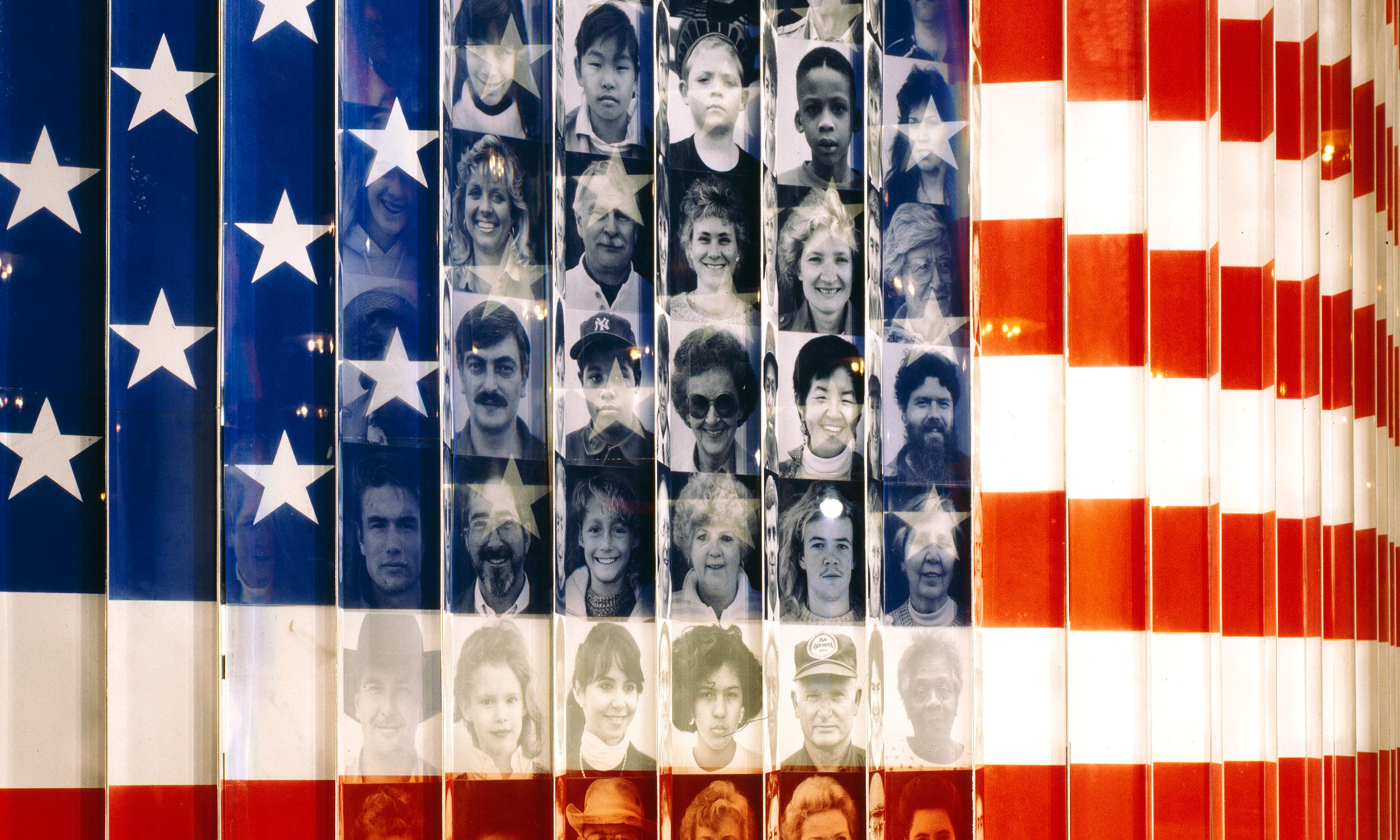
You have to learn to crawl before you can walk over hot coals. Our present love affair with diversity, inclusion, and multiculturalism got its training wheels in the early ’70s when the melting pot boiled over and Ethnic Awareness hit the fan.
It was a total rejection of E pluribus unum, our original version of inclusion whereby vastly different peoples pledged to the same ideals, language, and customs were to be gradually melded into a national type. Less loftily known as “Americanization,” the melding process eventually took on a cookie-cutter aspect that offended the obsessive individuality enshrined by the ’60s. Worse, the cookie in question was none other than that archenemy of progressives and hippies, the White Anglo-Saxon Protestant. This was the “real American” that foreign-born parents had urged their children to copy, so their descendants declared war on WASPs and the Ethnic Awareness Movement began.
It was marked by the usual cluster of T-shirts, bumper stickers, coffee mugs, and lapel buttons reading “Kiss Me, I’m Italian,” “Have You Hugged a Greek Today?” and “Czech Mate!” Novelists had a field day. In Any Minute I Can Split, Judith Rossner wrote, “WASPs were born toilet-trained,” and in Goodbye, Columbus, Philip Roth called us “those pug-nosed little bastards from Montclair.” In movies and miniseries, an aging Ray Milland forged a new career as the WASP father from Hell. Serious scholars had a go at us as well. In The Rise of the Unmeltable Ethnics, Michael Novak penned the unforgettable line: “The innocence of Johnny Carson’s face insults the night.” (That pug nose will do it every time.) There was no end to the awareness of the newly aware. They related wrenching stories of childhood trauma and psychological scarring caused by having a name that ended in a vowel, and blamed “Anglo-Saxon repression” for everybody’s sex problems, including their own.
The Ethnic Awareness Movement set out to destroy WASP hegemony. In that it succeeded, but like most of our idealistic movements this one was fraught with unintended consequences. Now, for the first time, one offshoot of the Old World was the same as another. At last we were all Europeans together — i.e., all whites. Add the Founding Father mental picture triggered by those longstanding collective put-downs, “dead white men” and “white male patriarchy,” and we see that “white” and “WASP” have become virtually synonymous. Consider the protest sign recently seen at an Hispanic demonstration: “Who Are You Calling Immigrant, Pilgrim?” There it is: Anybody who is against Hispanic immigration must have a name ending in a consonant — like Bradford, Hopkins, Alden, Winslow, Standish. You don’t get passenger lists like this on any old ship, but now that a European is a white is a WASP, you do.
To liven up the unintended consequences we now have a Pilgrim-in-Chief. Lou Dobbs is evidently a WASP and looks it, but it doesn’t end there because he bears a striking resemblance in looks and manner to the all-time Movie WASP, the ubiquitous character actor Gene Lockhart, he of the pug nose whose daughter was also in the movies and had the same nose. Lockhart was in so many movies of the ’30s and ’40s that it would be easier to list those he was not in. He played Stephen Douglas in Abe Lincoln in Illinois; Custer’s father-in-law in They Died with Their Boots On; the judge in Miracle on 34th Street — indeed, the judge in just about everything, as well as the mayor, the banker, the factory owner, the pillar of the church, and the town’s leading citizen, ever given to the hrummphing pomposity that goes with vests and pocket watches on heavy chains. He was so WASPy that even when he stepped out of character and played the poor, browbeaten Bob Cratchit in A Christmas Carol he came across as a middle-class suburban WASP, the ultimate white-collar family man pushing Scrooge’s papers. The dual image of Lou Dobbs and Gene Lockhart has obliterated Ethnic Awareness and revived awareness of ethnics.
One wouldn’t expect the Obama administration to supply America with a Gene Lockhart WASP, but it has. White House press chief Robert Gibbs, he of the rimless glasses and educated Southern accent, is straight out of a black-and-white photo in a history book. A McKinley cabinet member, a Taft cabinet member, a Hoover cabinet member. It doesn’t matter which as long as it’s an official black-and-white photo of a cabinet: all males, all in black suits, waistcoats, and stiff high collars, all with their legs crossed in the same direction, all with buttoned shoes showing, because Gibbs belongs in a pre–New Deal gallery of “real Americans” posing for an official cabinet photo. The Last Cabinet, starring Gene Lockhart.
Between Dobbs and Gibbs, America is saturated with Gene Lockhart WASPiness. One or the other is always on TV, but that doesn’t mean that WASP hegemony is back. On the contrary, our shrinking world has gotten so small that the possibilities for universal sameness are now bigger and better than ever. The Family of Man has hit the multicultural jackpot and raised inclusion to the nth degree. If you don’t believe me, get out your almanacs, turn to Flags of the World, and check out the flag of Somalia. It’s very simple, just a blue field with one white star in the middle. Look familiar? No? It happens to be alike in every detail to another flag, one that inspired a song, and I don’t mean the Somali national anthem. Still don’t know? Okay, be quiet while I sing:
First gallant South Carolina nobly made the stand,
Then came Alabama who took her by the hand,
Then quickly Mississippi, Georgia, and Florida
All raised on high the Bonnie Blue Flag
That bears a single star!










Comments