Don Bentley knows the satisfaction of flying an Apache helicopter: “You get to be the guy coming over the hill when soldiers are in trouble.” He discovered this feeling sometime before June 28, 2005, the day that he calls “the defining moment in my military career.” He was posted to Bagram in Afghanistan, serving on an Army quick-reaction team. “We were the 911 force,” he says. “We were the people you call in an emergency.”
The crisis came when four Navy SEALs on a surveillance mission against the Taliban fell into an ambush and lost contact with their headquarters. Bentley’s AH-64 Apache attack chopper jumped into action, joining several other aircraft, including an MH-47 Chinook that carried eight Army special-ops troops known as “Night Stalkers” as well as eight more SEALs. “We headed to the last known location of the missing SEAL team,” says Bentley, remembering the flight into Kunar Province, along the border with Pakistan.
Their task was to extract the four lost SEALs. What nobody knew at the time was that three of them already were dead. The fourth, Marcus Luttrell, was badly wounded.
Bentley’s job was to clear a landing zone for the Chinook — but the Chinook arrived ahead of his Apache, and as it did, a Taliban fighter on the ground launched a rocket-propelled grenade. It struck the Chinook, detonating on impact. Bentley knew that everyone on board was dead. “It was just rolling sheets of fire,” he says of the crash scene. “Nothing looked like a helicopter anymore.” Bentley and the others searched for the SEALs until they ran low on fuel, then returned home. Bentley’s gunner hadn’t even fired a shot.
The episode haunted Bentley, who at the time was a captain. “The whole reason you go into the Army is for a moment like this,” he says. “Imagine being a professional football player who spends his whole career trying to get to the Super Bowl and the first thing you do is fumble the ball.” Bentley is probably being too hard on himself: A lot of things went wrong during what was called “Operation Red Wings.” Yet Bentley says he couldn’t stop thinking about what had happened, especially after he was discharged from the Army a couple of years later. He replayed the battle in his mind, feeling the frustration over and over. “You can’t get it back. A lot of people died and you didn’t stop it. What will I ever do again that will be that important?”
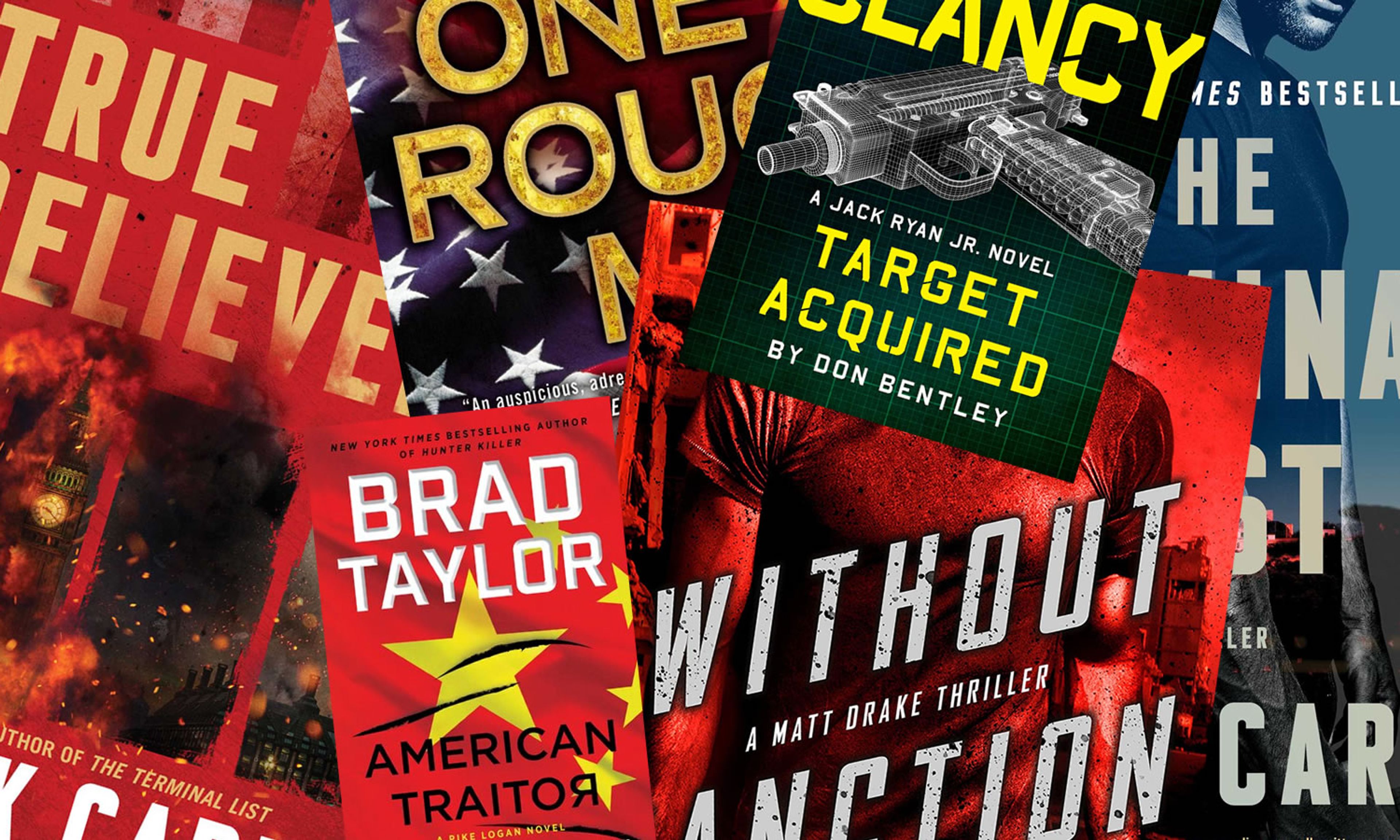
Luttrell later told the story from his perspective in Lone Survivor, a memoir that became a movie. Bentley also decided to write about it — not in a personal account, but rather as a novelist of military thrillers. His first, Without Sanction, drew on the emotional stress he had suffered in Afghanistan. Kirkus Reviews praised it as “a page-turner with the kind of small details that lend unquestionable authenticity.”
Bentley is one of several novelists who are reshaping their popular genre as veterans of the wars in Afghanistan and Iraq. Influenced by the likes of Tom Clancy, Vince Flynn, and Brad Thor — successful authors who have sought to blend national-security dilemmas with pulpy action, despite not having served in uniform — they draw inspiration from their combat experiences to create stories that are hitting the best-seller lists and could become the basis of movies and television shows in the 2020s and beyond. They all claim that their first objective is to write novels that entertain, but a conservative sensibility also animates their work, involving everything from the virtues of a martial ethos and American gun culture to the geopolitical threats faced by the United States in a hostile world.
The most prominent member of this new wave may be Jack Carr, a former SEAL sniper. “Since I was seven, I wanted to be a SEAL,” he says. “Since I was ten, I wanted to be a writer.” It helped that his mother was a librarian, and when he expressed interest in the military, she brought home books: nonfiction accounts about the armed forces plus adventure stories by the likes of Louis L’Amour and Jack London. Carr’s success suggests that SEAL training may be good preparation for the challenges of writing and publishing, as both require enormous amounts of commitment and determination. “They have high rates of attrition,” he says.
The former frogman refuses to say much about his service, and “Jack Carr,” in fact, is a pen name. Most of his work as a SEAL remains classified, he says. On September 11, 2001, he was deployed in Guam — and it was approaching midnight, local time, when the hijacked planes started to smash into their targets. “We watched it on a television in the basement of our barracks.” Soon after, he went to Kuwait to help enforce the oil embargo against Iraq. Eventually, he saw combat in Afghanistan and Iraq. In 2006, while he was on patrol in Baghdad, his unit drove into a trap. “I learned what it’s like to have the enemy set up on you,” he says. He remembered the incident years later as he wrote the violent scene that kickstarts his first novel, The Terminal List.
That initial book, published in 2018, became a breakout success. It introduced a series character, James Reece, a SEAL who finds himself at the center of a surprise attack that slaughters his comrades. “I never experienced anything on the scale of what I wrote about in The Terminal List,” he says, “but I took the feelings I knew from combat and tried to describe what it’s like.” Reece survives the massacre and goes on to discover a conspiracy within his own government. In a preface, Carr describes the disillusionment that fueled his plot: “The consolidation of power at the federal level in the guise of public safety is a national trend and should be guarded against at all costs,” he writes. “Revisionist views of the Constitution by opportunistic politicians and unelected judges with agendas that reinterpret the Bill of Rights to take power away from the people and consolidate it at the federal level threaten the core principles of the Republic.”
More best sellers followed: True Believer in 2019, Savage Son in 2020, and The Devil’s Hand in April of this year. The new novel begins on “the day that changed the world” — the one Carr spent in Guam — and it imagines a scenario in which Osama bin Laden’s 19 henchmen were aided by a network of allies who escaped detection and remained at large. In a plot influenced by the events of the last year, they plan a new attack so that “America will turn against itself, compounding the problem of racial discord, Marxist communist protests, a domestic insurgency, and the economic hit of COVID-19.” As Reece shoots terrorists and confronts a lethal contagion, Carr makes appreciative references to everything from Black Rifle Coffee to “147-grain Speer Gold Dot hollow point” bullets. He also editorializes: “Beware the government that fears your guns.” His hero receives occasional help from his journalist girlfriend, who writes “on the irony of politicians calling to defund the police, while surrounding themselves and their families with armed security paid for by the taxpayers” in articles that appear in National Review.
The tale is full of explosions, gunfire, and high-stakes politics — and now it appears destined for screens. The Terminal List is currently filming as a television series for Amazon, starring Chris Pratt as Reece. It remains to be seen whether Hollywood will cancel Carr’s conservatism: The second season of Amazon’s Clancy-inspired show Jack Ryan portrayed Venezuela as being under the despotic rule of a right-wing populist rather than the left-wing socialists of reality. Whatever happens with the Reece adaptations, nobody will be able to blame the source material.
Other writers in the field include Sean Parnell, who served in Afghanistan with the Army’s 10th Mountain Division. The fourth book in his series of thrillers comes out in September. (On May 11, Parnell announced that he will run for the Senate in Pennsylvania as a Republican; last year he lost a race for a House seat.) Reggie Gibbs, a retired Marine who participated in the invasion of Iraq in 2003, recently published Beyond the Urals, a novel set during World War II. Matthew Betley, a former Marine officer who fought in Fallujah, has put out a series of novels that involve deadly firefights, what it’s like to inhale the fumes from a burn pit, and more. “It’s a cliché to say ‘Write what you know,’” says Betley, “but that’s what I’ve done.”
The most prolific novelist among the 21st-century veterans is Brad Taylor, a former Delta Force operator who deployed to Afghanistan about a month after 9/11. “I can’t talk about that,” he says, nor will he discuss the years he spent going in and out of Iraq. But he’s happy to describe his final assignment, when the Army sent him in 2008 to teach at The Citadel, the military college in South Carolina. “I had a nine-to-five job, and I didn’t know what to do with myself,” he says. “So I wrote a book.”
This became One Rough Man, the first of 15 best sellers to feature the character Pike Logan. The latest, American Traitor, came out in January. It involves a Chinese plan to seize Taiwan. Taylor got the idea for it when he was researching an earlier story during a visit to the African nation of Lesotho, where he encountered the Belt and Road Initiative, China’s project to expand its influence by building infrastructure in other countries. “It has nothing to do with goodwill,” says Taylor of the Chinese strategy. “It’s all about control.” This got him thinking about the problem of Chinese imperialism and rising tensions with Taiwan, which the government in Beijing views as a breakaway province. “Taiwan is a well-functioning democracy,” says Taylor. “It has free and fair elections. China is doing everything it can to destroy this.” Taylor thinks China’s success would be tragic, and the hero of his new book tries to stop it from happening. Taylor says he’s not seeking to change anybody’s mind about geopolitics, but he admits that his plots have a purpose beyond providing vicarious thrills: “I write about current events that people should be aware of.”
Taylor borrowed the title of his first novel from something he saw in Okinawa, where he was born when his father served as an Air Force pilot during the Vietnam War, and to which he was deployed during his own military career. A sign above a bar in a Special Forces team room on the island reproduced a quote: “People sleep peacefully in their beds at night only because rough men stand ready to visit violence on those who would do them harm.”
This line — commonly attributed to George Orwell but in fact a paraphrase of sentiments from several writers — captures the spirit of these veterans who have taken up fiction. Even though their globe-trotting sagas of alpha-male heroes, dastardly villains, and deep-black agencies can veer toward the fantastic, they nevertheless provide the useful reminder that ordinary citizens owe much of their freedom and safety to fellow Americans who risk their lives in the line of duty.
Don Bentley — the onetime Apache pilot in Afghanistan — used a version of the rough-man maxim in his first book, Without Sanction, which features the protagonist Matt Drake, an operative with the Defense Intelligence Agency who is troubled by the botched extraction of an informant in Syria: “Everyone had paid a staggering price for my failure,” he confesses, in a first-person narrative that mixes wry observation with raw earnestness. The passage feels autobiographical, at least emotionally. “I put my story into that book,” says Bentley, who never has set foot in Syria but understands how a battlefield mishap can vex a veteran. Even rough men can require redemption, and Drake achieves his in a daring feat against what appear to be impossible odds.
Bentley’s redemption may yet come through his novels. His second thriller starring Matt Drake, The Outside Man, was released in March. June will see the publication of Target Acquired, Bentley’s entry in the ongoing series of Clancy-branded books. The Texas-based author still has a day job; he says he’s not quite ready to make the leap into full-time writing. Yet it’s also possible to see him dream big on the printed page. In a passage from Without Sanction that is both comic and harrowing, for example, Drake describes a bizarre conundrum: “I had to believe that if someday someone made a movie about this goat rope of an operation, the part about my riding to meet an asset atop a smoke-belching 1940s-era tractor wouldn’t make the script.”
But that’s the thing: It would make the script, and it would be a great movie of modern-day valor.












Comments