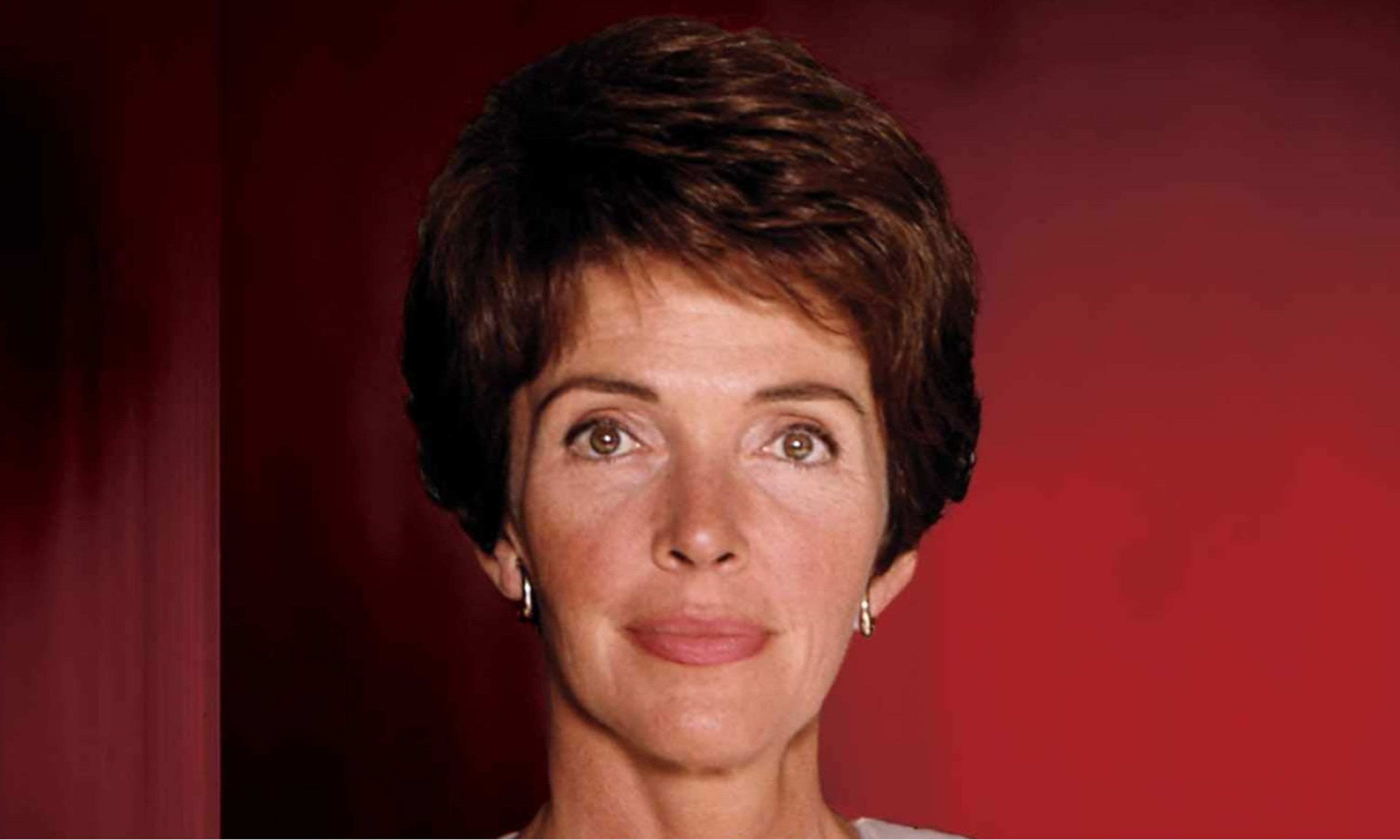
Karen Tumulty, a columnist for the Washington Post, has produced the most comprehensive account of Nancy Reagan we are ever likely to receive. Historians are finally coming to terms with what Mrs. R. actually was: one of the most consequential first ladies in history. Actor James Stewart once said that had Nancy met Ronald Reagan earlier, Reagan never would have been president because she would have seen to it that he received all the best parts Hollywood had to offer. With each passing day, the truth of that remark becomes more apparent.
There remain doubters. Some will never see beyond the caricature of the spoiled starlet spending hundreds of dollars on new White House china during a major recession (never mind that a foundation, dedicated to such purposes, paid the cost), or the greedy “arriviste” who hung on to clothes that designers had lent her (as if they had a use for them after they had been worn). Or, lest we forget, the astrologer. Forsooth!
Tumulty opens her book with a story of a private dinner at the White House residence in 1983. The only people present were the president, Secretary of State George Shultz, and their wives. It did not take Shultz long to discern that there was a purpose to the gathering: to discuss how the Cold War might be ended on terms favorable to the United States.
Nancy’s primary agenda was to protect her husband and to facilitate his success. She could instantly discern who had joined Reagan’s orbit to further the president’s objectives and who were there to advance interests of their own. She took a direct role in the hiring and firing of campaign aides and gubernatorial and presidential advisers. Even a partial list of top-level White House advisers whose scalps she could claim would be long. On the positive side of the ledger, she made common cause with people she thought could help make Reagan both a successful president and a great one. Shultz and two of Reagan’s chiefs of staff, James Baker and former senator Howard Baker, considered her a powerful ally.
When “what was best for Ronnie” was at stake, Nancy rose above past fallings-out. She pressed to bring campaign consultant Stuart Spencer into Reagan’s 1980 campaign, after Spencer, who had managed Reagan’s first campaign for governor, had defected to Gerald Ford’s camp in the run-up to the 1976 presidential nomination. She made the case for James Baker to be Reagan’s chief of staff after Baker had not only worked previously for Ford but had also managed George H. W. Bush’s primary campaign against her husband in 1980. What was in Reagan’s best interests, as she saw them, motivated her far more than policy or ideology. Yet in order to achieve her ends, she often ventured into both areas.
Tumulty is at her most perceptive when she examines the limitations of her own profession. As she discusses Nancy’s often strained relations with the media, she notes that unlike Tinseltown, which ran on dreams and fiction, the political world revolved around cynicism. There, Tumulty notes, “there was a harsher kind of spotlight, one that accentuated every imperfection.” One gathers that neither Nancy nor her image ever fully recovered from a piece by Joan Didion published in the Saturday Evening Post in which she cast California’s then-new first lady as a traditional wife at a time when militant feminism was on the rise. Other writers worked Nancy into the frame Didion had designed, often omitting facts that invited conclusions contradicting the conventional wisdom.
Almost always Nancy was described as the daughter of a wealthy brain surgeon and as married to a Hollywood celebrity–turned–politician who was bolstered by his rich friends. Readers were informed, often in mocking tones, that Nancy defined herself as a homemaker. Less widely reported were comments she had made that she was grateful for having the freedom to choose to stay home and care for her family, when economic pressures denied other women that option — or that, like her husband, she had not begun life among the “privileged.”
The woman who became Nancy Reagan was born Anne Frances Robbins on July 6, 1921. Her father, Kenneth Seymour Robbins, the scion of a once socially prominent New England family, was a car salesman. Her mother, Edith Prescott Luckett, performed in vaudeville, touring with the biggest names in the business. Nancy’s parents separated shortly after her birth. She spent her first two years as a “backstage baby” while her mother was on the road. At the age of six, Nancy went to live with her mother’s sister and her family in Bethesda, Md. She longed for the times her mother would be performing in New York City, where they could spend short intervals together.
A sense of security did not enter Nancy’s life until she was eight, when her mother married Loyal Davis, a prominent neurosurgeon, and took her to live in Chicago. When Nancy was twelve, Davis’s son by a previous marriage came to live with them. Almost overnight the little girl who once felt abandoned had become part of a stable family, with a vivacious stay-at-home mom, a doting father, and a little brother who also acted as her best friend.
Nancy bonded quickly with Loyal and considered him the most important person in her life until she met her future husband. She would go to any lengths to gain his approval. When she turned 17, Loyal legally adopted her and gave her his surname. He sent her to the finest schools and threw her a no-holds-barred coming-out party at a tea dance during her freshman year at Smith College.
Though Dr. Davis brought prestige and social prominence to the marriage, he was very much a product of the school of hard knocks. The son of a rail engineer whose education had ended in grammar school, Loyal had the importance of working his brain rather than his back drilled into him.
Although Edith did not return to the stage, she accepted gigs in popular soap operas broadcast over the radio. Chicago mayor Edward Kelly retained her to coach him on the delivery of his speeches. Tumulty paints a charming scene of Edith, a Democrat and ex-suffragette, and Loyal, a staunch Republican, enjoying themselves as guests in Mayor Kelly’s box the night that President Franklin Delano Roosevelt was nominated in Chicago for a fourth term. Edith established a reputation as one of Chicago’s leading charitable fundraisers and passed along to her daughter the skills she had developed as a networker. People, including Nancy herself, would joke that Nancy would be buried with a telephone.
The best anecdote in Tumulty’s book is a story Michael Reagan, the adopted son of Jane Wyman and Ronald Reagan, related of the time Edith showed up at one of his baseball games while he was at boarding school. Michael had had a difficult childhood, feeling out of place living under the same roof with either of his parents and their respective spouses, but he’d come to revere Edith. When Michael was up at bat with two runners on base, he heard Edith shout, “You better hit a home run, you little sonofabitch.” And for the only time in his life, he did. He said that he sensed she understood the problems he was having.
In 1986, late in her husband’s presidency, Nancy spoke for the first time in public of the pain she had carried with her from her childhood. To an audience of 430 children at the orphanage Boys Town, she said: “There was a time I did not know where I belonged either. Do you know what happens when you hurt inside? You start closing your heart to people. . . . You stop trusting people. . . . You start to feel you are not worth much.”
If in the annals of presidential history there were such a thing as an award for best supporting actor, the prize would have to go to Landon Parvin, who worked with Nancy on the Boys Town address and with both Reagans on at least two other important messages: Reagan’s remarks at a fundraiser chaired by actress Elizabeth Taylor in behalf of increased AIDS research and funding, and his address to the nation about his role in the Iran-Contra affair. In each case, Reagan signaled a shift in approach after the first lady mounted a relentless campaign to extricate him from a situation into which he and/or his staff had blundered. On such occasions, she relied on a wordsmith who was neither a policy wonk nor an ideologue but who had deep insight into the characters of the two principals.
With an assist from her mother’s contacts, Nancy as a young woman landed bit parts in Broadway plays and several ingénue roles in movies. Reviews were primarily favorable. Her real ambition, however, was to marry a man like her adopted father and to build a marriage as strong and as enduring as Loyal and Edith’s. She found a soulmate in Ronald Reagan, whose early years had been as troubled as hers, and she devoted the rest of her life to advancing and protecting him. She did it magnificently.
Editor’s Note: This piece originally mistakenly stated that Landon Parvin worked with Reagan on the president’s remarks on the heels of a controversy surrounding his visit to a military cemetery near Bitburg, Germany. Parvin did not draft those remarks. It also referred to Loyal Davis’s son as becoming Nancy Reagan’s older brother; in fact, he was younger than she.












Comments