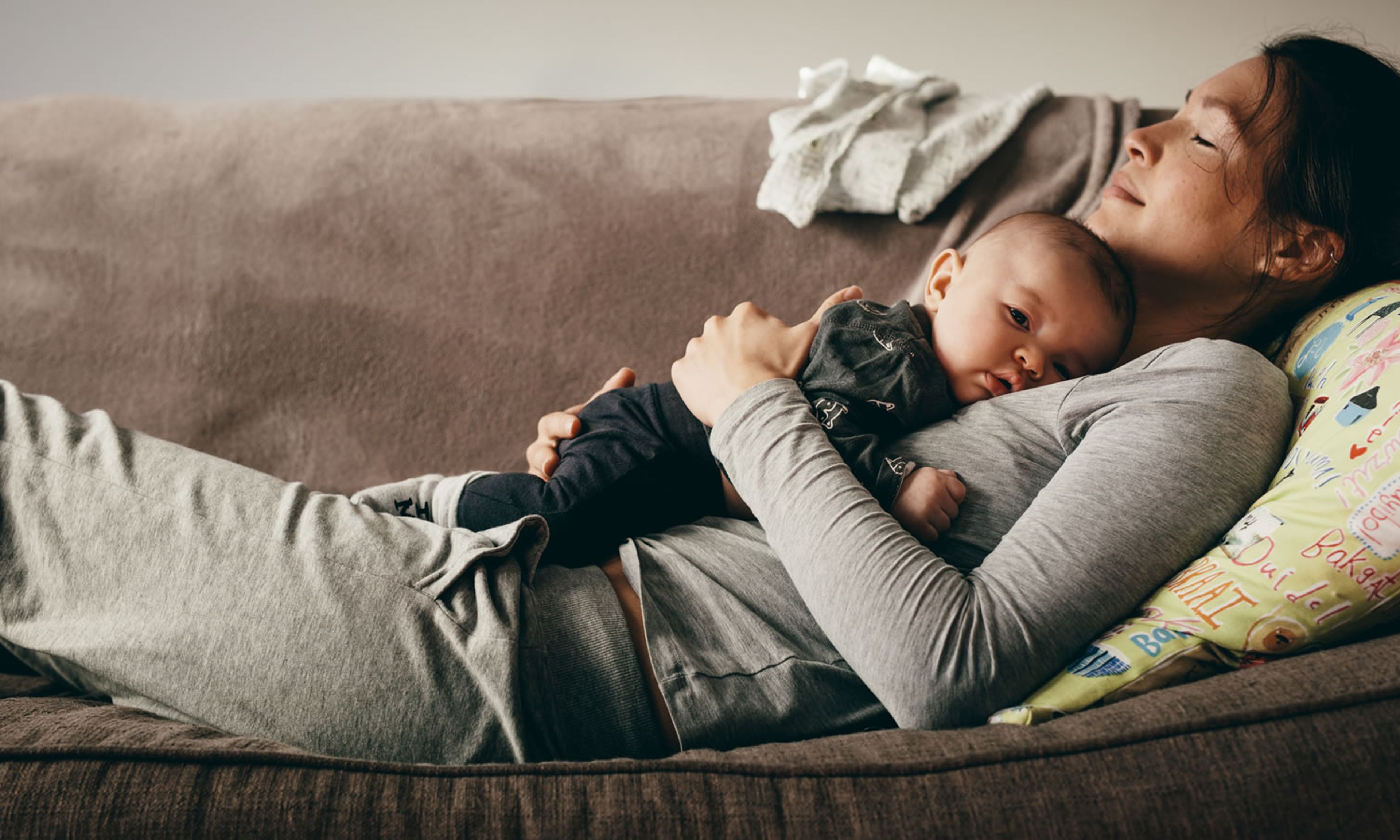
There is nothing quite like stepping out of a hospital after having given birth for the first time, holding a person who was living inside your body just two days ago. It feels as though you yourself have been reborn. The outer world seems huge and threatening. You’re blinking painfully in the bright sun. As a new mom, you can barely comprehend why the hospital staff would permit you to wander off with this miniature human, who might be carried away on a stiff breeze. Don’t you need a license for this? Is it normal to be whisked out the door, armed with six diapers and a nasal aspirator?
It is normal, at least in America. Maybe it shouldn’t be. In the Netherlands and New Zealand, new mothers are offered at-home personal assistants for the first few weeks of their baby’s life. Finland celebrates each birth by mailing the family a box full of baby essentials. Here in America, we take a rugged-individualist approach to family policy. This can be hard on moms, and Abigail Tucker explains some of the reasons in her new book.
This is a book, first and foremost, about the sociobiology of motherhood. If you’d like to know more about umbilical cords, oxytocin, or the miraculous properties of breast milk, Mom Genes will not disappoint. A writer for Smithsonian Magazine, Tucker is in her element as the intellectually curious journalist, visiting laboratories, maternity wards, and barnyards to explore the science of maternity. She is not squeamish. Rats, beetles, and infanticidal hamsters all come under her critical gaze. Lambs and chubby-cheeked toddlers get cameos too, but Tucker is fairly disciplined about keeping her focus on moms. We’re less cute, but still worth a second glance. I’ve watched scores of science documentaries with my own five sons, but none have held my attention like this book. Tucker makes moms sound amazing without ever lapsing into treacly sentimentalism. I want someone to televise this material, so I can make my sons watch it.
Mom Genes is more than just a science book, however. Tucker blends her sociobiology with an autobiographical account of her own journey as a mother of four. Her tone is candid and a bit cheeky, in the style of a down-to-earth mommy blog. Her stories are entertaining, but they add more than just comic relief. They humanize the discussion of placentae and progesterone. Moms may be fascinating specimens, but we’re clearly more than that. Here in the trenches with the rest of us cradle-rockers, Tucker knows about sleepless nights and toddler tantrums. This is a book about a woman’s effort to reconcile the things she sees under her microscope with her day-to-day experiences as a mom.
Tucker came to motherhood as an educated professional, accustomed to clearing meritocratic milestones with ease. She had a vague idea that children might be in the cards someday, but the details were fuzzy, and child-free life was pleasant. Motherhood upended everything: the Sunday brunches, the international travel, the leisurely bike-trail jogs. It didn’t just scramble her schedule, though. It changed her, in a thousand unexpected ways. New talents blossomed, while old ones atrophied. Plans changed, and priorities shifted. Nothing about her pre-maternal life seemed to explain this transformation, so she looked to sociobiology for insight.
Her findings are fascinating, though the implications are far from clear. When a woman becomes a mother, she undergoes massive physiological changes. There is nothing remotely equivalent in the world of adult humans. On the outside, we mainly see the baby bump, but that is the tip of the maternal iceberg. Beneath the surface, a new mom is morphing into a baby-builder, with her blood, bones, brain, and internal organs all shifting and reordering themselves. In a few short months, her sense of smell improves, but her memory declines. She becomes clumsier, but also more adept at reading facial expressions. Her brain literally shrinks with each pregnancy, but that’s really just the beginning, because the maternal brain is rewired in ways we are barely beginning to understand. After the birth, a mother’s brain will dole out dopamine whenever she rocks, nurses, or babbles at her infant. It will be hyper-alert to potential threats and, of course, to that tiny, pitiful cry. In crisis situations, though, a new mom may find that her stress responses are muted, and her fight-or-flight instinct enhanced. Her inner lioness has been activated, preparing her to run for the hills or fight off attackers, as the situation demands.
This all sounds very politically incorrect. Tucker assures us that it is science. If she is motivated at all by culture-war angst, she hides that fact very well. It’s possible to use sociobiology in service of culturally conservative arguments, but Tucker steers clear of those controversies. She has no discernible Mommy War insecurities, which fascinated me, as a lifelong religious conservative. My own maternal story was in some respects a mirror opposite of Tucker’s: Raised in the Mormon faith, I assumed in childhood that I would become a stay-at-home mom, and that idea somehow survived my public education, a stint in the Peace Corps, and an Ivy League doctoral program. I loved university life, but I somehow expected that childbirth would initiate a mom-makeover, converting my intellectual interests into a full-blown fascination with baby talk. It didn’t work as well as I’d hoped. As a new mom, I found myself missing my old life fiercely, and resenting religious conservatives’ seemingly insatiable hunger for testimonials about the bliss of mom life. It was confusing. I had planned to become Donna Reed and increasingly found myself thinking like Betty Friedan. Tucker was amazed by her maternal transformation; I couldn’t understand why I had not transformed, at least in the way I had been led to expect.
In fact, we may be circling around the same reality. Motherhood is incredibly demanding. Women seem, nevertheless, to have remarkable natural resources that help us to weather the storm. For Tucker, as for many women in our time, this was a startling and gratifying discovery. It might be heartening also for the terrified new moms stepping out through the hospital doors. They are equipped for motherhood in ways they never imagined.
There is a darker side to this picture, though, which my own younger self failed to glimpse. Motherhood is important and meaningful to the individual, but it is also much bigger than any particular person. When a woman becomes a mother, she perpetuates her species, her civilization, and her bloodline. Her own fate is more uncertain. From the earliest weeks of her pregnancy, her body willingly sacrifices its own valuable resources, putting her offspring’s needs before her own. Those priorities will become the new normal, extending for the next two decades at least. Some women thrive in this arrangement, finding joy in loving relationships and meaningful goals. There are no guarantees, however. Mothers excel at making others feel safe and comfortable, but in the process, we make ourselves far more vulnerable. The story doesn’t always end well.
Tucker is not naïve about the costs. She tells us the chilling birth stories. She explains in vivid detail how pregnancy “ransacks” the woman’s body, potentially leaving her vulnerable to any number of chronic conditions down the road. It seems that mothers of multiple boys are especially susceptible to diabetes, depression, and (according to one study) premature death. Your prayers are appreciated, gentle readers.
In a particularly moving chapter, Tucker describes her own struggles with postpartum depression following the birth of her third child. Mothers often struggle with mental-health issues, especially in the perinatal period; this seems to be the unhappy cost of maternal vigilance. The risk is greatly mitigated, though, when women are financially secure, with a strong network of emotional support. Mothers in general are happier, healthier, and more attentive to their children when they enjoy these benefits. In our time, many do not.
Conservatives will be quick to point out that marriage and traditional family are a time-honored solution to this problem. Those things do help, but are they enough? Perhaps we should consider that soldiers, rescue workers, or ER doctors are portrayed as heroes when they take risks for the common good, while maternal sacrifice is largely regarded as a private affair. Just like soldiers or cops, we mothers put our very bodies on the line for something greater than ourselves. Sometimes we even make the ultimate sacrifice. None of this qualifies us, or our surviving relatives, for public compensation or benefits. Monuments to maternal valor are vanishingly rare. How is it that maternal self-sacrifice is simultaneously a force of nature and our own personal business? Conservatives like to blame the sexual revolution for devaluing motherhood, but is it possible that our forefathers also took mothers too much for granted, counting on nature to draft women into honorable service?
With birth rates falling, and loneliness on the rise, we can’t afford that complacency anymore. The world needs moms. Cradles won’t just rock themselves. If we want women to get with this program, though, we need to foster a stronger sense of social responsibility for the well-being of mothers. The social science has long suggested that American parents are particularly unhappy compared with their childless peers, but also with parents in many other countries. As a group, moms are not particularly thriving in America today. That may partly explain why there are fewer of us.
Save the moms. We aren’t as cute as babies, but a world without mommy love won’t survive for long.












Comments