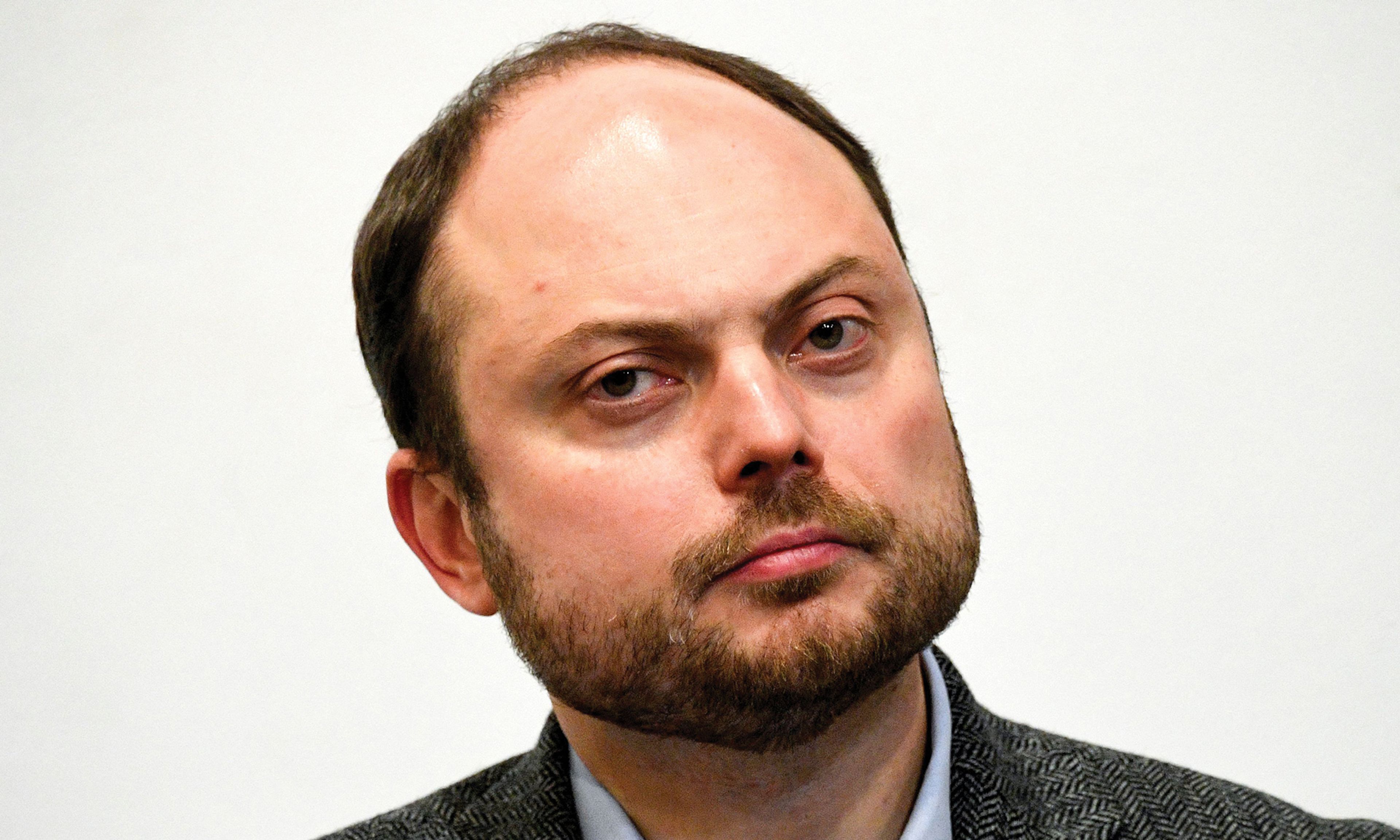
On March 15, Vladimir Kara-Murza gave a speech to the Arizona legislature. “These are very dark times in Russia,” he said. “These are times when we have hundreds of political prisoners, and that number is only going to grow.” Less than a month later, Kara-Murza himself became a political prisoner.
Born in 1981, he is one of the most prominent opposition figures in Russia. (Given the state of things, we should probably return to the word “dissidents.”) He is a politician, journalist, and activist. A proponent of democracy. For 15 years, he worked alongside Boris Nemtsov, the opposition leader. They became the closest of friends. Nemtsov was godfather to one of Kara-Murza’s children. (“In Russia,” Kara-Murza once told me, “that makes you family.”)
On February 27, 2015, Nemtsov was murdered, gunned down within sight of the Kremlin. This had a deep impact on the Russian democracy movement and, of course, on Kara-Murza personally. He has said, “My life is divided into before and after February 27, 2015.”
Three months after Nemtsov’s murder, Kara-Murza himself was nearly murdered, in a poison attack — the kind of attack for which Vladimir Putin’s agents have become infamous. After he recovered, Kara-Murza kept working, not scared off. He was again almost murdered — in another poison attack — two years later.
On the floor of the U.S. Senate, John McCain made a statement about Kara-Murza, a friend: “Vladimir has once again paid the price for his gallantry and integrity, for placing the interests of the Russian people above his own interest.” Congressman Ed Royce, then the chairman of the House Foreign Affairs Committee, called Kara-Murza “one of the bravest people I know.”
For the record, lots of people have called Kara-Murza “one of the bravest people I know.” Also for the record: McCain asked Kara-Murza to serve as a pallbearer at his funeral, which he did, when the time came (September 2018).
Last year, a team of independent investigators was able to identify the exact unit of the Russian secret police that poisoned Kara-Murza — and Alexei Navalny and others. (Navalny is the current Russian opposition leader, and also a political prisoner.) The investigators pinpointed the agents who carried out the attacks.
Wrote Kara-Murza, “My emotions are difficult to express with words. It’s one thing to know intellectually that someone has tried to kill you — and it’s quite another to see the names and photographs of the actual people who did this.”
For some years, Kara-Murza’s wife, Evgenia, and their children have lived abroad. “Obviously, it’s not an ideal situation,” Kara-Murza told me in 2017, “but it has to be this way. I go back and forth, but I spend most of my time in Russia.” He was willing to put his own neck on the line, but he was not willing to do the same with his family’s.
Many people asked him, or pleaded with him, to work in the West, rather than in Russia itself. That way, he would be safer, if not entirely shielded from danger. Nemtsov was dead. Kara-Murza almost died, twice. Wasn’t this enough? Hadn’t he paid his dues, so to speak? Did he really need to be on Russian soil, making it easier for Putin’s men? Kara-Murza rejected all entreaties, saying that he belonged in Russia.
“What does Evgenia think of all this?” I asked him in 2017. He answered, “If you ask her, she’ll say, ‘I knew what I was signing up for.’” Then, with a hint of a blush, he said, “I’m grateful to have such a woman in my life.”
Today, Evgenia tells me the following: “When we were dating, 20 years ago, I was looking at him and thinking, ‘You know, I can imagine spending my life with this man. He’s smart, he’s funny, he’s honorable. He has so much integrity.’ Later, when the poisonings and persecutions began, I thought, ‘I wish our lives could be a little more boring.’ But I do admire Vladimir. I’ve always admired and respected him for his principled stand, and I would never have him any different.”
Explaining Vladimir’s insistence on working in Russia, Evgenia says, “He believes that he would not have the moral right to call on people to fight if he were not sharing the same risks.”
Back in 2017, I asked Vladimir whether his name would protect him. He was a friend of U.S. politicians, he had been featured on 60 Minutes, he had spoken at forums around the world. He was a bit of a celebrity. Kara-Murza looked at me and said, in effect, “Are you kidding?” Then he said (I will quote directly), “If they can kill the leader of the opposition on the bridge next to the Kremlin” — he was speaking of the Nemtsov murder — “they can do anything.”
Vladimir Putin launched his all-out assault on Ukraine on February 24 of this year. Kara-Murza, naturally, cried against this assault. On March 15, he gave his speech to the Arizona legislature. On April 11, he appeared on CNN, from Moscow. He spoke of the Putin regime’s history of murder. Mincing no words, he said, “This regime that is in power in our country today — it’s not just corrupt, it’s not just kleptocratic, it’s not just authoritarian. It is a regime of murderers. And it is important to say it out loud.”
He went on to say, “It’s tragic, frankly, that it took a large-scale war in Europe for most Western leaders to finally open their eyes to the true nature of this regime.”
His interviewer asked him about being in Russia, after all that had happened to him, and others. Wasn’t he afraid of being killed? Kara-Murza answered, “Look, I’m a Russian politician, I have to be in Russia, it’s my home country. I think the biggest gift we could give to the Kremlin — those of us who are in opposition — would be to just give up and run, and that’s all they want from us.”
He was arrested that night. Five or six agents rushed at him when he was returning to his apartment building and parking his car. They dragged him into a van and took him to a police station. He was denied the right to call a lawyer. The next day, the authorities sentenced him to 15 days in prison for resisting arrest (something Kara-Murza had not done). It is typical for the government to sentence a dissident to 15 days on some little charge, while they cook up a bigger charge. Agents took Kara-Murza to a detention center.
Eventually, he did have lawyers, and very good ones: Vadim Prokhorov and Olga Mikhailova. (The latter is also lawyer to Navalny.) Kara-Murza does not have access to a phone or the Internet or anything like that. But, in detention, he was able to dictate a column to one of his lawyers.
Among the details he reported was this: When the agents rang the doorbell of the detention center, they said to the person opening, “Here’s a political for you. They should have called you from headquarters.” (By “a political,” they meant a political prisoner, not a common criminal.)
Some 15,000 Russians have been detained for protesting the assault on Ukraine. These people have assumed great risks and have exhibited notable bravery. In a column before his arrest, Kara-Murza recalled the seven people who protested in Red Square against Moscow’s invasion of Czechoslovakia in August 1968. The Kremlin of the time was saying that the whole nation supported the invasion. One of the protesters, Natalia Gorbanevskaya, a poet, reflected on those days, many years later.
“A nation minus me,” she said, “is not an entire nation. A nation minus ten, a hundred, a thousand people is not an entire nation.” So, thanks to the Red Square protest, the government “could no longer say that there was nationwide approval for the invasion of Czechoslovakia.”
On April 22, when Kara-Murza had been in prison for a week and a half, the authorities lodged their bigger charge against him. They accused him of violating a new law, instituted on March 5. This law essentially criminalizes any criticism of the Ukraine war whatsoever. It is punishable by up to 15 years in prison.
Before the war, there were a few independent media outlets left in Russia — the venerable radio station Echo of Moscow, for example, and the venerable newspaper Novaya Gazeta. (Over the years, six of the paper’s correspondents have been murdered.) Now all independent media have been shut down. Social media have been blocked. In another of his pre-arrest columns, Kara-Murza wrote, “Near-total darkness has descended on Russia’s information space with frightening speed.”
The first person charged under the new law — the March 5 law — was a blogger, Veronika Belotserkovskaya, who does not live in Russia, but in France. Her response: “I was officially recognized as a decent person!” In Kara-Murza’s case, the authorities cited the Arizona speech in particular. As of this writing, he is awaiting a court date.
His friends and allies are making as much noise as they can. Charles Krauthammer once told me about something that Meg Greenfield had said to him. She was the editorial-page editor of the Washington Post. When the life of Andrei Sakharov, the great Soviet-era scientist and dissident, hung in the balance, she wanted something on him in her pages at least once a week, she said. That way, the Post might help keep him alive.
Chief among the shouters, or campaigners, today for Vladimir Kara-Murza is his wife. I think of Avital Sharansky, who campaigned for her husband, Anatoly (later Natan), during his nine years in the Gulag. She had obtained a visa to go to Israel, he had not. Sharansky told me a few years ago, “The biggest mistake the KGB made was letting Avital out.”
“I’ve never been a public person,” Evgenia Kara-Murza says, “and I’ve never enjoyed being in the public eye. I am a quite introverted person, so I like working from home, and I like taking care of the kids, but unfortunately the situation sometimes changes, and I emerge when my husband is either poisoned or thrown in jail, because this is my partner, my soulmate, and I am prepared to do everything I can to bring my children’s father home.”











Comments