Recent Gallup polls have shown American religiosity falling to new lows. For the first time since 1936, Gallup finds that a majority of Americans are not members of any religious body, a trend driven both by rising rates of irreligion and by the fact that just half of religiously affiliated Millennials report being a member of a specific congregation. Our society is becoming less religious, and religious people are becoming less attached to their communities. This change has been much discussed for years, with conservatives bemoaning the loss of religious morality and progressives often celebrating the emergence of a society they say is less restrained, more diverse, and more open. But the history of American religion is far more complicated than either side lets on. American religious life has varied widely over time, and while the faithful today may have cause for concern, they do not have cause for despair.
Progressives and conservatives tend to tell competing stories about American religious history. Social conservatives often suggest that America is a “Christian nation,” or at least a nation “founded on Christian principles.” The devoutness of early American society makes clear to these conservatives that America is, on some deep level, truly a Christian (or, more recently, perhaps a Judeo-Christian) society. In particular, conservatives can cite the Treaty of Tunis (1797), which specifically links the office of the presidency to “the religion of the Messiah,” and the treaty with Morocco (renewed as late as 1836, and still in effect), which explicitly refers to the United States as a “Christian power.” For conservatives, America was a fundamentally religious (and specifically Christian) country from its founding until at least the 1960s, when secularism began to take hold, over time pushing the country away from its true roots.
Progressives, on the other hand, point to the overt secularism of the U.S. Constitution (especially when compared with that of other governments and laws of the time) and the wave of disestablishment of churches by the states after the Revolution, along with the widespread deism and agnosticism among the Founding Fathers, to argue against the idea of America as a “Christian nation.” To match the treaty precedents that conservatives muster, progressives can point to the Treaty of Tripoli (1796), which states that “the government of the United States of America is not in any sense founded on the Christian Religion.” For progressives, American history is progressive: The shackles of superstition and the unenlightened mind are gradually being removed, and American history is a story of rising religious diversity, reduced oppression of nonbelievers by religious institutions, and, ultimately, liberty of conscience and the rise of secularism.
The only problem with these accounts of religious history in America is that they are both wrong. Neither one bears much resemblance to the actual facts of religiosity in America, from the first European settlement until the present day. These narratives are false about both the history of religiosity (it is not a simple story of decline over time) and the history of American policy towards religion (neither rising liberty nor rising secularism adequately describes the record).
In a recent report for the American Enterprise Institute, I reconstructed historical data on American religiosity from denominational records, surveys, genealogies, census databases, and other sources, making it possible to create an apples-to-apples comparison of religiosity over a long period of American history. The figure below shows the result.
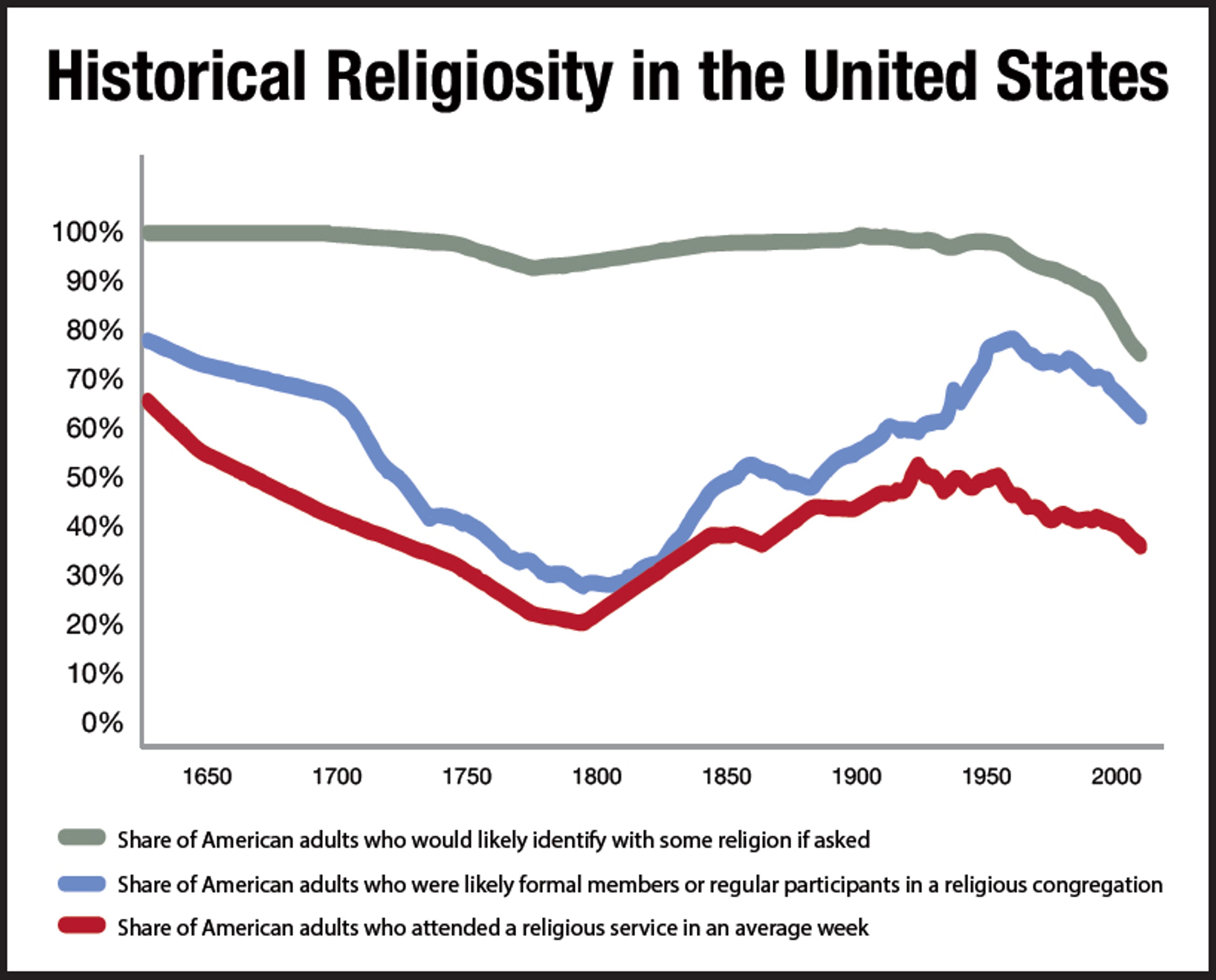
The entire 18th century saw declining religiosity in America, with the period of the American Revolution being a uniquely secular time. Americans had never before been, and have not since become, as unlikely to be a member of or to attend a religious congregation as they were in the period from 1770 to 1800. The revolutionary period was one of extraordinary secularism. Indeed, contemporary religious leaders left behind records of complaints about the proliferation of what they called “nothingarians” and we today call “unaffiliated” or “religious nones.” True, many of the people who were neither church members nor church attenders may have, in some very broad sense, identified themselves as “Christian,” but this did not always mean much. Indeed, the term “Christian” often simply identified a broad cultural lineage — participation in Christendom, or European civilization — as much as it signified any particular religious commitment. This explains why treaties could refer to the U.S. as a “Christian power” even while repudiating any idea of its having been founded on Christianity.
But that irreligion didn’t last. Even as the 18th century in America saw a collapse of the traditionally dominant faiths, such as Anglicanism and Congregationalism, from their wreckage came an outpouring of new faiths: Methodism, Restorationism, Adventism, Mormonism, Jehovah’s Witnesses, Shakers, and many others. The extraordinary number of new religious movements founded in the 19th century is a testament to how unchurched Americans were. There was enormous demand for the moral organizing force of religion, and insufficient supply from the traditional providers. As immigration rates rose in the late 19th century, faiths such as Catholicism, Lutheranism, Eastern Orthodoxy, and Judaism began to grow rapidly as well, helping new immigrants integrate into American society. Religious membership and attendance continued to rise or remained at high rates through about 1960, at which point it began to decline, as did the share of the population that identified with any religion.
Obviously, something has changed since the 1960s. Religious affiliation is falling faster than ever before, to lower levels than have been seen at any point in American history. But the decline in church membership and attendance has occurred at a much slower rate, and they remain far above the levels often found in American history. Americans today are more likely to be part of a religious community than they were in 1800; the change over time can be characterized neither by a gradual decline from a religiously pristine past nor by the onward march of rational thinking. It’s better to think of these rises and falls as fundamentally contingent processes driven by a variety of factors at different times and places. There is no “long arc” to American religiosity; there is just a constant tug-of-war throughout our history between religion and its detractors.
The forces driving these changes are in some cases obvious, and in others surprising. For example, the last 400 years have seen a fairly consistent diminution in the constitutional and cultural status of religion. Large databases show that American published texts have contained fewer and fewer religion-related words over the decades, and the constitutions of U.S. states and of the U.S. as a whole have become steadily more secular.
But there has not been a simultaneous increase in religious liberty. Reconstructing a history of religious violence in America suggests that it has risen sharply since the 1940s. FBI data since 1991 show no reduction in hate crimes committed on the basis of religion per million religious believers, and a considerable increase since 2014. Meanwhile, a growing number of other threats to religious liberty have appeared, such as anti-sharia laws that discriminate against Muslims by prohibiting them from using the same kinds of religious arbitration channels often used by Christians and Jews, or attacks on state religious-freedom laws, seeking to limit the protections those laws provide to businesses and to compel religious business owners to violate their consciences. While the Supreme Court in recent years has tended to side with religious organizations, the tide of public opinion (and the rising volume of lawsuits) is clearly turning against religious exemptions and even against nondiscrimination protections based on religious opinion or creed.
Again, while this may feel new to many believers in America, it is not. Religiously discriminatory laws in this country are older than the Constitution. Oath laws effectively disqualifying Quakers and Mennonites from public office, test acts discriminating against wide swaths of belief and opinion, legal restrictions on the founding of churches, and explicit requirements that churches register doctrinal statements to be approved by governments have all existed at one time or another in America. Maryland even fought a religious civil war between Puritans and Catholics from 1689 to 1692, which led to Catholicism’s being declared illegal until 1776.
In addition, states enacted “Blaine amendments” (named after James G. Blaine, the 1884 Republican candidate for president, a leader in popularizing such laws), which explicitly discriminated against religious (especially Catholic) educational institutions by banning them from receiving public funds. These amendments weren’t invented until the 1840s and did not become common until the 1870s. The early 20th century saw courts applying Blaine amendments ever more broadly, and by the mid 20th century the Supreme Court had de facto imposed a Blaine amendment on U.S. public education through various court cases limiting the presence of religion in schools, even though an actual proposal for a national Blaine amendment was defeated in the 1870s.
What began as a discriminatory vehicle for Protestants to keep Catholic and Jewish immigrants in check ultimately became a tool for secularization of the entire education system. And so it goes: Conservatives today often argue for anti-sharia laws even though such laws could lay the foundation for prohibiting virtually all religious arbitration. What begins in discrimination ends in secularization.
In recent decades, however, the most important component driving religiosity has been related to education: How many years of life will the typical person spend within a formally secular educational environment? To be clear, this is not asking, “How many years of education will a person receive?” because some years might be spent in environments that are basically religious, such as a parochial school or a religious university. But the more years that young people in a society spend in places where their daily routine is dominated not by the family business, parental instruction, or religious catechesis but by explicitly secular educational institutions, the more likely the society is to be irreligious. There are numerous tests of this. An empirical study of restrictions on religious workers serving as teachers in late-19th-century France found the restrictions had a negative effect on religiosity, while total educational attainment did not rise. Compulsory secular school in Turkey reduced various measures of Islamic devotion in the 2000s. Reforms in Indonesia that increased subsidies for secular primary schools but also religious secondary schools caused kids enrolled in the expanded secular primary schools to become less religious, but kids enrolled in the religious secondary schools to become more religious, while educational attainment rose for kids in both groups. Indeed, a wide body of international evidence suggests that it is not educational attainment that leads people to become less religious, but rather the secular context of that education.
Nor is this a story of religious kids going off to college and losing their faith: The evidence that college enrollment reduces religiosity is surprisingly weak. Rather, longitudinal studies show that most secularization happens at a younger age. For example, of the young people included in the National Longitudinal Survey of Youth 1997 cohort, just 3 percent had parents who had been raised nonreligiously, and 7 percent had parents who were nonreligious when the child was between ages 13 and 17. The share of kids who were nonreligious, by contrast, was 11 percent at age 13, and 17 percent at age 17. By age 21, about 22 percent of respondents still in the survey were nonreligious, a share that stayed essentially unchanged until the early 30s. In other words, of the gap between parental irreligion (7 percent) and the irreligion of adult children (22 percent) in this survey, four percentage points occurred before age 13 and another six percentage points between ages 13 and 17, leaving five percentage points for ages 18 to 21. Most “secularization” occurs among children, not young adults, and thus doesn’t reflect well-informed decisions of adults, but rather children choosing role models, peer groups, and fashions of the day, often before they hit puberty. It’s not “teen rebellion,” but rather a pervasive set of social narratives that are hard to escape.
How does this secularization of kids, and ultimately of the country, occur? Simple: Kids are spending an ever-increasing number of days in public-school environments, which are themselves becoming ever more secularized. As public school expands its claim on children’s lives and uses that claim to promote an overtly nonreligious life course, religion loses its salience and prestige for kids. It’s not that schools actively undermine faith (and there’s little evidence that religiosity is associated with lower educational attainment); it’s that schools provide alternative role models, advisers, and cultural narratives: athletes instead of martyrs, guidance counselors instead of pastors, progress in math instead of growth in piety. It is the subtle deprioritization of faith that drives secularization, not overt attacks on it. Bans on school prayer may have had some effect, but the growing popularity of after-school sports instead of church youth groups or catechism class is probably even more decisive. Religious parents are often complicit in this. In their new ethnography of religious parents (Handing Down the Faith), researchers Amy Adamczyk and Christian Smith show that just a third of religiously affiliated parents see passing on their faith to their kids as a top priority of parenting, and large shares of religious parents report believing that when religious activities conflict with other activities, it’s the religious activities that should be sacrificed.
Voluminous research (by Adamczyk and Smith, as well as myself and others) has found that the odds of successful religious transmission are very closely related to the frequency of intentional, formal, parent-led religious activities and instruction, but many religious parents continue to operate under the delusion that their children will just pick up religion along the way or return to the faith as they grow older. There is little evidence for those hopes, since numerous surveys have shown that people do not tend to get much more religious as they age beyond young adulthood.
So the question of American religiosity in the 21st century largely comes down to schooling. Other factors matter too, of course: For example, delayed marriage and childbearing probably nudge more young adults into a less religious lifestyle and thus decrease the odds that even religiously affiliated parents will attempt to pass on their faith. Onerous zoning regulations that force churches onto suburban bypasses, creating a “church row” in cities around the country even as neighborhoods where people actually live are devoid of religious institutions, probably play a role too. But without an end to explicit discrimination against religious education (through Blaine amendments and lack of school choice, particularly for younger kids), an improvement in parental work–life balance enabling students to spend more time with parents and less time in nonreligious extracurriculars, and a reduction of the implicit bias against religion in the public schools (which are artificially secular spaces out of synch with reality beyond the school doors), declines in religiosity are likely to continue. This is reason for concern, as declining rates of religiosity in combination with low population growth will cause congregations to shrink and die, and religious institutions around the country will be less able to sustain their communities of faith.
But it is not cause for despair. For all that the political tides often seem aligned against Americans of faith, major forces are working in our favor. Americans of all stripes believe in pluralism and choice as basic values, which is why the school-choice movement has been fairly successful at making political gains that help religious families. Even nonreligious parents can see the logic in diversity of schooling options. Moreover, many of America’s fastest-growing populations, including Muslim immigrants, sub-Saharan African immigrants, and Hispanics, are very religious and want to preserve cultural or linguistic practices that are threatened by the homogenizing public-school system. If conservative Christian schools can make common cause with Arabic-speaking Islamic schools, Roman Catholic Spanish-language preschools, and Ethiopian Christian academies, there are plausible coalitions of interest that could help them reclaim the educational landscape. But if we do not forge a political coalition with a positive commitment to religious pluralism, and instead continue to tolerate differential treatment and discrimination, as in the case of anti-sharia laws, the ark of faith in America will sink below the waters, never to be seen again.












Comments