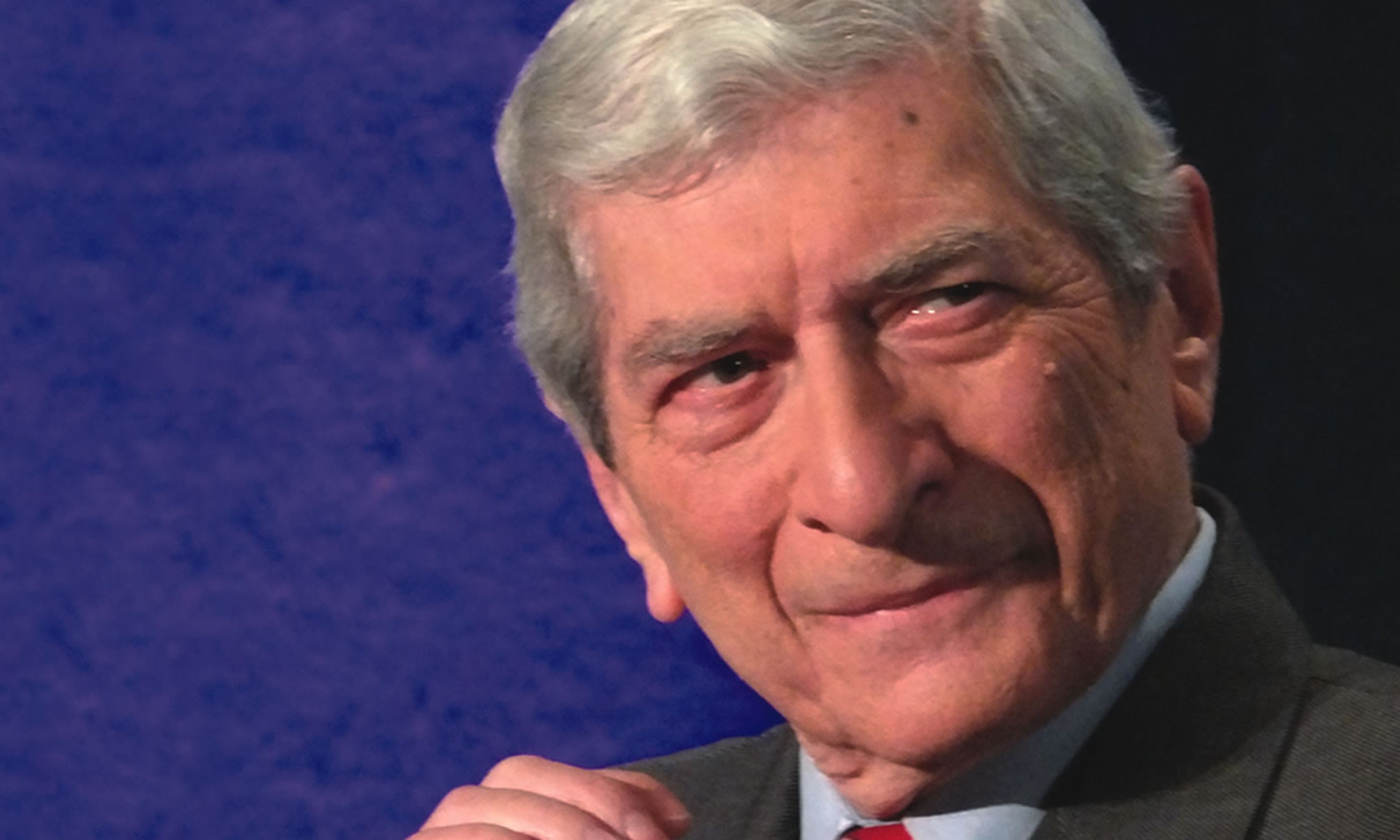
The voice and face are perfectly familiar, to someone who grew up with them. I am talking with Marvin Kalb, via Zoom. For 30 years, he was a reporter and analyst for CBS News and NBC News. In the mid 1980s, he was host of Meet the Press. Since 1994, he has hosted The Kalb Report, from the National Press Club.
He has also authored or co-authored many books — 17, in fact — including two novels. His very first book, published in 1958, was about his experiences in the Soviet Union. So is his new one: Assignment Russia: Becoming a Foreign Correspondent in the Crucible of the Cold War.
Though Kalb has reported from many parts of the world, Russia has been an abiding interest. It started in World War II, when he was a boy. He had a map in his room, and he moved pins around, to note where the armies were. When he came of age, the Cold War was heating up.
Marvin Kalb was born in 1930, in the Bronx, New York City. Later, the family lived in Washington Heights (Manhattan). Marvin’s mother, Bella, had emigrated from Kyiv in 1913; his father, Max, had emigrated from Zyrardov, a textile town in Poland, in 1914. He would have been conscripted into the czar’s army for World War I. Later, his parents — Marvin’s paternal grandparents — were killed in the Holocaust.
Max and Bella’s first child was Estelle; then came two boys, Bernard and Marvin, eight years apart. Both would make their names in journalism, primarily as foreign correspondents. They are very, very close. Marvin says that the Depression forged them. When you’re poor — when you have no money in the house whatsoever — you have to stick tight, to survive.
Bernie visited Marvin just a couple of days ago, and the brothers discussed the latest eruption of violence in the Middle East. At 99, says Marvin, Bernie is as clear as a bell. “He’s Bernie,” in short.
Marvin finds discussion of the Depression painful, but he’s willing to do it with me anyway. When he was a child, he would get up very early — at four or five o’clock — to go through garbage cans. If there was a milk bottle — intact — you could take it to a grocery store and get a penny for it. If you got five, that was enough for a subway ride.
Max Kalb was a tailor. He would ride the subway down to the Garment District and look for work. If he didn’t find any that day, how would he get home? His son Marvin has no idea. These memories are grim.
Most important to Max and Bella was the education of their children. CCNY — the City College of New York — was key. It was known as “the poor man’s Harvard,” as Marvin recalls. If you did well enough on tests to gain admission, tuition was free.
At CCNY, Marvin started out as pre-med, “to satisfy my mother.” Later it was pre-law, “to satisfy my father.” What satisfied Marvin, really, was history: European history and, above all, Russian history. Russia, or the Soviet Union, led by Stalin, was increasingly important in the world.
Marvin went from the poor man’s Harvard to the real Harvard for graduate work. (Bernie had followed the same track.) Marvin had two professors who were of particular importance to him: one senior and the other quite junior. The senior professor was Michael (Mikhail) Karpovich, born in Tbilisi in 1888. The junior was Richard Pipes, only seven years older than Marvin. He and his family had escaped Warsaw shortly after the Nazi invasion. Kalb and Pipes would be lifelong friends.
In the government department, there was a hotshot, just starting out: Henry A. Kissinger. In 1974, when he was secretary of state, the Kalb brothers wrote a biography of him. “We searched and searched for a title,” says Marvin, “and finally, in our desperation, settled on ‘Kissinger.’”
When Marvin was in graduate school, he got a call from Marshall Shulman, the well-known Russianist, who had written speeches for Dean Acheson. The State Department needed someone at the embassy in Moscow right away: a press aide, an attaché. The applicant had to speak Russian, be single, have a top-secret clearance, and be able to leave in a week. Marvin Kalb qualified on all fronts.
A top-secret clearance? Yes, he had it from serving in Army intelligence during the Korean War.
He leapt at the opportunity to go to Moscow for the State Department. He was there from January 1956 until February 1957.
On the Fourth of July, the ambassador, Charles “Chip” Bohlen, threw a party at Spaso House, i.e., the American ambassadorial residence. In attendance were Khrushchev and the entire Politburo. This was a sign that the Kremlin wanted better relations with Washington.
Bohlen tasked Kalb with looking after the defense minister, Georgy Zhukov. This struck Kalb as ridiculous — the imbalance of it. Kalb had come out of the Army a PFC (private first class); Zhukov was a marshal of the Soviet Union, and a hero of World War II. But Kalb relished the chance to talk with Zhukov. He peppered the marshal with questions about the war, which the marshal was pleased to answer.
He was also a drinker, Zhukov was. “He sucked down eight vodkas,” remembers Kalb. “I counted them.” After the eighth, Khrushchev called his defense minister and Kalb to him. Zhukov exclaimed, “I have finally found a young American who can drink like a Russian!” Kalb had been drinking only water, but Zhukov was none the wiser.
Khrushchev, 5′3′′, looked up at Kalb, 6′3′′, and said, “How tall are you?” Kalb answered — he has no idea how this popped into his head — “I am three centimeters shorter than Peter the Great.” Khrushchev laughed, and, as Kalb says, when a dictator laughs, everyone around him laughs, too. From then on, Khrushchev called him “Peter the Great.”
When he became a newsman, Kalb secured some good interviews with Khrushchev. The nickname — the height, the memory of the Fourth of July party — helped.
After his 13-month stint with the State Department, Kalb returned to Harvard, to complete his Ph.D. He promised his mother that he would finish it — nothing would distract him. But then came a phone call.
It was a Monday morning, and he was working in Widener Library. The day before, he had had an article published in the Sunday magazine of the New York Times — an article about Soviet youth. Kalb had been contributing steadily to Saturday Review, Gentlemen’s Quarterly, and other publications.
Anyway, a librarian came over and said, “Marvin, you have a phone call.” “Who is it?” asked Kalb. “Well,” said the lady, “he says he’s Edward R. Murrow.” Kalb guffawed. Murrow was a living legend, the heart and soul of CBS News. There was no way he’d be calling this grad student. “Just hang up on the guy,” Kalb suggested.
That afternoon, the librarian once more approached Kalb. “It’s the same man again,” she said. “Why don’t you at least talk to him?” Kalb agreed. And lo . . .
Murrow had read the article on Soviet youth. He wanted to talk about it — which they did, the next morning, in Murrow’s office in New York. They talked for three hours. At the end of this session, Murrow asked Kalb to come work at CBS. Kalb agreed with alacrity. The “Murrow mystique” was real and powerful, everyone from that period testifies. Even Mrs. Kalb approved.
In the years they knew each other — Murrow died in 1965 — Murrow and Kalb had a nice habit. The older man called the younger man “professor”; the younger called the older “sir.”
Kalb wrote his first book in 1958, while he was still a relative cub at CBS News. That book was Eastern Exposure, about his State Department stint. His publisher, Roger Straus, of Farrar, Straus and Giroux, threw a dinner party for him and his wife, Madeleine Green Kalb (a Russia scholar herself). Here is a slice of the new memoir — the 2021 memoir — Assignment Russia:
Roger had invited a number of his favorite writers, all somehow connected to Russia, but I remember only Max Eastman, the handsome and once-radical writer, poet, and translator whose reputation had ranged unashamedly from bedroom exploits to literary and political adventures. He had once been a socialist, editor of The Masses, but now shifted his loyalties to a respectable conservatism, writing mostly for William F. Buckley’s National Review. He seemed to have little respect for major magazines and newspapers, referring to them dismissively as the “money-making press.” In conversation around the dinner table, he casually dropped names such as Einstein and Chaplin. If he was trying to impress me, he succeeded.
Kalb got to Moscow — back to Moscow — in 1960 as CBS correspondent, fulfilling a dream.
How about the current occupant of the Kremlin, in power since 2000? “Vladimir Putin is a nationalist leader,” Kalb says to me, “who knows full well that the nation he leads is in trouble — not militarily but economically.” Kalb remembers Sergey Semionovich Uvarov, the 19th-century nationalist who served Nicholas the First. Uvarov was the subject of Kalb’s doctoral dissertation. And it was Uvarov who articulated the doctrine of “Orthodoxy, Autocracy, and Nationality.” Putin lives by that formula today, says Kalb.
“He is tough, determined, and very smart. He plays angles. He is vicious.” But “he is playing a losing hand, and he knows it.”
In his new book, Kalb talks about the importance of a free press to democracy, and he talks about it with me as well. He once asked Murrow, “What is your definition of freedom?” Murrow spoke of two pillars, or a two-part foundation, holding up a house — a house of freedom. The two parts are a system of law, or the rule of law, if you like, and a free press. When one of those is weakened, the house wobbles, if it doesn’t fall altogether.
Before his Q&A with me, Marvin Kalb did a Q&A with his daughter Deborah. “There’s one point I would like people to bear in mind,” he said. “This book was my way of saying thank you to the United States for welcoming my mother and father in the years before World War I.” Nothing came easily, true — “but they were given the opportunity for economic advancement, and religious and political freedom.” This is a continuing marvel, never to be taken for granted.











Comments