Oslo, Norway
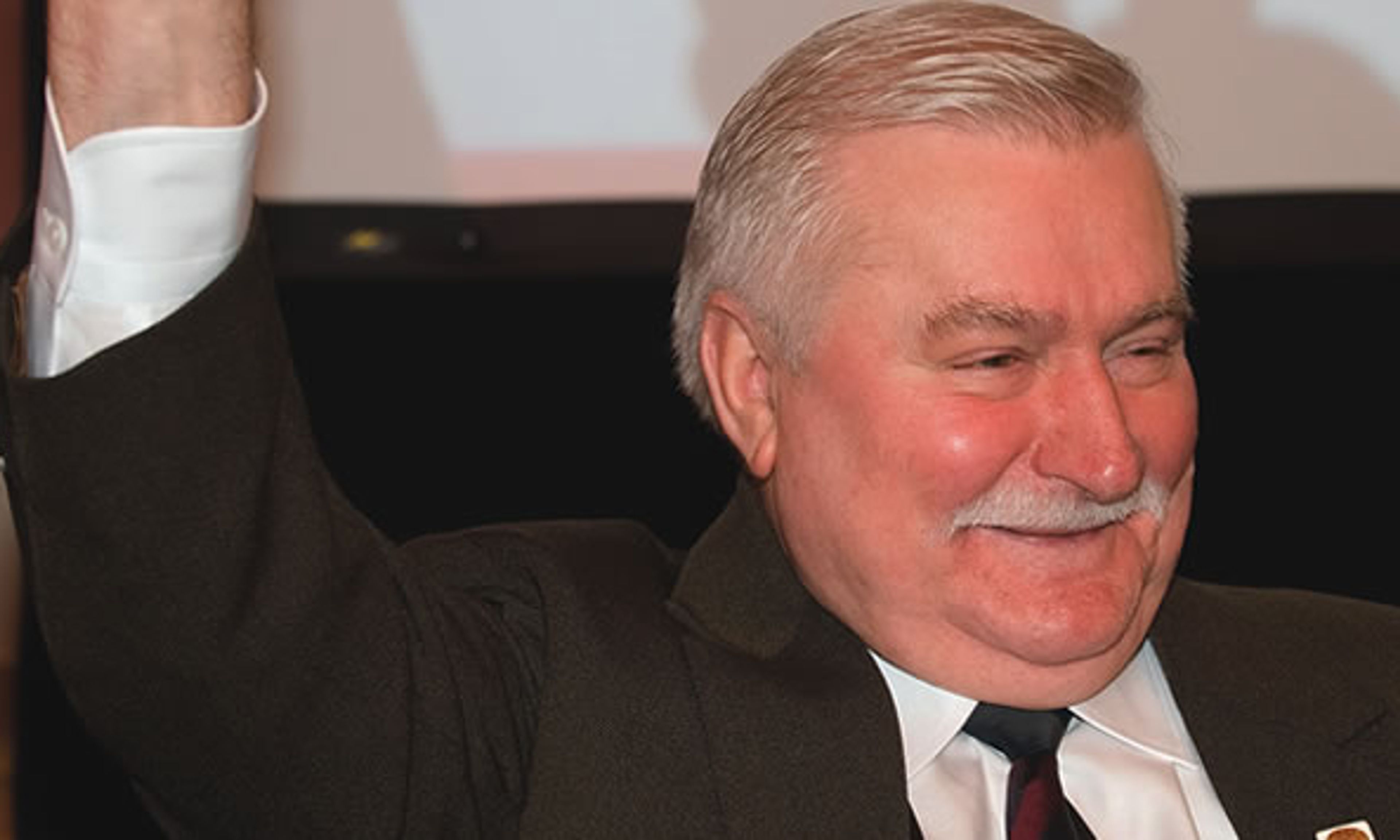
Lech Walesa sits in the Grand Hotel, here in the Norwegian capital: This is the hotel in which Nobel peace laureates traditionally stay, when they pick up their prize. But Walesa did not stay here. He did not come to Oslo at all when he won in 1983.
There were a couple of reasons for this. First, he did not want to come to this swank Western capital and “sip champagne” while many of his fellow democrats were in jail and hungry. And second: The Communist government might have prevented him from returning to Poland. As he puts it to me, “They could have made me an exile. The Communists could have said, ‘They love you so dearly in the West, they have given you the Nobel peace prize, why don’t you stay with them there, forever?’” And he wanted to continue to lead the struggle against the Communists.
In the long history of the prize — which began in 1901 — only a handful of winners have not come to Oslo to collect their medal and diploma, and give their lecture. The significant ones are these: Carl von Ossietzky in 1936 (he was a political prisoner of the Nazis); Andrei Sakharov, the Soviet dissident, in 1975; Walesa; and Aung San Suu Kyi, the Burmese democracy leader, in 1991. Even in the depths of apartheid, the South African laureates were able to come.
Walesa sent his wife, Danuta, in his stead. She took with her their eldest son, Bogdan. As Walesa says, “What were they [the Communists] going to do about that? It would have been a little bit difficult to act against this mother of so many children”: seven at the time. (There would later be an eighth.) On Presentation Day, December 10, Mrs. Walesa read her husband’s acceptance speech. In the evening, she and Bogdan stood on a balcony here at the Grand to watch the traditional torchlight parade go by. That parade included Norwegian trade unions, proud of 1983’s laureate.
I ask Walesa, “How did she do?” How had Mrs. Walesa performed? He shrugs humorously, saying, “Well, she did all right. She didn’t embarrass me.”
Walesa, as you know, was the leader of Solidarity, the trade-union movement in Poland. He was key in bringing down Polish Communism, and he symbolized the freedom struggle throughout the Soviet bloc. He was the first president of a free Poland: elected in 1990. But in 1983, things looked grim for him and his movement. Solidarity was banned. The government was waging a vicious propaganda campaign against him.
Honestly, he had hoped to win the Nobel prize in 1982, but the committee passed him by. (Winning were Alva Myrdal, the grande dame of Scandinavian socialism, and Alfonso García Robles, a Mexican diplomat. They won jointly for their disarmament efforts at the U.N.) On Oct. 5, 1983, the day the prize was announced, Walesa went into the woods with friends, to pick mushrooms. They listened for the news on a portable radio. It was his year.
As usual, President Reagan spoke well. He said that this was “a triumph of moral force over brute force,” and “a victory for those who seek to enlarge the human spirit over those who seek to crush it.” Also as usual, the new laureate’s countryman, Pope John Paul II, spoke well, saying that the committee’s decision had “special eloquence.” All over Poland, they rejoiced. For its part, the government, aggrieved, banned the playing of Norwegian or American music on the radio. No Grieg, no Copland!
Walesa is in Norway this year to take part in the Oslo Freedom Forum, a human-rights conference organized by Thor Halvorssen, that human-rights impresario. (He also runs the Human Rights Foundation in New York.) Walesa is an extra-special guest, the final speaker, almost the presiding spirit of the conference.
He is 66 years old, hale and hearty. He looks almost exactly like he did in his Solidarity days, with a full head of hair and that “walrus mustache.” The only difference is, those things are gray and white now. The Walesa charisma, I have read about and heard about, but now I experience it for myself. It is a powerful phenomenon. You have no trouble seeing why the workers chose him as their leader. Walesa is warm, expansive, funny, earthy — just what he’s supposed to be.
I tell him it is an honor to meet him (because it is). He says, “How do you know? Wait till you talk to me, it may not be an honor.” He then says that I ought to ask him tough questions, because “the tougher the questions, the better my answers.” And “if your questions are boring, I’ll fall asleep.” At one point, I say I will be quick about my work, because I know that he doesn’t have much time. He says, “Do I look unwell?” Do I think he’s about to kick the bucket? Walesa smiles broadly and chuckles. He loves to joke, and to have others joke back.
He explains what the Nobel prize meant to him, Solidarity, and the defeat of Communism. It meant everything, in a word. “There was no wind blowing into Poland’s sail. It’s hard to say what would have happened if I had not won the prize. The Nobel prize blew a strong wind into our sail. Without that prize, it would have been very difficult to continue struggling.” And, from a personal point of view, “it has made me immortal.” There’s that broad smile again. “The world could have forgotten a trade-union member,” a mere “organizer of strikes.” But “a Nobel-prize winner? That is something else.”
The struggle against Soviet Communism lasted as long as Soviet Communism itself: about 75 years. All those captive nations, all those dissident leaders, all those prisoners of conscience. The Nobel committee gave its prize to two persons in this general struggle: Sakharov and Walesa. It honored the anti-apartheid struggle in South Africa three times: in 1960 (when the prize went to Chief Lutuli, a great man); in 1984 (when it went to Bishop Tutu, later Archbishop Tutu); and, finally, in 1993 (when it went to Mandela and de Klerk, who were seeing apartheid out). The Nobel Peace Center here in Oslo now has a special exhibition honoring these South African laureates.
Another participant in the Oslo Freedom Forum is another great champion of freedom, Armando Valladares — for 22 years a guest in Cuba’s gulag. He remarks that, if the Cuban dictatorship were right-wing instead of left-wing, “we would have won two or three Nobel prizes already.” I think that is true. I also think that a Nobel prize to a Cuban dissident would have badly shaken the regime, if not toppled it. Even now it would go off like a bomb.
I ask Walesa what he thinks of the 1990 prize — which went to Mikhail Gorbachev. Chuckling, he says, “I think we can debate it.” He then says, “I’m certainly very fond of Gorbachev, and I respect him. But you should ask him the two questions I always ask him.” First, Walesa asks, “Did you betray Communism? Are you a traitor to Communist ideology?” Gorbachev says, “No, of course not.” Then Walesa says, “Okay. But you’re a bright guy. Did you really believe it was possible to reform Communism?” And that, says Walesa, “really pisses him off.” He “gets all red-faced and angry at me.” And he doesn’t answer.
Walesa says, “Gorbachev tried to reform the Communist system and failed. If he had succeeded, I’m the one who would have failed. So we were all very happy that he failed, and if they wanted to give him the Nobel prize for his failure? That was fine with us. He failed, he got the Nobel prize — everyone was happy.”
And we should also consider this, says Walesa: Gorbachev “had the instruments of rape, and he did not use them.” In other words, he had the brute power to suppress rebellion, as his predecessors had, and refrained from using it. “Every male has the instrument of rape,” continues Walesa. “Should we all be awarded Nobel prizes for not raping?” He then says, “I wonder how you’re going to phrase that for your article.” I say, “What’s to rephrase?”
Another speaker at this conference, Mart Laar, one of the first prime ministers of post-Communist Estonia, has already made a different point. Gorbachev, he noted, had his troops fire on unarmed people in Vilnius in January 1991, a mere month after he received the peace prize. That is not what you expect a peace laureate to do. (Arafat, maybe.) But, I reflect, only about 15 people were killed, and only about 600 were injured, and that’s nothing — practically kisses — from a Soviet leader.
And what, I ask Walesa, about the 2009 award, to Barack Obama? Walesa says, “The wise men of the committee gave the award to Obama for his potential merit, and to encourage him not to stray from a path of peace.” And then Walesa engages in some of his characteristic mischief: “Well, we could all get a Nobel prize for our potential merit — and in order to be encouraged. For example, every journalist could get the Nobel prize to be encouraged to write better.” How can I disagree with that?
Another question: Who, in Walesa’s view, might have won the peace prize, or should have, but did not? He wrinkles his brow, murmurs, and offers one name: Stanislau Shushkevich, the statesman in Belarus who was “a member,” says Walesa, “of that little group of people who dissolved the Soviet Union,” and who “continues to struggle for democracy,” against wretched odds. He ought to have won, and should win — but “the world’s not fair. Sometimes it is, but not always.”
It was fair in 1983, when this God-fearing, heroic Pole was drenched in Nobel glory.










Comments