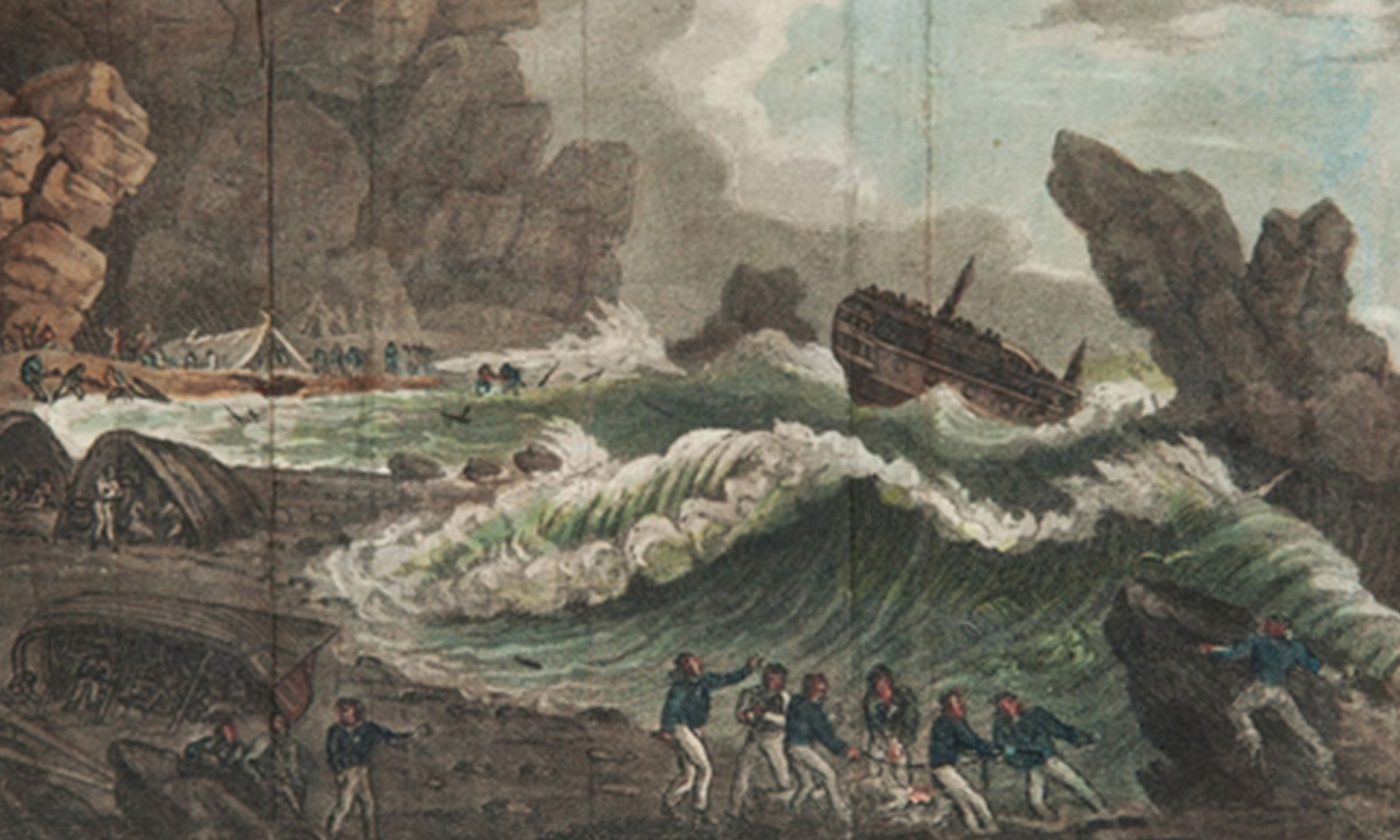
Truth may be stranger than fiction, as the cliché holds, because the most implausible stories stand up only with evidence to back them. But what happens when accounts differ? The result, as David Grann shows in The Wager, sometimes creates drama of its own. He takes as his subject a largely forgotten episode in the story of Commodore George Anson’s famous 18th-century circumnavigation of the world in which a British ship, after a brutal voyage around Cape Horn, foundered near an island off the Chilean coast. Some of the crew made it back through the Strait of Magellan to Brazil in a small boat and thence home, where they reported their ordeal. Their captain, presumed dead, returned later from captivity in Chile with his own story charging them with mutiny in wartime. Where did the truth lie?
Grann pursues an answer through what he calls “the archival debris” by piecing together a story of shipwreck and mutiny that ended in an inconclusive court-martial. He vividly re-creates the social dynamics in the “wooden world” of Georgian-era sailing. Two formidable personalities hold center stage. David Cheap, the indebted younger son of a Scottish gentleman who commanded the Wager, welcomed Anson’s expedition as a chance to make his fortune and recover a flagging career. John Bulkeley, the ship’s gunner and a man from humble beginnings who took pride in his hard-earned professional skill, came to doubt the captain’s judgment and commitment to the crew’s welfare. While Cheap and other officers held the king’s commission, the blunt-spoken gunner had only a warrant recognizing specialized expertise but granting less authority and status with lower rank and scant hope of advancement despite more than a decade’s service. Social hierarchy and the authority it conferred divided them as much as naval rank to make Bulkeley’s later challenge to his captain the more shocking.
The story began with plans for Anson to lead a British squadron of eight ships into the Pacific and seize a Spanish galleon bearing treasure to the Philippines. It was a gambit during an Anglo–Spanish war over colonial trade that opened in 1739 and merged into the War of the Austrian Succession (1740–48). Sir Francis Drake had shown Spain’s weakness centuries before during his own circumnavigation in 1577–80. Anson’s victory with a single ship over the larger Spanish Covadonga off the Philippines won treasure valued today at more than $80 million, but the triumph came at a steep cost even before the encounter. Only three of his ships had rejoined the squadron after rounding Cape Horn. Two of them later had to be abandoned. Storms had devastated the rest, forcing some to turn back. The Spanish force pursuing Anson itself lost two ships, one disappearing entirely with all hands. Severe weather presented dangers no less formidable than war.
Although the Wager made its passage around the Horn, it foundered from storm damage off an island on Chile’s remote southern coast. Sickness already had plagued the ship on the voyage across the South Atlantic. Originally a large merchant vessel built for long-distance trade with the East and West Indies, the ship had been purchased by the navy and reconstructed as a warship named for Sir Charles Wager. Early mishaps made the Wager seem a bad bet. It had two captains, both promoted to command other vessels, before Anson appointed Cheap to carry the ship through the fierce latitudes of its passage. The commodore gave his captains strict written instructions to stay with the squadron as best they could, but otherwise to meet at a rendezvous and wait 56 days. If Anson did not join by then, they were to continue the mission under the senior-most officer. Cheap stuck to his orders not only from duty, but because fulfilling them at any hazard would win his commander’s favor and with it the promotion he craved.
Grann shows in vivid detail the hazards of punishing seas and winds so fierce that sails had to be furled lest they blow away. The Wager’s mast splintered, but the crew set the rigging again. Scurvy, a disease caused by insufficient vitamins in preserved food, made it all worse. Cheap’s determination to round the Horn alarmed Bulkeley, who feared their course risked driving the ship onto a lee shore. In his private log, the gunner charted their course and conditions. The worst came to pass when, separated from the squadron, the Wager struck a rock and began sinking. The crew made it ashore on a remote island without food or shelter beyond what they salvaged.
Amid shipwreck, the crew fell apart as a community bound by duty under authority even as the ailing Cheap tried to keep order. He beat a defiant petty officer and shot another man who subsequently died. Incidents like these evoke the famous mutiny against William Bligh decades later. Bulkeley played an essential part in saving some goods and supplies from the wreck, and in building shelter and reconfiguring boats into a vessel to leave the island, but his criticism of the captain and officers grew. Where Cheap thought they should continue by making their way north to seize a Spanish ship by surprise, the gunner sought to turn back through the Strait of Magellan and find safety in Brazil. Either voyage involved staggering distance over rough waters. Bulkeley brought most of the crew to his side and presented the captain with a signed memorial demanding they return.
Cheap refused and stayed with two officers while the others made a perilous voyage under Bulkeley that carried few survivors to Brazil. After they reached England in January 1743 to report the Wager’s loss, he published an account of the voyage from his journal that sold widely. Bulkeley’s memoir of his experience as a gunner with no claim to gentility stood apart from the more common published accounts by officers recounting their voyages, but it had the smell of the sea along with a contemporary record to back its claims. His take set the terms of how the public and officials alike saw the story. Cheap was presumed dead. Anson’s triumphant return cast the Wager and its crew in the shade while bringing some kind of success to a stalemated war.
Islanders from Spanish Patagonia had rescued Cheap and his companions, and their journey by canoe to surrender in Chile had its own travails. He returned to England like Lazarus from the dead five years after his original departure, set on securing justice from a court-martial. Not only a venue to adjudicate crime, a trial before court-martial held officers to account for their command. Such a trial commonly followed shipwreck or capture and vindicated conduct as often as it held anyone liable. Cheap and his men thus stood trial before a court that absolved them all except a lieutenant who was given a reprimand. Proceedings closed, and the story faded from immediate view to avoid further embarrassment. Anson’s triumph kept the limelight it had earned.
Grann shows, however, that later accounts brought the Wager back into the public eye even as its captain and crew lived out their days. The midshipman John Byron, later an admiral and grandfather of the famous poet, published his own narrative in 1768 that captured the emerging spirit of romanticism. It also fed a demand for tales of the sea whether fact or fiction. The Wager inspired later writers, including Herman Melville and Patrick O’Brian, whose novel The Far Side of the World borrows parts of its story. Man’s struggle against nature — and against himself — has an enduring appeal that gives these episodes perennial interest. So does the question of whose account is true.












Comments