• It took much too long, but Arlen Specter has now been rejected by two parties.
• When Specter switched to the Democrats last year, after realizing he would lose a Republican primary, he made it clear that the chief principle to which he pledged fealty was that he should remain in the Senate. Pennsylvania Democrats had sufficient self-respect to reject his gambit. Now that Specter has lost the primary, conservative champion Pat Toomey will face off in the fall against Joe Sestak, an honorable liberal.
• Also in Pennsylvania, Democrats hung on to the House seat of the late Jack Murtha in a special election. Republicans had high hopes for the race, since the district is socially conservative and narrowly voted for McCain. The Democratic candidate, Murtha aide Mark Critz, aped his predecessor in running as a pro-life, pro-gun Democrat — and moved to his right by saying that he would have voted against Obamacare. He said, however, that he would not vote to repeal it. To take the House, Republicans will have to defeat such phony opponents of Obamacare (who are also, perforce, phony pro-lifers). To do that, the party as a whole will have to campaign on repeal. Then perhaps Republican Tim Burns will have a shot in the November rematch for the seat.
• Two sitting members of Congress, one in each party, lost their nominations. In Utah, conservatives angry about Sen. Robert Bennett’s support for the financial bailout and a health-care bill that made buying insurance compulsory placed him third in the Republican convention’s balloting. In West Virginia, Alan Mollohan lost a Democratic primary to a candidate who opposes abortion, gun control, and Obamacare. Bennett’s loss fueled a media story about conservatives’ growing intolerance. Mollohan’s loss furthered a narrative about the public’s hostility to incumbents. The truth is more prosaic. Utah is one of the most conservative states in the country, and its conservatives decided they would prefer a senator who reflects that fact. West Virginians tend to dislike government funding of abortion, and turned on Mollohan when he betrayed his commitment to vote against it. In many years politicians can afford to be a little to the left of their constituents, but 2010 is not one of them.
• Rand Paul, son of Ron, will be the Republican candidate for a Kentucky Senate seat. His victory is a black eye for Senate Republican leader Mitch McConnell, also of Kentucky, who wanted Trey Grayson to become the junior senator from his state. Paul won the nomination by playing down his libertarian foreign-policy views, highlighting his social conservatism, and running hard against the free-spending, Fed-empowering establishment. His libertarianism will make him a harder sell than Grayson would have been in November, but the populist-conservative national mood will probably put him over the top. The party should put hard feelings aside and give him whatever support he needs; we will stand by to provide criticism should it too prove necessary.
• Sen. John McCain of Arizona, facing a primary challenge from former congressman J. D. Hayworth, has been moving right, not always gracefully. His latest ad calls for building “the danged fence” on the Mexican border. Arizona conservatives should be glad that he has come around. McCain can be a pain in the neck — just look through our back issues from 2000 through 2003 to see what we mean. But he has had a pretty conservative record and is an important voice for the War on Terror and for spending control. (It was McCain, not Hayworth, who voted against Bush’s prescription-drug bill as a budget buster.) We hope that Arizona Republicans make sure that his voice will continue to be heard in D.C.
• If the Senate confirms Elena Kagan, the Supreme Court for the first time in history will have no Protestants (Roberts, Alito, Kennedy, Scalia, Sotomayor, and Thomas are Catholic; Kagan would join Jews Breyer and Ginsburg). Has the sun set on the Protestant empire? In many ways, it has been going down for decades. The mainline churches (Episcopalian, Presbyterian, Congregationalist) that once provided chaplains for the establishment have shot their bolt, and while evangelicals have grown in numbers and some forms of political clout, they lack status. Yet Protestantism has won despite losing: Stephen Breyer does not live in a shtetl, and Antonin Scalia is not Pius IX. Catholics and Jews (and Mormons and Buddhists) have the relation to state and society — devout, engaged, tolerant — that American Protestants and politicians developed over two centuries of trial and error. (P.S.: Will Muslims also be won over? The jury is out.)
• Too bad there isn’t a Cliff’s Notes version of the Arizona immigration law. Granted, it’s all of ten pages, about 1/200th the length of the health-care bill. But outspoken critics like Eric Holder and Janet Napolitano admit they didn’t peruse the law before condemning it, as if sitting down to read it were on par with undertaking Anna Karenina. Such critics have an a priori belief that the law is wrong and racist, no matter its actual content or legal merits, which Kris W. Kobach outlines elsewhere in this issue. According to the Associated Press, a State Department official even brought up the law in a human-rights meeting with the Chinese as an example of our own failings. In an interview with Fox News, State Department spokesman P. J. Crowley defended this outrageous self-abasement, while admitting that he, too, has not read the law.
The attempt to set off a car bomb in Times Square on May 1 was easily traced to Pakistan-born U.S. citizen Faisal Shahzad, who is now in federal custody. As investigations proceeded, three more men of Pakistani descent have been arrested. None is a citizen. Indeed, not one is lawfully resident in the U.S. Two have expired visas; the other was ordered deported in 2002 but has evaded that order. Shahzad’s immigration history has other questionable aspects. He did not properly qualify for either his original student visa or the subsequent H-1B (working) visa, and he married a U.S. citizen after visiting her just once. There was general agreement after 9/11 that our immigration and visa-monitoring systems needed radical overhaul — five of the 9/11 hijackers were visa overstayers. Plainly, too little has been done.
• Former New York City mayor Rudy Giuliani used to speak forcefully of radical Islam’s war against us. His successor, Michael Bloomberg, instead speculated that the Times Square car bomb might be the work of a disgruntled right-winger “that doesn’t like the health-care bill.” Asked in congressional testimony about the plot — and the happenstance that it came on the heels of the Fort Hood massacre and the attempted Christmas bombing, both carried out by jihadists — Attorney General Eric Holder could not bring himself to utter the words “radical Islam,” or any equivalent, insisting that “there are a variety of reasons why people do these things.” Around the same time, President Obama signed the Daniel Pearl Freedom of the Press Act while taking pains to avoid mentioning Pearl’s brutal murder by Muslim terrorists, catalyzed by a harrowing and longstanding interpretation of Islam. There are a variety of reasons people do things, including refusing to face the truth.
• Holder is now open to a congressional effort to expand Miranda’s “public safety” exception, which gives agents leeway, during an emergency, to interrogate a suspect without advising him of the rights to remain silent and enjoy the assistance of counsel. As Charles Krauthammer argues, this is a worthy idea, consistent with the rationale by which the Supreme Court created the exception in the 1984 Quarles case. Indeed, the Miranda Court itself denied creating a “constitutional straitjacket” and anticipated that its formula would be legislatively modified to deal with unforeseen circumstances. Yet one cannot help but observe, as Krauthammer does, that the Court has also reaffirmed the validity of detaining enemy combatants indefinitely during wartime. This enables interrogation for as long as it is fruitful, irrespective of Miranda and its exceptions. It is possible that confessions thereby derived will be inadmissible at trial, but the resultant intelligence may nonetheless save lives. That’s the benefit of seeing a war as a war, not a crime spree.
The Bigger They Are . . .
Imagine a giant hand reaching down, scooping up mobs of people in a single grasp. Some of the poor souls sticking out from the spaces between the fingers will, understandably, pound and scratch and bite against the massive fist.
Those are the tea partiers. And to whom does the massive hand belong? That’s Leviathan, of course.
Just for the record, properly speaking a leviathan is a giant sea creature. They appear in the King James Old Testament, in translation of a word that is the modern Hebrew for “whale.” In demonology, the Leviathan is one of the seven princes of Hell. But, according to the political philosopher Thomas Hobbes, the Leviathan is the absolute State (or, in his day, the King). Libertarian theorists, meanwhile, split the difference between the demonologists’ interpretation and the Hobbesian one; the Leviathan is Big Government.
In his moonlighting gig at the New York Times, National Review film critic Ross Douthat penned a very good column that brought the image of the Leviathan’s hand scooping up the tea partiers to my mind. Douthat argues that the crises at home and abroad are leading to “The Great Consolidation.” For all the populism and audit-the-Fed excitement these days, explained Douthat, what we are really witnessing is the elites’ successfully tightening the State’s grip on society. “From Washington to Athens, the economic crisis is producing consolidation rather than revolution, the entrenchment of authority rather than its diffusion, and the concentration of power in the hands of the same elite that presided over the disasters in the first place.”
Douthat’s diagnosis has merit. Disaster strikes, the public demands accountability, and then the elites who bungled things are replaced with new elites — often protégés of the old ones — who insist they need more power to make sure “this never happens again.” So the European Central Bank and the Federal Reserve get vastly expanded authority, and new agencies are created with oversight powers that will outlive the current crisis and sow the seeds of the next one. “This,” writes Douthat, “is the perverse logic of meritocracy. Once a system grows sufficiently complex, it doesn’t matter how badly our best and brightest foul things up. Every crisis increases their authority, because they seem to be the only ones who understand the system well enough to fix it.”
Though he doesn’t mention it, the process Douthat describes was most famously chronicled in the libertarian classic Crisis and Leviathan by Robert Higgs, in which Higgs described the “ratchet effect.” Because a crisis is a terrible thing to waste (cf. Rahm Emanuel), government expands power during trying times but never fully relinquishes it when the danger passes. Liberals call this the path of “progress.” Conservatives and libertarians have many names for it, including the road to serfdom.
The tea partiers, and their sympathizers, recognize what they see, which is why their rhetoric sometimes seems to overshoot the moment. They fear there’s no turning back on the road to serfdom.
But that’s not necessarily true. We are not talking about a cold, impersonal historical force in the spirit of Marx and Hegel. Higgs focused on government’s near-relentless expansion during the 20th century, but as economist Gary Anderson observes, the size and scope of government dramatically shrank in the decades after the Civil War and before the onset of the progressive revolution.
The logic of meritocracy may be perverse, but it is not inexorable. The current crisis, perhaps more than any preceding it, is a crisis of Big Government, and that offers us an opportunity to get out from under Leviathan’s thumb.
— JONAH GOLDBERG
• Sen. Joe Lieberman, with the support of two Republicans, including Sen. Scott Brown, has introduced a Terrorist Expatriation Act, which would strip American citizenship from anyone involved in a foreign terrorist organization. His purpose is to try perps such as Shahzad before military commissions, not in courts. But stripping citizenship for aiding terrorists sounds like a bill of attainder — convicting someone of a crime by legislative act, not trial — without the tedious formality of passing an individual piece of legislation. It is already illegal to give material aid to terrorists. Lieberman’s bill is needless, and intellectually sloppy.
• David Horowitz, fearless, goes where others are unwilling to go and gets answers that help clarify the modern world. The University of California, San Diego, was holding “Israel Apartheid Week.” Horowitz went to the campus to speak and to counter the dominant, suffocating anti-Israel propaganda. His speech was attended by a young woman from the university’s Muslim Students Association. In the Q&A, she confronted him. He confronted her back. He said, “I am a Jew. The head of Hezbollah has said that he hopes that we will gather in Israel so he doesn’t have to hunt us down globally. For it or against it?” The student said, “For it.” Horowitz said, “Thank you for coming and showing everybody what’s here.” Later, the student claimed she didn’t know what she was saying. Anyone can watch a video of the encounter, and read the ensuing statements, and decide for himself.
• Captured terrorists, the Left insists, should be given all the rights that the average American citizen would get in a criminal proceeding. Meanwhile, those cataloged as terrorists, often erroneously, on the government’s No Fly List are not entitled to their Second Amendment right to keep and bear arms — at least not according to the “No Fly, No Buy” legislation that’s currently before Congress. This is constitutional illiteracy. The Constitution does not mandate treating enemy detainees as civilian defendants, but does prevent the government from taking away citizens’ rights without due process of law, a requirement that the selection process for the No Fly List cannot possibly satisfy. The list’s false positives are legendary: Ted Kennedy, numerous children, a Marine returning from Iraq, and innocent people who share names with terrorists, for example. Fortunately, thanks to the pro-gun Blue Dog Democrats, this bill won’t fly.
• Credit Mahmoud Ahmadinejad with a cheeky sense of humor. Last year the Obama administration offered Iran a deal in which the regime would send a portion of its enriched uranium to a third country. The proposal was intended to deny Iran, at least temporarily, enough uranium for a “breakout capacity” to build a bomb. Iran rejected the deal and kept enriching uranium. Now Ahmadinejad has made a deal similar in form with Brazil and Turkey. Since Iran has more enriched uranium now, the deal has lost its original (minimal) merits: Iran can ship uranium out of the country while retaining enough to make a bomb. But the Iranians and their partners can claim that they have embraced the U.S. proposal. This is diplomatic defiance as mockery. The Obama administration immediately countered with an announcement that it had reached an agreement with Russia and China on U.N. sanctions that will be closer to enabling than crippling. Our Iran policy continues to be laughable, and Ahmadinejad is doing most of the laughing.
• “I can make a firm pledge,” Candidate Obama declared, that “no family making less than $250,000 a year will see any form of tax increase.” That promise has proved incompatible with the level of spending he prefers. With Greece-like deficits of 10 percent of GDP, the administration is beginning to realize that it could tax the rich at 100 percent and still not solve the nation’s long-term budget woes. Absent real entitlement reform, taxes on the middle class will have to rise. But it’s a long way down from Obama’s “firm pledge,” so White House budget director Peter Orszag is trying to soften the landing with a pillow of mushy words. The president’s pledge was a “stance” and remains something he “prefers,” but the president cannot say “no” to “this thing under $250,000” because he must “let the [newly formed Commission on Fiscal Responsibility] do its work,” Orszag recently said. On NRO, Jim Geraghty is fond of saying that all of Obama’s pledges come with expiration dates. Some of them start to smell rotten well before they expire.
• In the weeks before the House vote on Obamacare, Rep. Jerry Lewis (R., Calif.) wondered, reasonably enough, how much discretionary and administrative funding Congress was likely to appropriate to the bill’s complex of new entitlement and regulatory bureaucracies. The Congressional Budget Office has now answered his question. Fear not, gentle reader — it’s just another $115 billion or so. That brings the ten-year on-budget cost of the bill right up around the $1 trillion mark. Plus the costs of the front-loaded taxes and delayed benefits, the Medicare-cut duplicity, and the double-counting, of course.
• Justice Anthony Kennedy, writing for a 5–4 majority of the Supreme Court, disclosed that the Constitution contains more detailed instructions on the sentencing of minors than anyone had previously imagined. A Kennedy opinion from 2005 informed us that the Constitution, without saying so, forbids the imposition of the death penalty on juveniles. Now it turns out also to forbid giving juveniles who have committed offenses lesser than homicide life sentences without parole. Life sentences with the possibility of parole are still okay, for now. In the earlier case, Kennedy adduced the facts that 30 states do not impose the death penalty on minors and that the trend has been away from imposing it, as proof of an evolving “consensus” against it. Life without parole for juveniles in non-homicide cases presents a mirror image: It is allowed by 37 states, the District of Columbia, and the federal government, and both the treatment of juveniles and the handing out of parole have been getting tougher. Kennedy decided that such facts cannot be “determinative”; the Court must reach an “independent judgment.” Plus, a bunch of foreign countries reject the practice. Mark Tushnet, a liberal law professor, once mischievously suggested that judges decide cases on the basis of which result would best advance the cause of socialism. At least that would be a principle, which is more than Kennedy has.
• Sens. John Kerry and Joe Lieberman are forging ahead with a climate-change bill in the Senate, the analogue of a similar bill that passed the House last year. Like the House bill, Kerry-Lieberman would bribe a broad coalition of business interests, from industrial emitters to hedge funds that invest in green energy, in order to build support for devastating energy rationing that would raise utility rates and the price at the pump. (That’s a feature, not a bug: “Electricity rates would necessarily skyrocket,” Candidate Obama said of his preferred energy plan, because the point is to get you to use less energy.) A long list of businesses — including GE, Alcoa, and DuPont — have already signed on in support of cap-and-trade, but just in case that support starts to wane, Obama’s EPA stands ready to impose its own regulations on greenhouse-gas emissions, without any of the corporate subsidies found in the legislation. For the business community, it’s the old good-cop/bad-cop routine. For energy consumers, it’s all bad cop.
• The oil spill in the Gulf of Mexico threatens to do as much damage to U.S. energy policy as it has to the environment. Liberals have already made the spill the new Exhibit A in their case against fossil fuels. In evaluating their claims, we should be mindful of the economic and environmental costs of the spill relative to those associated with their preferred alternatives. Even if the economic damages exceed the $3.8 billion that it cost to clean up the Exxon Valdez, that would still be a far cry from the $161 billion annual hit to GDP that, according to the Heritage Foundation, would result from enactment of cap-and-trade legislation. Will the environmental damages outweigh the thousands of birds killed in wind turbines each year? Possibly. How about the slashing and burning of thousands of acres of rain forest that come as a result of ethanol subsidies? We doubt it. “Drill, baby, drill,” may have lost whatever usefulness it had as a slogan, but offshore drilling remains a crucial source of energy — and clearing obstacles to future exploration is still part of the right policy mix.
• Pennsylvania State University climatologist Michael Mann has engaged in some questionable antics, the fact that a university panel recently absolved him of all wrongdoing notwithstanding. Mann constructed his famous “hockey stick” graph — which depicted global temperatures as relatively static until the start of the 20th century, and skyrocketing thereafter — by leaving out a period of medieval warming. In an e-mail leaked during the Climategate scandal, fellow climatologist Phil Jones mentioned borrowing a “trick” Mann had used to “hide the decline” in global temperatures that tree-ring data suggest. These shenanigans, however, are not a matter that any government needs to resolve, and Virginia attorney general Ken Cuccinelli is wrong in wanting to turn them into one. Cuccinelli has filed a civil investigative demand (a subpoena, more or less) demanding documents — including all of Mann’s e-mails to, from, or mentioning about 40 other scientists — pertaining to a half-million dollars’ worth of awards and grants Mann received from the state (he was a University of Virginia assistant professor from 1999 to 2005). If Cuccinelli finds anything he considers evidence of fraud, he could sue for the money back. We sympathize with Cuccinelli’s desire for transparency in the wake of Climategate, and even with his irritation that his state funded Mann. But if states sued every academic whose data and political biases coincided to a suspicious degree, they would have little time for anything else.
• Conservative David Cameron and Liberal Democrat Nick Clegg both lost the recent British election and found themselves in the same dire straits. Either they would get into government or their parties would get rid of them. So they joined forces in a Con-Lib-Dem coalition government and have thereby gained an indefinite lease of political life, maybe for as long as five years. What the Lib-Dems have surrendered to make that deal consists almost entirely of empty dreams such as entering the shaky Eurozone. The Tories, for their part, have agreed to a referendum on electoral reform that could make them a minority party indefinitely and unravel the British constitution. A bad bargain, as John O’Sullivan explains in greater detail on page 36. Some Tories whistle hopefully that the coalition has at least compelled the Lib-Dems to tackle the deficit. But the markets would have done that anyway. And there is already talk of reducing the deficit by, inter alia, doubling the capital-gains tax. The Tories, as the senior partner in the coalition, will inevitably take most of the blame for unpopular deficit-cutting measures. Will all the Lib-Dems, many of them viscerally anti-Tory, remain supportive if they begin to lose safe seats in special elections on the issue of “Tory cuts”? Will Tories think it wise to stick with their junior partner if their safe seats begin to be plausibly threatened by right-wing protest parties? No, it doesn’t seem a very good bargain — except for Prime Minister Cameron and Deputy Prime Minister Clegg.
• The countries of the Eurozone, and of the International Monetary Fund (among others, us), have come to the rescue of Greece with a proposal to give it 40 billion euros (10 billion of them from the IMF) by year’s end. This is to tide Greece over its coming austerity, imposed to correct years of overspending. Even so, unemployment in Greece is projected to hit almost 15 percent by 2012, and may go as high as 20 percent. A few general strikes and Greece could simply renege. If the nation defaults, panic could sweep away the other heavy debtors in the Eurozone — Portugal next, with Spain and Italy not far behind. Or they may topple anyway. There would be more barriers to a general collapse if there were no euro in the first place, forcing soft economies to bear the load of a currency that is the ghost of the deutschmark. The larger problem is that no advanced economy is in very good shape these days, including that of the United States. How long can debtors prop up deadbeats?
• Lars Vilks is a bespectacled and slightly disheveled 53-year-old Swede who has gotten himself on front pages by publishing in a local newspaper a cartoon of a dog with the head of the Prophet Mohammed. Al-Qaeda has been offering $100,000 to anyone who kills Vilks. One among several plots to murder him involves Colleen LaRose, the American woman who dubs herself “Jihad Jane.” Vilks continues to run his all-out campaign for free speech regardless. In a recent lecture at Uppsala University, he showed scenes from a film with the title “Allah-o-gaybar,” featuring two half-naked men wearing Mo-masks. Of course some Muslims in the audience were there only to be offended, and a number duly rushed Vilks. The police wrestled them down, but one got through, though he did no real harm beyond breaking Vilks’s spectacles. A few days later, an attempt to set Vilks’s house on fire failed, and two young men, Muslims from Kosovo, were quickly identified as culprits and arrested for arson. Vilks is hoping to receive another invitation to lecture at the university. “I’m not really more afraid than what I think is realistic,” he says. He is no Leonardo da Vinci, but at least he is standing for freedom.
• Pres. George W. Bush decided to keep the U.S. separate from the U.N. Human Rights Council, because that body was hopelessly filled with the worst human-rights violators, including Cuba, China, and Saudi Arabia. When he became president, Barack Obama had the U.S. join the council and pick up 22 percent of the tab. Now, Libya has been elected, with 155 countries, or 80 percent of the U.N., voting for its membership. Other beauties recently elected include Angola and Malaysia. It is only an accident that Iran does not currently serve. (Instead, it graces the U.N.’s special panel on women’s rights — of course.) As U.N. expert Anne Bayefsky pointed out, the number of free countries on the council now stands below 50 percent. Our ambassador, Susan Rice, refused to say which states the U.S. supported for the council. She said she regretted the election of some, but “I’m not going to sit here and name names. I don’t think it’s particularly constructive at this point.” Neither is the U.N. Human Rights Council. Or the U.N.
• A British army sniper, Cpl. Craig Harrison of the Household Cavalry, shot dead two Taliban machine-gunners who had opened fire on an Afghan national army patrol in Helmand Province last November. Then with a third shot he disabled their machine gun. This wasn’t just good shooting, it was sensationally superb shooting. A GPS system measured the range at 2,707 yards, a new record for a sniper kill. Harrison was using an L115A3 specialty rifle made by a British firm, Accuracy International, firing an 8.59 mm round at a muzzle velocity of 3,000 feet per second. “The Boers knocked us silly at a mile,” reminisced Kipling’s old soldier (in the poem “Fuzzy Wuzzy”). Corporal Harrison knocked a couple of the enemy stone dead at a mile and a half. The politics of any particular war are a proper subject for debate; but there is surely no one who does not want his nation’s soldiers to exhibit the highest levels of skill and training under the orders they have been given. Britain can be proud of Corporal Harrison.
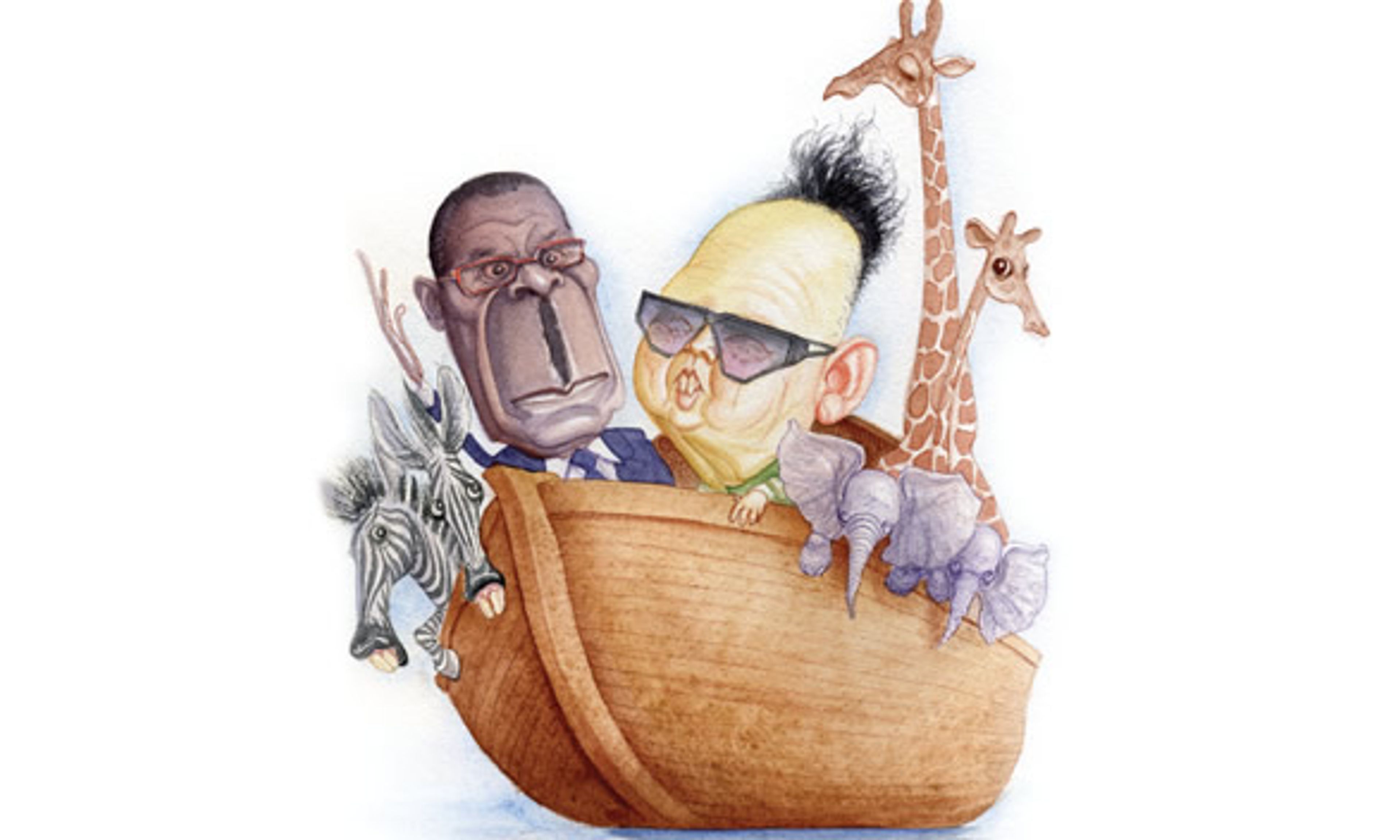
• What do you give to the Dear Leader who has everything? More specifically, what does the President-for-Life of a failed African state give to the P-f-L of a failed Asian state in gratitude for having trained a goon squad to slaughter 20,000 civilians in two restless provinces? If you are Robert Mugabe of Zimbabwe making a thank-you gift to Kim Jong Il of North Korea, the answer is: a Noah’s Ark of paired elephants, giraffes, zebras, and warthogs. Conservationists are complaining, and a few of the animals died en route, but for the survivors it’s probably a good deal: Poaching has been rampant in Zimbabwe since Mugabe’s “land reform” reduced much of the population to near-starvation. North Korea has food shortages too, but Kim’s secret police are vigilant enough that the Pyongyang presidential zoo is in little danger of a raid by hungry citizens in search of warthog cutlets.
• In May 1960, the Food and Drug Administration approved the Pill. That we all know which pill shows how famous the Pill became. It made contraception medical, displacing all those sheaths and caps. It extended women’s power over sex and reproduction, and thus over their working life, if they chose such a life. It allowed women to make pregnancy-free sex a matter of routine, and men not to think about pregnancy at all. Not that the Pill was unprecedented, or unique. Contraceptives had existed for centuries (see The Story of My Life, Casanova). American family size had been declining since colonial days; Pearl Harbor boosted women into the workforce years before the Pill. Nor did the Pill inaugurate the Sixties all by itself. (“Sexual intercourse,” wrote Philip Larkin, “began in 1963 / . . . Between the end of the Chatterley ban / And the Beatles’ first LP.” He did not mention the Pill.) Technology is always what we make of it. The Pill changed everything — but not entirely. It was an enabler of preexisting trends, for those who willed the trends; a symbol, a marker.
• WEEKLY NEWSMAGAZINE, NEEDS TLC, NAME YOUR PRICE! (George Will available for xtra) Newsweek, owned by the Washington Post Company since 1961, has gone on the block. Editor Jon Meacham, appearing on The Daily Show at the time of the announcement, defended his magazine as “one of the very few common denominators in a fragmented world.” But Newsweek is no such thing, which is one reason for its travails. Newsweek decided two years ago to cut out news almost entirely and become a weekly reader of thumbsuckers. Almost all of these were liberal (Jonathan Alter, Eleanor Clift). Journals of opinion, as we know well, have a circulation ceiling, to which the new Newsweek is plummeting. Before their fall, they were falling more slowly, the weekly print news summary being the most retro of all mainstream-media offerings. Whether Newsweek is as indispensable as Meacham apparently thinks we may soon find out.
• Uwe Mitzscherlich, 39, of Possendorf in eastern Germany, has married his cat.
• Five students at Live Oak High School, in Morgan Hill, Calif., were recently sent home for wearing clothing with images of American flags. The reason: It was Cinco de Mayo — a holiday that, like St. Patrick’s Day, is observed much more enthusiastically in foreign lands than in the country it celebrates. Live Oak’s principal explained that Mexican-American students were marking the occasion by wearing Mexico’s flag and colors, and he feared that fights might break out if the Old Glory–sporting students (one of whom was Mexican-American) were allowed to enter the school. If that’s true, then the principal banned the wrong flag.
• This spring, the girls’ basketball team at Highland Park (Ill.) High School won its first conference championship in 26 years. That success yielded an invitation to a prestigious interscholastic tournament in December. Excited team members have been busily selling cookies and holding fund raisers to defray their expenses, but now an assistant superintendent has told them the trip is off — because the tournament will be held in Arizona. A case of using educational policy for political ends? Not at all, the school-board president explained; it’s a safety measure. You see, if the team happened to include an illegal alien, and if she were stopped by Arizona police for lawful reasons, and if the police then found additional cause to suspect her legal status and asked for identification, she could end up in jail. In recent years, the school has also sponsored trips to China and Peru, where no such dangers exist.
• This year’s Miss USA contest, not having Carrie Prejean to kick around anymore, decided to spike interest by photographing its 51 competitors in lingerie and high heels. Compared with what’s out there, these shots look like Carry Nation in a union suit. But a bridge, however tiny, was crossed. The difference between what was not shown, and what might have been implied, used to generate a little spark. Once one implies openly, however tamely, the spark flicks out. Suppose, to take an example from a Hollywood classic, that in the famous bedroom scene of It Happened One Night, Claudette Colbert had unbuttoned her pajama top . . . Allure in art, even popular art like beauty contests, is not replaced by more allure, but by transaction.
• “I wanted to play baseball in the worst way,” Ernie Harwell once quipped. “And that’s the way I did play it.” There was nothing shameful in this admission. Except for Gehrig, Greenberg, Griffey, and a lucky few others, every American man is a failed baseball player. Yet Harwell became a spectacular success. As the radio voice of the Detroit Tigers for more than 40 years, he belonged to that generation of broadcasters who formed enduring bonds with their listeners. The names of the players might change from summer to summer, but Harwell was a rock-steady presence, a comforting reminder of continuity. His voice, with its nasal tone and hint of a Georgia twang, imprinted itself on a legion of fans who tuned in from their backyards, backseats, and backwoods. So did his personal example, which exhibited a deep faith to the very end. On May 4, at the age of 92, he fell silent — “long gone” (to borrow his famous home-run call with the drawn-out adjective), but not forgotten. R.I.P.
Resolve and Repeal
Out on the hustings, opposition to Obamacare appears to be a winning cause. But House Republicans are not yet doing enough to capitalize on the discontent in order to elect Republicans to office and, more important, raise the likelihood of an eventual repeal. The House Republican leadership ought to get behind a simple, one-sentence bill to repeal Obamacare — now.
Promoting such a bill would accomplish three goals. First, it would demonstrate that the Republicans meant what they said about Obamacare. If they truly believe, as we do, that it is a threat to limited, constitutional government, to free markets, and to American health care, then they are duty-bound to work toward its repeal; and it would be wise for them to let tea partiers and others skeptical about their steadfastness know that they accept that duty.
Second, a Republican campaign for this bill would force some House Democrats to co-sponsor it. Republicans would be able to divide House Democrats who voted No on Obamacare into two groups: the phony opponents, whom Speaker Nancy Pelosi allowed to vote No because she did not need them, and the true opponents. House Democrats who choose to co-sponsor the repeal legislation will advance the cause of repeal; the coalition against Obamacare will remain, as it has been, bipartisan. House Democrats who choose not to co-sponsor the repeal bill will make it easier for Republicans to take their seats.
Third, the campaign would help lift morale among opponents of Obamacare. If House Republicans, who unanimously opposed Obamacare, all co-sponsored a repeal bill — and put pressure on the Democrats who voted against the new law to join them — the repealers would quickly be within striking distance of a majority. That would both make it hard to dismiss repeal as quixotic and strengthen the case for electing Republicans in House races.
We understand that House Republicans are divided among several repeal bills, and that some House Republicans believe legislation should replace as well as repeal Obamacare. In our judgment, replacing Obamacare with workable conservative reforms should remain part of the conservative platform without being part of this year’s repeal legislation. All House Republicans have already gone on record supporting various health-care reforms, so the charge that they have no alternatives to Obamacare should not sting.
At this moment, the principal problem in American health care, and the principal obstacle to all conservative reforms to it, is the looming menace of Obamacare. House Republican leaders ought to build unity in their conference behind a repeal resolution, and then take the fight to the Democrats.
Ask, Tell, Don’t Defer
When Ayn Rand was told she was outside the mainstream of American thought, she replied that this purported mainstream was in reality “a stagnant swamp.” We have much the same reaction when told that Elena Kagan, the solicitor general and President Obama’s nominee to the Supreme Court, is in the mainstream of the contemporary legal culture and therefore deserves confirmation. The mainstream of the legal academy, in particular, is at best indifferent to the Constitution as originally understood and to its limits on judicial power. It is well to the left of American opinion more generally. And these features of our legal culture are why the old practice of deferring to presidents’ judicial nominees can no longer be followed.
There can be no doubt that Kagan was within the academic mainstream when, as dean of Harvard Law School, she protested against what she called “the military’s policy” on homosexuality by limiting its recruiters’ access to campus. She was within the mainstream as well when demanding in court that Congress keep sending Defense Department dollars to Harvard while it discriminated against the military. When the Supreme Court ruled unanimously that universities have to comply with congressional restrictions to receive federal funds, she was again in the academic mainstream in abandoning her principle. Standing up for justice at the expense of the military is one thing, at the expense of academics quite another. Kagan was also willing to work for President Clinton, who signed the hated policy into law.
The justices of the Supreme Court now have immense power compared with that they exercised for most of our history, and the legal culture encourages them to use it to achieve progressive ends. Since confirmation of a Supreme Court nominee now amounts to handing over a huge share of policymaking authority for decades, deference to the president’s picks is no longer justified. Nor should conservative senators vote to confirm Kagan on the theory that we could have done worse under Obama. We can do better than that standard.
Senators should ask Kagan specific questions about how she intends to use the vast power the Court now has. They should vote for her confirmation only if they are prepared to acquiesce to her answers.











Comments