And now, the hard part begins.
Everything looks so easy out on the campaign trail. A presidential candidate can make grandiose promises, willy-nilly, to rapturous applause and worry about the consequences later. Back in June 2019, Joe Biden promised he would cure cancer. Compared with that, Donald Trump’s pledge to “get SALT back” — either raise or eliminate the cap on the federal tax deduction tied to payment of some state and local taxes — would be easy to keep.
Under current law, an “individual’s deduction of state and local income, general sales, and property taxes is limited to a combined total deduction of $10,000, $5,000 if married filing separately.” Trump was the one who signed that change into law in 2017. Plenty of taxpayers in blue states pay considerably more than $10,000 in state and local taxes combined. Raising the SALT cap is a high priority for Republican House members in blue states. GOP congressman Mike Lawler of New York told reporters during the first week of the new year, “I’ve been very clear from the start, I will not support a tax bill that does not lift the cap on SALT.”
On January 11, Trump met with Republican members of New York’s House delegation at his Mar-a-Lago resort in Florida. Lawler emerged from that meeting declaring that Trump is “fully on board with lifting the cap on SALT” and that he “reiterated his support for lifting the cap on SALT” and spoke to them “about the need to come up with a number and work through it and build consensus in the House.” Trump’s economic advisers are reportedly considering doubling the cap on the state and local tax deduction.
This is the sort of proposal that makes the folks at the Committee for a Responsible Federal Budget tear their hair out. Their calculations suggest that doubling the SALT deduction would reduce tax revenue over the next decade by $170 billion and exacerbate projected deficits. Lawler wants to go well beyond doubling the limit; he’d like to increase the SALT cap to $100,000 for single filers and $200,000 for married couples filing jointly. The CRFB calculates that such a change would reduce revenue by $920 billion over ten years. This is not exactly populism, and Republicans in red states can fairly ask why they’re being asked to agree to a proposal of which 94 percent of the benefit would accrue to households that make over $200,000 per year, disproportionately in high-tax blue states such as New York and California.
If the GOP had more than 219 seats in the House — Matt Gaetz of Florida resigned, and the special election to replace him won’t be held until April 1 — the Trump team and congressional leaders could tell the seven House Republicans in New York and the nine from California, “Tough luck.” But as Mike Johnson’s challenging climb to another term as speaker made clear, unifying House Republicans is indeed akin to herding cats. Enacting Trump’s agenda will require the assent of just about every House Republican.
The tax cuts for individuals — but not businesses — in Trump’s 2017 Tax Cuts and Jobs Act are set to expire at the end of 2025. The lower tax brackets, the doubled standard deduction, the $2,000 child tax credit, and the raised threshold for the estate tax all need to be extended. The CRFB calculates that “extending the expiring individual and estate tax provisions under the TCJA would reduce revenue by $3.9 trillion over the next decade.” The Congressional Budget Office projects a $1.9 trillion deficit — 6.5 percent of our gross domestic product — for the current fiscal year, similar to that of the previous year. Extending the Trump tax cuts would worsen the outlook for the deficit and the debt. We can all scoff at the hypocrisy of big-spending congressional Democrats who become born-again deficit hawks the moment they lose control of the appropriations process, but that doesn’t change the numbers.
As of this writing, the U.S. government has collected $1.08 trillion in fiscal year 2025, which sounds like a gargantuan sum but is $25 billion lower than it was at this time last year. The DOGE — the Department of Government Efficiency, the commission headed by Elon Musk — will no doubt make some recommendations for cutting spending, but it’s difficult to envision it recommending, and Trump and the GOP Congress enacting, cuts that would balance out that $3.9 trillion in lost revenue from extending the tax cuts. Besides, innumeracy reigns supreme in these arguments. During Trump’s first term, for example, White House press secretary Stephanie Grisham contended that canceling the White House’s and federal agencies’ subscriptions to the Washington Post and New York Times represented a significant cost-cutting measure. “Hundreds of thousands of taxpayer dollars will be saved,” she declared.
Then there’s immigration. Something resembling a new bipartisan consensus is forming on the issue that involves tougher and more consistent enforcement of federal laws. As of this writing, the outlook for passage and enactment of the Laken Riley Act looks good. The bill passed the House, 264–159, with 48 Democrats joining all Republicans, and it advanced to debate in the Senate by an 84–9 vote, overcoming the threat of a filibuster. This legislation would require U.S. Immigration and Customs Enforcement to issue detainers and take custody of illegal immigrants who commit burglary, theft, larceny, or shoplifting, as defined by state and local law. That’s the good news. The bad news is that soon ICE is going to get a lot of calls from local police departments who have picked up an illegal immigrant on suspicion of theft. ICE is going to need a lot more space for these people, pronto.
In 2024, Congress passed enough funding for ICE to manage 41,500 beds in its detention centers. In mid-December, Trump’s incoming “border czar,” Tom Homan, told CNN’s Kaitlan Collins he will need a minimum of 100,000 beds to detain undocumented immigrants. “We need Congress to give us money to get this done,” Homan said. “We need at least 100,000 beds. . . . But I’m not going to put a limit. I’m telling the minimum, we need 100,000 beds, because we got a big population to look for.” A Freedom of Information Act request filed in September by the ACLU found that “private prison corporations, as well as other corporate entities that provide services to build temporary facilities, monitor compliance, and staff facilities submitted proposals for expanded immigration detention in response to ICE’s contract requests” in California, Kansas, Nevada, New Mexico, Texas, and Washington State. Using private prisons would expand detention capacity, but Trump’s vision will require a sizable boost in spending on ICE resources and detention centers.
Then there’s the question of how the new Congress might pass all these reforms. To avoid a Democratic filibuster, Republicans can bring up legislation through reconciliation, provided that each provision is related to the federal budget. Debate on reconciliation bills is limited to 20 hours, and the bill can be passed by a simple majority.
Congressional Republicans have debated whether they should try to enact this sweeping agenda in one giant reconciliation bill or in two separate, half-as-gargantuan reconciliation bills. If they put it all in one bill, as Speaker Johnson prefers, there would be half as many occasions for something to go wrong or for the package to get torpedoed by a handful of intractable holdouts. But putting it all in one bill also means the process would take longer, perhaps not reaching the president’s desk until early summer. GOP Senate leader John Thune reportedly prefers moving first on a bill focused on defense, energy, and securing the southern border while putting off the more complex tax fight until later in the year, to generate quicker results and build momentum for the second half of the agenda.
A one-track reconciliation strategy would be a “very serious mistake” that “maximizes the chances of failure,” Senator Ted Cruz told National Review’s Audrey Fahlberg in January.
“Whether it’s one bill or two bills, it’s going to get done one way or the other,” Trump told reporters in mid-January, adding, “One bill, two bills, doesn’t matter to me. They’re going to work that out, but the end result is going to be the same.” At any rate, the forthcoming legislative behemoth will somewhat resemble the hideous big-spending omnibus bills that House Republicans often complain about; to get the parts of the bill that a member of Congress likes, he must acquiesce to the whole thing, including parts he may well find wasteful or bad policy.
It makes sense for a leader to keep his options open. A president has imperfect influence over the legislative process in Congress. Compromises and trade-offs are just about inevitable. But Trump doesn’t like to get into the weeds of policy. He famously lamented one month into his first term, “It’s an unbelievably complex subject. Nobody knew health care could be so complicated.” Congressional Republicans face a slew of big questions, and at some point, likely sooner rather than later, they’ll need a bit of guidance and direction from the president. Trump has at least as much influence over members of his party in Congress as any other Republican president has had in the modern era.
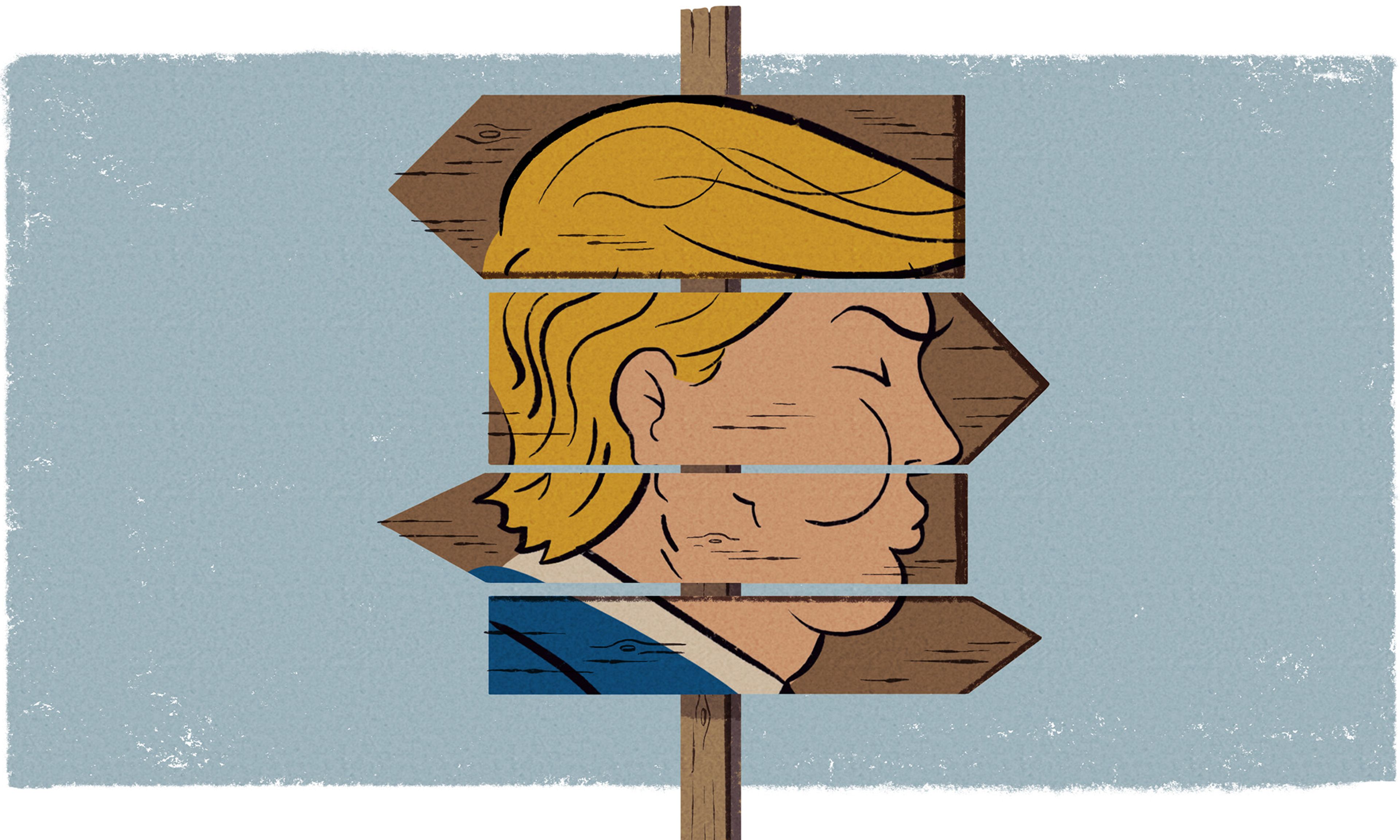
One bill or two? How high should the cap on state and local tax deductions be? How big a deficit is Trump willing to accept in his first year in office? How much expanded capacity does ICE need in its detention centers? To use a phrase associated with another two-term Republican president who had difficult fights with Congress, the time for choosing is approaching quickly.












Comments