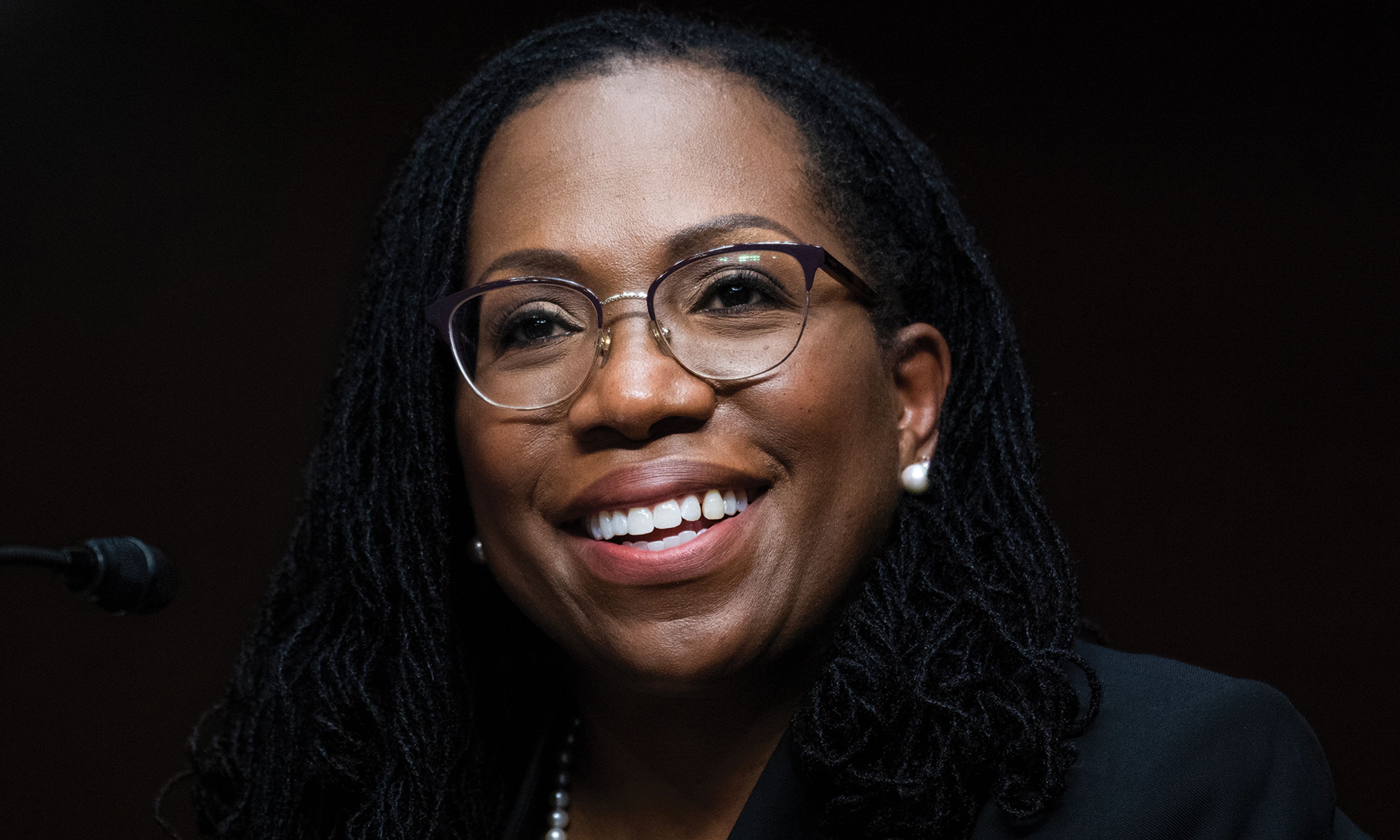
Few presidential decisions can influence the future direction of the country more than a Supreme Court nomination. After years of his handling other people’s nominations in the Senate Judiciary Committee, where he served as the senior Democrat for 17 years and chaired the hearings on Robert Bork, Clarence Thomas, Ruth Bader Ginsburg, and Stephen Breyer, one would expect Joe Biden to treasure the opportunity after Breyer announced his retirement.
Biden may get only one appointment. Clarence Thomas, the oldest member of the Court after Breyer, is 73, six years younger than Biden. Neither Thomas nor Samuel Alito, the two justices over age 70, would voluntarily retire with Biden in the White House. Add in Biden’s low approval ratings and the odds of a Republican-controlled Senate in 2023–24, and this could easily be Biden’s only shot.
Yet Biden tied his own hands. He preemptively announced, ahead of the crucial South Carolina primary in 2020, that his first nominee would be an African-American woman. This immediately took 97 percent of his potential choices off the table. Biden faced intense lobbying and picked the candidate favored by progressives: Judge Ketanji Brown Jackson.
Jackson, 51, grew up in Miami and graduated from Harvard College and Harvard Law School. She was a law clerk for Breyer; like Brett Kavanaugh, she was nominated to replace the justice for whom she clerked. As a working mother, she bounced around in practice and served on the U.S. Sentencing Commission before being appointed to the bench. In private practice, she wrote a brief defending a law against abortion-clinic protests, and defended Guantanamo detainees. Much is made of her being the first federal public defender nominated to a court that has no criminal-defense lawyers, but her two years of criminal work consisted of appeals, not trials.
She has, however, agitated since college for more-lenient sentencing of convicted criminals. It is for this, as much as anything, that she was the favored candidate of the same progressive activists who routinely criticized Biden’s record in the Senate as that of a drug warrior and an author of tough-on-crime bills.
Jackson spent a decade as a federal district judge and was elevated to the D.C. Circuit last year. She has written just two published opinions as an appeals judge, both released in February 2022.
Identity politics aside, Republicans will face two challenges in portraying Jackson as a wild-eyed radical. The first is her bubbly, all-American demeanor. Much like Amy Coney Barrett, she comes across like any ordinary professional working mom you might find at the local PTA. Americans know the faces of smug liberalism, perpetually outraged campus radicalism, and resentful street protest, and Jackson fits none of those molds.
At her introductory press conference, Jackson sounded the sorts of notes one would expect from a Republican nominee. “I must begin . . . by thanking God for delivering me to this point in my professional journey,” she said. “My life has been blessed beyond measure, and I do know that one can only come this far by faith. Among my many blessings — and indeed, the very first — is the fact that I was born in this great country. The United States of America is the greatest beacon of hope and democracy the world has ever known.” She cited the service of her brother and two uncles as cops in Baltimore and Miami, one of them a police chief.
This is not the rhetoric one associates with the cultural Left. Jackson served on an advisory board of a religiously conservative Baptist school. But she also sat on Harvard’s Board of Overseers while it was racially discriminating against Asian applicants, a controversy that is coming before the Court in the fall.
The second challenge is Jackson’s judicial record. The bulk of her decisions have involved either administrative law, criminal cases, or employment law; she has had few occasions to write on hot-button issues. Most of her opinions are written in plodding, workmanlike prose that does not lend itself to sound bites.
At her circuit-court confirmation hearing last April, when asked by Ted Cruz whether she believed in a “living Constitution,” a well-known divide in constitutional law, Jackson responded by pleading her lack of experience with constitutional questions:
I have not had any cases that have required me to develop a view on constitutional interpretation of text in the way that the Supreme Court has to do and has to have thought about the tools of interpretation. I am aware that the Supreme Court, at least with respect to certain provisions of the Constitution that it already interpreted, has looked at history and is focused on the original meaning of the text, say, in the Second Amendment . . . context in the Heller case. I just have not had any opportunity to do that. I have worked with those kinds of materials when I was in private practice. . . .
I believe that the Constitution is an enduring document. . . . It has, . . . the Supreme Court has said, a fixed meaning, that we’re to look to the original words in the Constitution and . . . as lower-court judges . . . interpret provisions the way in which the Supreme Court does, and they look at the text and look at the original meaning. And so if I ever had one of those cases, that is how I would approach the task.
In a written clarification, she cautioned that, “as a sitting federal judge, I am bound by the methods of constitutional interpretation that the Supreme Court has adopted, and I have a duty not to opine on the Supreme Court’s chosen methodology or suggest that I would undertake to interpret the text of the Constitution in any manner other than as the Supreme Court has directed.” Thus, she gave herself wiggle room to take a different approach if she should be on the Supreme Court.
Still, it is remarkable that Biden chose a nominee who, less than a year ago, said that she lacked the experience with constitutional law to answer questions about the interpretation of the Constitution — especially given that she has published nothing in the intervening year that would remedy that deficiency. It is also remarkable that a former Breyer clerk would, under oath, give this level of lip service to acknowledging the Constitution as having a “fixed meaning” and looking at its original meaning.
The cases that brought Jackson to national notice were a handful of Trump-era controversies in which she was visibly less careful. Ruling in favor of a House committee seeking to compel testimony from former White House counsel Don McGahn, she offered overheated Resistance rhetoric: “The primary takeaway from the past 250 years of recorded American history is that Presidents are not kings. . . . This means that they do not have subjects, bound by loyalty or blood, whose destiny they are entitled to control. Rather, in this land of liberty, . . . current and former employees of the White House work for the People of the United States.” Heady stuff for a subpoena dispute on which the D.C. Circuit divided, multiple panels of its judges disagreed with her, and her actual ruling was limited to requiring McGahn only to appear, not to testify.
Suspicions that Jackson was either auditioning or carried away with anti-Trump animosity hang over other cases, such as one in which she tried to impose judicial review on a deportation policy even though the statute said it was left to the “sole and unreviewable discretion” of the secretary of homeland security. The D.C. Circuit, in an opinion by an Obama appointee, disagreed with Jackson, writing that “there could hardly be a more definitive expression of congressional intent to leave the decision about the scope of expedited removal, within statutory bounds, to the Secretary’s independent judgment.”
Jackson has regularly sided with unions. In another case, she wrote a massive, 119-page opinion siding with the AFL-CIO to block a Trump-administration rule making it easier to fire federal employees. Again, the D.C. Circuit reversed her, with another Obama appointee joining the conclusion that Jackson did not have jurisdiction to hear the case. On the other hand, Jackson did reject an effort by environmental groups to sue to stop Trump’s border wall. On the D.C. Circuit, she sided with the CDC eviction moratorium even after Biden admitted that he was reinstating it just to buy time, without legal authority. The Supreme Court disagreed.
If Jackson is confirmed, what kind of justice will she be? She would be just the fifth Democratic appointee in the past 54 years. With very few exceptions (such as Breyer and Elena Kagan’s voting to strike down part of Obamacare’s Medicaid expansion), each of them was a reliable lockstep-liberal vote, but their styles are different: Breyer cast himself as the judicial institutionalist, Ginsburg as the folk hero, Kagan as the strategist seeking conservative allies, Sonia Sotomayor as the firebrand dissenter.
Jackson’s lack of grounding in constitutional cases makes her a potential wild card. She seems unlikely to take either Breyer’s role in promoting a particular view of judging, or Kagan’s politically savvy efforts at cross-ideological bridge-building. Maybe it would be worthwhile for originalists such as Thomas and Barrett to try to persuade her to take the democratic legitimacy of originalism seriously. Or maybe, given her willingness to bend the law in Trump-era cases, the Court will have another Sotomayor, howling emotive dissents into the void.
Either way, given what he might like to accomplish, Ketanji Brown Jackson seems a poor use of what may be Biden’s one shot.












Comments