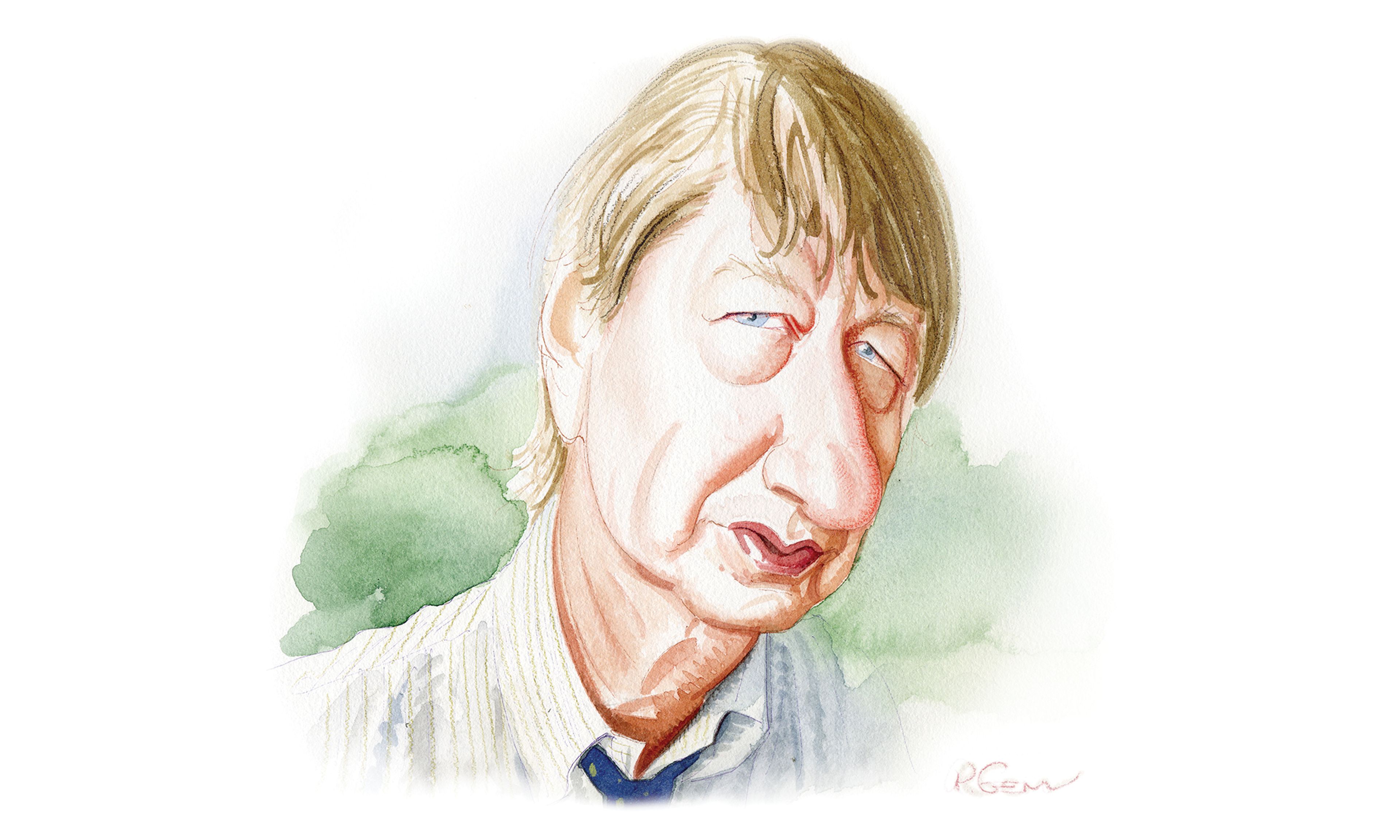
When I learned the sad news that P. J. O’Rourke — master storyteller, ideal drinking companion, brilliant observer of the darkly hilarious facts of life — had died of cancer in February, I did what people do these days when they lose someone they know. I went through my email archives to reread our last few messages to each other.
We had been talking, off and on, over the past few years about how his blockbuster book Holidays in Hell might be a television series. It would be set in various global hot spots, we decided, and feature the adventures of a recurring group of journalists.
“It’ll be challenging,” P.J. wrote, “but we really need to be as accurate as we can be.”
“What’s the hardest thing to capture about journalists?” I asked.
“The cowardice,” he said. “The cowardice is key.”
I laughed when I read it the first time. And I laughed when I read it the day he died.
The great thing about laughter is that it’s involuntary. It just erupts, from some reptile part of the brain. And that’s how we describe it, usually: The audience exploded into laughter! I burst out laughing! Laughter is like an alien baby buried deep in our chests that cannot be contained. It just has to come out, with a lot of noise and goo.
When something makes us laugh, it alters the rhythm of our breathing. We exhale in a loud staccato and our inhalations are short and gasping. And we don’t look so great doing it, either. We look like gargoyles, with our eyes all squished up and our mouths hanging open. We never look heavier or uglier than we do when we laugh, and that alone is a reason to make sure we do it every day, or more.
We are at our best when we’re laughing. Uninhibited, noisy, slightly feral — laughter comes over us so quickly that we don’t have time to turn it into something more respectable and subdued. Which is why, I think, what we laugh at is often what embarrasses us — body functions, unmotivated tantrums, social mortification — and what we’re not supposed to.
And the truth. When we really cut loose and guffaw, it’s because we’ve heard something true.
I was 13 years old in 1978, the year that National Lampoon Sunday Newspaper Parody hit the bookstores. It was an astonishing and irresistible object: a parody of a Sunday newspaper printed in the exact form of its target.
Folded in sections, with a colorful advertising circular for the local supermarket, Swillmart, and a dead-on send-up of Parade magazine, it had the look and feel of a real small-time newspaper, complete with a farm column, news from the local high school, an arts section, and recurring characters threaded through the pages like some kind of demented Balzac novel, had Balzac chronicled the fictional world of Dacron, Ohio, rather than 19th-century Paris.
There was something funny in every column inch. The photo captions were funny. The classified ads were funny. The foldout display ad for the local discount grocery, Food Clown, had ads for “Own Brand Clown Hams, semi-boned, completely tasty” for 99 cents a pound. Also: “Meat Feet” for 52 cents a pound, and the baffling offer of three 22-ounce bottles of something called “Liquid Electrician.”
I read every word, devoured every page, laughed the kind of suffocating and airless laughter where you’re not making any noise at all, just open-mouthed, red-faced, silent heaving. It had never occurred to me that the Sunday newspaper — that weekend institution, the thing my parents would flip through and pore over and carry from room to room during a lazy weekend — was something that one could make fun of. Was something that one was allowed to make fun of.
National Lampoon Sunday Newspaper Parody was my first introduction to the work of P. J. O’Rourke. Along with his collaborator, John Hughes — who went on to write and direct some of the funniest and most lasting movies of the 1980s — he marshaled writers and artists to create a full and hilarious snapshot of a small Ohio town.
P.J. knew a lot about small Ohio towns. He was born in Toledo and went to college at Miami University in Oxford, Ohio. The Sunday Newspaper Parody, and its predecessor, National Lampoon 1964 High School Yearbook Parody, worked because both had the ring of truth, the sting of experience. At the time, National Lampoon was the postgraduate version of the Harvard Lampoon, but it’s impossible to imagine either Sunday Newspaper or High School Yearbook coming from a twee Harvard graduate. It was the kind of thing that could come only from a kid from a small town in Ohio who grew up in a hardscrabble family where money was tight and you really might end up buying something from the local Food Clown called “Turkey Flakes.”
I didn’t know that at the time, of course. I was 13. All I knew was that whoever was behind this masterpiece was a comic genius. Ten years later, I was out of college and P.J. had moved from National Lampoon to the pages of Rolling Stone, where his editor, Jann Wenner, would send him around the world to do what he did best, which was to pay attention to his surroundings, talk to people, and tell the truth.
Which he did in an astonishing career, in at least three blockbuster volumes: Republican Party Reptile, Holidays in Hell, and his masterpiece, Parliament of Whores, in which he turned his war correspondent’s investigatory gaze on the workings and failings of the American government. Parliament of Whores remains a singular triumph: a deeply researched conservative manifesto that is also, on nearly every page, screamingly funny.
He was called a “satirist,” but that’s not quite right. In the hands of a master storyteller — I’m thinking here of the peerless Christopher Buckley, author of (among many novels) Thank You for Smoking, Little Green Men, and Supreme Courtship — satire is a heightened and electrified version of the truth. We laugh at satire not because it’s true but because it could easily be true.
By the time he was in full career, P. J. O’Rourke wasn’t a satirist or parodist. He was a reporter. He was investigating the world and telling the truth. And what’s amazing, he was making us laugh while doing so. P.J. found the humor in everything.
Now yes, I know, everything is not funny. Some things are too awful or evil or disgusting, frankly, to be funny, but in the great middle gray zone where most of us live — the part that P. J. O’Rourke investigated and chronicled during his long and astonishing career — laughter is the most appropriate and healing response.
And we’re experts, anyway, at telling our life stories and framing our experiences as tragedies. We’re great, already, at seeing ourselves as doomed heroes or hapless victims or romantic ingenues. That makes sense, of course, because humans are the only animals on earth who know they’re going to die — that doesn’t need a spoiler alert, right? — and so the stories we tell ourselves about ourselves naturally tend to that format, that kind of play, the kind where everyone ends up dead onstage and somebody gives a sad speech and then it’s over.
But mostly, honestly, life is sort of funny — a dark funny, maybe, but funny — and mostly, honestly, we make it through the toughest parts. I mean, if you’re reading this right now it means you’re up and about and not lying in a pile onstage with Hamlet and Lear and Agamemnon and Desdemona. And that means the story you’re telling, to yourself and everyone else, is a comedy.
P. J. O’Rourke never once flinched from telling us the truth about government and good intentions and socialist utopias and taxes and marriage and war. He traveled the world and came back with a notebook full of observations and his sense of humor intact. He never once failed to make us laugh at the bad news. And we are at our best when we are laughing.











Comments