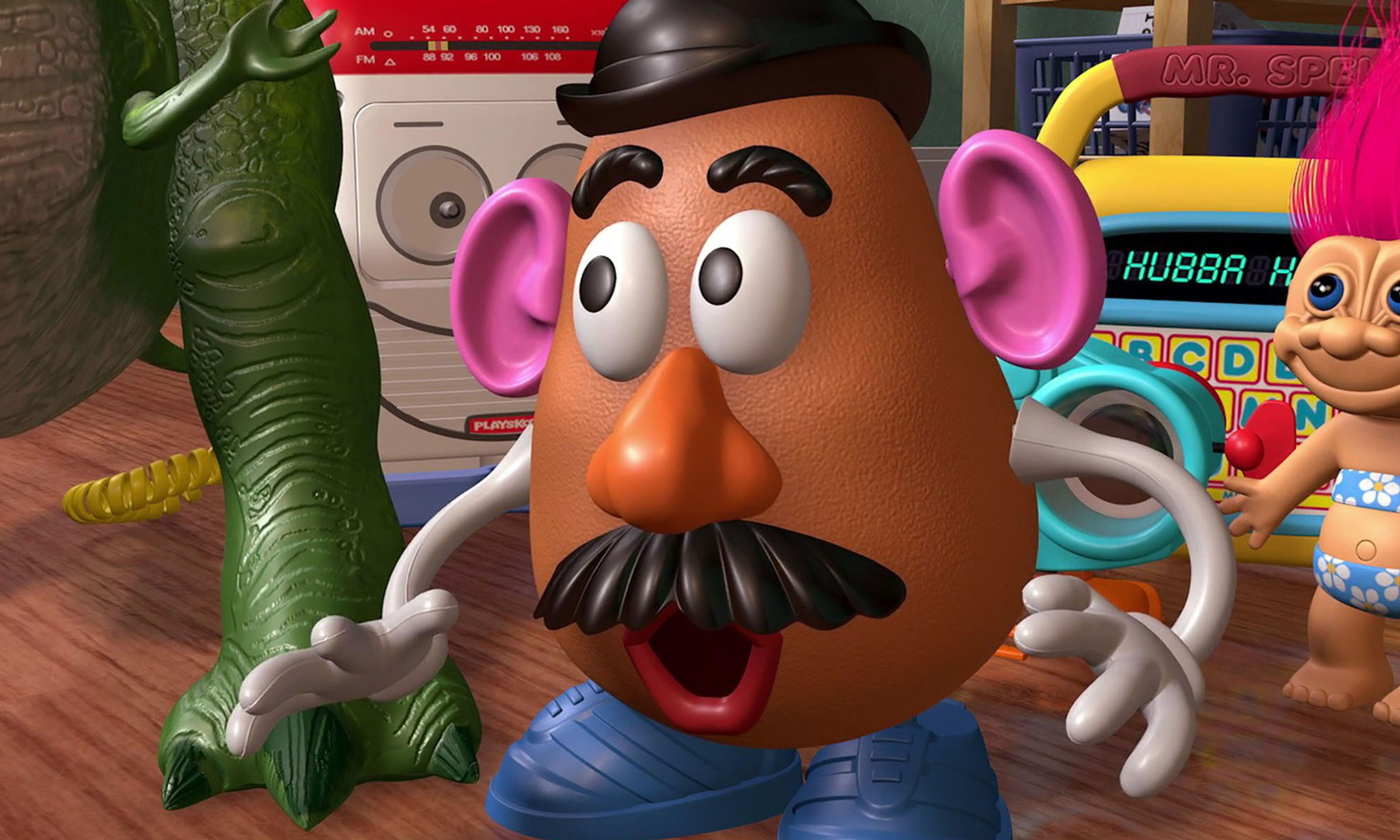
There was a brief kerfuffle on Twitter last month about Hasbro removing “Mr.” and “Mrs.” from the Potato Head toy, to make it Inclusive. Many people thought this was stupid, because it was, and Hasbro — soon to be renamed “Has-sibling,” no doubt — quickly clarified matters. They have dropped the titles from the logo, but there will still be a Mr. and a Mrs. Potato Head.
Whew. But let’s take a look at their initial announcement, which included this gem from Kimberly Boyd, Hasbro’s senior vice president of global brands:
“Culture has evolved. Kids want to be able to represent their own experiences. The way the brand currently exists — with the ‘Mr.’ and ‘Mrs.’ — is limiting when it comes to both gender identity and family structure.”
Hasbro, like other companies taking the proper postures, isn’t doing this to appeal to its customer base; they want to garner kudos and get some Instagram love, then tick off the “inclusion” box in the hopes that it insulates them from any difficulties down the road. If they fixed the whole “Mister” and “Missus” matter before 17 purple-haired people on Twitter with anime avatars started kvetching about how they felt Harmed by the cisnormative spuds, changing the boxes was a small price to pay.
You can understand why they think the archaic construct of “Mr.” and “Mrs.” is limiting when it comes to family structure. Not all kids have married parents, so best to dispense with that whole expectation in favor of some transitory series of relationships without formal titles. So we’ll get Mom Potato Head and Latest Dude Potato Head. Or Mom Potato Head and Absent Progenitor Potato Head Who Chipped In for Pampers but Stopped after a While. Also, not all kids have one male and one female parent.
But gender identity? Even by the terms of modern madness, how does having a male potato and a female potato abrade the new definitions of gender? If you drop “Mr.” and “Mrs.” because that’s too limiting, and Mr. PH might actually be female and Mrs. PH might be male, does that mean they are being forced by the Binary Gender Gestapo to suffer the piercings of misgendered plastic pieces? But the plastic potatoes are literally without gender identity; they are given gender by the things you poke in the holes, so to speak. There is literally no gender essentialism in a Potato unclaimed by identifying plastic parts. Are we to assume that a sizeable percentage of Mr. Potato Heads were actually innately female in some ineffable way no one can deduce, and they endured in silent misery as children slapped a mustache on them?
It is dangerous in today’s climate to note that Mr. and Mrs. Potato Head are reflective of reality. That’s such a loaded word, it’s practically hate speech. Identifying the dominant paradigms has somehow become defined as hating the instances that conflict with the paradigms. It’s like saying “Most people enjoy hamburgers” and being accused of wanting to exterminate people who usually order the Filet-O-Fish.
Recent surveys of young folk show a rise in nontraditional sexual identification — gay and lesbian poke along in the low single digits, but trans, queer, and bi have spiked. Some ascribe it to faddish ideas that give ballast to teens tossed in the hormonal tumult. Others suggest that the old stigmas have fallen away and that the portion of the population whose sexual identity varies like a seismograph is free to answer the survey honestly. There’s no harm in admitting that a percentage of college-aged women at some point might think that Mrs. PH has got it going on; if we’re 97 percent water, don’t be surprised if some people’s sexual identity is “fluid.” But it doesn’t mean that a norm isn’t a norm, any more than it means that things contrary to the norm are bad, or better.
The problem arises when toy-makers feel compelled to ditch the norms because they fear that simply asserting the norm as, you know, the norm is upholding some creaky nonsensical made-up power structure.
Why does this have anything to do with fake potatoes and extruded plastic pieces? No one asked Hasbro to weigh in on the issues of gender identity, just as no one really wants Jimmy Dean sausage to tell us where they stand on Peruvian labor conditions. But it’s now suspect if a brand does not align correctly. The other day, Oreo Cookie — I repeat, Oreo Cookie — tweeted out “Trans People Exist.”
Yes. And?
This immediately put all other cookie brands on notice, and it wasn’t long before Nilla Wafers felt compelled to tweet, “Trans people not only exist, but are valued and loved by Nilla Wafers.”
The silence of Keebler elves spoke for itself.
It’s almost as if Oreo was trying to get ahead of someone tweeting that the cookie was literally racist, as it has two strong black cookies guarding a soft white center. But it makes consumers wonder: Is my purchase of Oreos an endorsement of the erasure of biological women, as some would insist?
It’s the question of the day, really. Where does Oreo stand on the matter of nonparental involvement in pubescent gender-reassignment surgery? Does Cap’n Crunch have an opinion on studies that examined the long-term effects on bone density caused by hormone-blocking drugs? Does Tony the Tiger think that a national mandate for gender-neutral bathrooms would have a significant impact on small businesses?
And shouldn’t the Potato Head family have a trigger warning for the Irish?
You might ask: Where does it all end?
When the new ideas become the norms, of course. And then norms are fine.












Comments