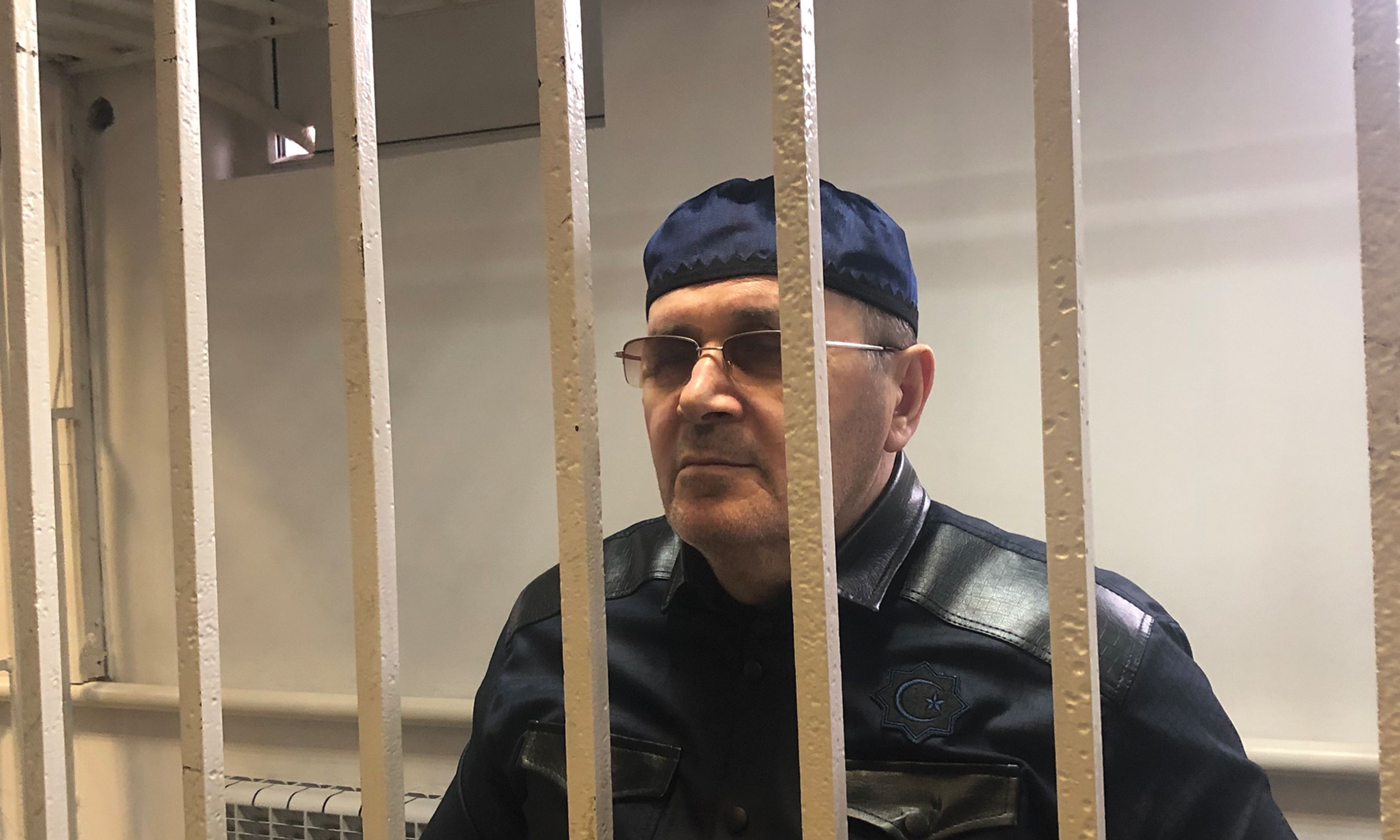
Chechnya is the worst place in Russia, “a nearly totalitarian enclave,” as Tanya Lokshina says. She works for Human Rights Watch in Moscow. Oyub Titiev says that Chechnya is “a testing ground for repression and terror.” Techniques perfected there can be applied elsewhere in the country.
Titiev works for the Memorial organization, about which I will say more in a moment.
Chechnya, or the Chechen Republic, is in the North Caucasus, with Georgia on its southern border. Since 2007, it has been ruled by Ramzan Kadyrov, a classic brute. He may be seen as Vladimir Putin’s viceroy in Chechnya. Kadyrov is a little Stalin, with some Caligula thrown in.
He likes to call his opponents “enemies of the people” and “foreign agents.” As he would have it, he and his comrades are “patriots” whereas their opponents are “traitors.” Oyub Titiev will have none of that. “They are patriotic toward Putin,” he says, “not toward the Chechen or Russian people. What kind of patriot robs his country, making millions for himself, while fighting his own people?”
Titiev is from an old Chechen family, and he was the Memorial director in Grozny, the capital of Chechnya. Memorial is the organization founded at the instigation of Andrei Sakharov in 1989. (Sakharov, you recall, was the great dissident and physicist.) Memorial’s purpose is twofold: to promote the truth about the past, and to promote democracy in the present. In 2017, I wrote in these pages about another Memorial worker, Yuri Dmitriev, from the Republic of Karelia. He is a political prisoner today, as he was then.
Oyub Titiev was a political prisoner from January 2018 to June 2019. Unable to work in his home republic, he lives and works in Moscow. I will tell you a bit of his story.
He was born in 1957 and grew up in his ancestral village, Kurchaloi. His father worked in the passport office of a police station. (These were internal passports, necessary to move within the Soviet Union.) Like many boys in the Soviet Union, and especially in Chechnya, he says, he aspired to be an athlete. He was a wrestler and weightlifter. As an adult, he taught physical education and founded a sports club, for youth. He also worked other jobs—in a furniture store, for example.
In 2001, five Memorial workers came to Kurchaloi, to investigate the usual horrors (abduction, torture, murder). Titiev met them by chance. He assisted them, driving them to homes and hospitals and the like. In due course, they offered him a job.
“What motivated you to do human-rights work?” I have asked this question of many people, and their answers tend to be the same: I don’t know. How could you not, given the circumstances? In a Q&A with me, Titiev says essentially this.
It has long been very, very dangerous to investigate human-rights abuses in Chechnya, and to defend innocents there. Anna Politkovskaya, the journalist, did so. She was murdered in 2006. Stanislav Markelov, a lawyer, did so. He was murdered in 2009. Zarema Sadulayeva was murdered later that same year. She had founded a children’s-rights organization. She was murdered along with her husband, Alek Dzhabrailov.
Natalia Estemirova, a journalist, worked for Memorial. In 2007, she won a prize named after Politkovskaya. Two years later, she herself was murdered—abducted from her home, shot up, and left in the woods.
At this point, the director of the Memorial branch in Grozny left the country with his family. This was understandable, not only in view of Estemirova’s killing but also in view of explicit death threats to him. The work of Memorial in Chechnya was suspended for six months. Then Oyub Titiev convinced the national organization to start it up again. He himself became director.
Under Ramzan Kadyrov, Chechnya is a festival of extrajudicial killings, collective punishment, secret prisons, “disappearings”—again, the usual. Titiev and his colleagues did what they could to expose these horrors. They did all they could to help victims and prevent new ones.
Titiev always figured they would stop him, sooner or later—one way or another. For example, they might plant drugs on him and arrest him. That would be the least they could do (the most being murder). The authorities had planted drugs on other critics of the government. And, on January 9, 2018, they did it to Titiev.
That morning, police stopped his car and made him get out. While they were “inspecting” the car, lo, they “found” 180 grams of marijuana under the passenger seat.
Why then? Why did the authorities move on Titiev at that moment? He thinks it was because he was working on a particularly sensitive case, known as the “Case of the 27.” On January 26, 2017, the authorities killed at least 27 people extrajudicially in Grozny.
The idea of Oyub Titiev as drug possessor or seller was laughable to anyone who knew him. Titiev is a devout Muslim who neither smokes nor drinks. Moreover, he is devoted to physical fitness, running or using the gym daily.
For the first ten days of his confinement—in the dead of winter, mind you—he was kept in a tiny windowless cell without heat. They told him they would harm his family if he did not confess. This rattled the prisoner, obviously, and he thought of ways to protect his family—but he did not, and would not, confess.
Indeed, he wrote a letter to Putin in Moscow, along with other high officials. The message: If you ever hear a confession from me, it will be because I was tortured into it.
Police went to Titiev’s home, looking for his son and his brother. They were not there. There were women, however, whom the police chased out. They evicted them from their own home. Titiev’s family left the country for safety.
In the midst of all this, Ramzan Kadyrov took to the airwaves—state television—calling Oyub Titiev a “drug addict.” He also railed against human-rights defenders generally: “They have no motherland, no ethnicity, no religion. . . . They have interests. . . . They keep smearing our Chechnya, trying to provoke us. . . . We are going to break the spines of our enemies.”
Say what you will about Kadyrov, he is not guilty of subtlety.
During these same days—January 2018—the Memorial office in Grozny was raided, and the staff threatened. A Memorial office in a neighboring republic, Ingushetia, was torched. The car of a Memorial lawyer in another neighboring republic, Dagestan, was torched. And so on.
As for Oyub Titiev, his trial lasted eight months. He had great support, internationally, nationally, and locally. Human-rights organizations publicized his case. The president of France, Emmanuel Macron, spoke to Putin personally about it. The Parliamentary Assembly of the Council of Europe gave Titiev its Václav Havel Human Rights Prize (in absentia). Amnesty International declared him a prisoner of conscience.
Amnesty made a blunt, and true, statement: All the fuss about Titiev, around the world, was affording him “a level of protection against torture.”
Amazingly, some 20 of Titiev’s friends and neighbors came to the court to testify. They vouched for the defendant’s integrity. This was amazing, says Titiev, because Chechens had seldom done such a thing in recent years. It was too risky. They would incur the wrath of the government. Even family members would not testify for family members. (“I do not judge them,” Titiev tells me.) But for Titiev, people showed up.
The trial was a sham, with many comical elements. Among those who wrote about the trial was Simon Cosgrove, of the U.K.-based group Rights in Russia. I will relate just one detail, reported by him and others.
On the day Titiev was arrested, CCTV cameras, oddly enough, were not working. There were 17 of them, on the road, in the police station, and at many other points in the relevant area. But every single one of them was under repair on that particular day, according to the prosecution.
The boss, Kadyrov, weighed in on the trial, confident of its outcome (for good reason). “Once the trial is over,” he said, “Chechnya will become forbidden territory”—forbidden territory for human-rights defenders such as Titiev and Memorial at large.
Near the end of the trial, in March 2019, Titiev himself made a statement to the court. It was a long and stirring address. “I’m a troublemaker,” he said. “I tried to get the authorities to pay attention to violations of people’s rights.” He also said, of himself and his colleagues, “If, over the years, we have managed to save even one person—and I know we have saved many more than that—our labor was not in vain.”
Titiev’s sentence was a relief, in that it was relatively light: four years of “corrective labor” in a minimum-security colony, with the possibility of early release.
One of the questions I put to Titiev is, “How did the other prisoners treat you?” They treated him royally, in a word. They knew of his case and respected him greatly. What’s more, they hated those who had framed him. They would not let Titiev clean his own cell or carry out other such tasks, wanting to do them for him.
Titiev was released on June 21, 2019, having been in custody for about a year and five months. It could have been so much worse, as you know. The attention of the broader world made a critical difference.
The ex-prisoner is still working for Memorial, but in Moscow, as I’ve said. There is no Memorial office in Chechnya. How could there be? In a sense, Kadyrov and his goons have won, driving the human-rights defenders out of Chechnya. But the final chapter has yet to be written. (It never is.)
Titiev hopes to live to see a better day for Chechnya. Putin despises Chechens, he says, deriving pleasure from Kadyrov’s depredations. Faith is the most important thing in Titiev’s life. If rulers had a deeper, higher sense of faith, he says, “I am sure there would not be so much hatred and anger toward people.”
Titiev’s friends and colleagues speak of him in almost reverent tones. They admire his quiet courage, his modesty, his fortitude—the example he sets. There are lots of names to remember in this crowded, turbulent, often impressive world, but add Oyub Titiev’s to your list.










Comments