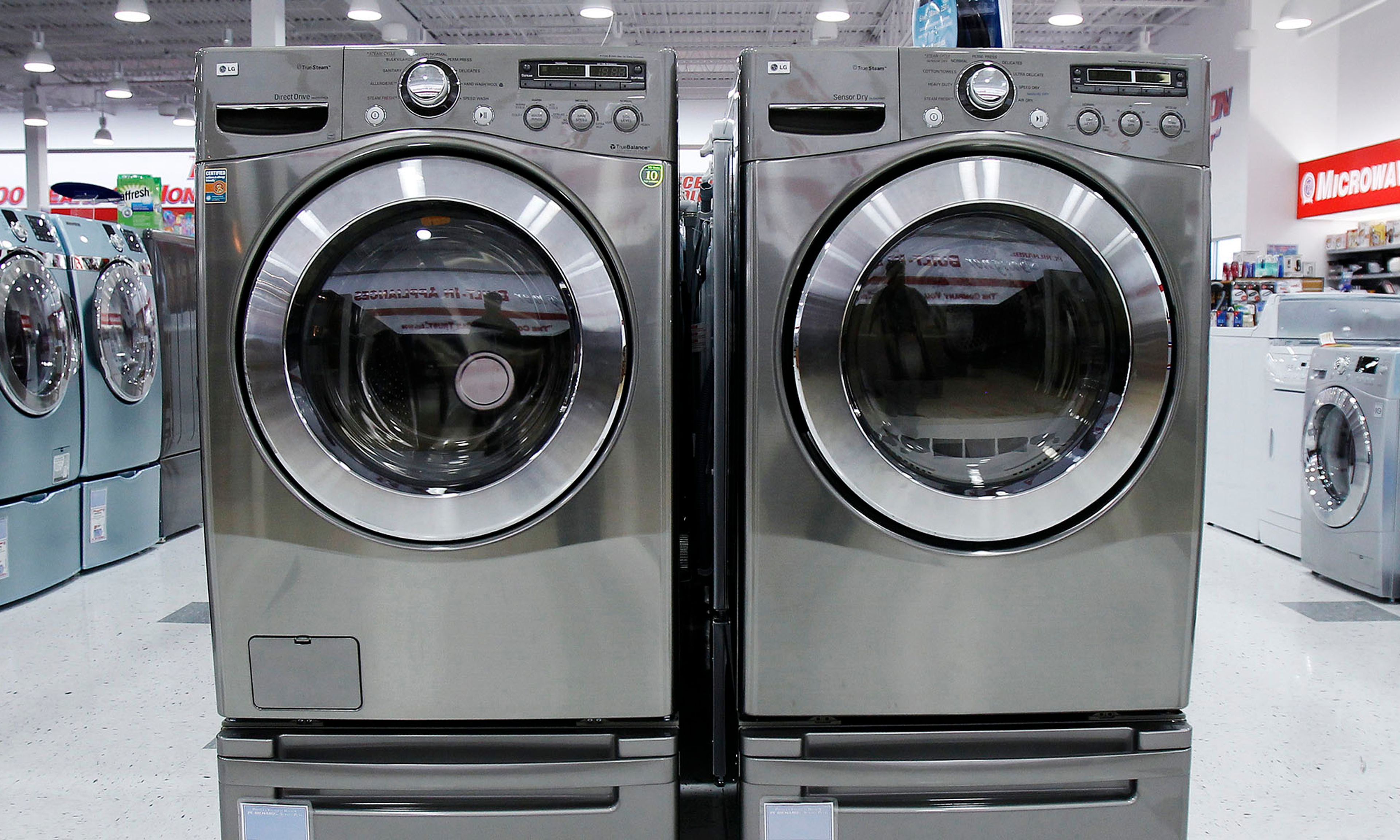
The appliance installer was not happy. He and his silent companion had to haul the washer and dryer up a long flight of stairs covered with snow. I had not shoveled the steps because there was naught but ice under the snow, and at least the snow gives you traction. You don’t want to look out the window and see two guys somersaulting backwards while a washing machine tumbles down the steps like the big rock at the start of the Indiana Jones movie.
Then they had to take the door off the hinges to get the washer and dryer in the house. The hinges were stuck from the cold, and I felt bad for not foreseeing the problem and pre-lubing the door. Then he said I hadn’t ordered the right hose. I said no, I bought the hose package. Every hose contingency had been anticipated. He grumbled and got one from the truck.
Eventually everything was sorted out, and he turned on the washing machine to make certain it worked. There was one light that blinked in error, and it was the telltale icon of a Wi-Fi signal. What’s that?
“Your washing machine is not connected to the Internet,” he said, curtly, as if he expected a man with snowy steps, unlubed hinges, and shady hose-buying stories not to understand. “You have to get the app.”
I nodded, thinking: And this is how my fortunes are ruined and my reputation lost.
Why, you ask, would you connect your washer and dryer to the Internet? For many of us gadget-besotted guys, the answer is simple: Because you can! We dreamed of a world like this. Imagine being on the other side of the planet on a business trip, and your Dick Tracy two-way-radio wristwatch buzzes with a message, relayed along the infinite tendrils of the global communication network. You look at your watch: It’s a text from your washing machine.
“Your load is unbalanced.”
You could leave the meeting: Sorry, guys, I have to take this, it’s from the washing machine. Wouldn’t that be cool?
When I looked up what the Internet-connected washing machine could do, I discovered it could download custom washing routines for various fabrics. Someone runs up to me on the street and says, “I have a party tonight and I just spilled cranberry juice on my chiffon gown and I don’t know what to do,” and I could download the instructions, nod with resolute intent, and say, “Let’s do this thing,” like they do in the cop movies. Note: This will never happen.
The machine could also send notifications to my phone telling me the dryer was done, in case that telltale melodic chime from the laundry room didn’t get the message across.
When I bought a fridge a while ago, I had the chance to get an Internet-connected model. You could use your phone at the grocery store to call up the interior cameras.
“You can see if you need milk,” said the salesperson.
“I assume I always need milk,” I said. “Worst-case scenario, you’re over-milked, which is better than under-milked. What about eggs? Can the cameras penetrate the egg carton to give an accurate count of the contents?”
No, they could not. Okay, well, maybe in a few years when the Internet fridge cameras have infrared ovoid-container-inspection systems, as the Pentagon probably calls them.
“But,” said the salesperson, “the front of this model has this screen, and it’s connected to the Internet. You can call up recipes, family photos — even read Twitter.”
The only thing more horrifying than the ability to stand in front of the fridge and scroll through Twitter is the certainty that I would do exactly that.
I’m not worried that nefarious miscreants will hack into my Internet of Things and mine Bitcoins with my doorbell. My online banking cannot be done without communicating with my phone, and there is a special feature that uses the phone camera to see if someone has a gun to my head. I reset the default password on my ISP-provided router, which is practically Wile E. Coyote, Super Genius–level stuff, compared with most people. But I don’t trust the Internet-connected washing machine.
Why? Because I’m sure the EULA, or End-User License Agreement, or Exceptionally Unclear Legal Absolution, has a clause like this:
“By using this app, you agree that the service provider (hereafter referred to as ‘Godless Information Gobbler,’ or ‘GIG’) will, in order to improve your experience, see which sites you visit, use your microphone and camera, access your contacts and location, and post to Twitter, Facebook, Instagram, and any other social-media sites not explicitly named.”
If you ask about stuff like this, they’ll wave it away. Oh, it’s just boilerplate. But then comes the day when we can’t do laundry because the washer is downloading new firmware, and there’s a bug in the code that makes it “Like” random tweets, and one of those was sent by someone who got banned for antisocial hate speech like “China is responsible for COVID” or “Men don’t lactate,” and then my job is in peril because I have spread misinformation or caused harm. I’m called in to HR.
“First of all, I didn’t do it. My washing machine did it. But if we were to want to craft a face-saving statement, we could say I actually do believe men can lactate in the sense that we buy milk, which I do, even if I suspect we have enough.”
No, it wouldn’t work. Even though I bought the total hose package, I’d be hosed. Totally.












Comments