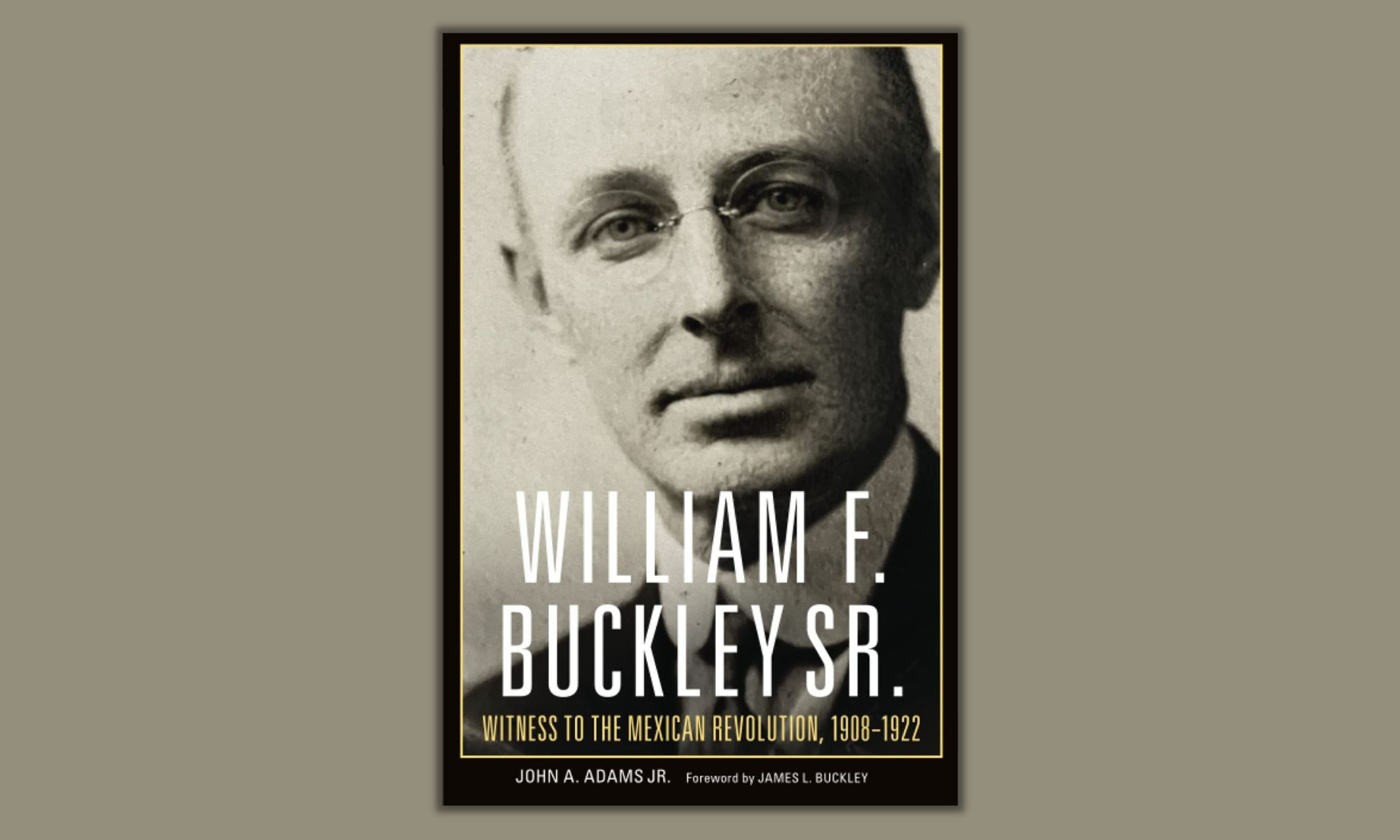
In 1909 a young American living in Mexico City visited the presidential palace at Chapultepec. The American, a lawyer from Texas, Will Buckley, listened as the ageing General Porfirio Díaz told the story of Mexico’s economic revival under his autocratic rule. When the general paused, Buckley spoke up. “That’s marvelous, your excellency,” he said. “But what will happen when you die?”
The room went silent. Díaz had been in power since 1876. He had no intent to abdicate. Nor did he have a death wish. A courtier whispered into Buckley’s ear: “His excellency will never die!”
Buckley’s question was impertinent. It was also perceptive. He understood that Díaz’s iron fist held Mexico together. The next year, Díaz was overthrown after a disputed election, setting off a decade of lawlessness, upheaval, and U.S. military action. Díaz, in exile, shuffled off this mortal coil in 1915. The Mexican Revolution had begun.
Buckley not only witnessed the chaos. He participated in it. He was one of the few American businessmen in Mexico to speak fluent Spanish. He was an intermediary between a rotating cast of Mexican strongmen and the U.S. government. In the early 1920s, when the revolution took an anticlerical turn, Buckley aided his fellow Catholics and sent money to counterrevolutionary insurgents. He passed on to his children lessons — in self-reliance, individualism, and nonintervention — drawn from south of the U.S. border. “Mexico dyed our father’s politics indelibly,” said Reid Buckley, “and bred in his children distrust of populist charmers of whatever ideological hue.”
All fathers influence their sons, but each father does so in his own way. If you want to understand the connections between Will Buckley and the development of modern American conservatism, William F. Buckley Sr. is essential reading. John A. Adams Jr.’s extensive archival research sheds light on the man to whom William F. Buckley Jr. owed his life, faith, and patriotism. Will Buckley’s southern gentility, linguistic agility, shrewd instincts, love of learning, and belief in the rule of law as the basis for freedom and prosperity earned him a fortune. And this intellectual, moral, and financial patrimony was instrumental in the creation of National Review.
Will Buckley was born on July 12, 1881, in Washington-on-the-Brazos, Texas. He was raised in San Diego, Texas, in the borderland between the United States and Mexico. He was one of six children. His father was an Irish Protestant immigrant, a wool farmer, sheriff, and taxman. His mother was Irish Catholic. He was raised in the church. The Buckleys were Anglos in a population that was more than 80 percent Tejano. Most people they knew spoke Spanish. Will Buckley was bilingual at an early age.
Buckley graduated from the University of Texas with a law degree. In 1908 he moved to Mexico City, with the goal of providing legal services to U.S. oil and gas companies. “Will was just under six feet tall,” Adams writes, “dark haired, fair complected, and with blue eyes accented by wire rim pince-nez that made him look older than his twenty-seven years.” He had entered a nation in political decay. Within a few years of his arrival, Díaz was gone, and Mexico slid into violence and plunder.
Díaz’s usurper, the democratic reformer Francisco Madero, was weak and uncertain. Soon Madero was overthrown by one of his generals, Victoriano Huerta, who in turn was deposed by the primer jefe, Venustiano Carranza, in 1917. But the jefe was not primer for long. He lost out to another general, Álvaro Obregón, who seized power in 1920. Throughout the decade, bandits such as Pancho Villa and Emiliano Zapata roamed the countryside, wreaking havoc.
The Mexican Revolution taught Will Buckley that social fabrics are easily torn and hard to mend. “He went to Mexico to practice law,” Buckley Jr. wrote, “and saw the revolution against the benevolent and autocratic Porfirio Díaz and what followed in its wake, and learned, and never forgot, his distrust of the revolutionary ideology.”
Civil order, in Will Buckley’s view, was freedom’s prerequisite. Where there was no sovereign authority, the strong preyed on the weak. Buckley saw plans of redistribution and social reorganization as invitations to graft and disarray. He was skeptical of government do-gooders. Of one Mexican politician, he wrote, “I have always regarded him as being dangerously theoretical. Like most intellectual men, he has the most unbounded confidence in the infallibility of his own conclusions.”
Will Buckley detested anarchy. Yet he managed it well. His language skills were in high demand. And civil war did not slake the industrialized world’s appetite for energy. Mexican oil was lucrative, plentiful, and for the taking. Buckley’s firm expanded to include his two brothers. He bought oil leases along the gulf in Tampico. “It was never the discovery of oil that excited him,” said Will’s daughter Priscilla, “but the chase for it, and even more than that, the techniques and tactics that enabled him to keep his small companies in the field without so much as a by-your-leave to the mastodons that sought to devour him.”
Buckley’s wit and integrity kept the mastodons at bay. He seemed to know everyone of importance. He was trustworthy. Businesses relied on his expertise. Mexican authorities sought his counsel. Pancho Villa admired his courage. And the Americans wanted information. The politicians in Washington didn’t understand Mexico. Buckley did.
If the Mexican Revolution confirmed for Buckley the dangers of political romanticism, economic nationalism, and arbitrary force, the American response to the revolution was itself an object lesson in hubris, moralism, and foreign entanglements. President Woodrow Wilson refused to extend diplomatic recognition to governments established through violent means. Secretary of State William Jennings Bryan repudiated the “Dollar Diplomacy” of Republican administrations that had privileged commerce over democracy. For Progressives in Washington, foreign policy was an exercise in spiritual uplift. As Wilson, a former professor, told a British diplomat: “I am going to teach the South American republics to elect good men!”
Wilson was a bad teacher. His passive-aggressive mix of condescension and military engagement won him no friends in Mexico, or elsewhere. Early on, Will Buckley backed American intervention in Mexico. He said it was the only way to protect American interests. In 1914, however, when Wilson ordered U.S. forces to seize the Port of Veracruz, disillusionment set in. Buckley did his best to protect Americans caught in the crossfire. In the aftermath, U.S. officials offered Buckley the chance to be the city’s civilian governor. He turned them down.
Buckley concluded that Wilson’s incursions into Mexico — another would take place in 1916 — did more harm than good. “He believed it was wrong for the United States to impose its ‘republican standards’ on Mexico, which had never had the remotest experience with full and free democratic government,” writes Adams. It was Buckley’s opinion that Wilson held Mexico to the strictest standard, and when the developing country inevitably failed to live up to Wilson’s ideals, the president would lash out with the heavy hand of the U.S. armed forces. Woodrow Wilson did not practice diplomacy. He had tantrums.
Buckley became a critic of Progressive foreign policy. He advised the Mexican government during the “ABC” (Argentina, Brazil, Chile) conference in Niagara Falls, N.Y., at which America agreed to leave Veracruz. Then, near the end of the Wilson administration, he worked closely with Republican senator Albert Fall of New Mexico, who organized a foreign-affairs subcommittee on U.S.–Mexican relations. Meanwhile Buckley’s company, the Pantepec Corporation, continued to grow.
And so did his family. In late 1917, Will Buckley met Aloïse Steiner of New Orleans. They were married by the end of the year. Like Will, Aloïse was multilingual: She spoke Spanish and French in addition to English. She was Catholic. And she was a southerner who referred to herself as a “daughter of the Confederacy.” William F. Buckley Sr.: Witness to the Mexican Revolution provides a reminder that, for all its association with New York and Connecticut, the Buckley family’s ancestry and cultural background are rooted well below the Mason-Dixon line.
The first of the ten Buckley children, Aloïse, arrived in 1918. A second, John, was born in 1920. The fourth, James, who wrote the foreword to this book, recently celebrated his 100th birthday. The sixth child, William Jr., was born in 1925.
By then, however, Will and Aloïse had left Mexico for America. In 1920, when General Obregón became president of Mexico, he targeted the Catholic Church. For years, Will Buckley had been a neutral arbiter between Mexico’s many factions. He abandoned that stance as soon as the church was attacked.
Buckley financed the armed opposition to Obregón. The general noticed. “The fact that the counter-revolutionists were decent men, and those in power barbarians, does not alter the political reality, which is that it is a very dangerous business indeed to back an unsuccessful insurrection,” Buckley Jr. wrote of his father. “And he knew it and barely escaped with his skin.”
Obregón ordered Buckley’s arrest. A headline in the Austin American of November 27, 1921, read: “Austin Man Draws Wrath of Obregón.” Buckley went to Texas, where Aloïse had taken the children. The family’s holdings and properties were at risk. He would not return to Mexico for close to a decade.
The narrative thread of William F. Buckley Sr. tapers off when its protagonist leaves Mexico. The text, so rich in detail for most of the book, skims across the remaining 37 years of his life. Perhaps Mexico defined Will Buckley to such an extent that he was not the same man after his departure. Or perhaps this book is more about the Mexican Revolution than it is about Buckley.
Still, Will Buckley’s story did not end with his return to America. Indeed, some of the most important events in his biography lay in the future: the design and construction of his homes in Sharon, Conn., and Camden, S.C.; the education of his children; his relationship with social critic and essayist Albert Jay Nock; his business expansion in Venezuela and the global reach of his Pantepec-Catawba company; his involvement in the America First Committee; his post-war political activity; and, last but certainly not least, his $100,000 “loan” to William Jr. to launch this magazine.
When Buckley Sr. died in 1958, National Review was struggling. His economic, social, and political ideas, expressed so eloquently by his namesake, were considered fringe. His opposition to the Mexican Revolution had been unsuccessful. Through his example, teaching, and generosity, however, Will Buckley had set into motion a conservative revolution within the United States. A revolution that was just getting started.











Comments