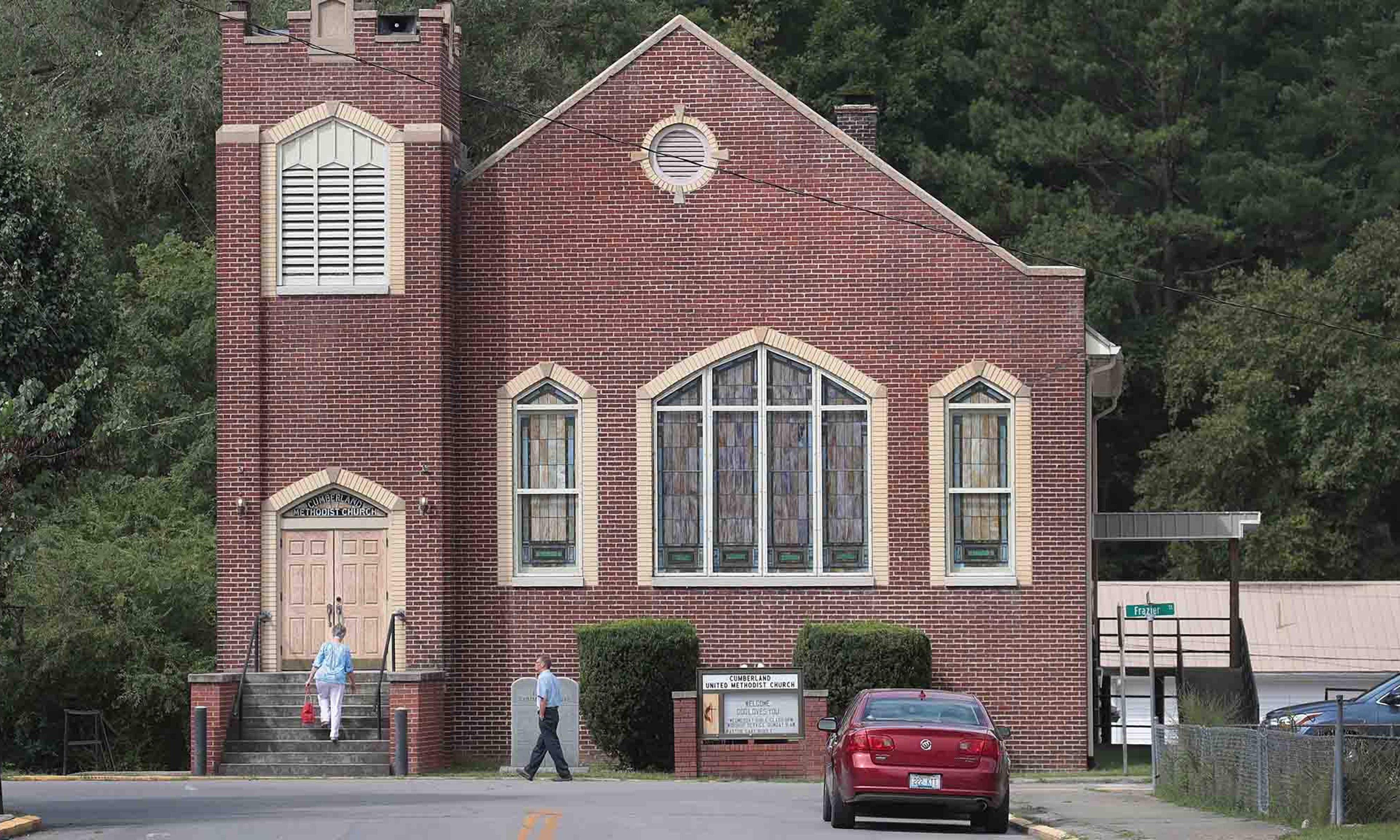
The United Methodist Church, America’s second-largest Protestant denomination, is not so united anymore. Its attempts to be a great “big tent” have devolved into a messy schism.
American Methodism was formally established in 1784, just after the Revolutionary War. The new denomination grew rapidly along with the new nation in numbers, geography, and prestige.
In 2000, America elected a United Methodist as president (one of several presidents with Methodist ties) along with the 107th Congress, which included an impressive 65 United Methodist senators and representatives, with many in each party. Except for the Southern Baptists, no Protestant denomination came close to our 8.3 million U.S. members. Denominational leaders bragged about how America had more United Methodist congregations than post offices and that the UMC was enough of a big tent to include both George W. Bush and Hillary Clinton.
Americans have tended to prefer entrusting public office to those with some religious affiliation but have hesitated when a political figure’s religion seemed scarily nonmainstream — recall negative reactions to John Ashcroft’s Pentecostalism, the black-liberation theology of Barack Obama’s former church, and Mitt Romney’s membership in the Church of Jesus Christ of Latter-day Saints. The UMC offered a safe affiliation for politicians of all stripes because it provided a vague respectability without offering much of a clue about what they actually believed.
For many decades, UMC leaders at all levels have been extraordinarily skittish about drawing even minimal boundaries of doctrine and discipline. UMC culture has placed a high priority on not offending people within or beyond our congregations.
Ironically, this insistence on a big tent contributed to the UMC’s present unraveling.
It would be a mistake to simplistically conflate the UMC’s theologically conservative faction with U.S. political conservatism. One major reason is that the UMC’s conservative coalition has become dominated by non-Americans. But in reviewing the liberal faction’s behavior, keen observers of American politics and culture will recognize such familiar tactics of the American Left as infiltration, disruptive protests, harsh intolerance in the name of “tolerance,” and hypocrisy about racism.
We were never truly the big, happy family that our rhetoric claimed. The union between our conservative and liberal factions, often self-described as orthodox and progressive, has been an increasingly unhappy, dysfunctional marriage.
Since the present UMC was formed by a merger of the Methodist Church and the Evangelical United Brethren (EUB) Church in 1968, we have steadily lost American members every year, while many American churches outside of our denomination have grown. Since that merger, a whopping 48 percent of our U.S. membership has left. Just in the two decades since the 2000 election, American United Methodism has lost one quarter of our members and much cultural influence. The number of United Methodist members of Congress has dropped by more than half.
Our big-tent approach has not worked.
To remain sustainable, any organization, religious or otherwise, needs clarity about its purpose, foundational principles, and rules of operation. In church-speak, this means a defined mission, doctrine, and discipline. On paper, the UMC has them. But in practice, we have contentious infighting even among top leaders over what United Methodism really stands for, with the official statements not reflecting the denomination’s reality.
Officially, the UMC has clearly defined basic “Doctrinal Standards,” principally the relatively brief Articles of Religion of the Methodist Church and the Confession of Faith of the EUB Church. But denominational leaders are neither expected to actually believe all of these doctrines nor prevented from contradicting them.
Officially, the UMC has clear rules, our supposedly governing Book of Discipline. But it has become increasingly normal for denominational officials to break this rule book with no consequences.
Public arguments and polling data reveal that United Methodists fundamentally disagree over whether the church’s primary mission should be to follow Jesus Christ’s Great Commission to make disciples of Him or to promote social justice. Since 2008, the official mission statement of the UMC has tried to mollify both perspectives by declaring it our mission “to make disciples of Jesus Christ for the transformation of the world.” But this wording cannot resolve the lack of agreement on what is more important.
Orthodox United Methodists want the church to help make the world a better place, while progressive United Methodists want people to feel closer to God. But the contrasting top priorities reflect very different perspectives. For the many progressive United Methodist clergy members who believe in universal salvation (which is rejected by our Doctrinal Standards), there is simply much less urgency in making disciples of Jesus, because it has less eternal importance — since everyone is already saved.
Clerical disagreement with official doctrine is not new. Our tradition has long asked ordination candidates, as a condition of their approval, whether they will agree to “preach and maintain” our doctrines. But such screening works only if those seeking ordination are honest and those charged with screening ordination candidates have the courage and conviction to lovingly but firmly block doctrinally unqualified candidates.
A great challenge to both conditions came in the late 19th century with the rise of theological modernism in “mainline” Protestant seminaries. This new approach denied the miracles recorded in the Bible, including the virginal conception and bodily resurrection of Jesus. In the UMC’s largest predecessor denomination at that time, several controversies over alleged heresy at its Boston University School of Theology led the Methodist Episcopal Church to abandon its earlier commitments to robustly guarding against “heretical instruction in doctrine or discipline” at its seminaries. We lost our collective appetite for doctrinal accountability.
Over time, we then welcomed more and more ministers who essentially crossed their fingers behind their backs while taking the required ordination vows of doctrinal loyalty. Some have frankly admitted to lying through this process in order to change the church from within. Many such clergy members ascended to the highest levels of denominational leadership.
Meanwhile, influenced by the legacy of the Social Gospel movement, our bureaucracy developed a habit of routine advocacy on every U.S. political controversy and consistent aligning with the left wing of the Democratic Party. Causes promoted by the UMC’s liberal bureaucracy in recent years have included establishing “open borders” (their words), demonizing Israel, opposing sanctions against North Korea, broadly decriminalizing drug use and prostitution, decrying American gun culture, and supporting reparations for African Americans. Politically conservative United Methodists have shown little interest in any mirror-image approach.
Together, the laxity about core doctrine and the dogmatic position-taking on countless political controversies have further promoted a cafeteria attitude to official church positions, one in which different United Methodists prioritize different segments of official UMC statements as “most important.” For progressives, this can mean prioritizing certain technically nonbinding left-wing political statements in the UMC’s 781-page Book of Resolutions while shrugging off reports of certain bishops’ denying the Resurrection or the sinlessness of Jesus Christ.
Our lack of common beliefs or a truly agreed-upon mission left us ill prepared for the onslaught of militant, uncompromising LGBTQ activism.
The 1972 General Conference added to our Discipline the statement — rooted in Scripture, the relevant writings of Methodism’s founder John Wesley, and consistent ecumenical Christian tradition — that the practice of homosexuality is “incompatible with Christian teaching.” Between then and 1996, we further clarified church rules to unambiguously prohibit our clergy from officiating at gay weddings or being “self-avowed practicing homosexuals.” Significantly, the Book of Discipline in this context “affirm[s] that all persons are individuals of sacred worth, created in the image of God,” and “implore[s] families and churches not to reject or condemn lesbian and gay members and friends.” But no matter how compassionate we tried to be about our stance, there was never an institutionally sustainable and intellectually coherent “middle way” between affirming same-sex marriages and not.
Progressive United Methodist officials increasingly defied the rules they were entrusted with upholding. Top denominational gatherings were disrupted by strident LGBTQ protesters, with whom some denominational leaders openly colluded to change the course of UMC business meetings, over the objections of other duly elected leaders. In the face of worsening tensions, the UMC held a special General Conference in February 2019 to try to settle our sexuality controversies.
By then, some prominent U.S. pastors who had previously been known as relatively moderate shifted to calling for the liberalizing of our sexuality standards. A major influence was the apparent belief that the UMC could not maintain its long-held social respectability in a rapidly changing American culture unless it abandoned its supposedly outdated disapproval of gay weddings.
But this was counterbalanced by another major shift: the growth of the global church. In 1984, non-Americans represented fewer than 5 percent of church members and 7 percent of General Conference delegates. But by 2019, non-Americans were on the cusp of becoming the majority of church membership and accounted for over 40 percent of delegates. So a rainbow coalition of orthodox American, African, Filipino, and Eastern European delegates defeated the American bureaucracy’s liberalization plan and instead voted to maintain traditional biblical standards on marriage. It also succeeded in strengthening on-paper enforcement mechanisms for the restrictions on clergy behavior.
The backlash was severe. Overwhelmingly white and liberal Americans, outraged that delegates from Africa dared to vote their orthodox consciences, targeted that region for collective financial punishments. In the States, the defiance of our marriage standards by bishops and entire regions became much more brazen and widespread. Despite the long-standing rules banning any non-celibate gay clergy, the denomination now has two openly partnered gay clergy members serving as bishops, with no accountability. The election of 13 U.S. bishops in November showed the new impossibility of ever electing another American United Methodist bishop who will affirm or enforce traditional marriage standards.
With the denominational bureaucracy increasingly dominated by liberal activists defying the Discipline’s rules and inventing their own de facto alternative rules, the anarchy has become irreversible. The longer conservatives fight for fleeting victories, the more our congregations suffer attritional losses. By early 2020, leaders of every region and faction had publicly agreed that our infighting had become unsustainable and that a split was needed. But conservatives’ options for how to actually move on have been limited.
For orthodox American congregations, the main way out is a provision enacted in 2019 that allows disaffiliation without the loss of buildings (provided that certain conditions are met and a significant but usually affordable exit fee is paid). This opportunity expires, however, with the final 2023 meeting of each regional annual conference, usually no later than June (with voting and paperwork due earlier), and has already been effectively blocked for many. Some annual conferences — including Alabama–West Florida, Florida, Illinois–Great Rivers, Iowa, Michigan, Mississippi, Tennessee–Western Kentucky, Upper New York, Virginia, and Western North Carolina — have extended the deadline by scheduling disaffiliation-focused sessions in late 2023. But even some of these require disaffiliating congregations to formally begin a process in June.
More than 2,400 U.S. congregations have left since 2019, a figure that should more than double by the end of the year. Those that have disaffiliated or are pursuing disaffiliation include one quarter of the UMC’s 100 largest congregations in America. Overseas, entire Eastern European regions have already begun leaving, with many African and Filipino departures expected to follow. Most of those departing are joining the Global Methodist Church, a new denomination formed by orthodox United Methodists. May this new denomination, and other denominations, learn from the UMC’s mistakes. Christian churches should welcome a wide range of people, but they must also be clear about what exactly they are welcoming those people into.










Comments