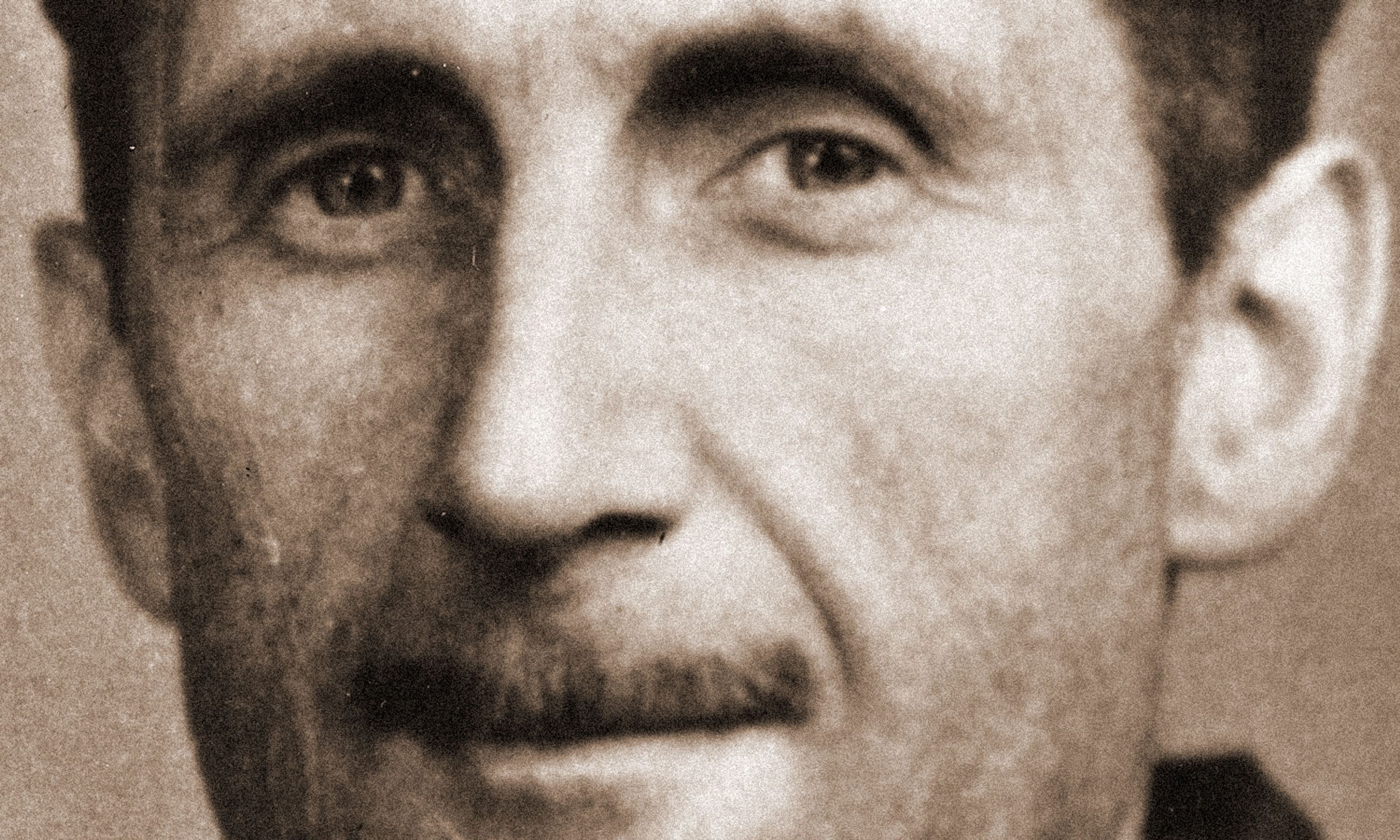
George Orwell once described himself as slumped in a wet trench and listening to “the crack-crack-crack of bullets a foot or two overhead.” This grim scene from April 1937 takes place in Homage to Catalonia, Orwell’s account of the Spanish Civil War. He was serving in a militia, and his politics were starting to shift away from the knee-jerk leftism of his early adulthood. He also struggled with boredom, even as a battle raged: “I spent most of the day reading a detective story — The Missing Moneylender its name was. I don’t remember the plot of it, but I remember very clearly the feeling of sitting there reading it.”
The novel involves debt, disappearance, and death. Orwell almost certainly knew it as a cheap paperback with a green cover, because later in Homage to Catalonia he recalled that he had “spent hours reading a succession of Penguin Library books,” in a statement that almost certainly included his experience with The Missing Moneylender.
Ever since I came across this passage, years ago, I’ve wondered why Orwell bothered to mention The Missing Moneylender at all. It’s the kind of concrete detail that lends authenticity and can be a mark of good prose, but it’s also random and puzzling. I can’t get past the idea that the reference serves an esoteric purpose whose meaning, if it can be teased out, will improve our understanding of the man who went on to write what may be the most important novel of the 20th century, Nineteen Eighty-Four.
So I’ve read The Missing Moneylender. I’ve read about The Missing Moneylender. I’ve asked scholars for their thoughts on The Missing Moneylender. And now I’m ready to make a confession, by way of quoting a character from the book: “The whole thing has been an absolute mystery to me.”
I probably never would have thought twice about this minor question of Orwelliana but for my own limited experience as a novelist. In 2010, I published The First Assassin, my single work of fiction. It’s a historical thriller set mainly in Washington, D.C., in 1861, as a hired killer seeks to murder Abraham Lincoln at the start of the Civil War. It’s amazingly good and you should buy two copies.
But I digress. My point is that in writing the novel, I learned a few things about the craft of novel-writing — and one of them is that almost nothing is accidental. In The First Assassin, I needed to invent a story with made-up characters. A few are based loosely on real people from the time. Others are products of my imagination. They all have names — and each name has a meaning. Most are so obscure that I doubt readers could figure them out on their own.
Take Frank Springfield, a secondary figure. I could have called him “Fred Gagne” or “Edwin Murdick,” but he’s “Frank Springfield” for a simple reason: As I wrote The First Assassin, I often commuted by Metrorail from Virginia to Washington, using the Franconia-Springfield station at the end of the Blue Line. In the evenings, when I caught a train home, I looked for the cars labeled “Franc-Springd.” Thus was born Frank Springfield. A couple of other characters carry the surnames of players who were once in the lineup of the Detroit Tigers. An offhand reference to a town is in fact the hometown of a friend from college. In video games, these are called “Easter eggs” — concealed messages that players can find by chance or searching. My novel is full of them, but they are mostly personal and insignificant.
When Orwell wrote Homage to Catalonia, he already had written five books, including three novels. He also liked the names of his characters to mean something. The most celebrated example is the protagonist of Nineteen Eighty-Four, Winston Smith, whose name calls to mind the extraordinary Winston Churchill as well as Everyman. Less apparent may be the name of an even more famous character: “George Orwell.” This was the pen name of Eric Blair, who chose it for its evocation of England. It refers to England’s patron saint and a river in Suffolk.
None of this proves anything about The Missing Moneylender. In the story, a detective from Scotland Yard expresses frustration at a perplexing moment: “What we want is more facts.”
The author of The Missing Moneylender was William Stanley Sykes (1894–1961), an anesthesiologist who, according to his obituary in the British Medical Journal, was known for his “quiet and retiring disposition” as well as “his wide general knowledge, his varied interests, his hospitality, and his kindness.” He wrote three novels on the side. The Missing Moneylender was the first, with initial publication in 1931. The opening scene involves a doctor, and much of the plot turns on medical practices and technology, as officials pursue a missing-person case that soon involves a manhunt, mistaken identity, red herrings — and what a character calls “an almost undetectable method of murder.” It’s an entertaining product of what some have dubbed the “golden age of detective fiction,” when British authors such as Agatha Christie and Dorothy Sayers were setting the standards of the genre.
Orwell wrote important essays on the likes of Charles Dickens — another author who made an art of naming characters — but he also enjoyed crime stories, and in a magazine article in 1944 he complained about their decline. “Since 1918,” he wrote, “a detective story not containing a murder has been a great rarity, and the most disgusting details of dismemberment and exhumation are commonly exploited.” The Missing Moneylender, for what it’s worth, includes an exhumation, though its description avoids gore.
Orwell offered strong opinions about detective stories, but he never wrote one of his own. He may have contributed to one, though, as L. J. Hurst of the Orwell Society has shown. Orwell died in 1950, but his diary wasn’t published until 1968. When it came out, it included an entry from 1940 with a stray thought: “How is it that England, with one of the smallest armies in the world, has so many retired colonels?” An almost identical passage appears in a 1941 detective story, Murder at Liberty Hall, by Alan Clutton-Brock, a boyhood friend of Orwell’s. Hurst highlights a few other similarities, including a character who resembles Orwell’s wife, plus a line, about “the strange case of the vanishing pawnbroker,” that at least faintly echoes The Missing Moneylender. “Did George Orwell write Murder at Liberty Hall?” asks Hurst. “Probably not. Did Alan Clutton-Brock base a lot of the story on what he heard from Orwell, possibly transcribing it? Almost certainly.”
None of this reveals why Orwell mentioned The Missing Moneylender in Homage to Catalonia. Perhaps the mystery of The Missing Moneylender will forever remain mysterious. “I’m beginning to think that the whole thing is a mare’s nest,” says a cop in the novel. “It will drive me dotty if it goes on.”
I know how he feels.
It spoils nothing to say that in The Missing Moneylender the investigators ultimately crack the case through a combination of hard work and lucky breaks. The best detective stories are full of twists and turns, but in one way they are utterly predictable: They always end with a solution.
My own investigation, however, has failed to reach a neat conclusion. Maybe that’s because Orwell meant nothing by his reference, and I’ve engaged in a futile effort. If writing a novel taught me that references often have disguised meanings, journalism has taught me that some inquiries lead to dead ends.
Journalism also has taught me that sometimes you must make the most of what you have. At one point in The Missing Moneylender, a detective asks a doctor to interpret a bewildering fact. “Frankly, sir, I have no idea,” says the doctor, whom Sykes describes as behaving as a “scientist whose goal is truth and who is not ashamed to confess to a difficulty in finding it.”
Toward the end of the tale, as the evidence of an ingenious murder begins to mount, the same doctor blurts out a hope: “It will give me the material for a very interesting paper.”












Comments