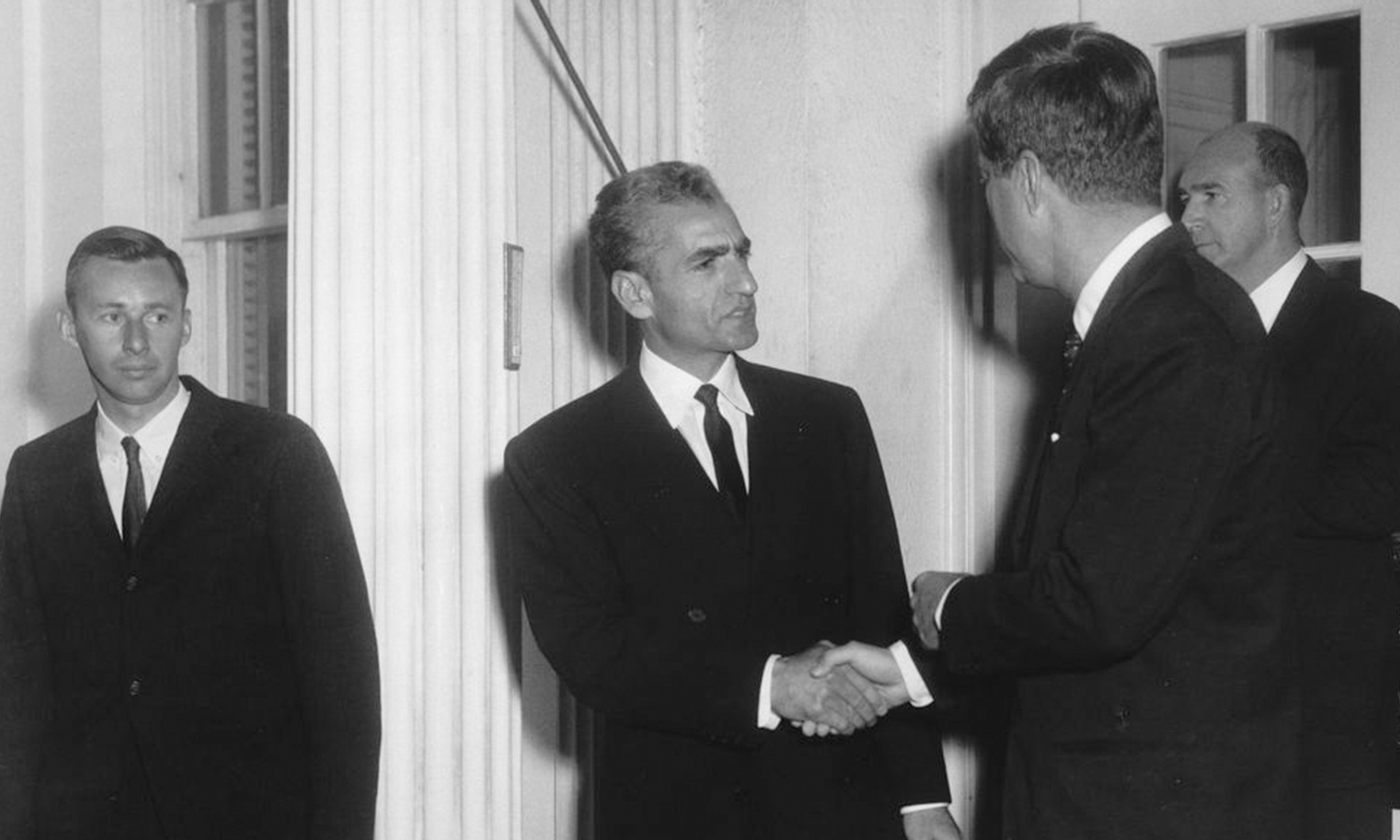
In 1943, Franklin Roosevelt held his first wartime summit with Winston Churchill and Joseph Stalin, in Iran. The country was impoverished and led by an inexperienced 22-year-old Shah Mohammad Reza Pahlavi. Persia seemed to have made an impression on America’s patrician president, who informed his secretary of state, Cordell Hull, “I was rather thrilled with the idea of using Iran as an example of what we can do with unselfish American policy.” Roosevelt went on to claim, “If we can get the right kind of American experts who will remain loyal to their ideals, I feel certain that our policy of aiding Iran will succeed.” Thus FDR established the template that would largely guide America’s policy for the next four decades of the shah’s rule. America would make its share of mistakes in Iran, but a dispassionate reading of history reveals that it often tried to steer the shah toward a constitutional government that was accountable to its people. Although routinely censured by professors and pundits, America’s record in Iran is worthy of praise.
The first thing that America did for Iran was to preserve its territorial integrity. The allies who had occupied Iran during the war had agreed to withdraw their troops six months after the cessation of hostilities. Britain and America honored their pledge. Stalin lingered in his occupation zone in the northern Iranian province of Azerbaijan and entrusted its management to the sadistic Lavrentiy Beria, the head of the NKVD, Russia’s interior ministry and overseer of prison camps. Under the watchful eye of Russian soldiers, a puppet government calling itself the “Azerbaijan Democratic Party” was set up, and Beria’s men created a secret police, which went on a killing spree, targeting Iranian army officers, police chiefs, local officials, and landed gentry. An area comprising the contemporary Republic of Azerbaijan was, like much of Eastern Europe, being carved out as a Soviet vassal state.
The Iranians complained, and Prime Minister Ahmad Qavam even journeyed to Moscow, only to be berated by Soviet functionaries. But Stalin’s latest land grab came at an inopportune time, as Harry Truman was growing wary of the Soviet dictator. America had a new containment policy, and Iran became the unlikely venue for the Cold War’s first confrontation. A string of American officials now emphasized that the threat or the use of force in Iran was unacceptable. At Truman’s prodding, Iran introduced a resolution in the United Nations, calling on Russia to leave its territory. The battleship USS Missouri was dispatched to Istanbul, ostensibly to return the body of the deceased Turkish ambassador but clearly as a show of force. Stalin blinked and disgorged his gain, the only time in the Cold War that the Soviet despot abandoned land held by his troops.
The 1953 coup that toppled Prime Minister Mohammad Mossadegh looms large over U.S.–Iranian relations: A malevolent CIA singlehandedly overthrew a popular politician who had the temerity to nationalize Iran’s oil. That simplistic narrative has somehow managed to penetrate our national imagination. Iran of the 1950s was a nation with real institutions and a cantankerous elite. The parliament defied the monarch, the prime ministers wielded real power, and a lively press chronicled all their misdeeds. Both the shah and Mossadegh distrusted this democratic spirit. While a parliamentarian, Mossadegh had been a champion of the rule of law, but as prime minister he too easily yielded to the temptations of power. A tight embargo by Britain deprived him of revenue, and the less money he got, the more despotic he became. He rigged elections, disbanded the parliament, usurped the powers of the monarchy, and showed little respect for the constitution.
In August 1953, Iran saw not one but two coups. The CIA was involved in the first coup, which failed. The baffled Americans soon gave up and thought of ways to snuggle up to the triumphant prime minister. The shah, true to his nature, proved indecisive in time of crisis and quickly fled the country. But Mossadegh’s ruinous policies had estranged too many of his own countrymen. He had by now rejected a series of reasonable offers to end the oil crisis, and his creeping dictatorship alarmed too many stakeholders, particularly in the armed forces, the clergy, and the merchant class. It was his aristocratic peers who turned against him and took the most consequential step to end his tenure. The second coup’s success surprised and gratified official Washington.
As one aspiring dictator left the stage, another walked on. The shah was not a typical Middle Eastern despot; he had a vision for modernizing Iran. He dreamed of a nation of factories, sprawling cities, and technological innovations of all sorts. His tragedy was that he believed none of this to be possible unless he concentrated all power in his own hands. Shortly after the coup, he began his relentless assault on Iran’s political order. The old conservative elite that had just saved his dynasty was to be replaced by a technocratic cadre. The parliament was to be reduced to a rubber stamp, and the press to be shuttered. The mainstay of his rule would be the armed forces, but now led by second-tier generals whose currency of exchange was blind loyalty.
None of this sat well with American presidents. The Cold War catechism dictated that success against the Soviet Union required that U.S. allies enjoy broad political support and self-sustaining economies. To those who think that Dwight Eisenhower strangulated Iranian democracy in 1953, it may come as a surprise to learn that he pressed the shah toward an inclusive government, rebuffed his many arms requests, and advised him to hold clean elections to the parliament. This theme was picked up by John Kennedy, who bluntly told the shah that “the main problem in Iran was internal” and that he should focus on development projects “aimed at achieving more sustained improvements in living conditions and therefore . . . political stability in the long term.”
To placate Kennedy and his cadre of action-intellectuals, the shah launched the so-called White Revolution in 1963. For the first time in Iran’s history, the government took large chunks of land away from the rich and gave them to the peasants. The shah built schools and universities, highways and airports, health clinics and hospitals. He increased literacy rates and reduced child mortality. Tehran was transformed from a sleepy town into a major urban center. The shah would be at the helm of a dynamic state, manned by technocrats pursuing his agenda of change. But this top-down modernization did not include political reform. In essence, the shah was planting the seeds of his own demise, as he created the modern middle class and a vast student population but refused to grant them any say in how the country was run. The Iranians disliked transactional bargains in which political passivity was exchanged for economic rewards.
Richard Nixon and Henry Kissinger were not the types to complain about autocrats. The two men’s amoral realism left little room for lofty democratic ideals. Burdened by Vietnam, they looked for a sentry to guard the Persian Gulf, and the shah was happy to comply if Washington stopped bickering with him about political liberalization. In 1972, Nixon journeyed to Tehran and famously implored the shah, “Protect me.” This was America’s most consequential mistake in Iran. With the guardrails taken off, the shah tightened the screws of his dictatorship and wasted his oil money on weapons systems that his country did not need and his army could not use.
Behind all the glitter of the 1970s, Iran was coming undone. The political atmosphere was suffocating, and the economy cooling. The shah was imperious and slowly dying of cancer, which he hid from everyone, including his wife. Corruption was widespread. Income inequality was pervasive, and the masses had lost confidence in civic institutions. Unlike the old elite, the shah’s technocrats had no feel for Persia. Perhaps as a way of resisting the shah’s infatuation with all things Western, many Iranians returned to their traditions and reclaimed their religion. With all avenues of political expression closed, the mosque became the center of the opposition, and the exiled cleric Ayatollah Ruhollah Khomeini its Islamist avenger.
When the revolution finally came in 1978, the shah’s regime collapsed with an alacrity that surprised even those leading the revolt. It was always an uneven fight. The shah was cynical and arrogant, but he was not cruel. He was unwilling to shed blood, and his second-tier generals, who had covered themselves in medals, proved as timid as the monarch they served. The shah’s vaunted secret police seemed ham-fisted and hardly in command of the situation. In Khomeini, the shah met a leader who had no compunction about sacrificing countless martyrs to God’s cause.
It is customary in retelling this story to blame Jimmy Carter for the disaster in Iran. The reality is that, by the time Carter was inaugurated president, it was too late. For all the talk of America’s meddling in Iran, the revolution was a truly Iranian affair. Carter and his aides held hundreds of hours of meetings about Iran. Some pressed for a coalition government; others wanted a crackdown. But the Iranians were no longer listening. Khomeini and the radicals were not interested in sharing power, and the shah and his generals did not have the stomach for a fight. The Pahlavi dynasty was not overthrown so much as it simply crumbled.
Too often, America is casually castigated for enabling the shah’s dictatorship and thereby making possible a radical Islamic revolution. But history tells a different story. America saved Iran from being carved up by Stalin. It provided Iran with billions of dollars in aid, technical assistance, and protection from a prying Soviet Union. Its role in the 1953 coup has been exaggerated, and Mossadegh was hardly the paragon of democratic virtue. Eisenhower and Kennedy tried to impede the shah’s rush toward autocracy. They succeeded for a while, but the shah was hardly an American puppet and unfortunately had a mind of his own. By the late 1960s, America was drowning in Vietnam, and Nixon needed proxies to patrol critical regions of the world. The shah was a poor choice to be America’s surrogate, as he could hardly sort out his own internal affairs. And Carter did not lose Iran. Khomeini won it. All told, America’s record in Iran was an honorable one, and its path was always paved with worthy intentions.











Comments