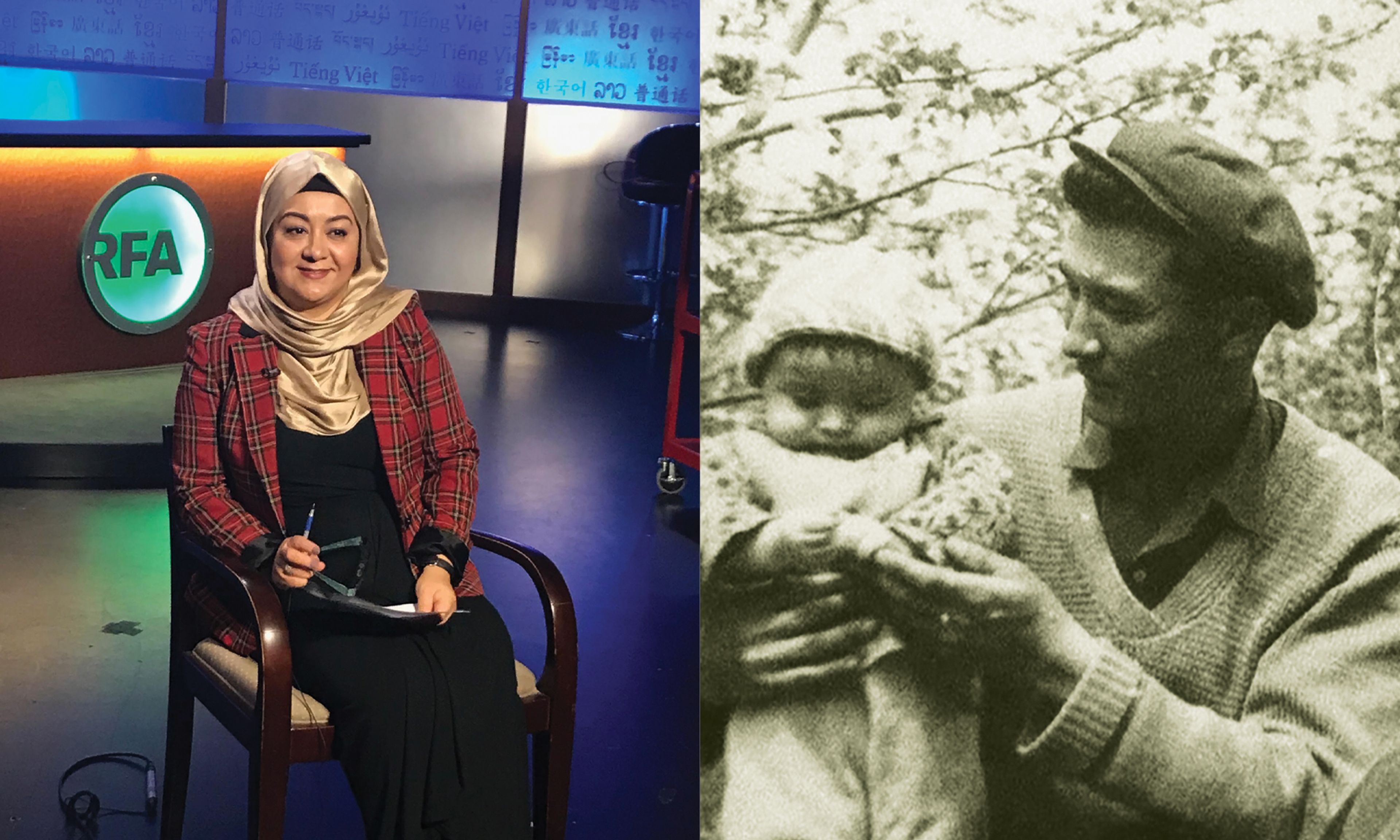
Gulchehra Hoja is well named. Her first name refers to the face of a flower: warm, smiling, full of hope. Her last name means “teacher,” or “knowledgeable person.” “Gul,” as she is known to family and friends, is indeed smiling. But there is a lot to despair over.
Another linguistic matter: “Uighur” or “Uyghur”? Gul prefers “Uyghur,” and she wishes that our media would unite on this little matter. One people ought to have one spelling, she says, not two.
How about “Xinjiang Province” versus “East Turkestan”? “We all hate that ‘Xinjiang,’” says Gul, with a bite and a laugh. The name “Xinjiang” means “new frontier,” or “new borderland,” in Chinese. It is “the political name of our country right now,” says Gul, but “our East Turkestan has thousands of years of history.”
For many years, she had to explain to people in the United States and elsewhere what a Uyghur is. Now, unfortunately, most people know. “We had to pay so high a price for that knowledge,” she says, again with a laugh.
The Chinese government has turned East Turkestan into a wretched, shocking surveillance state. They have set up a network of concentration camps, a gulag archipelago. What goes on in those camps? Brainwashing, drugging, forced abortion, forced sterilization, torture, starvation, rape, forced labor, murder. Children are separated from their parents, placed in their own camps.
On the outside, Han Chinese men are moved into Uyghur homes, to live with the women and children there — women and children whose husbands and fathers are in the camps (if they are still alive).
In short, the Chinese government is trying to break the Uyghur people. The government is trying to break Uyghur culture, Uyghur identity, and often Uyghur bodies. Some call it genocide, with ample justification.
Gulchehra Hoja knows exactly what’s going on in East Turkestan. She has interviewed many escapees, prison guards, and others. She is a Uyghur-American journalist, working for Radio Free Asia. She has won awards for her work — the Magnitsky Human Rights Award, for example. But she has paid a terrible price, and so has her family.
Gul was born in 1973, in the capital of her “country,” as she calls it. Ürümqi is the capital of East Turkestan. Her father, Abduqeyum Hoja, was a well-known archaeologist and author. Her mother, Qimangul Zikri, was a pharmacist and professor of pharmacology. They have one other child, a son, Kaisar Qeyum. “He is only a year and a half younger than I am,” says Gul, “but he will forever be a baby brother to me.”
One of Gul and Kaisar’s grandfathers, Zikri Elpetta, was a well-known composer. With colleagues, he established a Uyghur arts-and-culture center. Gul and Kaisar grew up around musicians, dancers, and poets. In 1992, Gul traveled to Japan, to participate in a student dance festival. She won a gold medal.
She, her brother, and their peers grew up in a relatively relaxed time. Mao’s Cultural Revolution ended with that leader’s death in 1976. Gul studied in Uyghur schools, staffed by Uyghur teachers, teaching in the Uyghur language. There were relatively few Han Chinese in the land. But things changed after the collapse of the Soviet Union.
Chinese leaders were spooked by this collapse. Suddenly, there were independent Turkic countries, such as Kazakhstan, Kyrgyzstan, and Uzbekistan. Chinese leaders were wary of a Uyghurstan or any other such country. They imposed a stricter rule, and moved many Han Chinese into the region.
Gul studied at Xinjiang Normal University, concentrating on the Uyghur language and its literature. Her plan was to become a teacher — but she went into television, creating and hosting children’s programs. These were the first TV children’s programs East Turkestan had ever known. “In a way, I did become a teacher,” Gul notes. She loved her work, and soon was a household name.
She worked not only for Xinjiang TV, in Uyghur, but also for CCTV — China Central Television — in Chinese. She appeared in music videos, commercials, movies. She confesses she was a bit of a star.
Eventually, however, she was unsettled by what she had to do. She was serving up propaganda. For example, she had to report on Uyghur children who had been taken from their villages to the “mainland.” (Gulchehra Hoja refers to East Turkestan as “our country” and China at large as “the mainland.”) The Uyghur children were being turned into Chinese. They suffered a great deal, she could see. But she had to report that they were happy and appreciative.
Fatefully, she took a trip to Europe in 2001. She spent a lot of time staring at a relatively new thing: the Internet. This was not possible back home. Gul learned what Uyghurs in the diaspora were saying and doing. She saw the work of Radio Free Asia, based in Washington, D.C. She felt a wave of shame about what she had been doing — the machine she had been serving.
While in Vienna, she offered her services to RFA. She knew, of course, that this would have a big impact, not only on her own life but also on the lives of her family. She felt she could do no other, however. “I couldn’t lie anymore.” She wanted to broadcast the truth.
Once she got to America, she placed a call home. She told her father where she was and why. He was silent, taking it in, for ten or 15 seconds. Then he said, “Oh, my brave daughter.” He and his wife are very proud of what Gul has done.
Immediately, they were targeted by the authorities: interrogated, harassed. They were forced to retire from their jobs. Other family members were similarly targeted, and so were Gul’s friends. The evidence of her career — tapes, movies, etc. — was banned. They were trying to make Gul an un-person.
In America, she knew no one, and she knew no English. As she put it in a talk last year, “I went from being a somebody to being a nobody.” But she carried on with her work, her calling. She married a Uyghur who had been born in Soviet Kazakhstan. They have three children, two girls and a boy.
Gul’s brother, Kaisar, was once set to marry. But the Chinese authorities put heavy pressure on the family of the bride-to-be. Kaisar has never married. To say that this and other things weigh heavily on Gul would be a gross understatement.
In 2017, China cracked down, with mad ferocity, rounding up Uyghurs en masse. Radio Free Asia was in the forefront of reporting on these events. China accused Gulchehra Hoja of being a terrorist, putting her on the Most Wanted list. Kaisar was arrested and thrown into the camps. Authorities told his parents that it was because of Gul’s reporting.
There are 15 Uyghurs, or Uyghur Americans, working at RFA. They are very close, as you can imagine. Eight of them currently have family members in the camps. The Chinese government is trying to silence the journalists. It’s not working.
On January 28, 2018, Gul published an interview with a camp survivor. It was the first such interview to appear in the media. It caused a great stir. On the night of January 31, a full 25 of Gul’s relatives in East Turkestan were rounded up. Some, she has never met: They were born after her defection.
Her mother, Qimangul, was imprisoned for two months. Her father would have been, but he had had a stroke, and was in a hospital: isolated, as an enemy of the people. He, too, has been labeled a terrorist, this elderly archeologist. In prison, Qimangul saw and suffered many horrors. She managed to tell her daughter about them, in a phone call later. There was no water to drink. The food was foul, noxious, and Qimangul did not want to eat it. But she did, to survive — for the sake of her daughter, she said. Qimangul did not want Gul to blame herself if she died.
Mother told daughter something almost funny: “You must be doing a good job, because you have made them very angry.”
In recent days, Gul has had an experience that few of us ever will: She watched her mother and her brother, on video, giving forced testimony. Kaisar was made to denounce Gul. Nonetheless, she was overjoyed. She knew he was simply reading from a script — and he was alive! The video proved it. Kaisar had not been out of prison very long, Gul could tell: His hair was just starting to grow back. “I know him, and he loves his hair. He was a very handsome guy.” To see him alive — even in rough shape — meant everything to her.
Qimangul’s script had her saying that her life was nice and normal in Xinjiang Province. This was obvious nonsense. And Gul felt her mother’s love for her come through, even in that awful video.
Gulchehra Hoja does not regret the decision she made in Vienna, in the summer of 2001: the decision to leave China and go to Radio Free Asia. But, again, the weight on her shoulders, and on her conscience, is very, very heavy. “My body is here,” in the Washington area, “but my mind and soul are back home.” She never stops thinking of her relatives and other Uyghurs in the camps, deprived of the basics of life. “Every sip of water I drink, I think about them.”
Through tears, she says, “I just want to be a good girl for my parents. Even one meal, I cannot cook for them!” A proper Uyghur Muslim daughter is supposed to care for her parents, especially when they are elderly. This, Gul cannot do — but she is doing a lot.
Her work, she says, enables her to hold on to her sanity. The knowledge that she is providing a voice for the voiceless. The fact that she and her colleagues are countering the barrage of lies that the Chinese government tells every day.
I ask her whether she has final words for an American audience. “Enjoy your freedom,” she says. “Appreciate what you have, every day.” Also, “remember that we are all connected. We are a big family in this world, on this globe, the only globe we have. Pay attention to those who are suffering” — Uyghurs, Syrians, others. “The world will be better if we hear each other, if we love each other. Be a human. A grateful human. I think tomorrow will be better.”







Comments