To assert that there must be due process of law before the state exacts punishment was, seemingly until moments ago, to assert a principle so foundational to the requirements of a free, prosperous society as to be humdrum. Now, to make such a statement is a firing offense. The city manager of Brooklyn Center, on the outskirts of Minneapolis, has learned this the hard way.
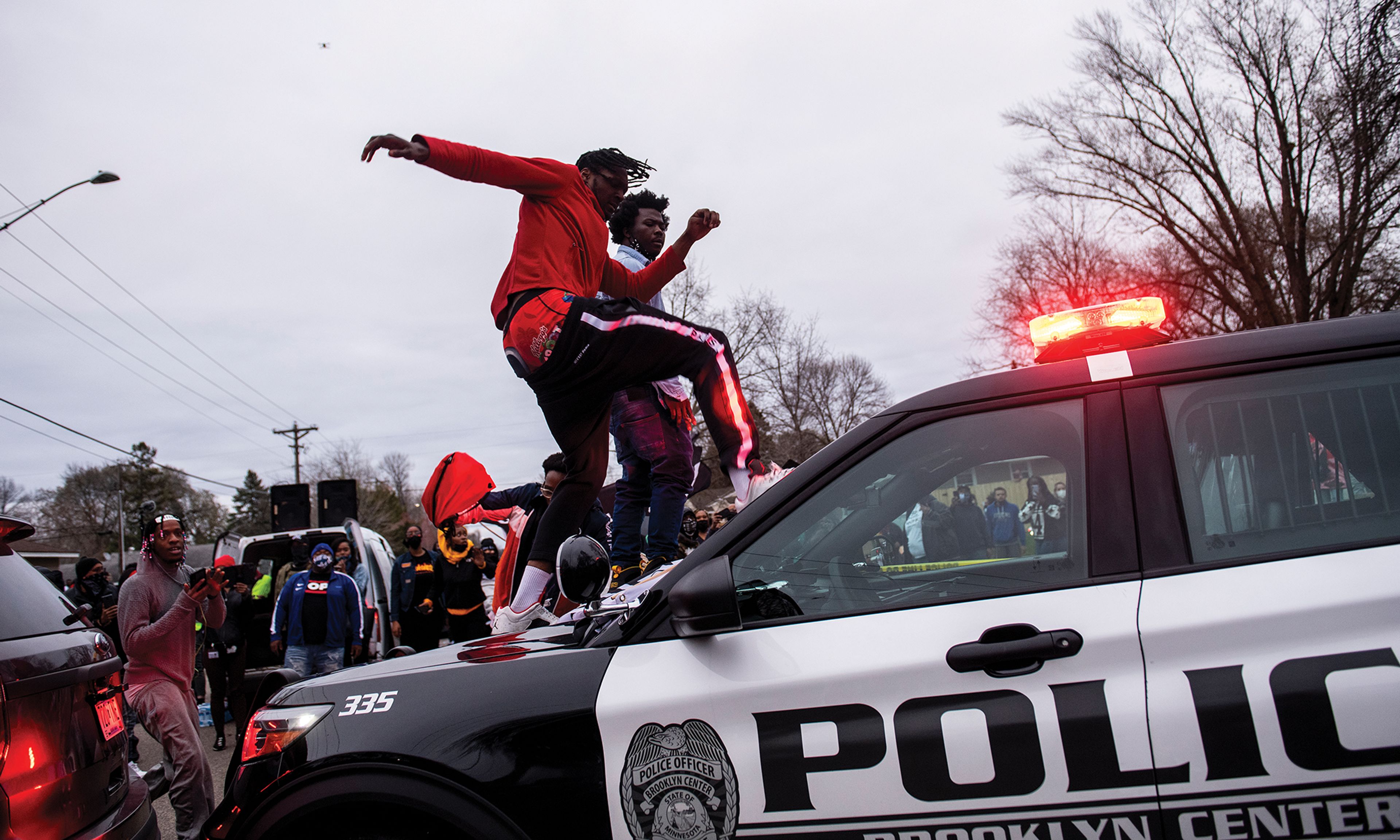
The town was aflame, as is now the social-justice ritual, after an unimaginable tragedy. At about 2 p.m. on Sunday, April 11, the local police pulled over Daunte Wright, a 20-year-old black man, based on what they said was a traffic violation related to expired registration tags. Running his identification through the system, as is routine, the cops learned that there was a warrant for Wright’s arrest. He had allegedly fled from Minneapolis police last summer when they were investigating his brandishing of a loaded Ruger .45-caliber handgun for which he had no permit. An arrest warrant had then been issued when he failed to appear for a hearing on the matter. Because of the warrant, the Brooklyn Center cops tried to detain him at the traffic stop. A struggle ensued as he broke free, got back in his car, and tried to flee.
Police body-camera recordings captured the horror that followed. Kimberly Potter, a 26-year veteran cop who spent much of that time training junior officers, warned other police on the scene that she was about to stun Wright with her Taser. In the frenzied moment, she mistakenly grabbed her gun and fired a round, killing Wright. It was an egregious accident, but an accident nonetheless.
As is customary in police shootings, Potter was immediately placed on administrative leave as an investigation of the incident began. Naturally, the fact that she was no longer performing police duties, and was unlikely ever to perform them again, was not good enough for the angry Left. Brooklyn Center mayor Mike Elliott proclaimed that Potter must be fired instantly, notwithstanding that she was a civil servant entitled to various legal protections prior to termination — what is quaintly known as “due process.”
At the time, city manager Curt Boganey, a longtime, well-regarded public employee, demurred to the mayor’s demand. All Brooklyn Center employees, Boganey said, “are entitled to due process with respect to discipline.” He continued, “This employee will receive due process, and that’s really all I can say today.” An utterly unremarkable statement, right down to the no-further-comment coda, which itself was emblematic of the due-process principle that government officials should not make gratuitous public remarks that could undermine the integrity of a legal process.
Mind you, Boganey was not implying that the suspended Potter was ever going to work as a cop again. He was merely honoring his responsibility to follow the legal procedures that a government is obliged to follow before terminating a public employee.
Was obliged to follow, that is, before the reincarnation of what Manhattan Institute scholar Fred Siegel calls the “riot ideology.” As demonstrations over Wright’s killing quickly turned violent, the city council convened an emergency meeting at which Boganey was fired. “He was doing a great job,” one member told Fox News, lamenting that she’d voted to remove the city manager owing to fears of “repercussions” from protesters if the council failed to act against his ode to the rule of law.
The two decades of mayhem that began in the 1960s were aimed at extorting public funds on the pretext of reforming cities and eliminating racism. By contrast, Siegel explains, today’s riot ideology, refined by Black Lives Matter Marxism and expressed in the writings of Ta-Nehisi Coates, holds that “America is inherently racist beyond redemption and that the black inner city needs to segregate itself from the larger society (with the exception of federal welfare funds, which should continue to flow in).” The most notorious manifestation of this aggression has been “defund the police” campaigns — with the funding, of course, being redirected toward favored progressive programs and the underwriting of woke activism.
A less well-appreciated development, one whose damage will be hard to undo, is the erosion of due process.
Few even pretend that the “protests” over Wright’s killing have been “mostly peaceful,” as the media-Democratic mantra goes. The rioting, burning, looting, and destruction of local businesses started instantly, persisted for over a week, and resulted in well over a hundred arrests — after another ritual: the initial mandate of police passivity, leading inexorably to an urgent need for police intervention. In part because of police involvement in an incident that ignites violent demonstrations, and in part out of officials’ ill-conceived hope that rioting will burn itself out, cops are first encouraged to desist in enforcing the laws; this only whets the sociopathic appetite, and as more businesses are destroyed and lives shattered, there follow the inevitable demands for police intervention.
There was no need to fire Officer Potter. She had promptly resigned after the incident, as had the department’s chief. It does not minimize the incommensurable sorrow of Daunte Wright’s family to observe that Potter’s life is shattered. The home of the 48-year-old mother of two adult sons, who is married to a retired police officer, has been barricaded by concrete blocks and iron fencing — like other attractive rioting targets in the Minneapolis area.
The resignation, of course, was not enough. With the mob baying for blood, Potter was swiftly taken into custody, charged with second-degree manslaughter, and not released until she had posted a $100,000 bail bond. “Protesters” made sure to march in the vicinity of the home of Washington County Attorney Pete Orput, demanding that he charge Potter with murder. The prosecutor dutifully vowed to proceed aggressively, though so far he has not upped the ante, maintaining that second-degree manslaughter is the right fit.
It’s not. The criminal-justice system is designed to address intentional and malicious wrongs — crimes, not torts. Accidents, no matter how grievous, are almost never fit for criminal prosecution. When they result from negligence by police or other public officials, they are grist for terminating the wrongdoer and for immense civil payouts.
If due process were worthy of the name, Potter would not face prosecution. Her error, while astounding, is not unprecedented. Out of over 4 million recorded Taser discharges in the last 20 years, there have been about a dozen known instances of accidental gunfire by cops who mistook their guns for their stun guns.
Under Minnesota law, “culpably negligent” homicide — i.e., manslaughter in the second degree — requires proof beyond a reasonable doubt that the defendant created an unreasonable risk and consciously took a chance of causing death. It is not an unreasonable risk for cops to be armed with Tasers and guns — even if, in a statistically negligible number of cases, police mistakenly fire the gun, we should still prefer that they have the option of effective, nonlethal force. Moreover, Potter did not create the risk; the municipality decides how to arm police. That is, Potter made a terrible blunder while consciously taking a reasonable, publicly approved risk. That is not manslaughter.
But she’ll be tried for it, and maybe for murder, too. Elliott, Brooklyn Center’s first black mayor and one of the tens of thousands of Liberian immigrants who have settled in the city, has called for Minnesota’s ambitious, progressive attorney general, Keith Ellison, to take over the prosecution — just as he took over the prosecution of the four Minneapolis cops responsible for George Floyd’s death last Memorial Day.
The most infamous of those cops, Derek Chauvin, was standing trial for murder in a courthouse ten miles away when the Brooklyn Center tragedy and consequent rioting took place. As one would expect, Chauvin’s counsel immediately moved for sequestration of the jury. It was an eminently reasonable proposal. The trial was in its last days of hearing evidence; the jury was going to be sequestered during deliberations anyway. One juror in Chauvin’s trial lived in Brooklyn Center, and others had ties to the city. Not only was rioting proceeding apace; the demonstrations inevitably spilled into Minneapolis (among other cities). The intense publicity surrounding Chauvin’s trial now connected his lethal detention of Floyd with Wright’s killing, under the defamatory narrative that white cops are hunting down young black men.
Yet Judge Peter Cahill declined to sequester the jury. Not just that: He gave everyone a long weekend, reasoning that because the case was complex — involving technical medical evidence and voluminous use-of-force testimony and manuals — the lawyers should have Friday off to prepare for summations.
Thus was the jury sent home, rather than insulated from press coverage, as the inveterate rabble-rouser Maxine Waters stormed into town. The California Democratic congresswoman violated the curfew imposed to tamp down the rioting and warned that the verdict in Chauvin’s trial had better be “Guilty, guilty, guilty,” or protesters would have to get “more confrontational.”
Though he denied Chauvin’s resulting mistrial motion, Judge Cahill later conceded that Waters’s provocation could give Chauvin an argument to get any convictions thrown out on appeal on due-process grounds. True enough, but Cahill was also blame-shifting.
Chauvin had forcefully contended from the start that he could not get a fair trial in Hennepin County, the epicenter of the George Floyd riots. Cahill refused to move the trial, reasoning that he’d blunt any danger of unfair prejudice by conducting a rigorous jury-selection process. Yet Minneapolis, the jurisdiction constitutionally obliged to give Chauvin due process, chose jury selection as the perfect moment to announce an astronomical $27 million payment to the Floyd family to settle a civil-rights case — effectively branding Chauvin a murderer.
The publicity surrounding the trial was heated and ubiquitous. Defense mistrial motions were shunted aside. After the long weekend of riots, the court directed that summations proceed, after which the jury would deliberate. As deliberations got under way, the left-leaning Star Tribune, a prosecution cheerleader throughout, published biographical details about the jurors — not their names, but more than enough for a snoop of average competence to pierce the veil of anonymity that they’d been promised.
Remember that day off the judge gave the lawyers to prepare summations because the testimony and the applicable law were complicated? Well, the jury deliberated for just a few hours before announcing it had reached a verdict. No notes to the court seeking to have testimony reread. No layman requests for clarification on abstruse points of law. Just rapid-fire convictions on all charges: two counts of murder and one of manslaughter.
The defense says the former cop was denied due process. The mob says it’s a start.











Comments