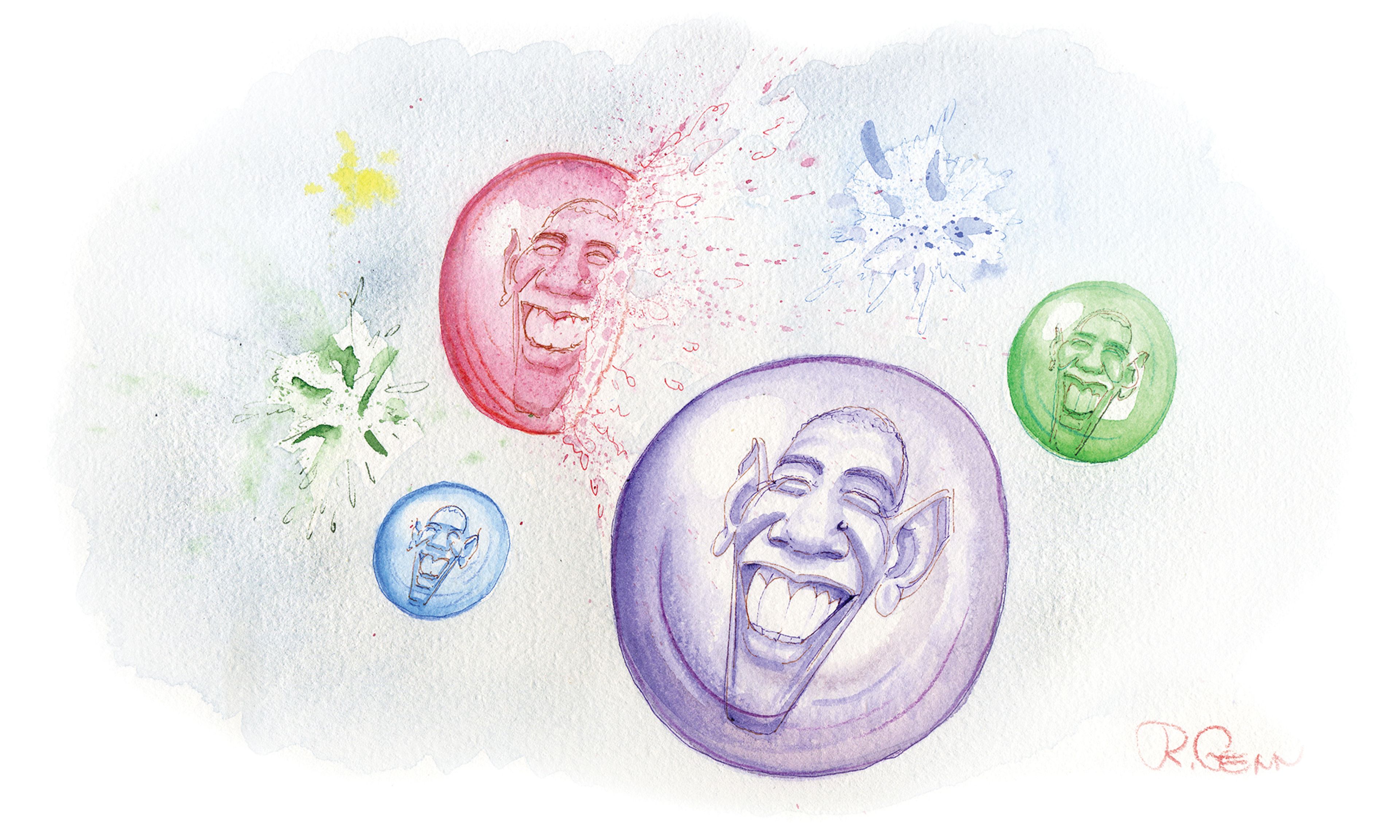
Democrats are determined not to repeat the mistakes they made during the Obama years. But their assessment of the successes and failures of the last Democratic president has been more wishful than hardheaded, and the lessons the party has learned are correspondingly mistaken.
The fact that Democrats in D.C. are trying to avoid replicating mistakes rather than building on achievements itself marks a change in their view of Barack Obama. High, sometimes messianic hopes greeted his ascension to power. Oprah Winfrey called him “the one” during the 2008 campaign. A columnist for the San Francisco Chronicle reported, “Many spiritually advanced people I know (not coweringly religious, mind you, but deeply spiritual) identify Obama as a Lightworker.”
Many liberals thought that Obama would bring the conservative, market-oriented era begun by Ronald Reagan to an end. The moderation that Bill Clinton had considered essential to winning the presidency for the Democrats could be cast aside, and the party could begin a long reign.
“From top to bottom, Democrats have decided to bet the party’s future on the belief that Americans prefer bold liberals to cautious ones,” the liberal pundit Peter Beinart wrote. James Carville, the Democratic consultant, wrote a book about the 40 years of dominance to come. Time magazine ran a cover story about the potential extinction of the Republican Party after the calamity of George W. Bush’s second term.
While Obama has remained extremely popular among Democratic voters — he had a 95 percent rating from them at the end of his presidency, according to Gallup — the hope that he would define an epoch was dashed. In part that’s because while Reagan was able to hand the White House to an ally, George H. W. Bush, Obama had Donald Trump to succeed him. Obama’s presidency had evidently not ushered liberals into a better world.
The reappraisal of Obama is also a function of the Democrats’ continued movement left. He may have looked like a bold progressive in 2009. Now his surging of troops into Afghanistan, his expansion of drone strikes, and his deportations seem disturbingly retrograde to many of them.
These two strands of progressive disenchantment with Obama have come together in Joe Biden’s first months in the White House. Many Democrats have persuaded themselves that their political failures during their last spell in power were the result of their not having been bold enough. They naïvely believed that congressional Republicans would negotiate with them in good faith, and so, they now say, they advanced proposals that were less far-reaching than they wanted. The Republicans strung them along for months, as the Democrats see it, and then voted as a bloc against Obama’s bills for cynical political reasons.
Democratic politicians are convinced that if they had passed a larger stimulus bill in 2009, the economy would have recovered faster and they would not have lost 65 House seats in the 2010 elections. The 2009 stimulus “wasn’t enough,” President Biden said earlier this year. Senate majority leader Chuck Schumer has said that “Congress was too timid and too constrained” back then.
Some in the left wing of the party believe further that Democrats should have pushed harder for the federal government to provide health insurance directly to millions of working-age, middle-class Americans as part of Obamacare. It would have been more popular, they think, than the mix of mandates, subsidies, and regulations that the Democrats actually passed in a vain attempt to make the plan more congenial to Republicans.
The Democrats have crafted an elaborate mythology to portray themselves as the victims of Republican perfidy. Many Democrats have claimed, for example, that Senate Republican leader Mitch McConnell said that his top goal was to make Obama a one-termer just as he was taking office. What McConnell actually said, about halfway through Obama’s first term, was that he hoped the president would moderate and that he would work with him if he did, but that otherwise he would have to be defeated for reelection for Republican legislative goals to be achieved.
Democrats also say that Obama went to Capitol Hill to share ideas about the stimulus with House Republicans at the start of his presidency, only to learn that Speaker of the House John Boehner had already issued a statement opposing the stimulus. In fact, House Democrats had already introduced a bill without Republican input, and Republicans had already made their opposition clear. At the meeting, Obama said he was willing to change the bill. Afterward, Republicans voted en masse against the House Democrats’ bill. Boehner said he still wanted to work with Obama on a stimulus.
In recollecting the fight over Obamacare, Democrats also exaggerate how far they went to address Republican concerns. They ditched the “public option” because of opposition from moderate Democrats, not Republicans. They refused to add medical-malpractice reform to the bill, even though it would have required no adjustment to Obamacare’s basic structure. White House chief of staff Rahm Emanuel shot down the idea because it would have angered the Democratic base. (We know that because his brother Ezekiel, who advised Obama on health care, wrote about it in an op-ed years later.)
Whether Democrats could have changed the economic and political trajectory of the Obama years by going for a larger stimulus is also open to question. A CNN poll in early 2010, months before the midterms, found that three-quarters of the public thought that at least half the stimulus money had been wasted. Making the stimulus bigger probably would not have improved that perception.
The economic argument for the stimulus depended on theories and models that assumed additional government spending would have led to a stronger recovery. But those theories and models overstate the positive effects of stimulus by failing to account for the way fiscal policy affects monetary policy. A bigger stimulus would, presumably, have led the Federal Reserve to make fewer asset purchases and to accelerate its schedule for raising interest rates, negating much of the positive effect. Democrats would likely have gotten a bigger economic boost out of urging the Fed to take expansionary moves such as ending the payment of interest to banks for holding excess reserves.
The Democratic second-guessers are right about one thing: If a bigger stimulus had made for a stronger economy, it would have helped Democrats in the 2010 election. But the scale of their defeats was larger than models based on the state of the economy predicted. Three political scientists summed up their research findings a few months later: “The economy and the president’s middling ratings indicated that the Democrats would lose seats. But by advancing controversial legislation the Democratic leadership appears to have turned a probable big loss into one of historic proportions.” Spending more money and passing a more left-wing health-care bill — assuming these things were even possible in Congress — might have caused more Democratic losses, not fewer.
It would be foolish for the Biden Democrats to drive forward by looking at their rearview mirror, even if that mirror were not distorted. Whatever should have been done in 2009, the economic situation in 2021 is very different. The recovery from the pandemic recession looks much more robust than the one that took place after the Great Recession, and the case for stimulus is therefore weaker.
There is also something superfluous about the Democrats’ current story about the Obama years. They had the votes to pass a $1.9 trillion stimulus, so they did. There’s no bipartisanship clause in the Constitution that requires them to scale back their ideas to get Republican votes. They could have passed the bill without pretending that Machiavellian obstruction by Republicans had crippled the last Democratic presidency.
A clearer look at the political history of the Obama years and, indeed, the past few decades might yield a very different conclusion from the one Democrats have drawn: Most sweeping policy initiatives have backfired on the party that proposed them. The Clinton health-care plan, Bush’s Social Security reform, Obamacare, the Republican effort to replace Obamacare: All of them showed a public that might sometimes reward revolutionary rhetoric but also deeply feared change.
But that’s not what Democratic politicians and activists want to hear, any more than Republicans in power have wanted to hear it. The purpose of the Democrats’ narrative of the Obama years is the same as that of many stories people tell themselves: to rationalize doing what they already wanted to do.








Comments