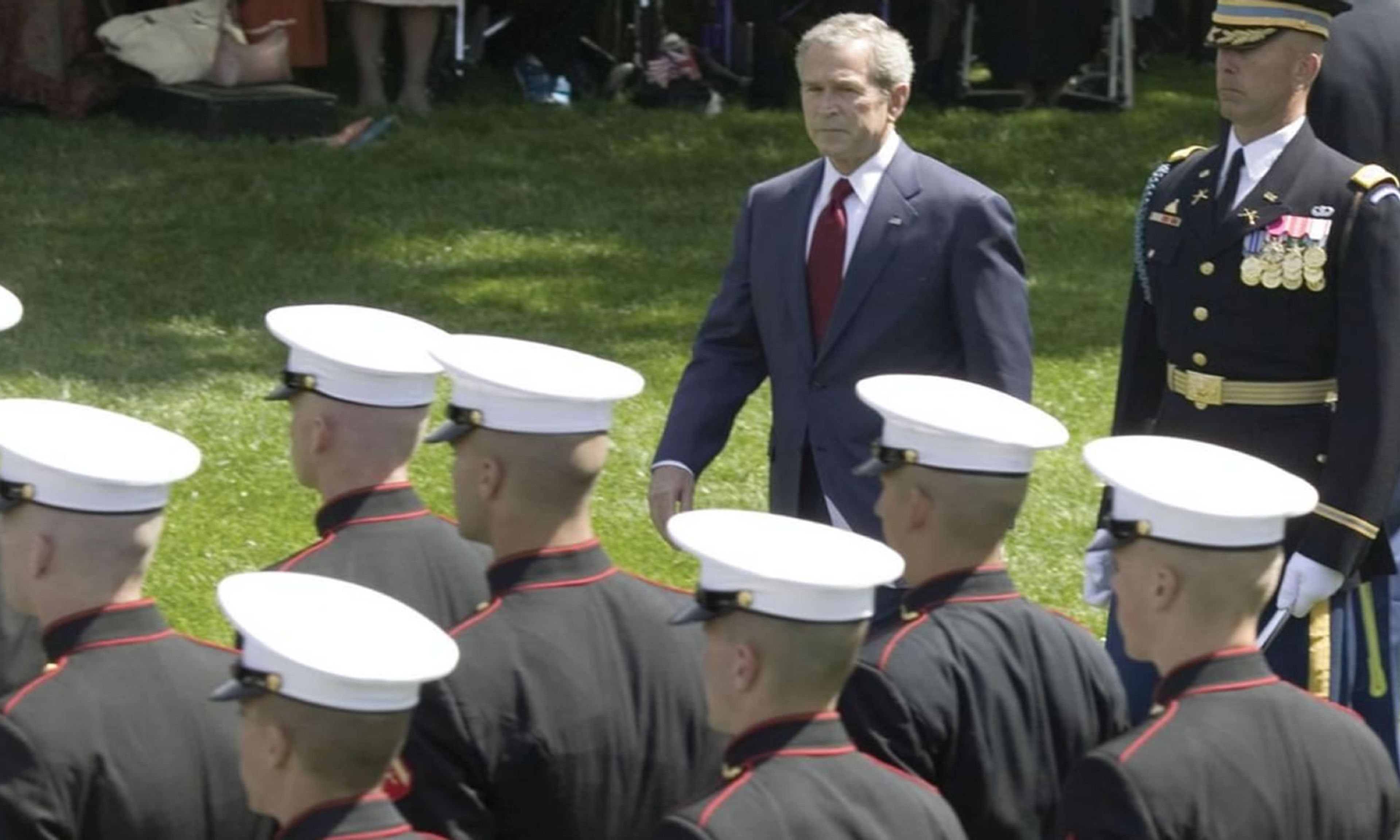
Paradoxically, the post–Cold War “unipolar moment” of American power has also been a period of constant crisis in American civil-military relations. Even Operation Desert Storm, now romanticized as a golden moment of the prudent use of armed force, had moments of extreme tension and uncertainty. We won’t know the details of the Obama administration’s debates over Libya for some time, depending on how soon we get the next Bob Woodward fly-on-the-wall book, but it’s a safe bet that the story will be similar.
Adding further to the paradox is the amazingly successful experiment of the All-Volunteer Force. The AVF was something of a hasty, ad hoc creation of the end-of-Vietnam era, but it has proved itself remarkably resilient and adaptable — in a word, professional — in ways never previously imagined. Its ability to reinvent itself as expert in the kind of irregular, counterinsurgency warfare that might have led to a different outcome in Vietnam gives the AVF tale a kind of cyclic completeness.
In sum, Americans find themselves in possession of a beast many of the founders would find abhorrent: a standing army. It’s an “imperial” army, too: U.S. forces defend immensely far-flung frontiers, eastward across Eurasia to the Hindu Kush and westward across the Pacific to Japan and Korea. And it’s a remarkably small force: While its mission is global and even extraterrestrial, it draws on less than 1 percent of the population, even if the overworked “reserve” is included.
One definition of paradox is “something that can’t go on forever” — and therefore Mackubin T. Owens’s study of U.S. civil-military relations, and his suggestions for “renegotiating the bargain” between American soldiers and American society, deserve the close attention of students of military affairs and geopolitics. In strategy and war, the means of power are inseparable from the ends of power, and the principal tools of American statecraft — despite all the popular talk about “soft power” and “smart power” and “reticent power” — are suffering from neglect: material neglect, as measured in aging weapons, insufficient manpower, and budget restrictions, but especially the political neglect of the elite classes.
As Owens observes, the link between citizenship and military service is increasingly tenuous. “With the end of the draft,” he writes, “the United States military has assumed a character closer to that of the long-term enlistee on the Western American frontier or serving in China or the Philippines during the early twentieth century than to the true citizen-soldier who serves during an emergency and then returns to civilian life.”
Three chief characteristics make our current volunteers different from the revered citizen-soldier ideal. First, military service is too often institutionally regarded as a kind of self-actualization therapy. Think of the “Army of One” commercials: They pictured not a “band of brothers” but a hard-bodied athlete running alone in a vast desert. In contrast to the lifetime service of the horse soldiers who served with John Wayne in Fort Apache, promotion and upward mobility are not only possibilities for today’s soldiers but actually requirements, as are decent pay and lifetime benefits. These may be the justly earned rewards of service and potential sacrifice, but they also can make for a kind of “special interest” in tune with, but distinct from, the broader national interest. It will be interesting to see, for example, whether — in the effort to restrain entitlement spending — military entitlements such as medical TRICARE for life are on the table along with troop and weapons cuts.
Second, the notion that the military represents a true demographic cross-section of American society is fictitious, as the repeal of the don’t-ask-don’t-tell law preventing open homosexuals from serving reveals. Harvard may, in turn, have repealed its ban on Reserve Officers’ Training Corps units on campus, but Ivy-type universities aren’t soon likely to be a major commissioning source; it’s been generations since American elites believed they had an obligation to take up arms in service to their country. And the military will not be enthusiastic about investing precious recruiting dollars in the Northeast. It’s much easier and more culturally congenial to look for young officer candidates in the South and Southwest.
Third and finally, the 35-year history of the All-Volunteer Force has created a deeply rooted identity among people in uniform that divides them from the civilian world. The traditional American citizen-soldier ideal is of military service that is essentially, as Owens puts it, “temporary and provisional.” By contrast, today’s professional identity is all but permanent — “Once a Marine, always a Marine” — and frequently passed from generation to generation.
To some degree, these traits are inherent in what Owens describes as the All-Volunteer Force “bargain.” As a society, we have agreed to tolerate a standing army, a large and professional military, to meet the needs of defending a world’s worth of strategic interests at a minimum cost and with the least disruption to the civilian pursuit of happiness. But the cumulative effects of post-9/11 operations in Iraq and Afghanistan, and the coincident rise in civil-military strife, suggest that this bargain needs to be renegotiated, even rewritten from scratch.
From the 2006 “Revolt of the Generals” calling for then–defense secretary Donald Rumsfeld to resign to the agonizing months of the Obama Afghanistan reviews of 2009 to the multiple general-firings by current Defense Secretary Robert Gates, the strains of a decade of constabulary, counterinsurgency combat seem to be widening the longtime gap between civilians and the military. For its part, the Obama White House has been nearly paranoid about the political influence of generals, particularly the surge star, Gen. David Petraeus; despite his many denials, the prospect of a Petraeus presidential bid has put the administration on edge, as Woodward chronicles in Obama’s Wars.
But the most dangerous fissure in civil-military relations is probably occurring at a lower level, among the mid-grade officers who have been most heavily engaged in constant operations and thus even more distanced from the currents of domestic politics. A recent article in the professional journal Joint Forces Quarterly by Marine colonel Andrew Milburn suggests what may be going on under the general-officer surface. The article, “Breaking Ranks: Dissent and the Military Professional,” advances an expanded understanding of professionalism that infringes on civilian supremacy and calls into question the need to obey lawful orders. His argument is detailed and comprehensive, but its faulty premises are apparent in the conclusion. “Military leaders,” Milburn writes, “are committed to challenge their civilian masters if [their] policy appears to be unconstitutional, immoral, or otherwise detrimental to the institution.” Officers are, of course, not bound to follow an immoral order; but questions of constitutionality are not to be decided by the Joint Chiefs of Staff. And “detrimental to the institution” is an exception that puts the good of the service above the good of the state, the Army before America.
Military leaders may well raise such questions in private deliberations over policy, but only in the context of what Owens, following Eliot Cohen’s book Supreme Command, describes as the “unequal dialogue” between soldiers and statesmen, in which discussion may be open but the decisions are the responsibility and the job of the civilians. Yet Milburn contends that officers have a “moral obligation to dispute” orders they deem unconstitutional or detrimental to their institution, and “to dissent in a manner that has the best chance of averting those consequences.” That is, the end justifies the means.
If this is what some officers now consider the nature of the “bargain” of the All-Volunteer Force, it is no wonder Mac Owens wants to renegotiate. However, it may also be that the rot has gotten deeper than Owens thinks. He rightly argues that healthy civil-military relations entail more than just civilian control, but takes for granted that the principle of civilian control — the premise that frames the “unequal dialogue” — is “accepted without question in the officer corps.” Milburn may indeed be an extreme case, but there has been a trend in his direction in recent years; the widely acclaimed writings of Army colonel Paul Yingling, notably in a number of Armed Forces Journal articles, echo some of Milburn’s themes.
In the end, any effort to bridge the civil-military gap depends not only on the willingness of military leaders to obey commands they may not like (but that are nonetheless lawful and moral), but on civilians’ educating themselves and constantly involving themselves in the details of tactics and the conduct of military operations. The dialogue ultimately may be unequal, but it needs to be a two-way, informed dialogue, not a monologue, and the process itself is critical. The art of civilian command of military force, employing the most terrible power of a state, is best grounded in an empathy that demands constant effort.











Comments