San Diego
Bill Walton, being a basketball legend, has a platform. Over the years, he has used it for a variety of purposes. Last year, he began to use it for one purpose in particular. You will get a taste of it in a Facebook post.
“Sadly, and with a broken heart,” Walton wrote, “I can no longer say that my hometown of San Diego is the greatest place in the world.” Nor could he say that it was “a safe, healthy, clean, and beautiful place.” Nor could he recommend that people come to the city “to live, work, and play.”
Why? The scourge of homelessness, an explosion of homelessness, blighting the city.
Homelessness is a scourge throughout the country, of course. California has gotten a lot of attention for it. San Francisco is now infamous for homelessness, and general disorder. Los Angeles has a new mayor, Karen Bass, who was sworn in on December 12. The first thing she did was declare a “state of emergency,” concerning homelessness.
San Diego? By consensus, it is one of the most delightful cities in the country. A mural downtown says, “Smile, You’re in San Diego.” And yet there is this vexing and tragic problem of homelessness.
Kevin Faulconer was mayor of the city from 2014 to 2020. “I spent more time on homelessness than on any other issue,” he tells me. He and others — including Bill Walton — say that the current mayor, Todd Gloria, has fallen down badly on the job. Walton has dubbed homeless encampments “Gloriavilles.”
The political whys and wherefores might be left to another piece. What I will relate here is that, in San Diego, there are many civic organizations confronting the problem. They are “points of light,” as the first President Bush would say.
One of them is the Lucky Duck Foundation (LDF), with which Walton is associated. His wife, Lori, serves on the foundation’s board. It is an energetic, conscientious board. The activities of LDF are manifold, with each one warranting something like a piece of its own.
LDF provides shelter — “Gimme shelter,” goes an old song. It is an urgent need. “We can’t go at the speed of government,” says Drew Moser, the executive director of the foundation. You have to go faster. LDF is concentrating on two categories of people: youth and seniors.
The foundation provides meals — to somewhere between 600 and 1,000 people a day. It provides coats that turn into sleeping bags. LDF has given out some 8,500 of those. They are made in Detroit, by formerly homeless people, and cost $150 each.
LDF funds job-training programs. And on and on.
One more thing: The foundation admonishes government to do its job — in particular, a job that civil society can’t do, namely law enforcement. Take care of crime.
LDF carries out some projects on its own, and many others in collaboration with others. Everyone working on this problem stresses that if you care more about results than about credit, you can go a long way.
The mission of the Lucky Duck Foundation is an interesting one, or interestingly worded: to “alleviate the suffering” caused by homelessness. No one fancies that the problem can be cured — can be erased outright. But to alleviate the suffering is a tremendous service.
LDF was founded in 2005 by Pat and Stephanie Kilkenny. Pat was greatly successful in the insurance industry. At first, LDF directed its philanthropy to an assortment of causes. Eventually, however, it focused on just one — the big one, the one staring everyone in the face: homelessness.
In 2016, the Kilkennys joined forces with Peter Seidler and Dan Shea, who had started the Tuesday Group. Every Tuesday, in Seidler’s office, businessmen and civic leaders meet to talk about what to do: what to do about this great problem. Every Tuesday? Yes.
What if Tuesday is Christmas, and then New Year’s Day? Doesn’t matter. The group meets.
Seidler is the owner of the San Diego Padres. (His grandfather, Walter O’Malley, owned the Brooklyn Dodgers, which became the Los Angeles Dodgers.) Dan Shea is a partner in an investment group. They corral their friends to get active on homelessness. So do the Kilkennys, so do others.
How, incidentally, did the Lucky Duck Foundation get its name? The symbol of the foundation is a four-leaf clover, with one of the leaves being a duck’s foot. Pat Kilkenny is an alumnus of the University of Oregon, whose teams are the “Ducks.” He is of Irish heritage (as his name tells you). And the idea is: The fortunate should help the less fortunate.
One morning, I am on my way to see a “bridge shelter,” owned by LDF. This is not a shelter on or under a bridge. (I certainly see people living under bridges.) “Bridge” is meant as a metaphor. These shelters serve as bridges between the street and something more permanent.
On my walk to the shelter, I see tent cities, or rather tent corridors, as the homeless line streets and sidewalks. Before you is the variety of maladies that come with homelessness. In addition to seeing, you smell.
One of the worst parts of being homeless is the inability to keep clean. People are often in their own filth, or exposed to others’. The stench is like an accent on this form of human misery.
When I arrive at the shelter — at 16th Street and Newton Avenue — everything is different. There is no smell. There is no dirtiness. There is peace, quiet, and safety. It’s like an oasis. “This is damn near a miracle,” I think.
The slogan of the Alpha Project, which operates the shelter, is “Where Miracles Happen!” The project is headed by Bob McElroy, who is a point of light almost literally: In 1991, he was honored by the Points of Light Foundation, which was started by President Bush.
When McElroy speaks of the residents at the shelter, he says “we.” This is not noblesse oblige. He himself was homeless, and he has experienced it all — all of those rotten maladies. His identification with the residents is total. This means, among other things, that he has high standards for them, and cannot be fooled.
“You can’t bullsh** a bullsh**ter,” McElroy observes.
The residents are afforded material comforts: a bed, a shower, a toilet, health care, etc. But, crucially, they are also afforded dignity.
When they first walk in, they are given an ID — a thing that maybe they haven’t had in a long time. “Out there,” on the streets, they’re nobody. “People walk by you and wouldn’t piss on you if you were on fire,” says McElroy. “In here,” they are somebody.
“Out there,” they’re a “bag lady,” a “dumpster diver,” a “panhandler,” a “drug addict,” a “crazy person.” “In here,” they’re a mom, a dad, a brother, a sister — a human being.
In the course of a long conversation, I ask McElroy, “What makes people homeless? Is it ever separate from mental illness, alcoholism, or drug addiction?” He says, in essence, “It’s bad choice after bad choice: a cavalcade of bad choices.” And it may take a Herculean struggle to straighten out.
“We don’t give up on anybody,” says McElroy, though people may stumble and fall, time and time again. “God didn’t give up on me.”
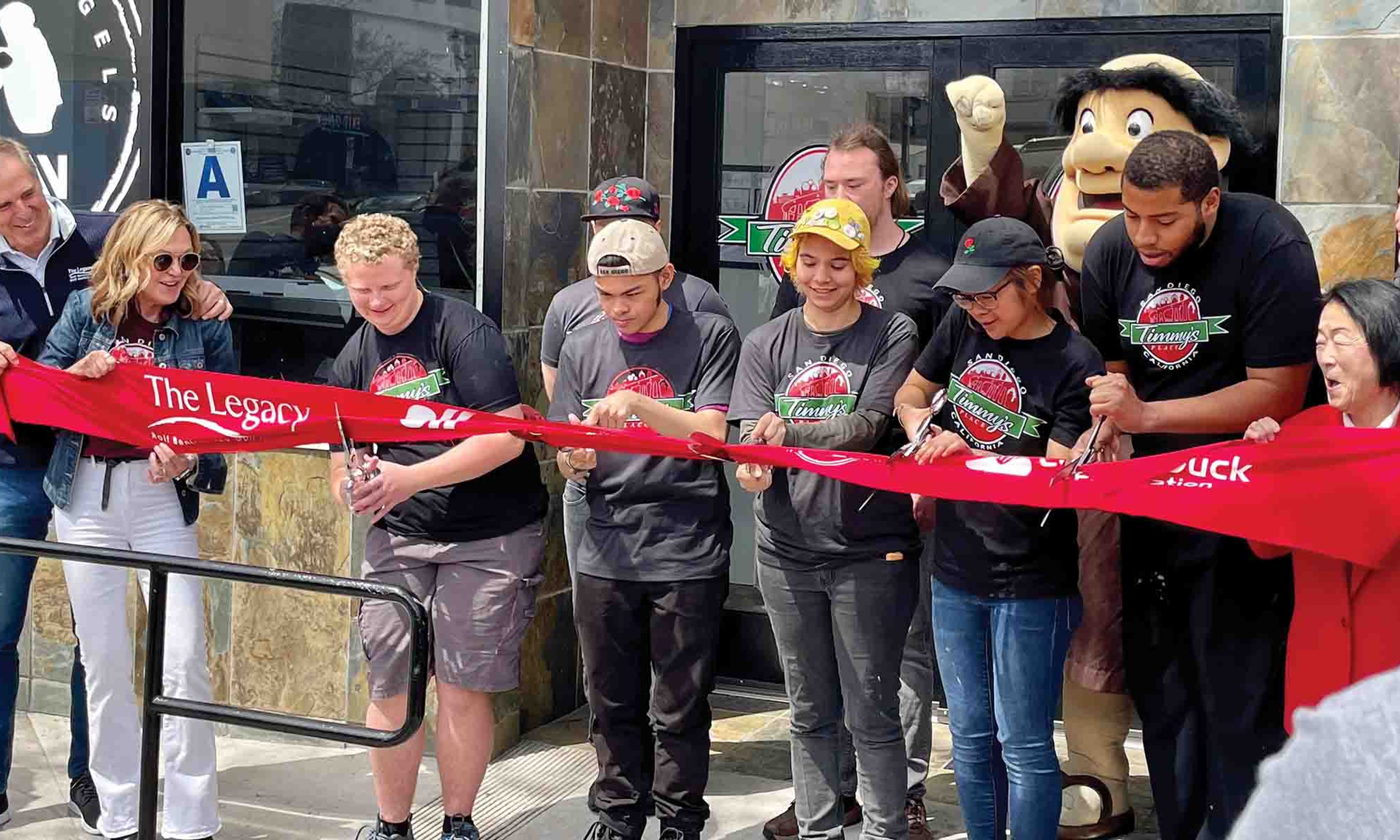
The next morning, I attend a grand opening, complete with ribbon-cutting. The new establishment is Timmy’s Place, which is a pizzeria and a print shop — an unusual combination. But this is an unusual business. It is on the ground floor of a shelter for young people, and the young people are the employees.
Who is Timmy? A son of Rolf and Mary Benirschke. Rolf is a favorite son of San Diego, a placekicker for the Chargers in the 1970s and ’80s. He and Mary have four children, three of whom have special needs. Timmy, they adopted from a Russian orphanage when he was three years old. “He’d been through unbelievable trauma,” says Rolf — “trauma we couldn’t even imagine.”
In San Diego, says Mary, Timmy had “a beautiful upbringing.” But when he was 18, “addiction just got a hold of him.” He was on the streets for five years. His parents were desperate to help him. Finally, Timmy got straight, and is working two jobs.
Timmy’s Place is an enterprise of the Rolf Benirschke Legacy Foundation, the Lucky Duck Foundation, and two other groups: Urban Street Angels (USA) and the Union of Pan Asian Communities. USA runs the youth shelter. I congratulate the head of the organization, Eric Lovett, on his work. He demurs, stressing the collaborative nature of the effort. “It takes a village,” he says. “Yes,” I answer, “but a village needs a mayor” — this, he will allow.
Kids in the shelter have had the hope knocked out of them, says Lovett — by abuse, by other kinds of betrayal, by all sorts of things. “This,” he says, referring to the shelter, “is where we give hope back to the hopeless.”
The grand opening of Timmy’s Place is a festive occasion. It’s almost like a holiday, though a working holiday, for the kids are behind the counter. Among the attendees is the Swinging Friar, who is the mascot of the San Diego Padres. There is a real Padre, too: the pitcher Nick Martinez.
A choir sings — the Voices of Our City Choir, which is composed of homeless people, of all ages. A woman up front is in a wheelchair. One song goes, “You are the best in the world at being you. / Be still and know you’ll end up where you need to.” In another song, the women sing, “Everybody’s got a thing, but some don’t know how to handle it.” The men respond, “Don’t you worry ’bout a thing. Don’t you worry ’bout a thing, mama.”
In Little Italy, where I’ve been staying for a couple of days, I’ve noticed one particularly wretched man: body covered in grime; long, matted hair; rags loosely tied around his feet. Little Italy is a beautiful, affluent enclave, popular with tourists.
This evening, I see the man at a garbage bin, from which he is eating and drinking. A pizzeria (not Timmy’s Place, but Mr. Moto) is 20 yards away. “Can I get you some pizza?” I ask him. He shuffles off as fast as he can.
After a while, I see him at another bin, this one directly in front of the pizzeria. I figure I’ll try one more time. “I’d love to get you some pizza. It’s just right there.” This time, he speaks, saying, “No,” and again shuffling off.
Why? Mental illness? Distrust or dislike of me? Who knows? Homelessness is a tough nut to crack. Anyone who’s glib about it, should be ignored. But there are people — very knowledgeable people — who are addressing this problem here in San Diego. They can’t save everyone, but they are saving some. Many. They are stupendous, these points of light.












Comments