The political theorist Yascha Mounk once worried that the “populist moment” would “turn into a populist age — and cast the very survival of democracy in doubt.” But has the moment passed already?
With Tucker Carlson exiled from Fox News, and a majority of Americans saying that, all things being equal, they prefer that Donald Trump not be elected president again in 2024, has populism popped?
Hardly.
Let’s face it, the word “populism” is more of a slur or a snort. It’s a swear word among the establishment. Figures such as Tony Blair warn of the “carnage” of populism. Others talk about it as a disease. Donald Trump’s campaign in 2016 occasioned in Foreign Policy perhaps the boldest anti-populist headline ever written: “It’s Time for the Elites to Rise Up against the Ignorant Masses.”
First, it helps to be clear about what we mean. There is a populist “style” in politics. It’s the salt of the earth against the corrupt elite, the virtuous producers against the wicked rent-seekers. Contrary to establishment belief, this is not reducible to a Marxoid politics of envy; it is a theme ingrained in Western culture and imagination going back to the prophetical books of the Old Testament. Populism will be a recurrent theme for millennia if political freedom lasts so long. But populism is not a political philosophy or doctrine. Political views that are unwelcome in think tanks, in universities, or among well-connected lobbyists but get bandied about by popular amateurs are, by definition, populist ideas, whatever the content.
America’s most famous populist movement, the Farmers’ Alliances of the 19th century, had a signature idea: end the gold standard. Why? Farmers ran their businesses by borrowing money. And a gold standard in a nation with a rapidly growing population and economy meant constant currency deflation. Every loan taken out had to be paid back in dollars that were worth much more in the present than when borrowed. Southern farmers felt that they were at the mercy of banks, western farmers that they were at the mercy of the railroads. The alliances circulated books among their supporters by thinkers such as the economist Henry George. The more moderate populists promoted bimetalism under the slogan “Free Silver,” a position that eventually took over the entire populist movement. But the most radical and most detested populists called for fiat currency, a central-bank-issued dollar with no connection to precious metals.
Now, of course, if you want to find real devotees of Henry George, your safest bet is to go to a think tank or a university rather than a farmer’s market. Nothing about that 19th-century economist’s ideas have changed except their status. And today the U.S. is run on fiat currency, while any suggestion of going back to the gold standard is held to be the idée fixe of boneheaded populist goldbugs.
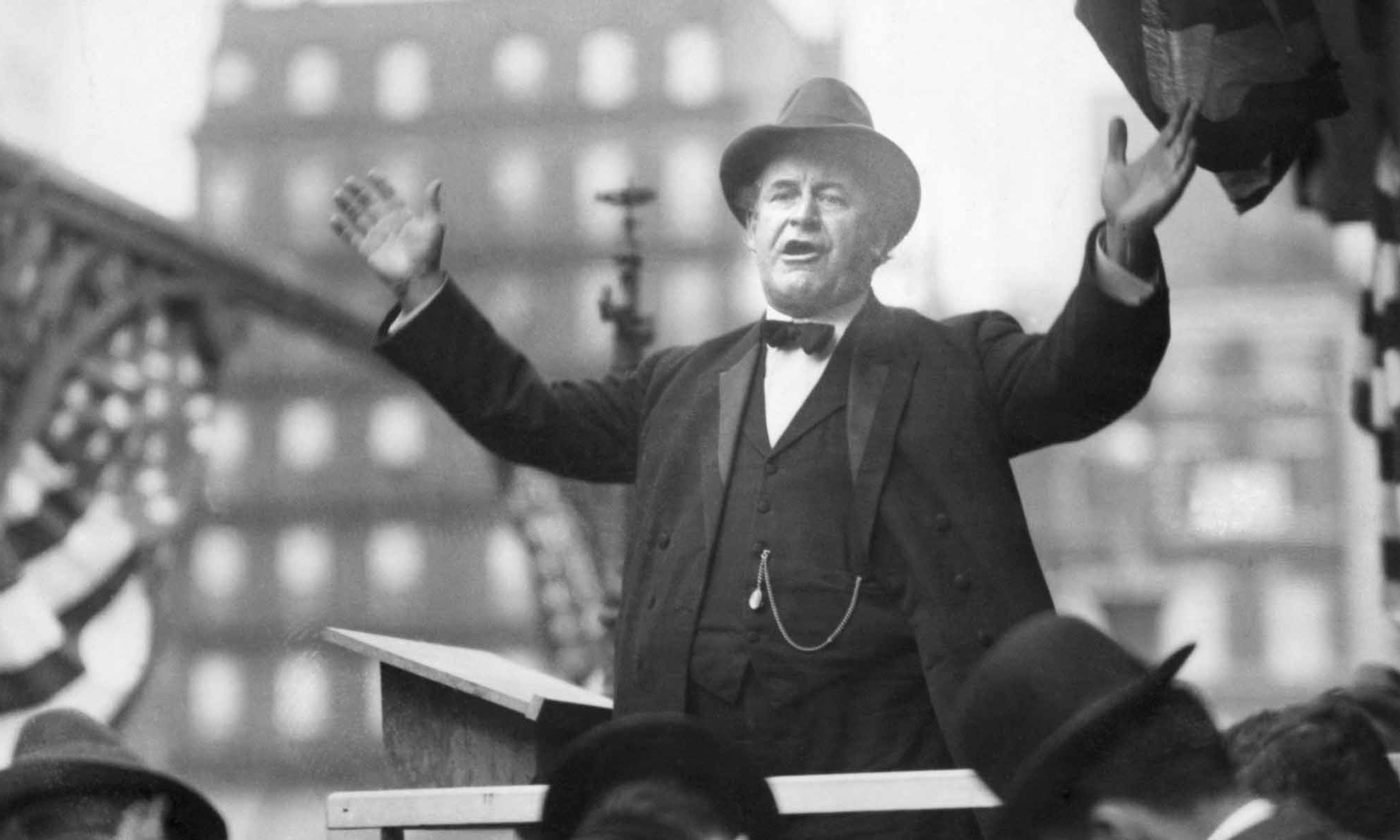
That brings us to the relationship of conservatives to populism. Conservatism began as a defense of institutions against revolutionary change from below. It was slow to embrace democracy, and, in its dogged constitutionalism, it retains its bias against transitory majorities and the abuse of the doctrine of popular sovereignty. Conservatism was born as a political practice for institutions and families that had high status. Not coincidentally, when populism sank the Democratic Party under William Jennings Bryan, the beneficiaries were the Republicans, both the conservatives and the progressives.
The English philosopher Roger Scruton located populism’s danger precisely in its prophetical character. Populist leaders ride majorities to vanquish their opponents, not compromise, conciliate, and govern with them like true democrats. So it is true that there is a tension between populism and conservatism. The populist mode can be an obstreperous, even deranging ally.
But William F. Buckley Jr. embodied the modern American conservative’s more complicated relationship to populism. Raised by a Catholic oilman working in Mexico, he was born into a Catholic-flavored anti-communism; educated in an elite English boarding school, he took on the more Cavalier style of Toryism. Finishing his formation at Yale, he developed an appreciation of the majority’s common sense against elite fads. He began his career by charging that America’s leading institutions had been captured by a liberal elite, one with a specific vice. In Rumbles Left and Right he wrote:
I should sooner live in a society governed by the first two thousand names in the Boston telephone directory than in a society governed by the two thousand faculty members of Harvard University. Not, heaven knows, because I hold lightly the brainpower or knowledge or generosity or even the affability of the Harvard faculty: but because I greatly fear intellectual arrogance, and that is a distinguishing characteristic of the university which refuses to accept any common premise.
Just as democratic majorities must be restrained by a bill of rights and a constitution, so elites running institutions must accept some premise of the common good, or else they end up perverting their institutions, using them for their own ends and making them despised by the common people.
Today, populist and nationalist political movements are a politically conjoined kick-reflex against post–Cold War globalization and progressive utopianism. In America, “globalization” has meant mass migration into the country and our economic enmeshment with China. Social scientists and economists have confirmed that U.S. counties that experienced “China shock” — a stiff decline of jobs in the face of Chinese imports — logged more votes for Trump than for any previous Republican presidential candidate.
Although it is not absent from the young, populist discontent in America on matters of trade is especially concentrated among voters old enough to remember a more industrial economy, or old enough to remember a more halcyon age for the region they live in that is now in decline. Trump’s trade war with China did not fundamentally change the economic dynamics in Sino–American relations. His hostility to China overall did change, however, the footing of the U.S., and his Democratic successor, Joe Biden, has started fumbling toward a more aggressive position against China.
In Europe, globalization has meant mass migration for some countries, but also the implementation of free trade and free movement across an expanding European Union. In a continent where sinecures are held longer and the state manages more of the economy than in the U.S., the political fallout of these arrangements has disproportionately landed on the young. Consequently, right-wing populism is a youth movement across the continent. In Spain, Vox, a right-wing populist party, is the first choice of young voters. Italy’s last election was the first in which 18- to 24-year-olds could vote for the senate. A near majority of voters in this age group cast votes for two right-wing populist parties, Giorgia Meloni’s Brothers of Italy and Matteo Salvini’s Lega. The majority of voters in France under 30 voted for either Marion Maréchal or the left-wing populist and communist Jean-Luc Mélenchon. Even in Greece, which elected a populist-socialist government a decade ago, a majority of young people now identify with the Right, including a frightening number of supporters of the openly fascist party Golden Dawn. Largely, this represents not a rebirth of social traditionalism among young voters but their disenchantment with and distrust of established institutions and their despair about their economic future.
We are now at the tail end of the Left’s long march through the sense-making institutions of democracy, such as education, academia, and media. Even the generosity that Buckley saw in Harvard’s faculty is now gone. According to political scientist Eric Kaufmann, right-leaning academics face severe discrimination in hiring, grants, and promotion. Seventy percent of conservative academics report a hostile departmental environment for their beliefs. And younger progressive academics are more authoritarian in their approach, willing to break rules of tenure to expel conservative ideas from their institutions. Predictably, in a 2017 poll, Pew Research found that just 36 percent of Republicans believe colleges and universities have a positive effect on the way things are going in the country.
For media, it’s even more dire. In the five years of what we might call the Trump era, the share of Republicans with “at least some trust in national news organizations has been cut in half — dropping from 70% in 2016 to 35%” in 2021, according to the Pew Research Center. Could it be that conservatives noticed not only bias but hysteria? Not only spin but outright falsehoods and lies?
Exile from these institutions pushes conservatives toward a more populist stance. And it pushes natural populists, even moderate ones, toward conservatives. The very fact that America’s leading institutions are, in effect, polarized against half the country will tend to exacerbate the current dynamic. The absence of conservatives will make progressive institutions blind to certain problems or perspectives, leading them to misgovern more arrogantly and inspiring populist reaction.
Populist conservatism has not lacked for examples of elite failure, high-handedness, or hypocrisy in the last several years.
We saw, during the pandemic, public-health authorities and institutions act in craven and self-serving ways. Viewing American citizens through a demeaning anti-populist lens as mere rubes, bigots, and ignoramuses, Dr. Anthony Fauci openly admitted that he lied to the public about certain matters — for instance, his estimates of herd immunity — based on his gut sense of what they could handle hearing. Coming from someone with utterly impeccable judgment, such a liberty might be forgiven as the discretion of a leader. But with his often faulty judgment, Fauci radiated condescension and high-handed arrogance toward the public at large.
Populists have watched as the ideas they instinctively embraced — masks don’t really work; Covid was probably caused by a lab leak from China; the Covid vaccines have an effect on women’s menstrual cycles; conservative views are getting throttled on social media — were denounced as conspiracy theories for years before they were quietly acknowledged to be true. They’ve watched as elite truths — Donald Trump was elected by Vladimir Putin; the Hunter Biden laptop is a foreign-disinformation op — turned out to be, more or less, elite conspiracies themselves.
Again, a partnership with populism is not a natural or auspicious one for conservatives. And such a marriage has its downside risks. The 19th-century populist movement made a great noise in American politics, and eventually the Democrats capitulated to the movement and nominated William Jennings Bryan. The effect was to make the Democrats too attached to a narrowly rural voting base, a problem that afflicted them for decades and ushered in a small golden age for the Republican Party. McKinley Republicans were able to cauterize the appeal of populism by imagining a broader class of worker that needed defense and protection from an energetic government.
Conservatives must also be mindful that populism doesn’t provide the tools for political success on its own. The most astonishing political achievement for conservatives in the last four decades has been the overturning of Roe v. Wade and the counterrevolution effected throughout the American judiciary. This movement relied on popular activism at the street level by pro-lifers for over a generation, and it relied on deft political leadership, bold tactics, and the institutional formation of new elites through the Federalist Society. That is to say, populist revolt against the liberal judiciary could achieve its victory only once it had been channeled by small-“r” republican institutionalism.
Populism is the sign that there is a potentially dangerous disconnect between governing institutions and the people in whose name they govern. Health is restored when the genius of our republican system tames, channels, and elevates the passions of our democratic people into a program of reform that disciplines the self-seeking of our elites, and turns them back into the servants of the commonweal they were meant to be.










Comments