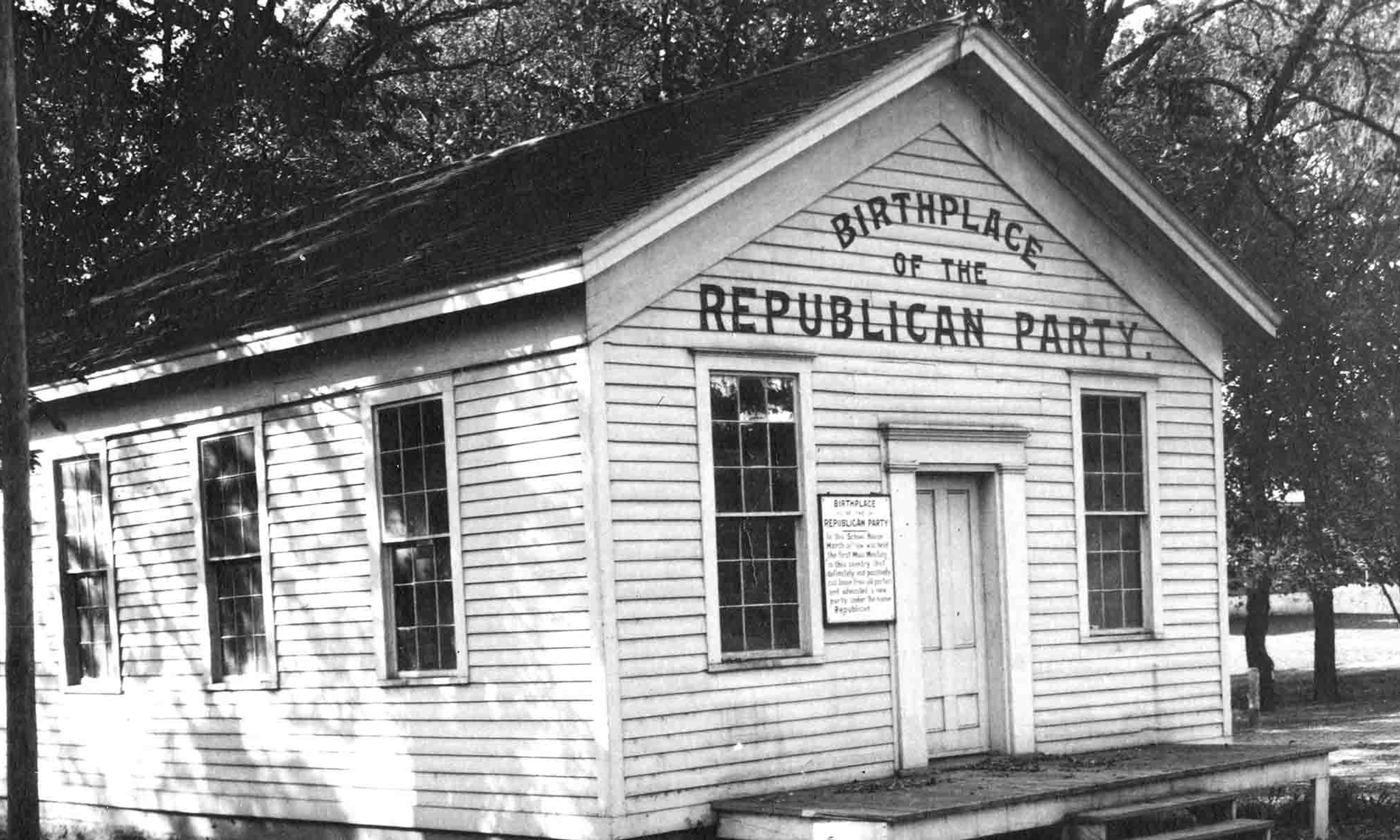
A few weeks ago in Ripon, Wis., a small white building was loaded onto the back of a truck. It was the Little White Schoolhouse, sometimes called the Birthplace of the Republican Party, and it was being moved to a more accessible location across town. Back in 1854, those walls provided a venue for a meeting of concerned citizens looking to protest the westward expansion of slavery. This activist movement soon solidified into a political party that, six years later, nominated Abraham Lincoln to the presidency. Today the schoolhouse is open to visitors, but Wisconsinites were startled to find, as the move was finalized, that it was losing its status as a registered historic landmark. Sorry, party of Lincoln.
Perhaps the decision will be successfully repealed. The whole dustup appears to be mostly a consequence of bad planning and miscommunication. For Wisconsin Republicans, though, it’s hard not to feel that insult is being added to injury. These are difficult times for conservatives in the Upper Midwest.
Wisconsin Republicans are still smarting from the election last month that gave liberal judges majority control of the state’s supreme court. It was a discouraging loss for pro-life groups, but also for the state’s conservatives, who are scrambling now to come up with new strategies that might prevent the Democrats from riding the same momentum through 2024. In Minnesota, the Democrats (known within the state as the “Democratic–Farmer–Labor Party,” or “DFL”) gained the majority in the state senate in November, giving them a level of control that they hadn’t enjoyed since 2014. They quickly got to work protecting partial-birth abortion, authoring gun-control legislation, piloting “ethnic studies” curricula, and making the state into a “transgender sanctuary.” The Minnesota house recently passed a billion-dollar omnibus environment bill meant to reach “clean energy goals.”
Just a few years ago, the Republicans had high hopes of converting the Upper Midwest into a new conservative stronghold. Now, they seem to be struggling to maintain a foothold. These are politically engaged states with high voter turnout, and they like moderate, capable politicians who help foster a thriving civic life. A certain brand of populism can play well in the Upper Midwest, but it’s not the kind the Republicans are presently offering, and progressives across the nation have been very willing to open their wallets to buy a blue Midwest. Unless the national party can somehow turn a page, conservatives in this region will likely keep fighting an uphill battle.
In some respects, Minnesota and Wisconsin seem quite different. Wisconsin’s conservatives have glowing memories of a recent “golden age” in which their state seemed to be emerging as one of the vital centers of American conservatism. They beat back the unions under Governor Scott Walker and watched native sons such as Paul Ryan and Reince Priebus ascend the ranks of the Republican Party. Right-leaning voters were energized by the Democrats’ brazen attempt to recall Walker, and that momentum helped him to win reelection in 2014.
Wisconsin certainly has some conservative roots; beyond being the birthplace of the Republican Party, it is also home to the Bradley Foundation, a long-established champion of conservative ideas, and it has a powerful network of homegrown talk-radio hosts. Through the late ’80s and the ’90s, the state was genuinely purple, choosing Democratic presidential candidates but staying loyal to the Republican governor, Tommy Thompson. Through the Tea Party years, the Republicans seemed ascendant, and Donald Trump captured the state in 2016. Two years later, Democrat Tony Evers pushed Scott Walker from the governor’s mansion. The GOP maintained solid majorities in the legislature, but in hindsight, this was an obvious turning point.
Conservatives in Minnesota have fewer nostalgic memories to cherish, living in a place that has long tacked further to the left. The only state in the union to reject Ronald Reagan, it has not embraced a Republican presidential candidate since Richard Nixon in 1972. Housing more than half the state’s population, the Twin Cities help to explain why Minnesota is one of the bluest states in the Midwest. That’s not the whole story, though.
Until quite recently, the Democratic Party in Minnesota was something of an outlier, retaining some pro-life politicians and also a strong measure of rural support, especially through the still-unionized Iron Range in the north. When their base still contained actual farmers and laborers, the DFL had strong motives to retain a more staid and moderate style of governance. Older conservatives still have affectionate memories of DFL stalwarts such as Wendell Anderson and Skip Humphrey, who attended to lifestyle issues, prioritized public safety, and avoided picking needless culture-war fights. Polarizing culture-war initiatives and sweeping environmental bills polled badly with miners and dairy farmers. The uninspiring but competent Amy Klobuchar still stands as a fair representative of the kind of Democrat Minnesotans have tended to support. Locally, many Minnesotans see Ilhan Omar, a radical progressive from Minneapolis, as more of a noisy outlier. Right now, the DFL seems to be moving in Omar’s direction, but it may take the public some time to recognize this fact.
Donald Trump inspired a moment of hope for conservatives in both states. Trump did not exactly steal Upper Midwesterners’ hearts; in the 2016 primaries, he was shellacked by Marco Rubio in Minnesota and by Ted Cruz in Wisconsin. Nevertheless, his surprising general-election performance indicated that the blue-collar Democratic oases were crumbling at last. That looked like a moment of opportunity, especially when Wisconsin finally selected a Republican president. It even seemed possible that Minnesota might be scooped from under the Democrats’ noses. That was the high point, however.
Wisconsin conservatives lost the governor’s mansion in 2018, lost the state to Joe Biden in 2020, and then lost their supreme-court majority. Janet Protasiewicz’s victory in the supreme-court race on April 4 was especially worrisome because it was decisive; she won by eleven points in a state that is more accustomed to slim margins and hard-fought battles. Minnesota, for its part, lurched back to the left in 2020 and then moved further left in 2022. The new DFL-controlled legislature does not appear to have read Michael Kazin’s What It Took to Win, a historically grounded plea for the Democratic Party to recover its middle- and working-class roots. Instead, it’s apparently rejoicing in a newfound freedom from demanding working-class constituents. It might look from the outside as though Minnesota is now lost, chasing California and New York in a race to be the wokest state in the union.
This is less true than it appears. Wisconsin’s fundamentals are still in many ways favorable for the GOP, and Minnesota’s Republicans lost several very close races in 2022 even as the DFL was flooded with donations from out of state. But it does look as though Minnesota and Wisconsin may, after all, stand or fall together for the Republicans. They are grappling with similar challenges, and the high times that Wisconsin saw through the Walker years are starting to look like the happy consequence of unusual events that cannot be replayed. These are battleground states that need the hard sell for conservative policies. But the evidence suggests that they are persuadable, and they could be a fertile testing ground for new Republican strategies if the Right pulls itself together enough to offer a more substantive platform.
To win in the Upper Midwest, Republicans need to grapple with three major challenges. They have floundered over the abortion issue, which has galvanized moderate and left-leaning voters. They are at a significant disadvantage in spending. And they need to stop the bleeding in the suburbs. Although rural areas have consolidated for the Republicans, those gains cannot compensate for punishing losses in suburbs of Milwaukee, Madison, and the Twin Cities.
None of these problems are unique to the Upper Midwest, and if the party could find reasonable solutions, it could win in more states than just Wisconsin and Minnesota. The extent of the challenge is perhaps more eye-opening here than in most other places. Wisconsin’s recent election set records for spending, but Protasiewicz spent about $6 million more than her opponent, Daniel Kelly, with much of that coming from a small number of ultra-wealthy donors such as Steven Spielberg. The imbalances were even more severe in last November’s election, when Evers spent about $42 million to Tim Michels’s $28 million.
In Minnesota, Trump’s strong showing in 2016 seems to have triggered an avalanche of left-wing support; local reporting indicated just before the 2022 election that the DFL had raised $19 million for state campaigns, compared with just $1.1 million that had been raised for the Minnesota Republican Party. Governor Tim Walz, the incumbent, had more than $9 million to challenger Scott Jensen’s $5.6 million, even as outside groups pounded Jensen relentlessly with ads presenting him as an anti-vaxxer and abortion extremist.
Particularly in light of his views on vaccination, Jensen may not have been the strongest candidate for Minnesota. In such a hostile climate, though, it’s extremely difficult to present a nuanced message on abortion. Somehow Republicans will need to meet that challenge, because the suburbs are jumping ship with panic-inducing speed. Wisconsin saw several suburbs swing more than 20 points toward the Democrats, just between 2018 and 2022. In Minnesota, it is widely understood that the DFL has mostly jettisoned the “farm and labor” elements of their coalition, but as educated professionals race to the left, Republicans find it increasingly challenging both to raise money and to win.
As in other places, it can be difficult to judge the impact of the abortion issue next to a Trumpian populism that falls especially flat with conflict-averse Minnesotans and Wisconsinites. The Upper Midwest does have its own populist tradition, threading its way through the Grange Movement, Wisconsin’s Depression-era Progressive Party, the Minnesota Miracle of 1971 (which redistributed more state funds to schools and local government), and the right-to-work rhetoric of the Walker campaign. Midwesterners can be receptive to campaigns in behalf of workers or middle-class families, but smashmouth populism has limited appeal here. A figure such as Ron Johnson is viewed outside the state as a hard-liner, but in Wisconsin he runs ads of himself changing his grandson’s diapers. Walker sounded some populist notes, as a degree-less grassroots candidate railing against corruption, but he was plainspoken, clean-cut, and a family man. A populism built on culture wars and social-media memes will struggle to take root in frozen northern soil.
The real concerns of citizens in the Upper Midwest should leave the Republicans plenty of openings. It hardly makes sense to write off Minneapolis and Milwaukee as lost causes for Republicans when violent crime has been a major concern in both cities over the past few years. Minnesotans used to pride themselves on their high-quality public education, but private-school directors report a noteworthy rise in applications as parents look for alternatives to public schools that now have serious disciplinary problems and ideologically charged curricula. Inflation-stressed citizens will likely grumble over continued tax hikes, at a time when it is well known that Minnesota is running a budget surplus of $17.5 billion. The abortion issue clearly needs to be contextualized within a broader platform, which stresses public safety, charts a path to education reform, and shows how to promote and preserve economic prosperity. Convincing suburbanites to support the Right will take some doing, but it should be possible when Republicans can give Upper Midwesterners so many reasons to vote for them.
Then there is that Little White Schoolhouse. When Republicans gather in Milwaukee in July 2024 for the Republican National Convention, what will the mood be? Will visitors tour the historic building, confident in the political tradition they are maintaining and handing down? Or will there be a sense of quiet desperation as crucial battleground states slip irrevocably out of their reach? The future hangs in the balance, for the Republicans, and for the Upper Midwest.












Comments