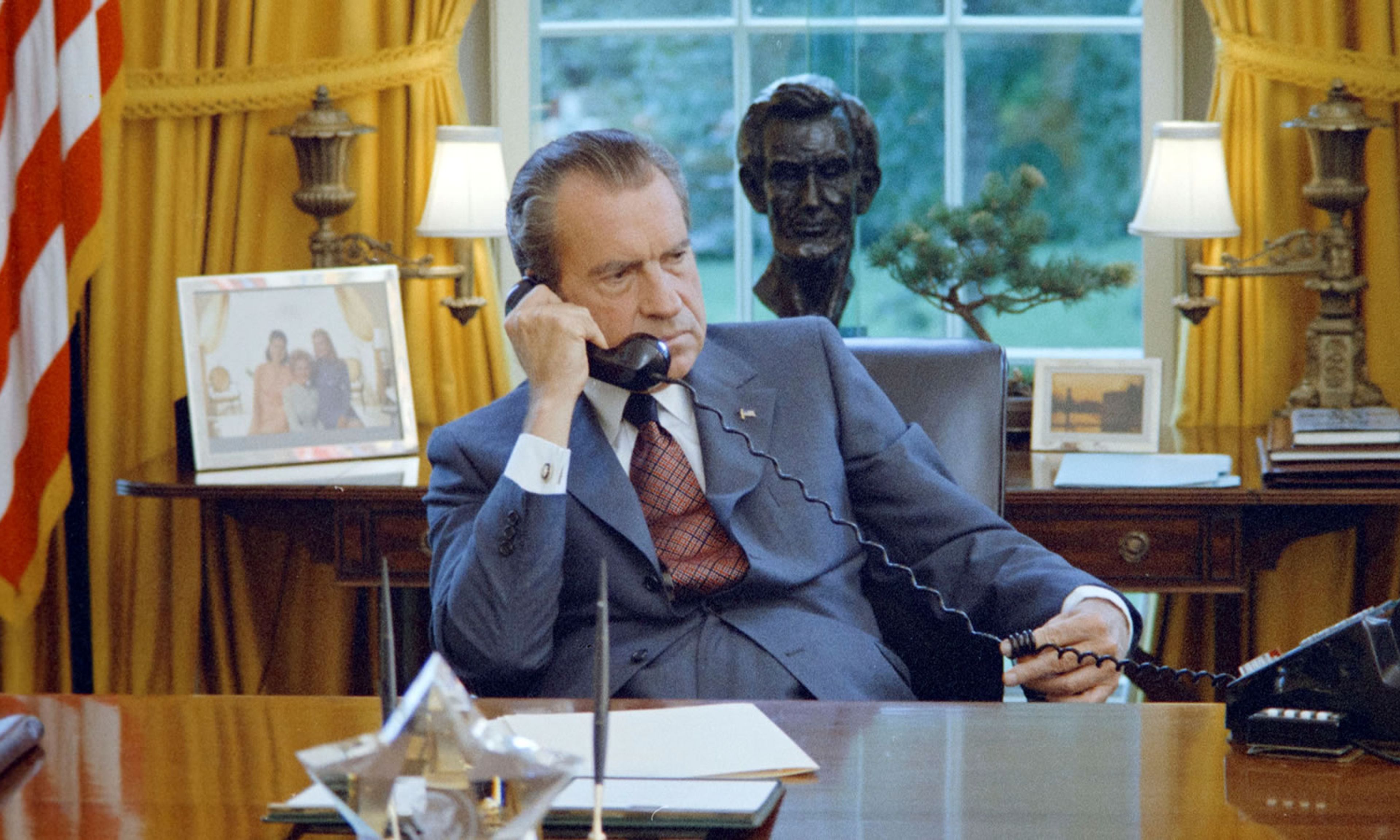
Nixon’s Never-Spoken Secret
In an otherwise interesting article about the 1980 election (“The 1980 Presidential Election in Retrospect,” October 19), Craig Shirley writes that in the 1968 campaign “Nixon said he had a ‘secret plan’ to end the war in Vietnam.” The simple fact is that Nixon never said it, but it has been repeated constantly until it has become a “fact” and a staple for Nixon critics. One would have thought that Shirley knew the truth about this canard. There were complaints from Nixon’s opponents in New Hampshire in the 1968 primary that Nixon had “a secret plan to end the war.” A reporter picked them up and put the words into Nixon’s mouth in an early example of what we now know as “fake news.” Many years later, on October 13, 2002, Ray Price, Nixon’s chief speechwriter, wrote to the New York Times spelling out what had truly happened, in an effort to put the matter to rest. But the lie about Nixon’s “secret plan” lives on, even in the pages of National Review. I am reminded of the last scene of The Man Who Shot Liberty Valance, in which the James Stewart character tells a reporter that his entire distinguished political career is based on a lie; he did not kill Liberty Valance. The reporter closes his notebook and says, “When the facts contradict the legend, print the legend.”
John H. Carley Boca Grande, Fla.
Craig Shirley responds: No one goes out and claims to have a secret plan to end a war or win a football game, although more than a few used to claim over beers at Elaine’s that they had a secret plan to write a book. That’s why I put “secret plan” in quote marks. He did not say it. But it has become quite common patois to say that Nixon had a secret plan to end the Vietnam War.
The Will of the Voter
In “Voting for Life” (October 19), Ramesh Ponnuru and Robert P. George argue that being pro-life from religious conviction brings an obligation to “vote in solidarity with the unborn victims of abortion.” Single-issue voting is a cousin of the fallacy of composition: Abortion is wrong, a candidate is pro-choice, therefore voting for that candidate is wrong. Taking a stand on an issue is simpler than voting for a representative, the latter inevitably being a compromise.
A vote does not “wholly determine whom one wills to be president.” A lesser-of-evils vote determines who should not be president. Don’t waste your vote out of a poorly reasoned sense of obligation. Vote with care, and if compelled by conviction, commit to pro-life advocacy.
Andy Mercer Annandale, Va.
Ramesh Ponnuru and Robert P. George respond: To cast a vote for Joe Biden to be president, even on a lesser-evil rationale, is inescapably to will that Biden be president. He pledges to entrench abortion as a constitutional right, dismantle some of the few remaining limits on it, and provide subsidies for it. A voter who grasps the evil of this agenda but wishes to vote for Biden anyway had better have reasons as strong as the gravity and scope of the injustice he is looking past.
Correction
The Week (October 19) stated that Breonna Taylor was killed by police in Lexington, Ky. In fact, she was killed by police in Louisville, Ky.











Comments