Brooklyn, N.Y.
‘Green-Wood is an active cemetery,” reads a sign outside the entrance, and I can’t help smiling. I know what they mean — people are working, being buried, etc. — but still . . .
You enter through fantastic arches, designed by Richard Upjohn during the Civil War. This could be the façade of the Munsters’ house, I think. At any rate, the arches make a perfect entrance for a grand cemetery, especially as night falls, as it is doing now.
I’ve come for a concert, and a highly unusual one.
Green-Wood Cemetery, here in Brooklyn, was founded in 1838. In addition to a cemetery, it is a splendid public park. Green-Wood has been designated a National Historic Landmark.
In 1866, the following words appeared in the New York Times: “It is the ambition of the New Yorker to live upon the Fifth Avenue, to take his airings in the Park, and to sleep with his fathers in Green-Wood.” (By “the Park,” the author meant Central.)
Yes, the great and the good are buried here — and at least a few of the bad. Regulations said that you could not be buried at Green-Wood if you died in jail. Boss Tweed got around that, or at least his family did.
Not a few musicians lie here. There’s Louis Moreau Gottschalk, the first classical-music star in America (born in 1829). There’s Leonard Bernstein, who’s buried with the score of Mahler’s Fifth Symphony lying across his heart. Needless to say, Bernstein felt very close to Mahler, his fellow composer-conductor.
Another composer, Elliott Carter, lies in Green-Wood. He died in 2012, at 103. I interviewed him on the eve of his hundredth birthday — one of the most intelligent people I have ever been around.
More than half a million people are buried here. One of them is especially important tonight: James Weldon Johnson, that Renaissance man who lived from 1871 to 1938. He wrote the words to “Lift Ev’ry Voice and Sing” (sometimes known as the “black national anthem”). His brother, J. Rosamond Johnson, wrote the music. It is a great song, outstanding in the American treasury.
Lift ev’ry voice and sing,
’Til earth and heaven ring,
Ring with the harmonies of Liberty;
Let our rejoicing rise
High as the list’ning skies,
Let it resound loud as the rolling sea.
It was Johnson (James Weldon) who inspired tonight’s concert. (J. Rosamond, by the way, is buried up in Hastings-on-Hudson, N.Y.) The concert is called “To America,” which is also the title of a Johnson poem. The program has been put together by Andrew Ousley, a music impresario, and Harry Weil, an official at Green-Wood.
Ousley (rhymes with “Browse-ly”) is the founder of Death of Classical, an organization whose name plays on an old theme, or worry: the death of classical music. I often quote Charles Rosen, the late pianist-scholar, who said, “The death of classical music is perhaps the oldest tradition of classical music.” Ousley puts on concerts in crypts and catacombs.
The spirit of his organization, or project, can be seen in his fundraising. Here are his donor levels, from entry to top: Pallbearers, Eulogizers, Undertakers, Crypt Keepers, and, finally — I love this — Angels of Death of Classical.
For tonight’s attendees, there are snacks on a table: chips, cookies, and Life Savers. Exactly what I have at home, I think. My pandemic diet.
I keep saying “concert,” in reference to tonight’s event, and so it is: but the event also includes poetry and dance. In different shifts, small groups — masked and socially distanced — walk from site to site in the cemetery, hearing and seeing various performances.
Ousley says, simply, that this has been a brutal year in America — pandemic, social unrest, the presidential campaign — and he wanted to do something to reaffirm the goodness of our country. Or if not its goodness, its higher ideals and better self. I think of a Lincoln phrase: “the better angels of our nature.” Also, Ousley wanted to offer something rare: a live performance.
Today is October 23. I last reviewed a concert, live and in the flesh, on March 6. (It was a chamber concert at Carnegie Hall.) In between, there have been online concerts — livestreams — only.
Our group walks to a chapel, whose interior is lit, slightly, by little candles. There are shadows on the walls. Members of a string quartet wear black masks. There is dead silence, for now. It is all very . . . cemetery-at-night–like.
After a minute or two, a man recites a poem: “Inhale, Exhale,” by Terrance Hayes, who was born in South Carolina in 1971. The theme of his poem is captured in this line: “America — do you care for me, as I care for you?” I think of a Langston Hughes poem, “I, Too,” which has a similar message.
The string quartet plays “Lift Ev’ry Voice and Sing” — an arrangement of it, that is. No words, no singing. The quartet then plays Elegy: A Cry from the Grave, by Carlos Simon (not to be confused with Carly Simon). He was born in Washington, D.C., in 1986. His elegy is lush, beautiful — what some critics would call, not very nicely, “neo-Romantic.” Are you allowed to write that way in this day and age? I’m glad Simon has.
Before we leave the chapel, a baritone sings “Sence You Went Away” (yes, “Sence”), a wonderful love song by H. Leslie Adams. It sets a poem by James Weldon Johnson. Adams is one of our senior composers, born in 1932 (Cleveland). He wrote Nightsongs — a cycle that includes “Sence You Went Away” — in the early 1960s.
Incidentally, we have been instructed not to applaud, for any of the performances tonight. Which adds to the solemnity, and the weirdness, of the evening overall.
On we go to the next site, a monument to DeWitt Clinton, that key New York politician in the first quarter of the 19th century. A bass emerges from behind the monument to sing a spiritual: “Deep river, my home is over Jordan.” Maybe I can indulge in a linguistic note? You can sing either “Jordan,” rhyming with “Gordon,” or “Jerdan.” Southerners tend to sing “Jerdan,” and so did Marian Anderson, “The Lady from Philadelphia.” Our singer tonight, however, chooses “Jordan.”
Further on, we hear a cellist play a piece by Caroline Shaw, born in North Carolina in 1982. It is a nifty piece, In manus tuas, based on a motet by Thomas Tallis, that English genius from way back (the 16th century). As the cellist plays, a dancer dances, with the aid of a spotlight. Her shadows dance, too. It is a spooky, engaging experience, out here in the cemetery.
As we walk to the next site, a man tells his companion, “This feels like the coolest thing in the world going on right now.”
Under a tree, two different singers sing two different songs — very different songs — involving trees: “Ombra mai fu,” from Handel’s opera Serse — an aria known, in its instrumental versions, as “Handel’s Largo” — and “Strange Fruit,” the song by Abel Meeropol, published in 1937, made famous by Billie Holiday two years later. “Ombra mai fu” is an ode to a plane tree; “Strange Fruit” is about lynching. I’m not sure there has ever been a more unusual pairing, but what the heck? Each number is a classic.
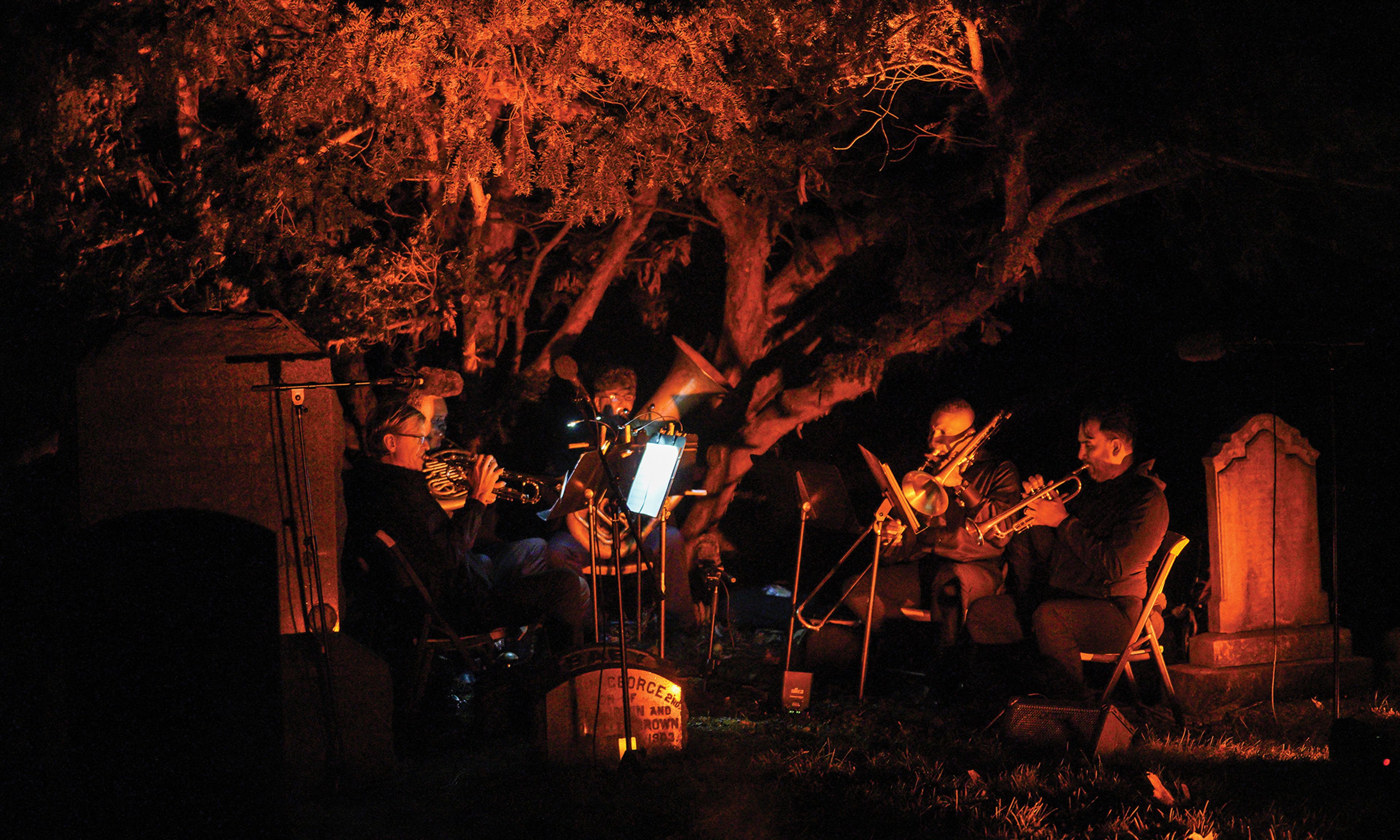
In due course, we arrive at the Civil War Soldiers’ Lot, where a brass ensemble is assembled. They play “Lift Ev’ry Voice.” They also accompany a singer in “Somewhere,” the song from Bernstein’s West Side Story. It is one of the best art songs in the whole American repertoire. Schubert would be pleased to claim it.
The last offering at the Civil War Soldiers’ Lot is a rollicking, jazzy version of “The Battle Hymn of the Republic,” which almost has me dancing.
Our final stop will be the Catacombs. En route, though, we go through the Weeping Beech Tunnel, where a violinist is improvising . . . on “Lift Ev’ry Voice.”
At the Catacombs, a Johnson poem is read: the titular poem of the evening, “To America.” Then we hear George Walker’s Lyric for Strings and Samuel Barber’s Adagio for Strings (in their original versions, for string quartet). Barber wrote his Adagio in 1936; Walker wrote his Lyric ten years later. He hated it when the two were compared. “They’re nothing alike!” Walker would say. He protested too much — but they are both marvelous pieces.
George Walker died two years ago, at 96. I got to know him toward the end of his life. He dedicated “the Lyric,” as he called it, to his grandmother, Malvina King, an ex-slave. (She lived with George’s family, in Washington, D.C., as he was growing up.) He also referred to the Lyric, tenderly, as “my grandmother’s piece.”
In the Catacombs, another poem is recited, this one by Langston Hughes: “Let America Be America Again.” It ends with the words, “And make America again!” I envision a hashtag, “#MAA.”
The evening closes with — for the fourth time — “Lift Ev’ry Voice,” sung by a tenor. He does not sing all the verses, unless I’m asleep at the switch. In any event, I think of Bill Clinton — who once boasted that someone had described him as “the only white man in America who knows all the verses to ‘Lift Ev’ry Voice and Sing.’”
Who knows? It may have been true . . .
Leaving Green-Wood Cemetery, I think about live music — there’s nothing like it, wonderful as streamings and the rest are (as substitutes). “The coolest thing in the world going on right now”? I don’t know about that, but this concert, or whatever we should call it, was a great idea. The evening has been fortifying, reaffirming, somehow. Kind of funny: Come to a cemetery, feel more alive.










Comments