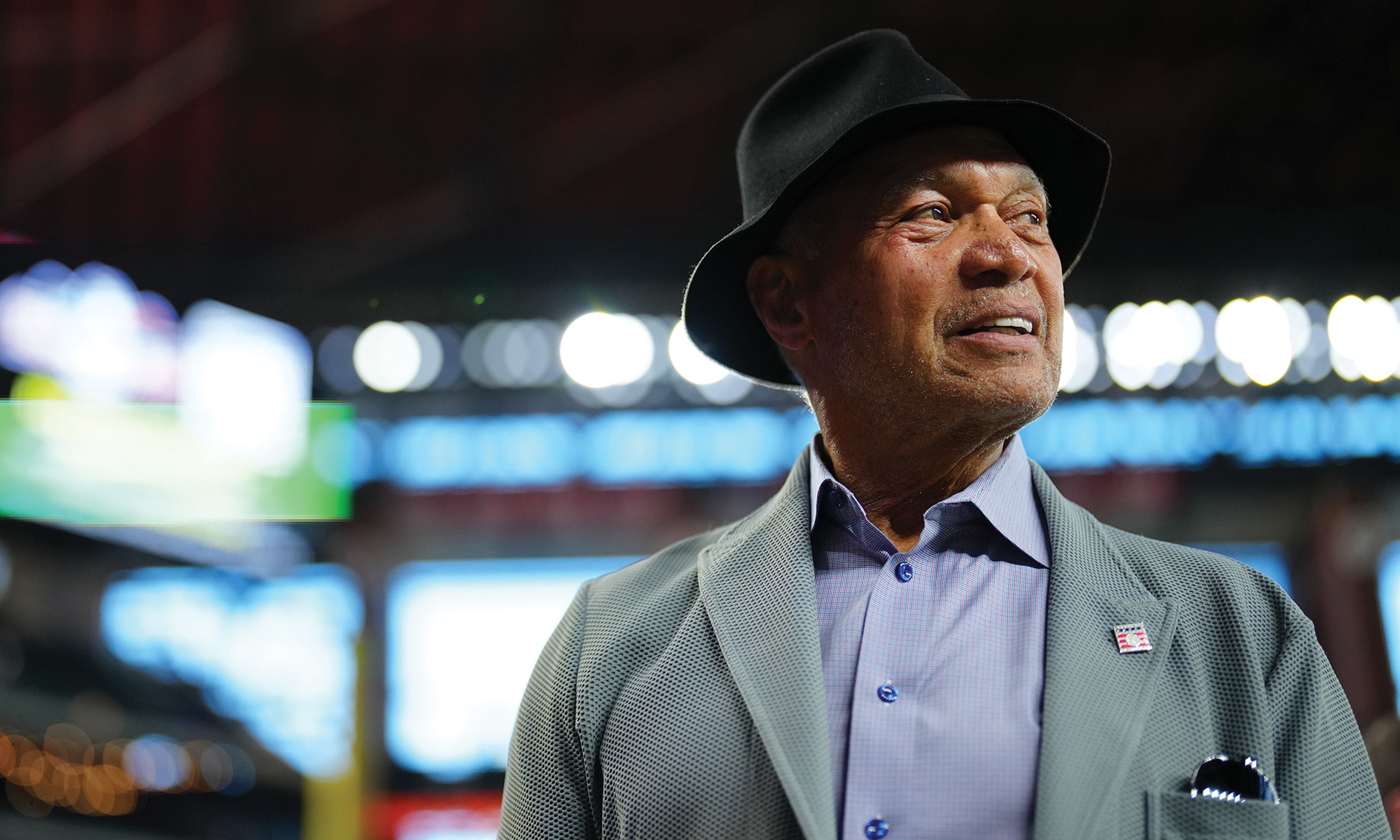
On June 20, Major League Baseball staged a game at Rickwood Field in Birmingham, Ala.: a “tribute game.” Rickwood was the home of the Birmingham Black Barons, a team in the Negro Leagues. The Barons played from 1920 to 1960. The game in June was a tribute to the Negro Leagues.
MLB greats were gathered, to watch the game and comment on the past. One of them was Reggie Jackson, who played in Birmingham at the beginning of his career: for the Double-A team of the Kansas City A’s (later the Oakland A’s). Reminiscing, Jackson said, “I walked into restaurants and they would point at me and say, ‘The nigger can’t eat here.’” And so on and so forth. Lots of “nigger.”
I gulped. Not because I was naïve. I knew what Jackie Robinson, Roy Campanella, and other pioneers had faced. But Reggie Jackson? He was of “my time” — not those times. Jackson’s career stretched from 1967 to 1987. When he started out, I was in preschool, and when he finished, I was in grad school. Feel free to laugh, but Jim Crow and the civil-rights struggle seemed distant to me, when I was young — when I was in high school, let’s say.
Here is another laugh: The Vietnam War seemed distant. Something “historical,” like the Korean War or the world wars. I entered college in 1982. Saigon had fallen seven years before.
One more laugh, just for the fun of it: Watergate seemed distant! Might as well have been Teapot Dome! Time is such a tricky phenomenon, isn’t it? Things that seemed distant when you were young can seem near when you are not.
In 1984, I was in Washington, D.C., enrolled in a program on government and politics. This was like a domestic semester abroad. I was smitten with government and politics. (Today, the smiting is of a different sort.) One day, I had a question for my grandmother, a lifelong Washingtonian: “Gram, when did the fancy country clubs — Burning Tree, Columbia, Congressional, and the rest — start admitting Jews?” She looked at me slyly and said, “Have they?”
Yes, they had — but only very, very recently.
When I was quite young, I was scandalized by the idea of Jewish country clubs. It offended my notion of pluralism and integration and Americanism. “Clannish,” said critics (and “critics” is a mild word). At some point, I learned that Jewish clubs were founded because their members had been denied admission to other clubs.
“My daughter is only half Jewish,” said Groucho Marx. “Can she go into the pool up to her knees?” “My son is only half Jewish. Can he play nine holes?”
I had a lesson in identity: Sometimes, identity is forced on a person. You may not want to feel tribal, but such a feeling may be forced on you by the broader world.
Stefan Zweig was born in 1881, nine years before Groucho. He grew up in Vienna, the great cosmopolitan capital of the Austro-Hungarian Empire. From a secular family, he never felt Jewish. That changed in about 1933. In 1942, the day before he killed himself, he finished writing The World of Yesterday, soon to become a classic. Its subtitle: “Memoirs of a European.”
“A European”! You may think of yourself as one — but do your “fellow” Europeans?
* * *
“Pivot” is a word familiar in our politics. Let me now pivot to those politics. Kamala Harris is frequently called a “DEI hire.” “DEI” stands for “diversity, equity, and inclusion.” People used to say “affirmative-action hire.” Our terms evolve.
It’s true that Joe Biden wanted to choose a black woman as his running mate in 2020. I have opposed this kind of thing my entire life — choosing by race. But Biden’s choice was not mere “social justice” (troublesome term). It was electoral calculation (which is not unknown in politics, and not even wrong).
In 1984, Walter Mondale wanted a female running mate — the first ever. Some accounts say that he really wanted Dianne Feinstein, the mayor of San Francisco. But would the country accept the first Jew and the first woman on a ticket in the same person? In any case, Mondale went with Geraldine Ferraro, a congresswoman from New York.
In 2008, Barack Obama passed over Hillary Clinton, his chief rival from the primaries. He went with Joe Biden. Sensing an opportunity, John McCain went with a woman: Governor Sarah Palin of Alaska. In her first speech, upon being selected, Palin said,
I think today of two other women who came before me in national elections. I can’t begin this great effort without honoring the achievements of Geraldine Ferraro in 1984 and, of course, Senator Hillary Clinton, who showed such determination and grace in her presidential campaign.
Clinton had received 18 million votes in the primaries. When she conceded to Obama, she spoke of “18 million cracks” in the “highest, hardest glass ceiling.” Palin quoted this language and added, “But it turns out the women of America aren’t finished yet, and we can shatter that glass ceiling once and for all.”
Was this bad? All this “I am woman, hear me roar” stuff? I don’t know. It was politics.
If I had my way, politics would be about ideas, without regard to skin color, sex, and other “immutable characteristics,” to use a phrase I grew up with. But I don’t get my way. I always liked E pluribus unum, a national motto (though “In God We Trust” is our official one) (I like that too). I always liked the concept of the melting pot. Quaint, right?
Over the years, people tried to replace “melting pot” with “gorgeous mosaic” (a phrase associated with David Dinkins, who was mayor of New York). There was also Jesse Jackson’s “patchwork quilt.” Fair enough. I like quilts, and mosaics. But I was, and am, a holdout for the melting pot.
I am also a holdout for color-blindness. Color-blindness! Talk about quaint! People like to equate color-blindness with naïveté about race and racism. They also like to equate it with malice. With lingering resentment, I recall what Al Gore said to the NAACP during the 2000 presidential cycle:
I’ve heard the critics of affirmative action. They talk about a color-blind society. Give me a break! Hel-lo? They use their “color-blind” the way duck hunters use their duck blind: They hide behind it and hope the ducks won’t figure out what they’re up to.
Rightly understood, color-blindness is a principle and an ideal (both): We do not judge by race or ethnicity in this country. We have had more than enough of that, over the generations. We take people as people: our fellow Americans, children of God, what have you.
In my estimation, race-consciousness is a curse — a bane of human existence. “The only race is the human race,” goes a glib old line. Glib, yes, but laudable, I think. And yet . . .
Recall Leon Trotsky: “You may not be interested in war, but war is interested in you.” You may not choose race-consciousness, but race-consciousness may choose you. For all I know, Reggie Jackson would like to be a plain old American, unhyphenated and unqualified. But call him “nigger” enough times . . . (That word is like a knife-stab.)
* * *
Having touched on vice-presidential nominees, I will pivot to Supreme Court nominees. Let’s begin in 1980. Running for president, Ronald Reagan pledged to nominate a woman. He was elected, and in June of his first year, a seat came open: Potter Stewart was retiring.
Reagan had not pledged that his first nominee would be a woman. He had a free hand — or free-ish? He did not know whether he would get another pick — his predecessor, Jimmy Carter, had served four years with no pick at all — and he wanted to keep his pledge, no matter what. He nominated Sandra Day O’Connor.
Was that wrong? That he aimed for a woman, rather than “the best person”? You could argue it was. I might agree with you. But the Supreme Court had been in business for almost 200 years. Maybe it did no harm that there was now a woman on the Court?
In 1991, Thurgood Marshall was retiring. He was the first black American on the Court, and there had not yet been another one. President Bush nominated Clarence Thomas to succeed him. He swore up and down that Thomas’s race had nothing to do with it. Skeptically, a reporter asked, “Was race a factor whatsoever, sir, in the selection?” The president answered, “I don’t see it at all.”
Lord knows I admire Bush, and Thomas — but come on. I did not just fall off the turnip truck. (I learned that expression, as it happens, from President Bush himself. I can’t say I’ve heard it since, except from me.)
Question: Should there ever be a time when the Supreme Court has no black member on it? My answer: In theory, why should it matter? If all nine members of the Court are Chinese-American women, fine with me (as long as their legal understanding is sound). If all nine members are left-handed Rastafarian men, fine with me (as long as their . . .). But life is not lived in theory. There are prickly all-too-human considerations.
I hated it — hated it — when President Clinton said he wanted “a cabinet that looks like America.” Who cares what they look like! What matters is what they think like, act like, are! Yes, but . . .
In 2022, President Biden decided to put a black woman on the Court. There had never been one. He nominated Ketanji Brown Jackson — who in most respects was an utterly conventional Supreme Court nominee. She went to Harvard College and Harvard Law School. Was an editor of the Harvard Law Review. Clerked for a Supreme Court justice (Stephen Breyer). Was a judge on the D.C. Court of Appeals. She was from Central Casting, Judge Jackson was. And a black woman.
The selection of justices by race and/or sex is bothersome to me. I also think it is discordant with American ideals. Nevertheless, this thought occurs to me: The Court had been in operation for 233 years. When was it time to have a black woman on it? In 2067 or so? Maybe wait until the 22nd century, just to be sure?
Representation is important to people — representation of the “wrong” sort, or unfortunate sort, as I see it. When I was young, I rebelled against the idea that black children had to have black teachers or coaches in order to have “role models.” I would argue — I was quite the arguer — “Are you also saying that black teachers and coaches can’t be role models to white children? Do white children have to have whiteys? Does a teacher or coach have to be the same color as his charges in order to be a role model?”
I was right. But I was also . . . maybe not so right. You have to walk in other people’s moccasins, if you can — even if the walk does not ultimately change your views.
Though I am white, I have never thought of myself as white. A luxury, you might say. If you were tall in a society full of tall people, would you think of yourself as tall? Short people, though, would be height-conscious.
You know what makes white people race-conscious? When they marry someone of another race. Or adopt a child of another race. They are more attuned to racism. They start to see things with different eyes and hear things with different ears.
Another thing that makes people feel race-conscious? When they are denied a job, or a place, on account of their race. There must be redress, people say — redress in America, for hundreds of years of discrimination, and worse. Okay. But lives are lived individually, aren’t they? Shall the sins of the fathers be visited upon the children, and unto how many generations?
A quick personal story: Thirty-plus years ago, I was interested in a job — a low-level job — at the Los Angeles Times. An editor there did me the favor of being candid: “You may not think very much of affirmative action, Jay, but it is rigorously practiced here.” He meant: no chance.
But I will quote President Bush again, quoting a song: “Don’t cry for me, Argentina.” I have done okay (according to some). Others, though — of whatever hue or sex — struggle and struggle to gain a foothold.
* * *
I could tell stories till the cows come home — illustrating different points, and contradictory ones — but I will confine myself to one more. When I was in high school, I had a friend who was a pianist. A black girl (which is relevant). One day, I asked her, “Who’s your favorite pianist?” She said André Watts. “Why?” I asked. Sheepishly, she said, “Because he’s black.” Then she kind of giggled. “Oh, Emily!” I said. “What does that have to do with anything? How can race be a criterion in music? On top of that, his mother is Hungarian! That’s the whole reason he’s in music in the first place!”
I was correct. I was also an ass. In my defense, I was 16. I have learned more about the world in the years since, I hope. I will never give up on my ideals. But maybe I am more . . . I don’t know. I think of the phrase “sadder but wiser.”
When I discussed these questions in an online column, I got a note from a longtime reader — a bright and thoughtful guy — who said,
We should give up on trying to eliminate racism, sexism, etc., and admit that forming groups, judging appearances, and practicing conformity are inherent human behaviors. I shouldn’t treat a good-looking woman better than an ugly one, and I shouldn’t be more upset that a deer got run over than that a rat got run over, and I shouldn’t want Brandon Nakashima to win his next tennis match because he is a Japanese American like me, but I do.
I understand. I don’t like it, but I understand.
If my above scribbles have been messy, it’s because the issues are messy, I think. They are not black and white. (Take that however you wish.) There is a famous title, “An American Dilemma.” (The subtitle of that book — written by Gunnar Myrdal and published in 1944 — is “The Negro Problem and Modern Democracy.”) “Dilemma” comes from Greek, meaning “two premises” or “two assumptions.”
I understand that people are group-minded — tribal, if you like — whether from biology or in reaction to the world as they find it. This has to be accommodated, or at least allowed for, in politics and other human affairs.
But, again, I’ll take my stand (to echo another famous American book title). I will never give up on my beliefs. Will never give up on man as man. “Of a truth I perceive that God is no respecter of persons.” “There is neither Jew nor Greek, there is neither bond nor free, there is neither male nor female.” “We hold these truths to be self-evident.” All that jazz. Good jazz, universal and eternal.












Comments