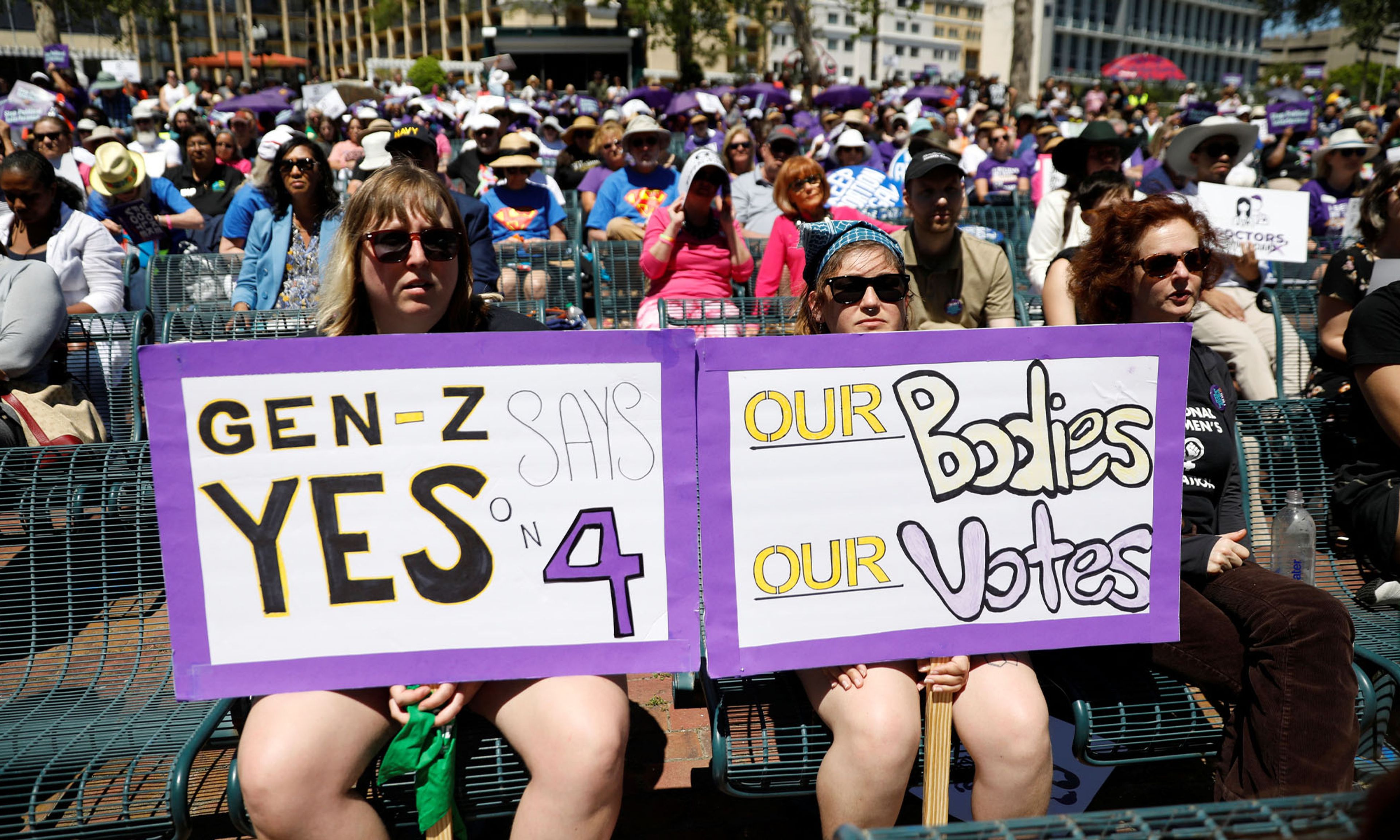
On the evening of August 15, Florida governor Ron DeSantis sat in a chair onstage at Jesuit High School in Tampa beneath a message on an enormous white screen. “VOTE NO ON 4,” it said, in bold letters. “NOT WHAT IT SEEMS.”
The message referred to Amendment 4, an abortion-rights initiative on the Florida ballot this fall. The referendum, whose formal title is “Limit Government Interference in Abortion,” is billed as a commonsense measure. “The overwhelming majority of Floridians think we should all have the freedom to make our own personal health care decisions without interference from politicians,” Floridians Protecting Freedom, an alliance of abortion-rights groups, said on its website. As the message above DeSantis indicated, opponents argue that the referendum is deceptive. And according to DeSantis, its sweeping changes to abortion laws would affect not only Florida but also six southern states — Georgia, South Carolina, Alabama, Arkansas, Louisiana, and Mississippi.
“You look at the entire Southeast region: We would be the only state that isn’t pro-life,” DeSantis said to the audience of 500 at the school’s auditorium. “So guess what? Everyone from the Southeast, where are they going to go? Florida is going to be a tourist destination for abortion.” Two months earlier, DeSantis warned that if Amendment 4 were approved, the state would “become the abortion mecca of this region.”
DeSantis has a stake in the outcome. In April, he signed a “heartbeat” bill into law that prohibits abortion after the sixth week of pregnancy and includes rape and incest exceptions up to 15 weeks. If Amendment 4 is approved, by all accounts the heartbeat law will be gutted. But self-interest has not sullied DeSantis’s judgment. “It’s a bait and switch,” former State Senator Kelli Stargel said in an interview. The referendum would do more than “limit” governmental restrictions on abortion. It would all but eliminate them. Despite its claims to “protect freedom” and “limit government interference,” the referendum would allow “the abortion industry to police itself,” as Peter Northcott, director of state strategies for National Right to Life, said in an interview.
Northcott’s assessment is no flight of fancy. Increasingly, the abortion industry is policing itself in Michigan and Ohio. Voters in each state approved sweeping abortion-rights initiatives in the past two years. The same groups that wrote the language for their referendums, Planned Parenthood and the ACLU, wrote the language for Amendment 4, and the similarities between the initiatives are obvious. They forbid not only “prohibitions” on abortion but also “delays” and “restrictions.” To judge from recent developments in Michigan and Ohio, Amendment 4 would gut two Florida restrictions that currently require a woman seeking an abortion to make two in-person visits to a clinic at least 24 hours apart and provide written consent that she was informed about the procedure. If the case put forward by such groups as the Michigan chapter of the ACLU prevail, Amendment 4 would gut Florida’s parental-consent law, too.
Wiping out restrictions could well make the Sunshine State “an abortion mecca.” A doctor would be allowed to an abortion on a woman eight or nine months’ pregnant by signing a form saying the procedure was necessary to protect her “health,” a term that is undefined. Teenage girls from throughout the Southeast may be able to cross state lines into Florida to get abortions at all nine months of pregnancy without parental consent. Indeed, on its website, Planned Parenthood tells women living in Alabama, Mississippi, Arkansas, and Louisiana that “you may be able to get an abortion in other states.”
Such a scenario could hardly be more different from the rosy future that some pro-lifers saw two years ago when the Supreme Court struck down Roe v. Wade (1973) and Planned Parenthood v. Casey (1992). In Dobbs v. Jackson Women’s Health Organization, the high court recognized that abortion was not a constitutional right to be enforced by the courts; it was a matter to be regulated by the people and their elected representatives.
Twenty-two states put meaningful abortion restrictions on their books — limits that would have been impossible under Roe and Casey. Among the most notable was Ohio, where in 2019 lawmakers approved legislation to prohibit abortion after six weeks even in cases of rape and incest. But the ambitious law backfired. It misjudged public opinion and, worse, underestimated its foes. Planned Parenthood and the ACLU seized on the law’s lack of exceptions for rape and incest. The groups found examples in which pregnant minors in Ohio were denied abortions even though they had been raped; wrote puffy language for a ballot initiative; and, after getting enough signatures to qualify for the ballot last fall, outspent pro-life forces by more than two to one.
Voters approved the referendum by a margin of 56.8 to 43.2 percent. Abortion-rights interest groups recognized that their strategy could be replicated, and they have replicated it in six other states besides Florida this fall — Arizona, Nevada, Missouri, Nebraska, Montana, and South Dakota.
Of those battles, the most significant is in Florida, the third-most-populous state. Abortion-rights groups have come prepared. In April, Anna Hochkammer, executive director of Florida Women’s Freedom Coalition, told Politico that her organization wrote Amendment 4 with an eye on Florida’s conservative tilt. “You basically have to give people who are independents and Republicans permission to agree with you on this thing, to disagree with their individual candidate or their party,” she said. “Then you have to figure out what you want to say, what you want to do. And then you have to poll it. When you have a disagreement between one noun and another noun, one verb and another verb, you really do have to spend the time and money polling these things to see whether moving a comma or changing an adverb changes what voters perceive of this language.”
Amendment 4 is only 49 words in two sentences but has three sweeping implications.
For starters, the referendum would grant a qualified right to abortion until birth. “No law shall prohibit, penalize, delay, or restrict abortion before viability,” the amendment says, “or when necessary to protect the patient’s health, as determined by the patient’s healthcare provider.”
The final clause is crucial. Post-viability abortions are permitted if a health-care provider such as an abortion doctor signs a form saying that continuing the pregnancy poses a health risk to the woman. The term “health” is, to repeat, undefined, as is “viability.” Indeed, Hochkammer said the amendment would untether viability from the usual standard of 22 to 24 weeks of pregnancy, the time most doctors consider a human fetus capable of living outside the womb. “It’s a decision that should be made by a doctor, made by a medical team, made by a patient and her family with their health care provider and not arbitrarily defined somewhere far, far away by people who don’t understand the context of any particular situation or case,” she said. (Many media outlets dismiss the incidence of third-trimester abortions, as the procedures account for less than 1 percent of the roughly 1 million abortions in the United States each year. Even so, the figure amounts to 9,000 to 10,000 annually — roughly the same as the number of children, teens, and adults 30 years and younger who were murdered as the result of gunfire in 2022.)
Second, the referendum would likely knock down Florida’s 24-hour waiting period and informed-consent laws. After all, the requirements “delay” a woman from getting an abortion and “restrict” her from procuring one. In Michigan and Ohio, judges temporarily knocked down those restrictions already.
On June 25, Michigan Court of Appeals judge Sima Patel temporarily invalidated the state’s mandatory 24-hour waiting period for abortion and its informed-consent law. “The Court is convinced the mandatory delay exacerbates the burdens that patients experience seeking abortion care, including by increasing costs, prolonging wait times, increasing the risk that a patient will have to disclose their decision to others, and potentially preventing a patient from having the type of abortion that they prefer,” Patel wrote.
On August 23, Franklin County judge David Young temporarily struck down both Ohio’s 24-hour-waiting-period requirement and its informed-consent law. On the latter, Judge Young approvingly quoted Dr. Sharon Liner, the medical director of Planned Parenthood’s Southwest Ohio Region. “As a health-care provider, it is my duty to obtain informed consent from patients,” she had said. “I don’t need the state to mandate this.”
Third, the referendum may even strike down Florida’s parental-consent law — a 2020 statute that requires a girl younger than 18 seeking an abortion to receive written approval from her parents or legal guardian. For one thing, Amendment 4 would invalidate any “restrict[ion] . . . before viability.” Judges are likely to view a requirement for consent as a restriction. After all, the parents could say no. For another thing, Amendment 4 refers to a “patient” rather than distinguishing between adults and minors. Finally, the referendum makes no mention of upholding the state’s parental-consent law. Instead, it says it would uphold Florida’s parental-notification law. The omission is significant. As Northcott of National Right to Life said, notifications can happen after a teen has had an abortion.
To be sure, parental-consent laws in both Ohio and Michigan remain on the books despite the two states’ new abortion laws. Yet for how long? In March, Michigan’s ACLU chapter and two other organizations released a 36-page report denouncing the state’s parental-consent law as undermining the “safety, health, and dignity of young people.”
While Ohio has not documented the effect of its law, Michigan has done so. In 2022 alone, after its pre-Dobbs abortion standards were upheld in court challenges, the number of out-of-state abortions in Michigan tripled to 2,000, according to Planned Parenthood. Paula Thornton Greear, the group’s director in the state, gushed that the abortion initiative was laxer than Roe v. Wade. “Roe was the floor and not the ceiling,” she said. “Prop 3 is a wonderfully shiny, fantastic, necessary foundation that we must build upon.”
Whether Governor DeSantis and pro-lifers can stop the same scenario from playing out in Florida is unclear. Amendment 4 needs a supermajority of 60 percent to pass, and two recent polls show that its support is close to the threshold. In July, a state panel added language to the referendum noting that if it passed, it “would result in significantly more abortions” than the 84,000 performed in the state last year, and “fewer live births.” Abortion-rights groups cried foul, but the state supreme court upheld the addition. And on August 30, former president Donald Trump said he will “be voting no” because Amendment 4 allows abortion until birth. Pro-lifers may need more breaks to prevent the Sunshine State from turning into a California-style golden state for abortion.










Comments