Arika Okrent jokes that she originally wanted to call her new book “What the Hell, English?” Instead, she relegated her would-be title to the introductory section of Highly Irregular, her learned and captivating study of how the weirdness of our language unfolded. But what the hell, indeed — English presents oddities and pleasures too numerous to count and, perhaps until now, too difficult to decipher.
Okrent, an award-winning linguist and writer, wields sharp and powerful tools that satisfyingly scratch our linguaphilic itch (from the Old English gycce). Call it exploration with a purpose: “It’s not the case,” she argues, “that English is just weird. It’s weird in specific ways for specific reasons. It’s not utterly unexplainable chaos. It’s just highly irregular.”
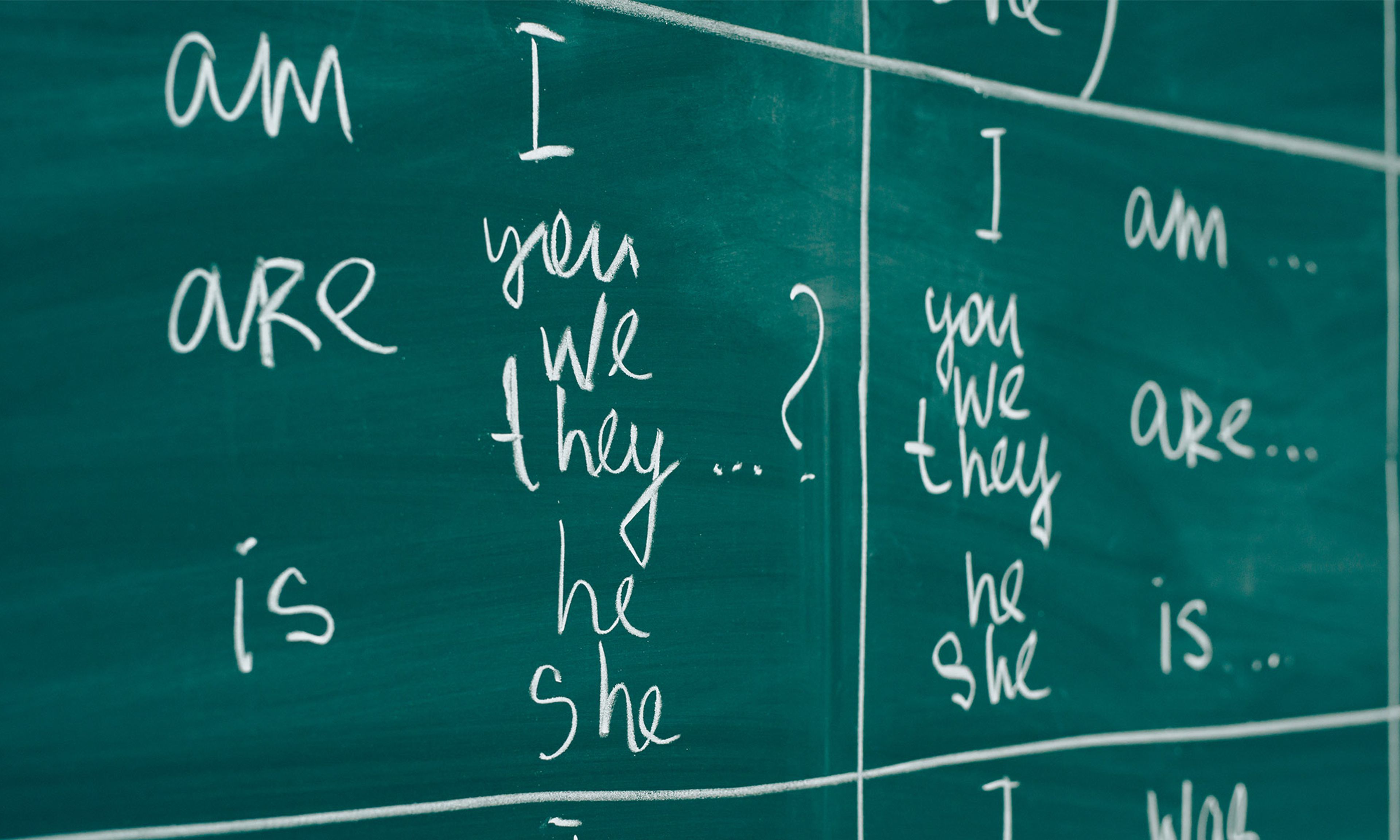
If you’re curious about why we say Woe is me (instead of Woe am I), why we egg people on, why colonel is pronounced kernel, why multiple moose aren’t meese, and how come we say how come, this is the book for you. It’s also skillfully and charmingly illustrated by Sean O’Neill, Okrent’s frequent collaborator.
Okrent mostly attributes English’s idiosyncrasies to the barbarians, the French, the printing press, and what she calls “the snobs.” The British Isles, of course, were subject to a seemingly unending series of ancient and medieval incursions; the marauding invaders (from the Latin vadere, via Old French), comprising Celts, Jutes, Saxons, Angles, Normans, and others, sought, with varying success, to impose linguistic hegemony on the conquered masses.
But English’s unsteady and unusual development transcends mere historical circumstance. While, as Okrent acknowledges, attempting to corral all our language’s disorderly impulses is a fool’s errand, a few themes that help explain them emerge from Highly Irregular: the triumph of the everyday, the dichotomy between mundane and fancy, and the inexorable power of standardization.
First, English’s centuries-long development reflects the predomination of quotidian terms. Take the past tense: Why do we say ate, took, and spoke but also glided, baked, and climbed? Okrent explains that the relatively late practice in Old English of appending d or ed to verbs to establish the past tense mostly displaced the original forms. But words for our most basic, elementary functions — such as eating, taking, and speaking — successfully resisted the standardizing tendency. “Because we used them so frequently, their forms were reinforced over and over again, bolstering them enough to withstand the changes around them,” she writes.
Similarly, why do we say eleven and twelve but then, beginning at thirteen, revert to forms relating to ten? Okrent hypothesizes that ancient Englanders “didn’t have much reason to distinguish numbers above ten,” and the language therefore didn’t develop higher-order figures, with their novel, ten-dependent numbering system, until banking and commercial enterprises had sufficiently matured. (Similarly, the Spanish words for numbers switch to the teens at 16, while French and Italian shift at 17.) “The words we needed earliest and used the most frequently are usually the most irregular,” she writes. “Their weirdness is a sign of their importance.”
Second, earlier, Germanic words typically reflect earthier instincts while newer, French-inflected terms carry a more refined air. Compare, for example, the synonym pairs dirt and soil, house and mansion, craft and art, want and desire: In each pair, the Norse root comes first, bearing down-home authenticity, while the Latin-based word follows, striving to elevate the discourse. This tendency carries over into the agricultural sphere, where Anglo-Saxon peasants toiled on farms herding calves, cows, pigs, and deer, while the Norman nobles dined on veal, beef, pork, and venison.
Third, linguistic standardization, whether inadvertent or intentional, can be a difficult force to resist. For instance, the wh sound was originally pronounced with the breath of an h exhaled through a w-shaped mouth, and the consonant combination was sequenced as hw instead of wh. But as gh, ch, and th gained traction as common spellings for sounds absent from the Latin alphabet, hw became wh and came to encompass words such as whole, which didn’t originally begin with w. The same tendency explains could: Should and would are past-tense forms of shall and will, but can, whose past-tense form is could, has no l. Nevertheless, as its brothers’ past-tense forms included silent ls, so did can’s.
The printing press sharply accelerated this trend and entrenched standardized spellings, as typesetters strongly preferred uniform conventions to chaotic eccentricities. Okrent chronicles the impact of printing, which “didn’t make our letters, decide how they should represent sounds, or create a spelling system” but rather “took decisions made loosely and on the fly, spread them around, and turned them into stronger habits.”
At other times, standardization was deliberate. Those whom Okrent labels “snobs,” primarily 18th-century linguists, publishers, and pedants addicted to “intentional meddling,” consciously manipulated the language. Their meddling included the introduction of the supposedly sophisticated silent letters in doubt, indict, receipt, and salmon, as well as the Hellenized spellings of medical terms that originated as diaria, asma¸ and fleume. Interestingly, however, the color/colour, center/centre, lionize/lionise differences between the United States and our British cousins stemmed from the anti-snobbish machinations of Noah Webster, who sought to simplify American spellings. (This example illustrates how “the exception proves the rule,” an adage whose roots Okrent explores.)
Okrent concludes by arguing that as English continues to evolve, we ourselves must shoulder the responsibility for its adaptation. “When it comes to language,” she writes, “we are creatures of habit and creatures of creativity.” The debate over literally nicely exemplifies this dichotomy: While purists insist on its use only in its original, well, literal sense, the word has routinely been used as a (nonliteral) intensifier (hello, President Biden!) since the early 1800s, much like very (literally: truly, from the French vrai) and really. We can huff and puff about “improper” usage, but we also inevitably engage in it.
In the end, Okrent demonstrates that, when it comes to English’s weirdness, “we get the blame, but we also get the benefit.” Benefits indeed abound (from the Latin ab, or “away from,” and undare, or “wave,” with an added Middle English o) for the reader of this delightful book (from the Old English boc, for document or charter, and from the Germanic buch, or “beech”).
Editor’s Note: An earlier version of this piece incorrectly stated that English was not Arika Okrent’s first language.











Comments