France and Great Britain were always rather embarrassed by their World War I alliance with autocratic Russia. It came as something of a relief, therefore, when word reached them that Czar Nikolai II’s government had collapsed in the streets of Petrograd and been succeeded by a democratic “provisional government”; they could then claim that the war pitted democracy against authoritarianism. In this volume of The Red Wheel, his novelistic history of the Russian Revolution, Aleksandr Solzhenitsyn cited elated members of the French parliament: “In your revolution lies the entire future of international democracy.” More important, he pointed out, not by way of praise, was that the United States was the first country to recognize the revolutionary government. Not the least reason for President Wilson’s decision, as he suggested in his war message to Congress, was that “Russia was known by those who knew it best to have been always in fact democratic at heart.”
For most Western historians, the March (February O.S.) Revolution was a glorious, if short-lived, event in the history of an otherwise backward — that is, undemocratic — Russia. Solzhenitsyn did not view it that way. He judged the revolution to have been a catastrophe that prepared the way, within months, for the Bolshevik coup d’état. This volume, newly translated into English, is the third of four that make up Node III of The Red Wheel; it focuses on the week of March 16–22, 1917. Not even the indefatigable Solzhenitsyn could complete his projected reconstruction of the years beginning with the Great War and ending with the Red victory in Russia’s civil war; he therefore opted for “a narrative in discrete periods of time.” Each period forms a “node” — a detailed account of a brief but pivotal moment on the road to and through revolution.
By March 16, the czar, not wishing to be separated from his hemophiliac son Alexei, had abdicated in favor of his younger brother Mikhail, who, on being informed that his safety could not be guaranteed, declined the honor. Amid violent chaos in the streets, two centers emerged to fill the resulting power vacuum: the provisional government, appointed by the Duma (parliament), and the Soviet (Council) of Workers’ and Soldiers’ Deputies. From the first, as Solzhenitsyn made clear, it was the latter that wielded the greater power.
One man, Aleksandr Kerensky, was a member of both the Soviet and the provisional government. Although that self-described democrat and socialist has always been admired in the West, Solzhenitsyn held him in contempt; he was “intoxicated with himself.” He fed upon the worshipful receptions he received as he raced back and forth around Petrograd and Moscow delivering speeches of such length that he sometimes fainted from exhaustion. Unfortunately, according to Solzhenitsyn, the other members of the provisional government were not made of sterner stuff. Prince Georgi Lvov, for a time the weak and irresolute prime minister, once asked his colleagues in all seriousness why the country needed police.
Solzhenitsyn portrayed Pavel Milyukov, the minister for foreign affairs, who was known and respected in the West as a historian and leader of the leftist but nonsocialist Kadets (Constitutional Democratic Party), as reckless, ambitious, and self-admiring. An unrestrained critic of the czarist government, he had done as much as anyone to pave the road to revolution. It remains something of a mystery, then, why he was one of two ministers to argue for the preservation of the monarchy. The other was Aleksandr Guchkov, the minister of war, who, hoping to save the monarchy, had pressured the czar to abdicate. In one of the documents that Solzhenitsyn reproduced in this volume, Guchkov warned General Mikhail Alekseev, commander in chief of the army, that “the Provisional Government possesses no real power. . . . It exists only as long as the Soviet of Workers’ and Soldiers’ Deputies allows it.”
The members of the Soviet were primarily Mensheviks and Socialist Revolutionaries — socialists to the right of the Bolsheviks. At the head of its 30-member executive committee was the Menshevik Nikolai Chkheidze, a Georgian beloved, according to Solzhenitsyn, by the proletariat. For Chkheidze and his comrades the revolution was far from over. The Soviet quickly issued “Order No. 1,” according to which members of the military were to obey only those governmental orders that did not conflict with the Soviet’s own. It demanded that Nikolai and his family be placed under arrest, and it opposed the return to work that the government insisted was necessary for prosecuting the Great War.
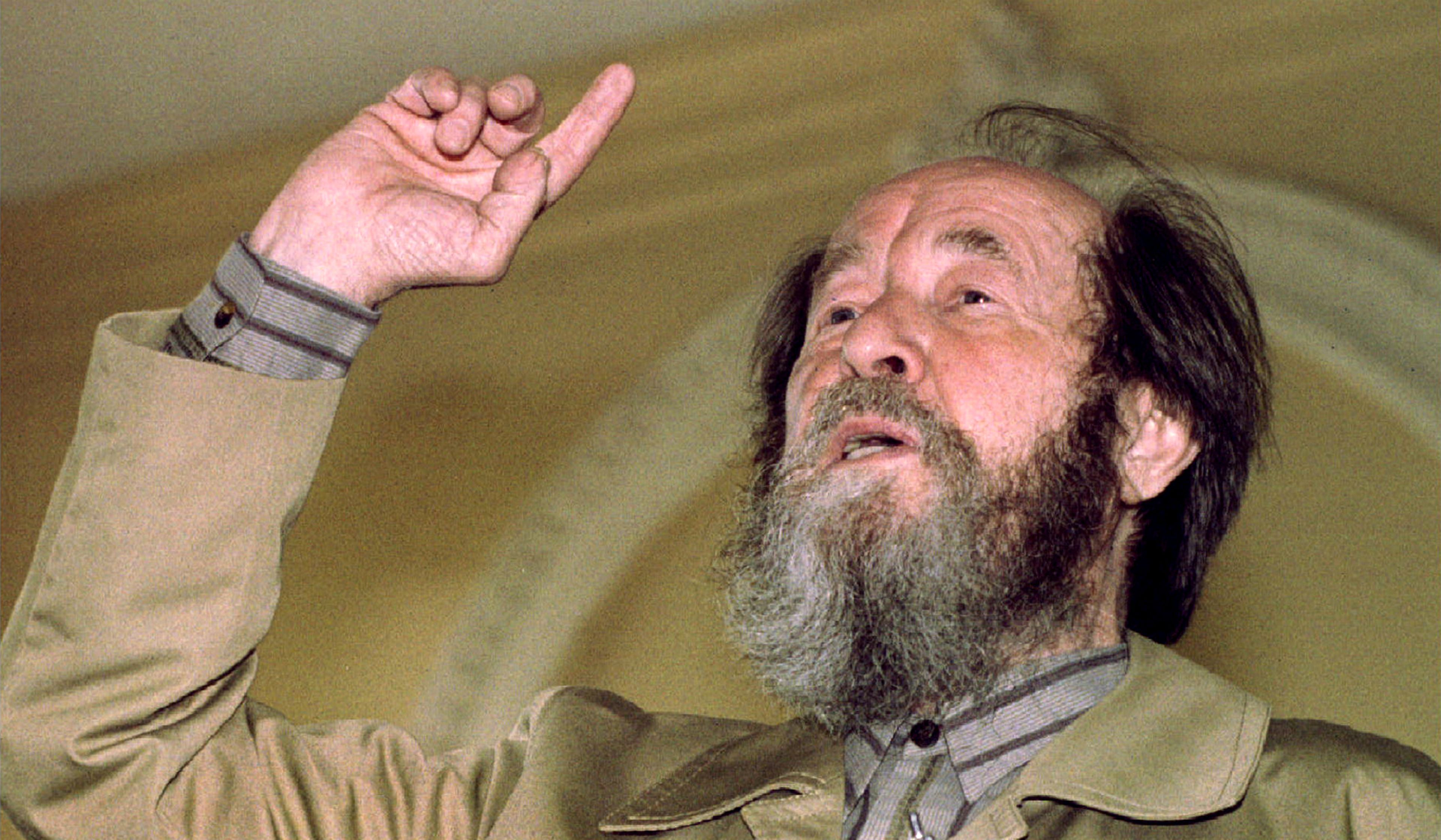
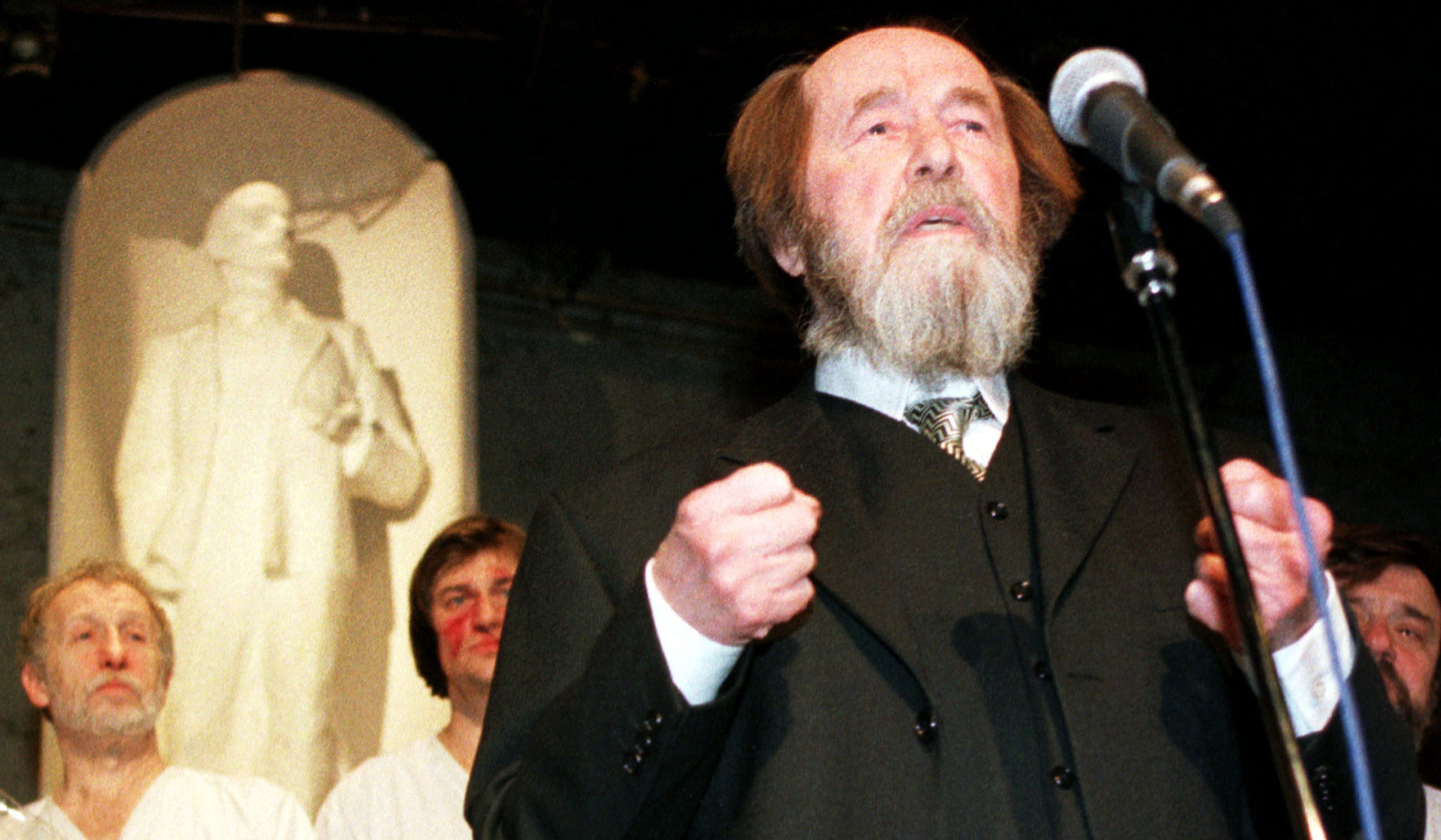
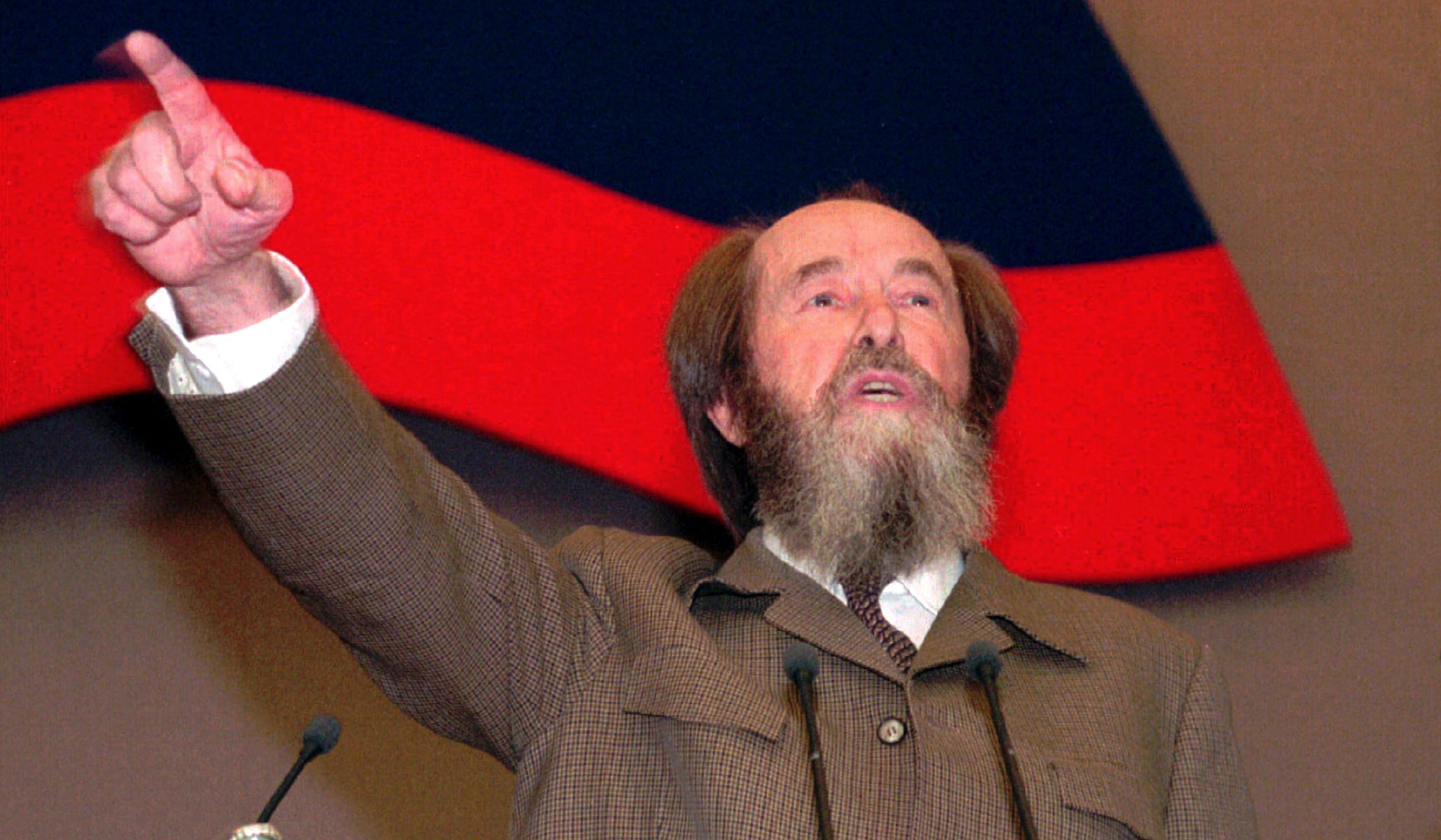
Russian writer Aleksandr Solzhenitsyn gestures emotionally as he addresses people of Far East capital Vladivostok on May 30, 1994.
Alexander Natruskin/Reuters
But should it have continued to be prosecuted? Solzhenitsyn’s judgment was that the war was the source of both the March Revolution and the Bolshevik seizure of power. The most important of the “nonhistorical” characters in The Red Wheel is Colonel Georgi Vorotyntsev, who speaks for the author: “Russia needed peace. Peace alone! Peace above all! Peace first of all!” He believes “that we should neither have entered this war for anything nor even signaled our willingness to do so. This was our fatal error.” The conflict, according to Vorotyntsev/Solzhenitsyn, was but one of many senseless wars in which Russia had engaged. “All of us [the gentry and educated class] betrayed our people — and long ago, and in so many ways! We gave them up to this war, too — betrayed them.”
While the government and the Soviet competed for power, anarchic conditions ruled the streets of Petrograd; the crowds of demonstrators that had begun by demanding bread had turned into mobs. Released from any outer or inner restraint, they smashed windows and looted stores. They murdered police officers, stormed prisons, and set common criminals (along with the political prisoners) free. As a result a wave of robberies, burglaries, arson attacks, and murders washed over the city. It is in the nature of revolutionary murders, Solzhenitsyn wrote, that “they cannot be tried or disputed and don’t even require apologies. Someone was killed — yes, they were, that’s it, bad luck.”
The chaos in the streets did not long remain restricted to Petrograd; it quickly spread to Moscow and across Russia. In Nizhni Novgorod, “the crowd obtained the release of the criminals (1300 men). There were no more police.” In Tula, “all police precincts were attacked and the entire police force arrested.” In Saratov, “the revolution began with the killing of city policemen. The morgues were filled with their bodies.”
Owing in part to personal experience in the Soviet Union and the West, Solzhenitsyn entertained a low opinion of the press. He was quick, therefore, to highlight the lies retailed in the revolutionary newspapers. “Inasmuch as the revolution had been immediately declared great, bloodless, sunny, and smiling, . . . they had to hush up officers’ bodies and the policemen torn to shreds.” Only one newspaper bothered to print an obituary of the liberal Admiral Adrian Nepenin, a victim of revolutionary justice.
No opposition to the revolution came from the press, but then, as Solzhenitsyn pointed out in amazement, there was little or no resistance from any quarter. During the French Revolution, he noted, “the French monarchy resisted for three years, while ours — all of three days.” Grand Duke Nikolai Nikolaevich, supreme commander in 1914–15 and viceroy of the Caucasus, quickly declared himself to be a sincere adherent of the new regime. Many aristocrats and Guards officers put on red bows. Everyone tried to assure everyone else that his fondest wish had always been the overthrow of the old order. Most important of all, Nikolai abdicated without a fight.
But perhaps resistance would have been futile. Not so, according to Solzhenitsyn. The revolutionaries were largely untrained and poorly armed. Because of the relative calm then existing at the front, up to a million soldiers would have been available to retake Petrograd. Thirty thousand would have been more than enough, but the Supreme Command thought only of surrender. “It was a panopticum of weak and incapable men.” Those words reflect Solzhenitsyn’s view that history is radically contingent; nothing is inevitable. The revolution resulted from the action (or inaction) of men and women who could have chosen different paths.
Solzhenitsyn’s highly critical account of the March Revolution is of a piece with his hostile attitude toward all revolutions. He was not opposed to change; quite the contrary. He believed strongly and wrote often that czarist Russia had been in need of a reform program of the kind advanced by Prime Minister Pyotr Stolypin. Had that great leader not been assassinated in 1911, and had the czar not decided for war, Russia would almost certainly have been spared the revolution to come. In the fall of 1993, Solzhenitsyn gave an address in Les Lucs-sur-Boulogne commemorating the bicentennial of the counterrevolutionary Vendée Uprising. He told those gathered that he would not wish a “great revolution” upon any nation. France, he said, had a Thermidorian reaction that overthrew Robespierre, but the revolution in Russia “was not restrained by any Thermidor as it drove our people on the straight path to a bitter end, to an abyss, to the depths of ruin.” Those words, and Solzhenitsyn’s riveting account of the March Revolution, should give Americans pause.











Comments