Conservatism, rightly understood, is premised on a realistic understanding of human frailties, shortcomings, and wickedness. If we understand the world to be fallen, we accept that such a designation applies to the whole world and all of its parts.
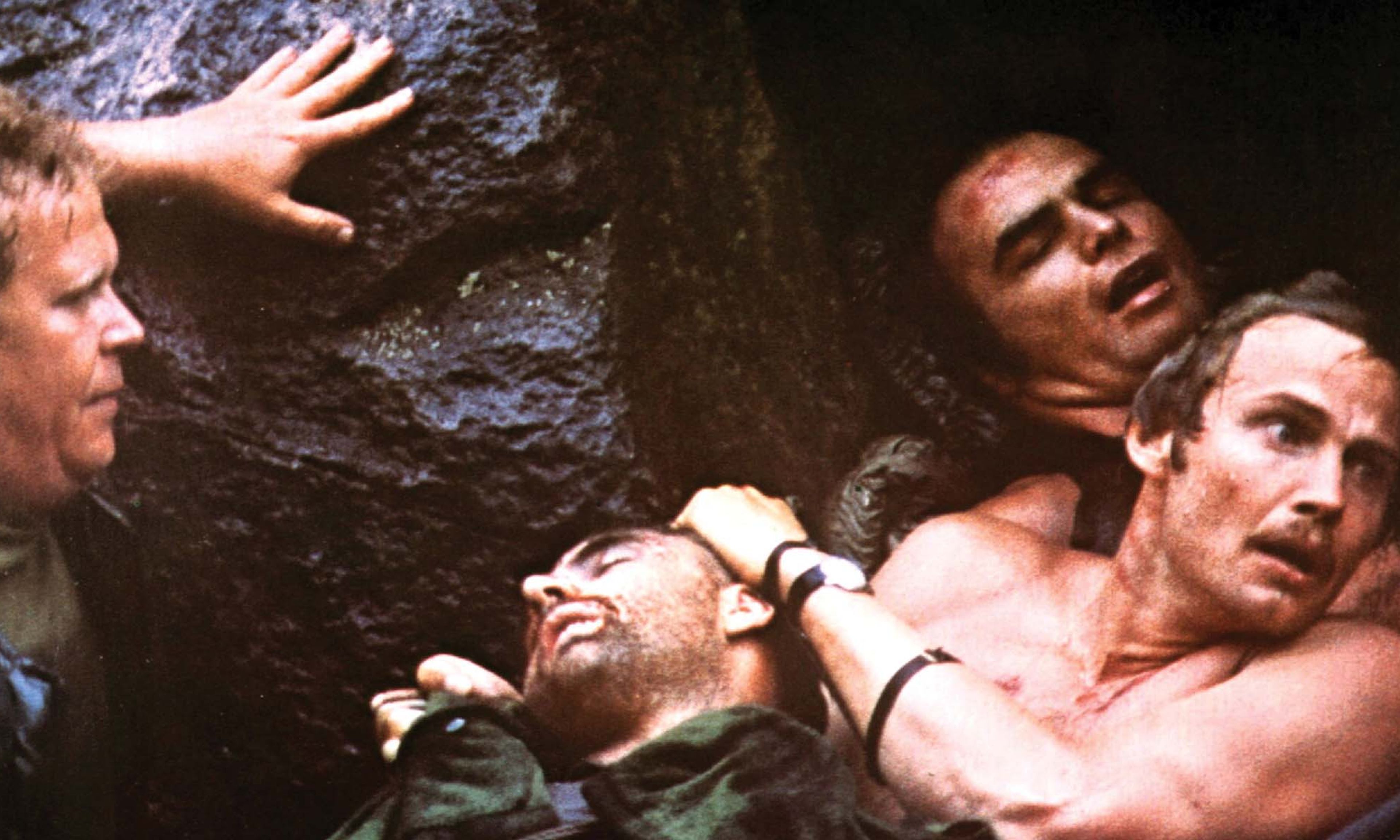
By this reckoning, Deliverance, John Boorman’s 1972 masterpiece about four men from Atlanta who contend with the wilds of northern Georgia, is one of the most profoundly conservative films ever made. Adapted by poet and novelist James Dickey from his acclaimed 1970 novel, the film takes the position that backwoodsmen and city-dwellers alike are capable of ghastly things, and that the country is as likely as the city to be a scene of evil. Seen today, the film remains as unforgiving in its depiction of fallenness as it was when first released by Warner Bros. 50 years ago.
At the center of the story are a quartet of genteel Atlantans — Ed (Jon Voight), Lewis (Burt Reynolds), Bobby (Ned Beatty), and Drew (Ronny Cox) — who, in a state of debateable readiness, embark on a larkish canoe trip on a fictional river, scheduled to be dammed, upstate. As played by Reynolds with an intensity and physicality that will surprise those familiar with his shaggier, paunchier presence in such slack efforts as Smokey and the Bandit and The Cannonball Run, Lewis is unquestionably the most committed and competent in the group, but none of the men — each accustomed to houseboats and suburbs and Sunday afternoons watching professional football — are prepared for the trials and torments they will encounter.
Although faithful to the outline and spirit of the novel by Atlanta native Dickey, Deliverance benefits from the outsider’s vision of Boorman, an Englishman who has made a career of sizing up what are, to him, and hence to us, strange lands: The California of his great neo-noir Point Blank (1967), the Manhattan and Africa of his much underestimated horror sequel Exorcist II: The Heretic (1977), and the Burma (now Myanmar) of his brilliant drama Beyond Rangoon (1995) are as exotic and forbidding to the viewer as they must have been to their anthropologist-like director. Comparatively cozy are those films that most clearly spring from Boorman’s own mind, such as his Arthurian pageant Excalibur (1981) or his World War II–era autobiography Hope and Glory (1987).
Boorman’s talent for teasing out the threatening dimensions in what might otherwise be unremarkable locales is given its ultimate expression in Deliverance, which, time and again, sets the visiting Atlantans at odds with their surroundings. How mysterious these urbanites must appear to the locals, who decline to laugh at their jokes and express bewilderment at their naïve-sounding plans to tempt a forbidding river: “Where you going, city boy?” one asks. In the famous “dueling banjos” scene early in the film, Drew, having stopped with his travel mates at an untended service station, picks out a tune on his guitar and soon finds himself “answered” by a boy on a porch cradling a banjo. Even if one does not know what the film has in store for its characters, it’s obvious that Boorman does not mean to peddle clichés about the communal power of music and the brotherhood of man but, in the banjo-playing boy’s strange opacity, to emphasize the unbridgeable chasm between city types and country folks. Although Drew eagerly partakes in the music-making, the boy, photographed from below to replicate the vantage point of Drew, remains an enigma: his head cocked in puzzlement and his laughter ambiguous and unknowable.
The Atlantans can seem like boorish, uncomprehending intruders into the backcountry, and some of the dialogue flirts with the idea that an unspoiled Eden is being trampled upon. “There’s something in the woods and the water that we have lost in the city,” Bobby says. But Boorman is no back-to-nature sentimentalist. The filmmaker took stock of the rural American South and found not the noble savage but savagery itself. The abundant greens and swirling waters can look idyllic, but the film establishes soon enough that we inhabit a time after the Fall. After straying from their intended route, Ed and Bobby — occupying their own canoe at a distance from Lewis and Drew’s — run into territory controlled by a pair of mountain men, who, in Boorman’s design, are more like ciphers than full-fledged characters; in the credits, they are not even given names: Bill McKinney is called “Mountain Man,” and Herbert “Cowboy” Coward, “Toothless Man.” By any name, they are terrifying.
Offended by Bobby’s patronizing offer to buy whiskey from them and utterly intolerant of Ed’s obsequious attempts at schmoozing (“Gentlemen, we can talk this thing over,” Ed says, with Voight projecting just the right aristocratic condescension in his voice. “What is it you require of us?”), the mountain men, one of whom carts around a rifle and both of whom behave with undisguised hostility, take the citified intruders hostage and compel them to submit to their demands. Bobby is sexually assaulted by one of them, an act made all the more horrifying for being witnessed by a temporarily paralyzed Ed, whose belt has been removed and used to tether him to a tree. In a scene played with excruciating slowness, Boorman fully captures the sense of violation that comes through in the novel. “I had never felt such brutality and carelessness of touch,” Dickey writes, in the voice of Ed, in the novel, “or such disregard for another person’s body.”
This scene is as harrowing as any in modern movies — and it’s followed by a moment as electrifying as any: Having silently come upon the attack on Ed and Bobby, Lewis stands in his canoe and aims a bow and arrow at McKinney’s character, who is preparing to participate in an assault on Ed but whose back is turned toward Lewis. In a series of cuts that on their own justified film editor Tom Priestley’s Academy Award nomination (one of three nominations earned by the film), Ed makes eye contact with Lewis through the dense thicket and silently exhorts his friend to release the arrow, widening his eyes and deepening his breathing but unable to speak without giving away Lewis’s position. When Lewis’s arrow pierces the chest of the mountain man, and his accomplice is overpowered and then flees, the film itself seems to exhale. It is perhaps contemporary cinema’s most vivid validation of the traditional man of action; at a moment of maximum urgency, a man capable enough to have mastered a bow and arrow — a lethal man, an unafraid man — is needed.
Moral and physical dilemmas remain. The canny, self-interested Lewis urges his friends to help him bury the body of the slain mountain man instead of leaving him to plead self-defense to local authorities who are, by his lights, sure to be corrupt. “I’ll be goddamned if I’m going to come back up here and stand trial with this man’s aunt and his uncle, maybe his mama and his daddy, sitting in the jury box,” says Lewis, who, by taking the decisive action that unquestionably saved Ed and Bobby, has earned more than a little credibility.
The mountain man is buried, an arduous, dirty, time-consuming procedure in a film that, again and again, emphasizes the sheer harshness and hardness of the Atlantans’ journey out of the wilds. Boorman shows us how difficult it is to dig a grave and place a man inside it, and how grueling it is to navigate rough, rocky rapids. The ordeal proves too much for a suddenly sallow-faced Drew, who plunges from his canoe into the water. Lewis theorizes that Drew has been shot by the so-called toothless man, who at this point survives, but it seems likelier that Drew succumbed to nothing more than simple exhaustion. Moments later, a waterfall lined with rocks submerges all of the men and violently catapults Lewis, who injures his leg to the point of exposing bone. Meanwhile, the relatively able-bodied Ed and Bobby are left to contend with the bodies of the second mountain man (eventually felled by Ed) and Drew. “Oh, God, there’s no end to it,” Bobby says, speaking as though he is referring not merely to their ordeals on the river but to the larger predicament of humanity. It is the largeness of the film’s conception of evil that makes it so lasting: a mountain man can be monstrous, a vacationer can be capable of murder in defense of his friends.
In the end, the Atlantans receive deliverance from this hell in northern Georgia: Having hatched an explanation for the death of Drew, and justified in their own minds the necessity of their having killed the mountain men, the three survivors are given a pass by a suspicious but not too inquisitive sheriff, who, in a cameo by a chagrined-sounding Dickey, reckons that the best he can do is to insist that this trio return whence they came. “Don’t ever do nothing like this again,” the sheriff says. “Don’t come back up here.”
Deliverance reinforces the conservative notion that darkness exists “anywhere, everywhere, nowhere,” to invoke the memorably philosophical phrase used by Lewis in answer to Drew’s question of where they are to bury the body of the first slain mountain man. And the film amounts to a powerful caution against hubris: It suggests that sometimes the best course is not to explore, let alone attempt to conquer, the vast unknown but, to echo Dickey-as-sheriff, to stay home.
The film’s most terrifying image comes near the end: Ed, having been delivered at last to his bed in the arms of his wife, dreams of a lone hand — Does it belong to Drew? Does it belong to one of the mountain men? — rising from the murky depths. When the final history of Hollywood is written, it will turn out that it was not Jaws but Deliverance that told audiences to stay out of the water.












Comments