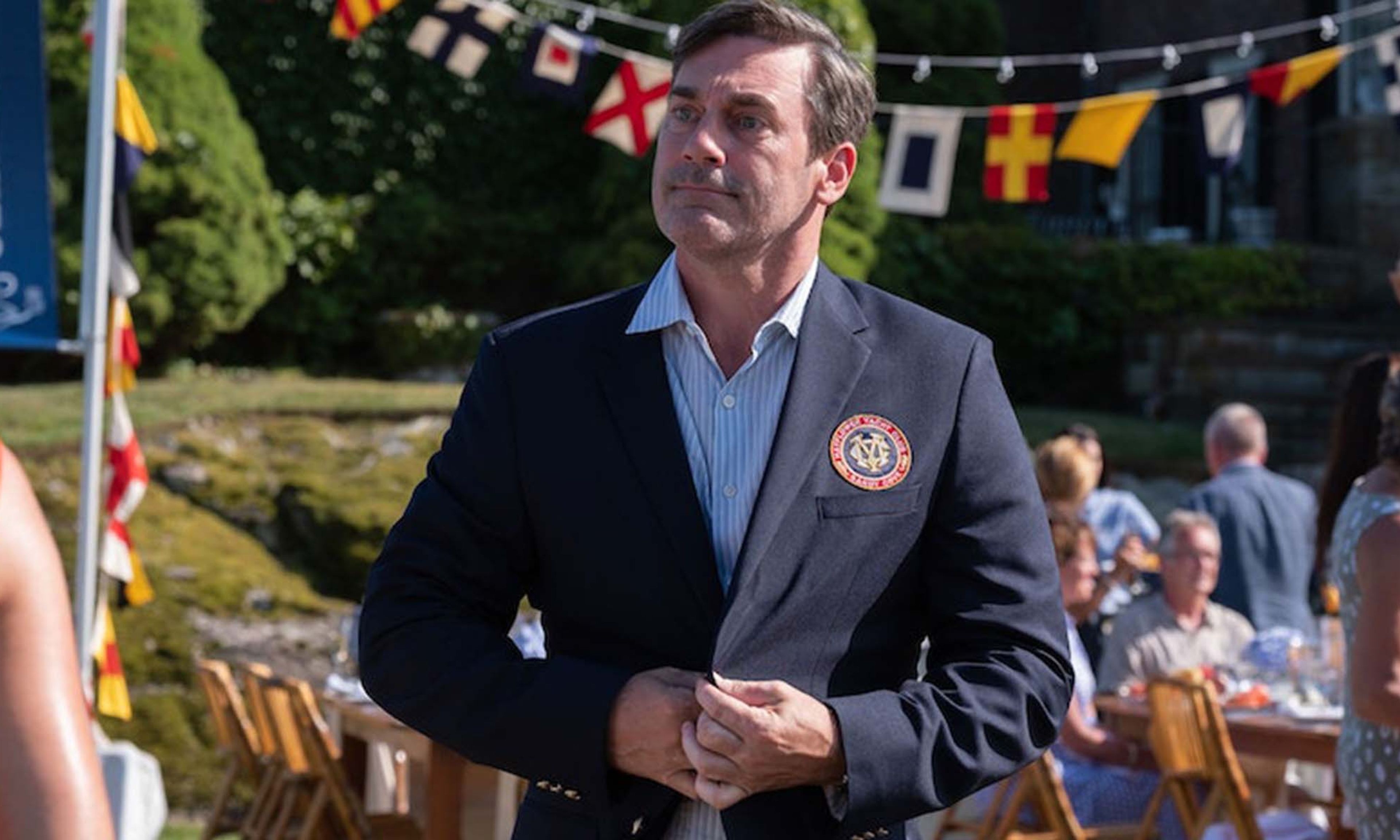
What should Hollywood do with Jon Hamm? The star of Mad Men, the ridiculously handsome incarnation of mid-century American masculinity, has been working steadily ever since his career-defining part wrapped up, showing himself game for every kind of role. He’s played a few leads, but mostly he’s been a supporting actor, sometimes relying on his intense alpha-male features to play cops and military heavies, sometimes sending up his good looks in comic parts or as Ralph Bellamy–esque rejected suitors.
It’s a fine-enough career but a waste of charisma. Yet it’s hard to know exactly what wouldn’t be a waste, because what worked for Hamm as Don Draper — a magnetism that attracted and repelled at once, that made women regret their desire for him and men feel inadequate in his shadow — isn’t the ideal combination for male movie stardom, which usually trades on the simpler “Women want him, men want to be him.” And it’s particularly nonideal in current-era Hollywood, where a certain kind of handsome-white-guy arrogance is especially on the outs.
So Hamm’s newest part, in the mystery-comedy-caper Confess, Fletch, represents an interesting experiment. Directed by Greg Mottola, who made two terrific male coming-of-age movies, Superbad (2007) and Adventureland (2009), and faded a bit thereafter, the new movie trades on the recent revival of murder-mystery storytelling (Knives Out, the Agatha Christie adaptations by Kenneth Branagh), but it’s trying to bring back a more distinctive brand: the Fletch novels and their Chevy Chase–starring adaptations, which were big in the 1970s and 1980s and haven’t been much heard from since.
There’s a reason for that, which is that they’re very much stories of their time. I’ll quote the New York Times obituary for the novels’ author, Gregory Mcdonald, describing his protagonist: “Irwin Maurice Fletcher was young, cocky and smart but no white knight. A Southern California newspaperman turned beach bum, he flouted authority wherever he found it. . . . He was a cad, a deadbeat (unpaid alimony), an opportunist and a sometime accumulator of vast ill-gotten wealth. He was, in short, the perfect hero for the countercultural ’70s, and the public ate him up.” And he was also the perfect character to be embodied by Chevy Chase, an actor who made the phrase “charmingly unlikeable” seem like it’s not an oxymoron.
But if it was possible for a good-looking, caddish white guy to posture as an enemy of authority in the 1970s or 1980s, translating that kind of narrative to the present day seems tricky. Not because authority is any more respected nowadays, but because the rules for what counts as countercultural have shifted so dramatically. (And the idea of the swashbuckling journalist has fared, shall we say, poorly.)
For instance, in an age when conservatives feel like outsiders, you could imagine a “based Fletch” puncturing woke pieties and tangling with PC institutions — but it’s hard to imagine that kind of adaptation getting a green light. Alternatively, you could imagine a “woke Fletch” sticking it to the structural forces of patriarchy and white supremacy that the Left insists still dominate our culture — but can a privileged white dude with a history of unpaid alimony and a very pre–Me Too–era style really be a vehicle for wokeness?
This leaves Confess, Fletch in a somewhat uneasy in-between place. Fletch is a genuinely good part for Hamm: a character a little too handsome for his own good, walking the line between charming and deplorable, surprising you with a rubber-faced reaction one moment and deadpan sarcasm the next. And the movie has a lot of fun with its caper style and cast, throwing in everyone from Kyle MacLachlan (as a shady art dealer) to Marcia Gay Harden (as a Mediterranean countess) while successfully updating Fletch’s profession — making him a former investigative reporter who turned to private-investigative work when the Internet killed the media business. (John Slattery, Hamm’s old friend from Mad Men, is a welcome presence as the depressed editor of a fictional Boston newspaper.)
But the actual mystery plot, involving paintings stolen from the wealthy father of Fletch’s Italian girlfriend (Lorenza Izzo) and an attempt to frame our protagonist for murder, is something less than airtight and sags badly by the end. Which leaves the edge, the satire, as the movie’s raison d’être — but Confess, Fletch doesn’t know exactly what it’s satirizing.
Is it sending up its main character, by referencing his “white privilege” and surrounding him with women and minorities (including the two cops, Roy Wood Jr. and Ayden Mayeri, charged with investigating the murder) who are constantly exasperated by his antics? Is it making fun of the decrepit establishment forces he’s contending with, or trying to infiltrate — the police, the art world, a WASPy yacht club? Is it making subtle sport of current progressive pieties (Slattery’s newspaperman gets in a few digs at Millennials) by “centering” such an aggressively white male specimen and letting him get away with . . . well, not that much, but some at least mildly un-PC behavior?
Ultimately the movie slashes in multiple directions, but with a deliberately blunted tip. It’s a pity: This is the right kind of role for Hamm, but for Irwin Maurice Fletcher, it’s the wrong moment for a comeback.











Comments