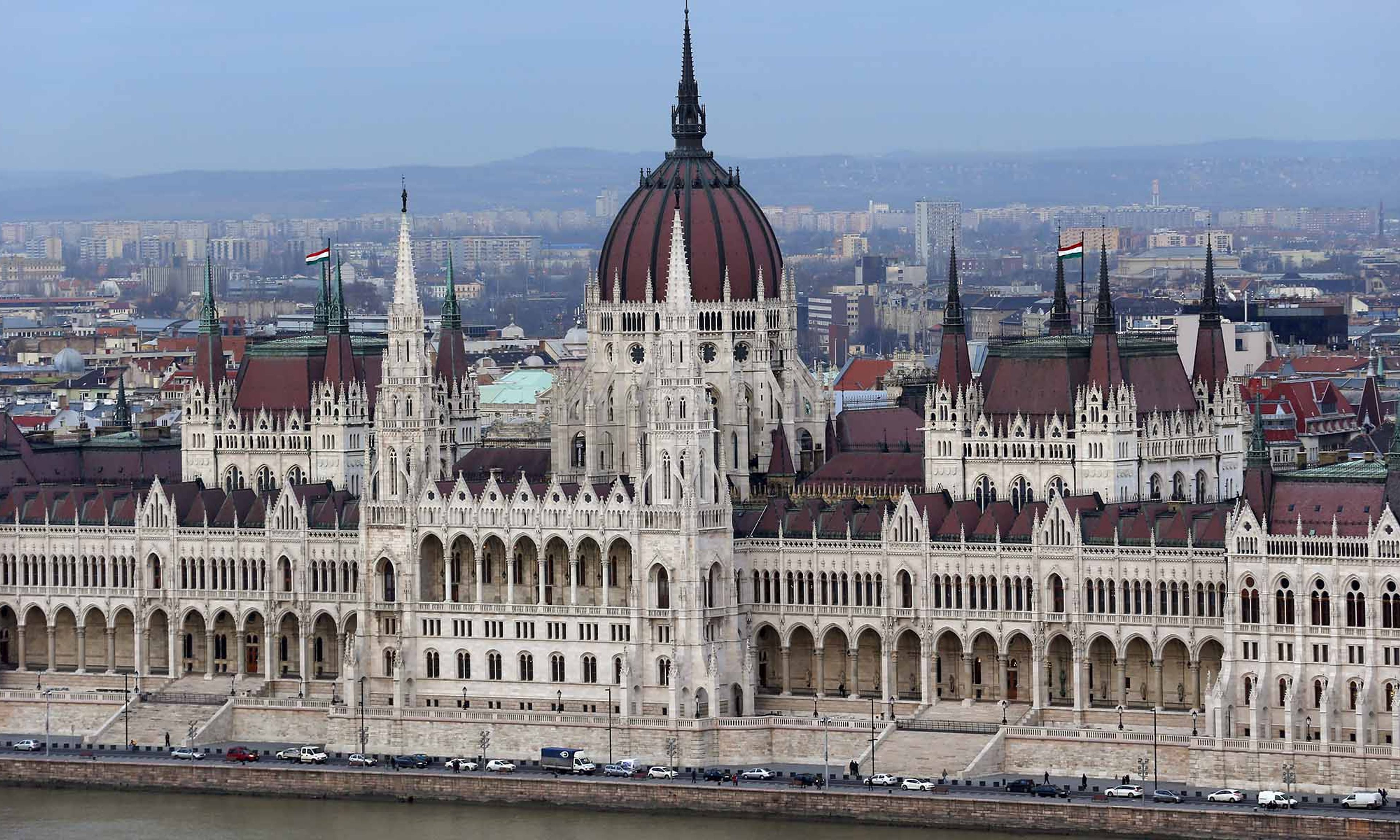
Victor Sebestyen is a refugee from Hungary, and his Budapest is a book that conveys a longing for the life he might have led if circumstances had been different. The joys outweigh the sorrows. Whenever he visits the city, he says, the first place he goes to is Rózsadomb, a district of old cobbled streets and expensive houses, “a healthy place for a historian to loaf and think.” And what he thinks about is Hungary, its rough ride down the centuries and its survival.
The Hungarian language has affinities only with Finnish, and its singularity kept — and still keeps — Hungarians together and apart from the neighbors. Sebestyen’s familiarity with this difficult language frees him up for a spectacular range of quotes from Hungarian writers, some of them first-class but still untranslated. One of the outstanding poets is Miklós Radnóti, who was shot on a forced-labor march during the last war. He also fills in details about other Hungarian refugees, such as the prolific journalist Ephraim Kishon, and Edward Teller and Leo Szilard of atom-bomb fame. A tablet on the wall of a house in Pest records that Arthur Koestler, one of the fiercest enemies of the Soviet Union, once lived there — uncontroversial evidence that communism really is over and done with. Another Hungarian speciality is gypsy music that incorporates Magyar folk themes. Franz Liszt called his most famous compositions “Hungarian Rhapsodies” and the result was that “Magyar chauvinists were not pleased.” (In any case, the best-known czardas was written by Johann Strauss the younger, who was Austrian to boot.)
The Magyars were a nomadic tribe that settled in the Danube basin rather more than a thousand years ago. Hilly and picturesque Buda is on one side of the river, and flat and busy Pest is on the other. One of their kings imposed Christianity on them, and this was a first step in turning them into the civilized Hungarians that they have long since become. Otherwise oblivion might well have been their historic fate. Magyar territory was always extending or diminishing. An opening chapter of this book gives some idea of the horror of the Dark Ages. For instance: “In the next thirty nine years the country changed its ruler six times. Three kings died a violent death. The royal family’s feuds brought the intervention of foreign armies nine times. . . . Law and order was utterly destroyed and there were two pagan rebellions, both suppressed with the utmost savagery.” This leads to the proposition that this nation has a way of converting even the worst disasters into heroic defeats.
Suleiman the Magnificent, the Ottoman sultan, invaded the region, and at the decisive battle of Mohács in 1526 the Hungarian king, seven bishops, and 15,000 mercenaries were killed. After the battle, the sultan merely observed in his war diary, “Massacre of two thousand prisoners” and then “Rain fell in torrents.” Ottoman soldiers looted Buda and set fire to it. A poet wrote some satirical verses, and the sultan had him ridden on a donkey round the city and then strangled to death. Hungary was now one among the many provinces paying tribute to the Ottoman Empire. Mosques and minarets in Hungary still mark the furthest reach of the Ottoman conquest in Europe.
An Ottoman army besieged Vienna in 1683, and failure then to capture that city began the Ottoman decline and the ascendancy of the Habsburgs. The Austrian emperors saw themselves as Catholics with a dynastic claim to the throne of Hungary. A few Hungarians stayed loyal to the Ottomans. One such brought the first printing press into Constantinople and became a Muslim. But from the 18th century onwards, Austria had to find a workable relationship with the Hungarian minority, and Hungarians had to decide whether they could live without independence. Here was an issue of war and peace and all Europe was well aware of it.
The Habsburgs wanted to replace the Hungarian nobility’s right to elect the king with a hereditary monarchy, that is to say, themselves. Ferenc Rákóczi, prince of Transylvania, was the first to rebel, only to be captured and condemned to spend the rest of his life exiled in a Turkish fishing village. For most of Europe, the 1848 revolution had the aim of reform, but in Hungary it proved a war for independence. Count Lajos Batthyány became the revolutionary prime minister. In the Habsburg repression to restore the status quo, he was shot. Almost all the nobility made their peace with the Habsburgs and had reason to do so; they alone could vote and they had the privilege of paying no tax. Two princes and 80 counts held more than half the country. The Esterházys, for instance, owned a million acres and more than a hundred villages and lived in feudal splendor in 30 castles or palaces. When a well-known British agriculturist told one of the Esterházys that he had 11,000 sheep, the prince replied that he had the same number of shepherds. A latter-day Esterházy prince had the distinction of being imprisoned by the Nazis and the communists.
The merits of aristocratic rule are presented with great skill and even a touch of nostalgia. Insiders, aristocrats were in a position to know when to put pressure and when to abstain. The upheavals of 1848 and the War of Independence had brought to the throne the 18-year-old Franz Josef. He was afraid that concessions to Hungary would encourage the Czechs, Serbs, and other minorities to demand the same. Only an aristocrat like Gyula Andrássy could have influenced Franz Josef to agree to the 1867 compromise, which was a form of power-sharing that kept Hungary in the empire, and he did it by conducting a passionate — and chaste, we are to believe — friendship with the beautiful Empress Sisi, a German princess for whom Hungarian independence was a lifetime cause.
After 1867, Budapest became a grandiose capital city with monumental architecture and boulevards. Gustav Mahler was the musical director of its Royal Opera, and the beau monde made the New York Café and the pâtisserie Gerbeaud so famous that they even survived communism. In spite of traditional animus, most Jews were coming to think of themselves as Hungarians. A chapter on pogroms ends with a remark from Count Julius Károlyi, which goes deep. “Just as we keep the gypsies so that they can play [music], we keep the Jews so that they can work instead of us.”
The fatal shot in 1914 that killed Archduke Franz Ferdinand put an end to the Habsburgs and the old aristocratic order and opened the Age of the Dictators. Between the wars Hungary was in the hands of two mediocrities. Béla Kun tried to imitate the 1917 Bolshevik revolution, and Admiral Miklós Horthy prevented him from doing so; the one was at the mercy of Stalin, who had him shot, the other was at the mercy of Hitler, who had him imprisoned and had his son sent to the Dachau concentration camp. Because Hungary was always on the losing side, Allied policy-makers felt that punishment was due. Harold Nicolson, the eminent author and Churchillite member of Parliament, for instance, in one of his wartime Friday talks on the BBC, thought it right to tell listeners that Hungarians “have done much harm and little good in Europe.”
Cécile Tormay, Sándor Márai, Christine Arnothy, and others have left vivid eyewitness accounts of living through horrors even worse than anything the Magyars experienced in the Dark Ages. Under the orders of Adolf Eichmann, the Germans deported and murdered 437,402 Jews, about half the Jewish population. Lasting 102 days, the Soviet siege of Budapest was as savage as the Battle of Stalingrad. There was no question of liberation. Leaders of the Hungarian Communist Party had spent the war in Moscow and now Sovietized the country bit by bit with what were known as “salami tactics.” Hungary became another police state in the Soviet bloc. Sixty Andrássy Street, once the headquarters of the secret police, is now a memorial, its underground cells adorned with photographs of everyone who was victimized in them. When protest turned into revolution in 1956, the Soviet Politburo gave the purest possible illustration of communism in action. Promising to withdraw their troops, the Soviets invited Pál Maléter, the general directing the revolution, for discussions and kidnapped him. Given a guarantee that he would be safe, Prime Minister Imre Nagy left his refuge in the Yugoslav Embassy, only to be kidnapped, flown to Romania, put on trial, and hanged. His last recorded words were a forecast that he would be rehabilitated — and so he was in 1958. That was the moment when Sebestyen, his mother and father, and his brother and sister were among the 150,000 desperate people who fled the country. He doesn’t speak of what they went through, and he stops short of commenting on the present dispensation in the country, but he writes with such knowledge and sympathy that he no doubt thinks the days of heroic defeats are over.











Comments