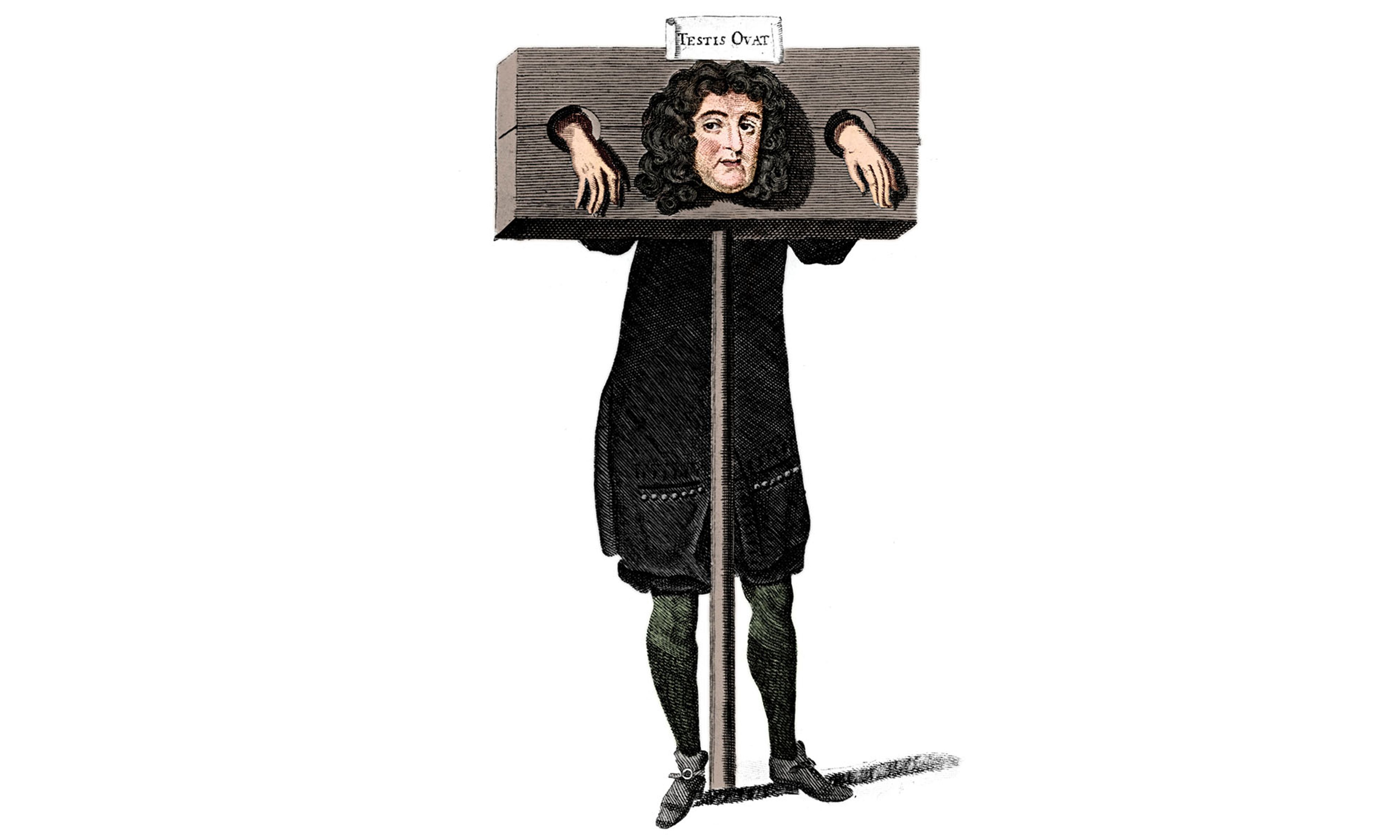
Party politics was born of flagrant lies, religious bigotry, public hysteria, and unbridled paranoia. It emerged in late-17th-century England from a political crisis that threatened to throw the country once again into internecine bloodletting. A vibrant print culture, which profited as much from peddling lies as from telling the truth, whipped up the crisis. So too did politicians, many of whom lied without compunction or countenanced the lies of others solely to bolster their own political purposes. In addition to bringing the country to the brink of its second civil war in living memory, the political crisis cost the lives of a few dozen innocent people, many of whom died by being hanged, drawn, and quartered. Victims included elites as well as regular people: They shared only that they belonged to a disliked religious minority.
Victor Stater’s fantastic new book tells the story of this sordid episode in English history known then and since as the “Popish Plot.” It was, as his book’s title indicates, a hoax — it was a plot that never was. At a remove, the plot seems decidedly implausible: It was alleged in 1678 that a secret group of Jesuit clergy and Roman Catholic laity were colluding to murder Charles II so that his Catholic brother could succeed him on the English throne. Then Protestant England could be re-Catholicized.
A few things fertilized the soil from which the Popish Plot emerged. Succession issues plagued early modern English politics. Charles II had plenty of children, none of them legitimate; it meant that his brother, James, duke of York, stood next in line for the throne. Secret plots against the crown had also long bedeviled English politics. Elizabeth I’s government had to see off the Ridolfi, Throckmorton, and Babington Plots. In 1605, Guy Fawkes got found out before he could blow up king and parliament in the Gunpowder Plot. Rumors abounded of many more. That the plots had failed did nothing to make the specter of plotting less ominous. That almost all the actual and fake plots were Catholic ones only heightened fear.
Contemporaries would have called it popery, not Catholicism, and considered it less a religion than a twisted ideology. As the poet and pamphleteer Andrew Marvell put it at the time, “Popery is such a thing as cannot, but for want of a word to express it, be called a religion: nor is it to be mentioned with that civility which is otherwise decent to be used, in speaking about the differences of humane opinion about divine matters.” The operating theory in early modern England was that popery had a noxious conjoined twin — “arbitrary government.” Marvell again: “There has now for diverse years, a design been carried on, to change the lawfull government of England into an absolute tyranny, and to convert the established Protestant religion into down-right popery.” Never mind that Catholics were around 1 percent of the English populace or that English Catholics had long renounced armed sedition, hoping only to pass their lives peaceably among their neighbors. English Protestants would have countered that Irish Catholics had revolted unexpectedly and ferociously in 1641. That surprise uprising had been an early event in an archipelago-wide civil war during the 1640s and early 1650s, in which nearly 7.5 percent of Britons had died.
For the Popish Plot allegations to take root and bear fruit, even in this fertilized soil, some people had to lie brazenly, repeatedly, and convincingly; others had to be credulous enough to believe those lies; and still others had to be cynical enough to say that they believed them. Unfortunately for those “plotters” dragged to the gallows, there were plenty of each. The Popish Plot for which they were punished with death had many interconnecting strands. And many of the characters involved in it were almost unbelievably odd.
Titus Oates instigated the “plot.” Stater describes him as “a shifty vagabond with a past so full of misdeeds and scandal that showing his remarkably ugly face in public was an act of courage.” Two different Cambridge colleges had booted him for deceit and sexual misconduct, but he claimed to have left with a degree and somehow managed to get into clerical orders. He later fled to Tangiers as a naval chaplain to avoid a perjury trial for falsely accusing a schoolmaster of sodomy. Seeing no career path for himself as an Anglican chaplain, he converted to Catholicism and convinced the head of London’s Jesuits to send him to study in Valladolid, where he met a future plot “informer,” William Bedloe, who also robbed him. Having worn out his welcome in Spain but claiming to have obtained a doctoral degree while there, he returned to London, where he begged money and food from prominent Catholics. He also fell in with Israel Tonge, “a half-mad English clergyman with an obsessive hatred of Jesuits.”
Oates regaled Tonge with tales of Catholic plots, including one to murder the king. Tonge believed him and had Oates swear evidence before a magistrate, Sir Edmund Berry Godfrey. Tonge also personally warned the king and his chief minister, the earl of Danby, of the plots. Charles and Danby recognized a fake when they saw one. But when Godfrey turned up dead in a Primrose Hill ditch, with strangulation marks around his neck and a sword thrust through his chest, Oates’s allegations gained traction. (Stater reckons that Godfrey had hanged himself and that his family had staged the “murder” scene.) Godfrey’s death was enough to justify rounding up a few Catholic priests and laymen and for the House of Commons to invite Oates to detail the plot for them. He shone in his parliamentary performance, adding the names of five Catholic peers to the list of conspirators. Soon he and others accused Charles II’s wife, Queen Catherine of Braganza, of plotting to kill her husband.
Who could possibly have believed this? Or acted as though they believed it? Charles and James’s political enemies was one answer. Chief among them was Anthony Ashley Cooper, earl of Shaftesbury, who had been a royal minister but had also encouraged the king to divorce his Portuguese Catholic queen. Shaftesbury could hardly countenance Charles’s Catholic brother succeeding him, and he used the Popish Plot to bolster his efforts to persuade Parliament to pass legislation to exclude James from the succession. Three successive parliamentary sessions considered legislation to exclude James; three different times Charles shut down Parliament. Along the way, other fraudulent informers revealed other fake plots. And presses pumped out pamphlet after pamphlet — many of them pseudonymous or anonymous — hyping rumors and counter-rumors. Fears of the enemy within convulsed the nation.
Out of this Exclusion Crisis emerged nascent political parties. The parties took the names their enemies gave them. Whigs (from wiggamore, a Scottish cattle thief) committed themselves to preventing James and any other Catholic from becoming England’s monarch. They professed themselves implacably opposed to popery and arbitrary government and counted Shaftesbury among their leaders. Tories (from toraighe, an Irish bandit) professed themselves committed to divine-right monarchy, passive obedience, and the established Church of England.
Charles and James got their revenge, at least in the near term. Charles was a trimmer by nature but would not bend over the issue of his brother’s succession. In the face of Whig pressure, he proscribed exclusionist Whigs from public office both in central government and in the localities. The replacement of London’s Whig sheriffs with Tory ones convinced Shaftesbury to flee to the Netherlands, knowing that Tory sheriffs would empanel Tory juries who would more easily be persuaded to convict him of some treasonable offense or another. He died in Holland two months after his flight. Charles died in 1685, converting to Catholicism on his deathbed, and James succeeded him with little substantive opposition. He and Charles both targeted the various plot informers, fining, jailing, flogging, and pillorying them whenever possible. Oates got fined £100,000 for perjury and for having libeled a peer: He spent time in the stocks, got whipped, and would have faced life in jail had the Glorious Revolution not intervened.
That revolution forced James II from the throne. Not a trimmer, he had come to the throne with an idée fixe: bring Britain back within the fold of the Church of Rome. In that mission he failed disastrously, convincing both Whigs and Tories to join together — or at least quietly to acquiesce — to give him the boot. It was a rare moment of semi-comity between the two parties, which barely lasted past James’s abdication and decampment for the Continent.
That the country did not actually descend into civil war again was significant. The Popish Plot, Victor Stater argues, had “threatened a renewal of civil war in Britain, but in the end it ushered in a new political model instead of war: two political parties competing, more or less peacefully, for power.” Stater tells a complex and convoluted story with absolute clarity. His historical judgments are sure and grounded on decades of digging about in the archives. And his pen sketches of the various characters are often mordantly funny. As a work of historical scholarship, Hoax is terrific. It also reminds us, if reminders are needed, to be wary of charlatans and zealots bearing news of secret plots.












Comments