• “Putin’s War Is a Crime Against the Planet,” says Tom Friedman. We knew there was something wrong with it.
• The Federal Open Market Committee raised the federal-funds rate by three-quarters of a point for the third consecutive meeting. The projections of committee members were not as optimistic as they had been in the past, and they’re likely still too optimistic. They predict that unemployment will rise to 4.4 percent in 2023 (it’s currently 3.7 percent) as interest-rate hikes cool the labor market and quell inflation. But they think the economy will still grow, which has never happened when unemployment rises that much. They continue to maintain, inconsistently, that they have all the tools necessary to bring inflation back to 2 percent but that the war in Ukraine is a significant source of inflation. The total amount of spending in the economy continues to rise quickly, so the tightening really has hardly even begun. The transportation sector, which was making money hand over fist for much of the past two years, is rapidly cooling off, a leading indicator of recession. We’ve already seen two quarters of negative GDP numbers. The “soft landing” is looking less and less likely.
• Speaking at a fundraiser in New York, President Biden went after the proposal by Senator Lindsey Graham (R., S.C.) to set a national 15-week limit on abortion. Or at least he attacked what he pretended was in the Graham bill. “I’m talking about no exceptions — rape, incest — no exceptions, regardless of age,” he said, though in fact Graham’s bill includes exceptions in cases of rape and incest. “My generic point,” Biden continued, “and I happen to be a practicing Roman Catholic — my church doesn’t even make that argument now.” That was also false. The Catholic Church’s teaching on abortion, unlike Biden’s public positions on it, is clear and long-standing: Innocent human beings from the moment of conception have an inviolable right not to be deliberately killed, a right that should be protected in law. Pope Francis has called Biden’s support for legal abortion as a Catholic politician an “incoherence.” It’s a word that could charitably be applied to many of Biden’s recent utterances.
• Graham had two primary objectives when he introduced the bill. The first was to begin a long fight to eventually end the barbaric practice of late-term abortion, which is tantamount to infanticide, throughout America. The second was to stake out a position backed by a majority of the American people that draws a sharp contrast with the views of congressional Democrats, who almost unanimously back a right to abortion in all 50 states through all nine months of pregnancy. Republican divisions over Graham’s bill have hurt both objectives, as many GOP legislators ignore their earlier support for a federal abortion limit and say that abortion laws should be left entirely to the states. Graham’s bill has nevertheless prompted a debate about late-term abortion in some races. In Florida, GOP senator Marco Rubio backs Graham’s bill and hit his Democratic opponent Val Demings for supporting legal abortion “until the moment of birth.” Some mainstream media “fact-checkers” have tried to cover for Demings by pointing to her stated support for legal limits on abortion after viability, but this is unpersuasive. The federal abortion bill that almost every congressional Democrat, including Demings, voted for would create a national right to abortion after viability until birth whenever a nurse, midwife, or doctor determines the viable pregnancy poses a risk to the mother’s mental health. In a column on late-term abortion, Washington Post fact-checker Glenn Kessler acknowledged that “on paper” Germany has a twelve-week limit on abortion but said that “in reality” Germany permits abortion until 22 weeks because the law includes a mental-health exception. He evaded delivering a firm judgment on Rubio’s central claim, but the same logic applied to the bill Demings voted for requires us to conclude that “in reality” she supports legal abortion until the moment of birth.
• Stacey Abrams has made it clear that in addition to being an election-denier she is a science-denier. “There is no such thing as a heartbeat at six weeks” of pregnancy, Abrams said at a campaign event. This is nonsense. According to Johns Hopkins University, a human’s “heart is beating” by four weeks of pregnancy. For years, even the website of Planned Parenthood declared that a “very basic beating heart and circulatory system develop” by five to six weeks of pregnancy. But this biological fact is inconvenient for supporters of abortion. Sometime in the last few months, Planned Parenthood edited its website: It now says that “a part of the embryo starts to show cardiac activity.” Abortion does strange things to the heart, and the mind.
• The House, with the votes of every House Democrat joined by only nine Republicans, has passed the Presidential Election Reform Act. At this writing, a bipartisan Senate version has eleven Republican co-sponsors, enough to overcome a filibuster if every Democrat supports it — a prospect that improved when it passed the Rules Committee on a 14–1 vote. Each bill would amend the Electoral Count Act of 1887 in order to avoid a replay of the challenges brought to certifying the 2020 presidential election. Among other things, both the House and Senate versions clarify that the vice president’s counting role is ministerial, raise the threshold for objections to electors, and bar state legislatures from appointing their own electors if they already held a popular vote on Election Day. The House bill, however, would authorize novel federal court lawsuits arising entirely under state election law for failure to count legal votes, thus undermining federalism — while allowing no parallel right to stop the counting of illegal votes. The Senate should hold the line on such mischief, but Senate Republicans should urge a prompt vote with the aim of getting ECA reform enacted into law in this Congress. Doing so is good governance, and would call the Democrats’ bluff. In the spring, Senator Chuck Schumer (D., N.Y.) and Joe Biden both openly opposed a vote on ECA reform for fear that it would undermine their case for a broader overhaul of voting and elections law. The latecoming House bill came months after the death of that overhaul. It was crafted on a party-line basis and seemingly designed to repel House Republicans. The Rules Committee moved after Mitt Romney accused Schumer of dragging his feet on the more carefully negotiated Senate bill because he was “looking for a messaging bill to show that Republicans are unwilling to protect our elections process.” If Schumer proves Romney wrong, both men will have done a good deed.
• QAnon is a movement that, in brief, believes that the U.S. government is controlled by Satan-worshiping pedophiles. One day, there will be a “storm,” when all this is exposed and punished. In 2020, when he was president, Donald Trump said, “I don’t know anything about QAnon.” He then said, “I know they are very much against pedophilia, they fight it very hard.” In recent weeks, online, Trump has been circulating QAnon messages and memes, including ones that show him in QAnon paraphernalia. “The Storm Is Coming” is a stock line. A Trump rally in Youngstown resembled a QAnon ceremony, as attendees thrust their index fingers in the air, a QAnon gesture. This did not play well on television, as many viewers found it creepy or puzzling. At Trump’s next rally, in Wilmington, N.C., security agents asked attendees to put their fingers down when the same gesture was made. QAnon is a sick cult in which a great many gullible people have been swallowed up. Presidents, ex-presidents, and serious political parties should stay far away from it.
• Texas governor Greg Abbott and Florida governor Ron DeSantis have taken migrants to other cities and states to prove a point on immigration policy. DeSantis’s tactics, in particular, have raised questions that deserve further investigation, such as the allegation that his aides misled the migrants. The gambit has, however, succeeded in forcing heavily Democratic parts of the country to pay attention to a problem they would prefer to ignore. New York, Washington, D.C., and Martha’s Vineyard are providing Democrats with just the slightest sample of the crisis that border and other states face while the Biden administration dithers. And local Democratic officials are apoplectic. At a press conference, District of Columbia mayor Muriel Bowser whined, “We’re not a border town” — as if the nation’s capital were hard-strapped compared with the well-funded burgs of El Paso, Yuma, or Hidalgo. One of the virtues of the governors’ move is that it forces sanctuary cities to confront the real-world consequences of encouraging illegal migration. If a few coach buses of migrants are enough to cause Democrats to declare emergencies and beg for the National Guard, how much more serious for border states are the estimated 18,000 illegal crossings per day?
• We’ve seen Republican governors come under fire for opposing bills protecting women’s sports. But now Demo-cratic governor Laura Kelly, of Kansas, is also on the defensive. “Of course, men should not play girls’ sports. Okay, we all agree there,” Kelly said in an ad for her reelection. But Kelly has vetoed legislation excluding males from female athletics, describing it as “hateful” and “discriminatory.” Defending her campaign ad to critics on the left, Kelly clarified that she thinks the issue of men competing against women based on transgender status ought to be decided on a “case-by-case basis” and said that she was referring only to “a male over the age of 18.” Her principles appear to be in transition.
• New York State attorney general Letitia James filed a mammoth civil lawsuit against Trump, the Trump Organization, the three adult Trump children who are executives there, and other company officers and components. The state alleges that Trump engaged in more than a decade of indefensible business fraud, grossly inflating assets for purposes of insurance coverage and business loans while minimizing their value for tax purposes. James seeks $250 million in penalties and wants to ban the Trumps from doing business in the state for five years (which could put the company on life support). The investigation was initially federal, but prosecutors in the notoriously aggressive Southern District of New York dropped it. The Manhattan district attorney’s office went twice to the Supreme Court to acquire Trump’s financial records but concluded there was insufficient evidence to file any major charges. James, who ran for office on a vow to get Trump, appears to have taken the crumbs from the prosecutors’ table. She had her splash press conference. Now will come years of plodding litigation.
• Don Bolduc, a retired Army brigadier general, won the Republican nomination for the U.S. Senate in New Hampshire. During the primary, he was adamant that Joe Biden and the Democrats had stolen the 2020 presidential election from Donald Trump. Asked about the issue in an August debate, Bolduc said, “I signed a letter with 120 other generals and admirals saying that Trump won the election, and, dammit, I stand by my letter. I’m not switching horses, baby. This is it.” It was not it. After winning the nomination, Bolduc saw the light, or something. “I’ve done a lot of research on this, and I’ve spent the past couple of weeks talking to Granite Staters all over the state from every party, and I have come to the conclusion — and I want to be definitive on this — the election was not stolen.” He added that, “unfortunately, President Biden is the legitimate president of this country.” Voters who know Biden won, and voters who have convinced themselves that Trump did, will each have to ask themselves which group Bolduc is taking for suckers.
• Before moving ahead with its proposed Title IX rewrite, the Department of Education had to open a two-month window for public comment. The comments period closed in mid September after 200,000 submissions. Many of the comments expressed warranted public alarm. First, the department seeks to expand sexual harassment to include all “unwelcome sex-based conduct.” Second, it would remove several due-process protections for students accused of sexual misconduct. Third, it would redefine sex to include “gender identity” and thus threaten female-only sports and spaces. And finally, it would encourage schools to aid children’s gender transitions without informing parents, and even to investigate parents unwilling to embrace social and medical transitions. This couldn’t have passed, and didn’t pass, ever pass Congress, and it should be firmly resisted.
• Virginia governor Glenn Youngkin (R.) has overhauled the state’s model policies for school districts on the topic of gender, and not a moment too soon. In 2021, Democratic governor Ralph Northam had instructed schools to “allow students to assert a name and gender pronouns that reflect their gender identity without any substantiating evidence.” Teachers and administrators would be expected to use these, and documents rewritten to reflect them. Northam’s policies also demanded schools provide access to girls’ restrooms and locker rooms to boys who identify as girls. In terminating these recommendations, Youngkin reminded school districts of their duty to “keep parents fully informed about all matters that may be reasonably expected to be important to a parent, including, and without limitation, matters related to their child’s health, and social and psychological development.” The new model policy states that “schools shall defer to parents to make the best decisions with respect to their children.” That should go without saying, but in Virginia it needed to be said, and we commend Glenn Youngkin’s administration for saying it.
• Gender-inclusive language has infiltrated the U.S. Air Force. Dear old “mom” and “dad” are now too gendered, as are “you guys” and “girlfriend.” Cadets are instructed to use “parent” or “caregiver,” “y’all,” and “partner” instead. This training is billed as making “the country’s military more competitive.” At what?
• A freight-rail strike was averted at the eleventh hour, in a deal announced by Secretary of Labor Marty Walsh after a reported 20 hours of negotiation between carriers and unions in Washington. The Biden administration would like to claim this deal as a huge win, but there’s hardly a better case of defining success down than not having an economy-crippling strike. The Railway Labor Act was passed in 1926 in large part to avoid rail strikes, giving parties plentiful options to resolve disputes without them. It has largely worked, and the U.S. has had few rail strikes since the law was passed. That we came to the precipice of a strike this time was largely on Democrats. The 2–1 Democratic majority on the National Mediation Board released parties early from mediation at the behest of organized labor. And Biden self-identifies as “the most pro-union president leading the most pro-union administration in American history,” which has whipped up union sentiment and encouraged greater risk-taking in negotiations. A strike may yet be in the offing. Members still need to ratify the deal, and the key issue at the end of the negotiations, sick leave, may not have been resolved adequately. Leaked details of the deal say that workers can have three annual periods off for medical-care visits but that these must take place on Tuesdays, Wednesdays, or Thursdays and must be scheduled 30 days in advance. The rank-and-file might not be satisfied with this and could still strike. And once we get to the other side of the midterms, Democrats will have less political incentive to keep their union allies on a leash.
• Hurricane Fiona struck Puerto Rico, which consequently needs help. A ship carrying 300,000 barrels of diesel from Texas was headed there but stopped short. The problem: It sails under the flag of the Marshall Islands. Under the Jones Act, a shipping law that is one of the most protectionist currently in force, all ships that carry goods between U.S. ports must be flagged in the U.S. The Marshall Islands–flagged vessel carrying the diesel from Texas requested a waiver to be allowed to dock. At print time, the Biden administration has not granted it, even though Puerto Rico governor Pedro Pierluisi has directly asked it to do so and Puerto Rican port officials have followed ordinary channels for requesting a waiver. It’s common for the Jones Act to be waived when a disaster strikes Puerto Rico, but the island is always punished by the protectionist law. There simply aren’t many Jones Act–compliant vessels, so the law makes goods there more expensive year round. The Biden administration should waive it immediately for ships bringing supplies to help the hurricane recovery effort, and it should call for the law’s repeal so that Puerto Ricans — who are American citizens, remember — don’t have to keep enriching the water-transportation lobby.
• When federal judge Aileen Cannon granted former president Trump’s request for a special master to conduct a privilege review of the 11,000-plus documents seized by the FBI from Mar-a-Lago, she included about 100 classified documents in her order. The Department of Justice believes Cannon’s decision was entirely wrong but limited its appeal to these documents, arguing that it was very unlikely a former president could have viable attorney–client or executive privilege claims over them. Cannon also barred investigators from using the documents in the ongoing criminal probe, pending the special master’s review, and the department objected to that too. In a unanimous opinion, three appeals-court judges (including two Trump appointees) agreed with the department. The panel also shredded Trump’s half-hearted claim to have declassified the documents, noting that he had offered no evidence that he had done so. The wisdom of prosecuting Trump over any of this is open to question, but that he mishandled documents concerning national security is not.
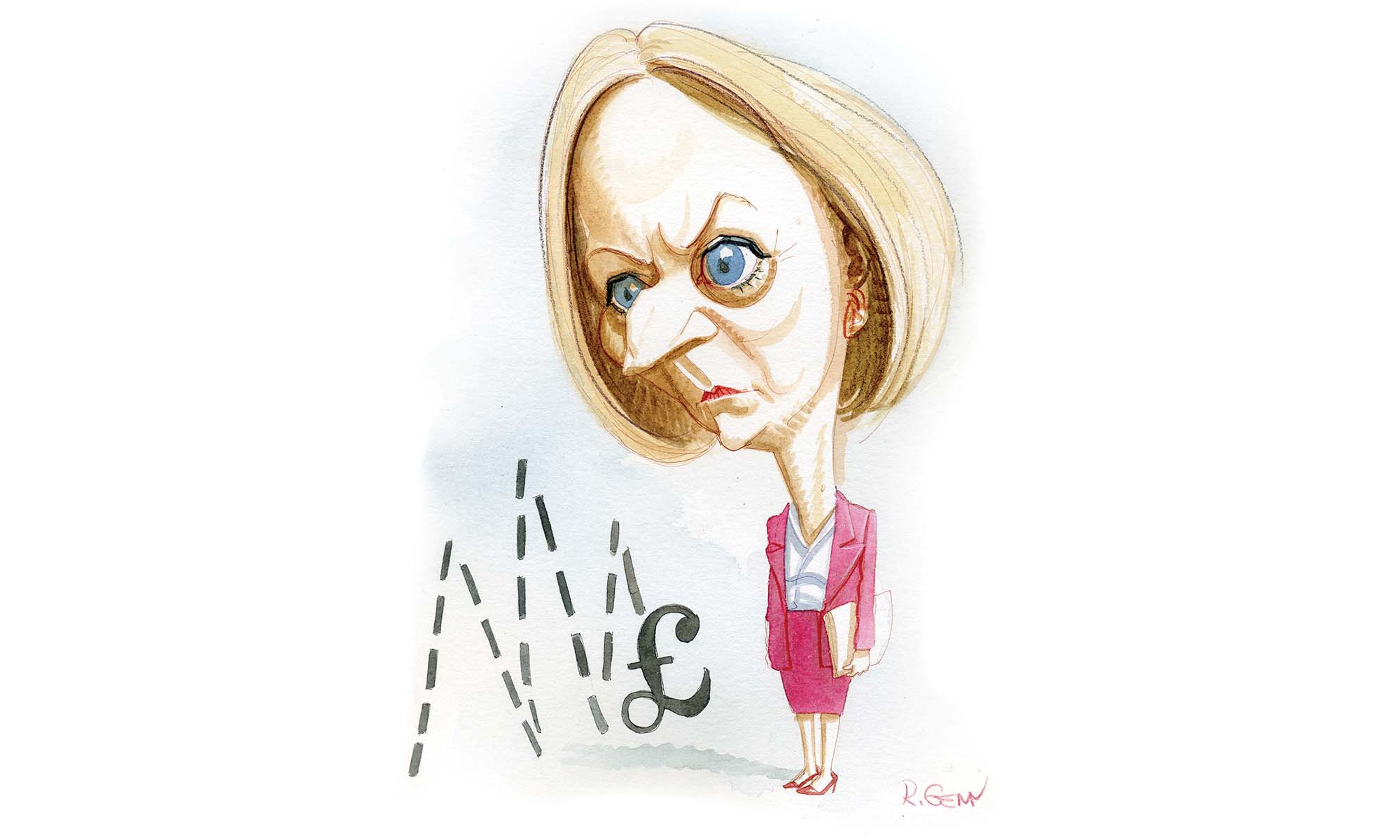
• First the queen dies, then the pound collapses. Sterling is even flirting with dollar parity for the first time in decades. In part, this is simply the reciprocal of dollar strength, but it was also the markets’ reaction to financial plans advanced by the government led by new prime minister Liz Truss. These include sheltering business and consumers from the worst of the current energy spike, which was a political necessity. More controversial were tax cuts including the dropping of a planned increase in the corporate tax rate, a reduction in the basic income-tax rate, and the reversal of various social — security-tax hikes. But it’s a proposed cut in the top rate of income tax, from 45 to 40 percent, which will cost a comparatively modest £2 billion, that has really enraged Britain’s easily enraged. The market reaction, which included a sharp rise in yields on British-government debt, was overdone, but Truss cannot ignore it entirely. Her supply-side revolution (with wide-ranging deregulation, we hope, to come) must also include spending cuts. That won’t be easy with Labour 17 points ahead in at least one poll and the next election a little over two years away.
• Meloni is not Mussolini. After the victory of right-wing parties in Italy’s election, the country’s next prime minister will almost certainly be Giorgia Meloni. Based on preliminary results, her party, Brothers of Italy, which was founded only in 2012, took 26 percent of the vote. As things now stand — Italy is Italy — it will rule in coalition with Matteo Salvini’s League and the seemingly indestructible Silvio Berlusconi’s Forza Italy. Their combined 44 percent ought to hand them a clear majority in both houses of Italy’s bicameral parliament. Much is made of Meloni’s party’s “fascist roots,” but these are more genealogical (it is a successor of various successors) than ideological. Its meteoric rise owes far more to those two great destabilizers, mass immigration and the euro, than to anything that Il Duce ever thought or said. The party’s euroskepticism is likely to be reined in by the need for EU cash at a difficult time, but Italy will take a tougher line on immigration. The biggest cause for concern for now? Ukraine. Meloni is a supporter. Her partners not so much.
• The career of Mahmoud Abbas, the 87-year-old head of the Palestinian Authority on the West Bank, is heading toward a bumpy end, one that illustrates the defects of one-man rule. In 2006 he lost elections to Hamas, otherwise Palestinian Islamists, and it’s been a smoldering civil war ever since. Abbas is now in the 17th year of a four-year term, and his legitimacy rests on the use of force directed against two very different rivals, Israel and Hamas. Israel sends regular patrols to the West Bank to arrest anyone considered a terrorist. Almost to a man, the suspected are Hamas agents and activists determined to settle accounts with Israel and the Palestinian Authority at the same time. Abbas therefore has every reason to want them arrested, but to West Bankers that looks as though he were a collaborator and Israel were keeping him in power for its own sake. Things have reached such a pitch that in Nablus and Jenin, the two largest West Bank cities, Palestinians have had firefights with other Palestinians. Hamas accuses the Palestinian Authority of “national crime.” Palestinians apparently find it impossible to decide who will represent them.
• The Islamic Republic has specified how a woman is to wear a hijab or veil and set up the so-called morality police to enforce obedience. Mahsa Amini, a woman of 22, was walking in a Tehran street when these special policemen found fault with her veiling. They took her to prison and murdered her there. An uprising then took place all over the country and abroad, and an unknown number of people lost their lives in the repression. Mahsa Amini symbolizes the plight of her nation, and she will have a place in its history.
• Last year Canada changed its assisted-death laws to allow people with “grievous and irremediable” conditions or physical disability to end their lives — no terminal illness required. The law rapidly expanded to include Canadians whose only illness was a mental condition, such as depression. This summer, the Lancet published an article sounding the alarm that Canadian rates of assisted suicide are quickly surpassing those in Belgium and the Netherlands. Partly because Canadian courts instigated the legalization of assisted suicide as a matter of liberty, Canada’s assisted-suicide regime has few guardrails in place. Consequently, Canadian health-care institutions began offering assisted suicide almost casually, or as a matter of course. A Canadian Forces veteran suffering from PTSD was offered euthanasia by an employee of Veterans Affairs Canada before he was offered any treatment for his condition. This scandal came just days after a report that another patient, suffering from depression and suicidal ideation in Ontario, had expressed an urgent desire to get out of the hospital to his family weeks before he was euthanized, with “hearing loss” listed as his reason to request death. The slipperiness of the slope is most evident when you’re already partway down it.
• Billionaire Patagonia founder Yvon Chouinard, a self — described socialist, announced that “Earth is now our only shareholder” and that he was transferring control of his company to a newly founded environmentalist organization. The environmentalist applause obscures two inconvenient truths. The first is that a surprising number of enormously wealthy people don’t like to acknowledge that they are enormously wealthy; Chouinard contends he never intended to become a billionaire or Patagonia to become a $3 billion company. The second inconvenient truth is that even self-described socialists will make moves to avoid capital-gains, gift, and inheritance taxes. The billionaire decided that Patagonia’s profits would be put to better use if kept from the U.S. government. Yes, that’s just what we’ve been arguing all along.
• As the absence of non-avian dinosaurs reminds us, the risks that may or may not flow from climate change could easily be eclipsed by the destruction that could be caused if a large enough asteroid or comet hit the Earth. So the news that NASA has crashed its DART spacecraft into an (admittedly harmless) asteroid at a range of 7 million miles is something to celebrate. There will be even more reason to cheer if (and we won’t know for a couple of months) the crash was enough to knock the asteroid as far off course as desired. If it was, it will mean that we will be well on the way to developing a planetary-defense system that doesn’t depend on a team of veteran oilmen headed by Bruce Willis. And there’s a lesson here too for climate policy-makers. The first is the paramount importance of toughening our defenses against whatever the climate might bring us, and the second is to put rather more trust in human ingenuity than in bureaucratic command and control to solve what at first appears to be insoluble.
• Brett Favre is in the news, and it’s not because he’s coming out of retirement to save Jim Geraghty’s New York Jets. No, he has exchanged inside handoffs for insider favors, misappropriating millions meant for impoverished women and children to fund a volleyball arena, and later trying the same with an indoor football-training facility. Favre and then — governor Phil Bryant (R., Miss.) exchanged texts wherein the former star of the Green Bay Packers leaned on his fellow Southern Mississippi alum to come up with funds to benefit their alma mater. More than $1 million was apportioned through a nonprofit operated by a mother-and-son duo who have now pleaded guilty to state charges of misspending welfare money. Bryant and Favre are being sued in civil court, and while Favre has paid back the amount used, he has yet to pay hundreds of thousands in interest on the sum. Texting has never redounded to his benefit in the long run.
• University of Texas teams are the Longhorns, and their fans flash a sign with their hands — a sign indicating horns. Their non-fans, when they want to give a middle finger (so to speak) to UT, flash a sign with the horns down, rather than up. Some University of Alabama football players were doing this after their team defeated UT on a recent Saturday. The Alabama coach, Nick Saban, admonished the players, “Don’t do that sh**!” He later told the team — as he recounted in public — “We don’t need to degrade the other team’s traditions. Just go play.” Good goin’, Coach.
• We could recite Roger Federer’s statistics: eight Wimbledon titles, five U.S Open titles, 237 consecutive weeks as world No. 1 — we could go on. Federer is one of the greatest tennis players of all time, and one of the greatest athletes. More than that — could there be more? — he has been a gent, a role model, an ideal sportsman, really. The great and good Federer has now retired at the advanced age, in tennis terms, of 41.
• Donald Blinken was a financier, a patron of the arts, a U.S. ambassador to Hungary — many things. He was also the father of the current secretary of state, Antony Blinken. The obit in the New York Times contained the following passage: “He and Rothko listened to a recording of ‘The Marriage of Figaro’ while hanging Rothko’s paintings in Mr. Blinken’s apartment.” We can hear WFB say, “Beat that!” Donald Blinken has died at 96. R.I.P.
• Greg Pollowitz was a loyal reader and, before he left us for other work, a beloved contributor. Writing on National Review Online, he had an eagle eye for news and great and clever wit. Those who interacted with him the most remember his love for his family, who lost him to leukemia on September 17. During his rounds of chemotherapy, his social-media posts were windows into the life of the happy warrior we always knew him to be. R.I.P.
• Aram Bakshian Jr., born and raised in Washington, D.C., incarnated the best of an older generation of Beltway conservatism. He wrote speeches for Richard Nixon, Gerald Ford, and Bob Dole and directed the White House office of speechwriting for the first half of Ronald Reagan’s first term. His thumbnail obit for Dole illuminated the scribe as well as the boss: “If I had to describe his style it was ten percent Calvin Coolidge and ninety percent Gary Cooper. . . . Speeches were almost an imposition on his time.” Bakshian wrote lively pieces for NR, mostly book reviews, but most delightful were the evenings when he dropped by for editorial drinks to share his wit and his observations, all via his gifts as a raconteur. A workhorse, not a flamethrower, but withal someone who enjoyed life and imparted that enjoyment to others. Does the type exist anymore? Dead at 78, R.I.P.
Russia Reels
Vladimir Putin murders journalists and makes a sham of elections, yet like any shrewd despot he strives to keep abreast of popular sentiment. His war against Ukraine is criticized by two minority groups at home: Russian democrats enduring his persecutions, and harder-liners who increasingly accuse him of not doing enough as news from the front worsens.
The largest group, however, and the one to which he is most attentive, is ordinary Russians who are not particularly hostile to Ukrainians but not sympathetic either, who do not follow and do not wish to follow events so long as Putin’s latest show of strength seems winnable, remote, and low-cost.
Putin’s proclaimed intention of mobilizing 300,000 men risks roiling that group. Flights out of the country were sold out, then canceled. Traffic jams clogged border checkpoints. There were anti-war demonstrations, not only in Moscow and St. Petersburg but also in the provinces, from the Caucasus to Siberia, where recruitment hit hardest. No wonder, since the newbies face insertion into ill-equipped, low-morale units whose officers and NCOs have been devastated. The new levies are meant to give a battle-weary military a chance to regroup while holding the line until winter slows the pace of war and spikes energy prices in Europe. Russian Orthodox patriarch Kirill has promised soldiers that all who die in Putin’s war will go to heaven. Many will have the opportunity to test this assurance.
Meanwhile the toll on ordinary Ukrainians keeps mounting. Strong stomachs may consult the testimony of medic Yuliia Paievska to the Helsinki Commission (American lawmakers who monitor human-rights compliance). Paievska, whom the Russians held prisoner, despite her medical role, for three months after their capture of Mariupol, recalled “prisoners in cells screaming for weeks, and then dying from the torture without any medical help.”
Putin has accompanied his call-up with referenda in occupied eastern Ukraine, purporting to let the terrorized vote whether they wish to be formally incorporated into Russia. Election-fraud mavens in this country should take a look at Russian election practices: armed goons handing out ballots or escorting voters to the polls. The sham votes come coupled with an ominous warning, delivered by Putin himself, that threats to Russia’s “territorial integrity” could provoke a nuclear response. “We will certainly use all the means at our disposal to protect Russia and our people. This is not a bluff.”
Saying you are not bluffing already suggests that you are. But Putin is desperate enough, and his threat real enough, that he must be assured that the United States and NATO have not damaged or coveted one inch of pre-2014 Russian soil. If Putin escalates the war he has begun, the consequences will be dire.















Russian law enforcement officers detain a person during a rally after opposition activists called for street protests against the mobilisation of reservists ordered by President Vladimir Putin in Moscow, Russia, September 24, 2022.
Reuters Photographer
James Buchwald, R.I.P.
James Buchwald was a young and talented engineer convinced that he could build something better, his mousetrap coming in the form of a natural-gas compressor. He succeeded. Determined to find a more efficient way to move natural gas from drilling sites to pipelines — and eventually to American homes — this tinkerer, a man of insight, vision, mechanical skill, tenacity, and precision, turned his basement into a workshop and there created the device, the “separable reciprocating natural-gas compressor,” that would play a central role in America’s reemergence into energy independence, its technology and efficiencies unleashing the potential of hydraulic fracturing and then pushing the tapped essence of power and prosperity through America’s vast network of pipelines.
The Depression-era kid from Cleveland was much more than an inventor who sought to make beautiful machinery. Ariel Corporation, the company he and two associates launched from scratch in 1966, revealed he was also a business visionary — the kind that really ought to be studied by MBAs. Buchwald’s firm not only crafted a line of what is considered the world’s premier compressors (some over a half-century old continue to reciprocate away), made in one of the world’s most acclaimed manufacturing facilities (in Mount Vernon, Ohio), but also championed exceptional in-field customer service and developed new distribution systems. Mindful of the energy industry’s cyclical nature, Ariel stockpiled some of its accumulating wealth in order to assure its workers (their allegiance is profound) of employment in market downturns. Buchwald was also an ardent believer in sharing profits with the workforce.
How to top all that? From youth Buchwald was an inveterate reader, and his greatest love — aside from his wife of 72 years, Maureen, and his family — was America, whose trails and pathways he knew with great intimacy as a hiker and biker (of both the pedal and the motor variety). After passing Ariel’s reins to his remarkable daughter, Karen, Buchwald took on his final role countering the ideological assault on the nation’s roots, through all-in support and strategic involvement in the Ashbrook Center’s vital programs to educate students, teachers, and citizens “in the history and Founding principles of our country and the habits of reflection and choice necessary to perpetuate our republic.”
He was a great friend of National Review, this patriot, inventor, father, husband, benevolent boss, philanthropist, Boy Scout troop leader, bookworm, business maven, entrepreneur, and motorcyclist — this man of little-known but outsized consequence who profoundly loved this sweet land of liberty, who championed Washington, Madison, Hamilton, and Jefferson, who admired Bill Buckley and cared about his little fortnightly journal. The world is a much better place for Jim Buchwald and all his 94 years of tinkering, leadership, and passion. Requiescat in pace.
— Jack Fowler












Comments