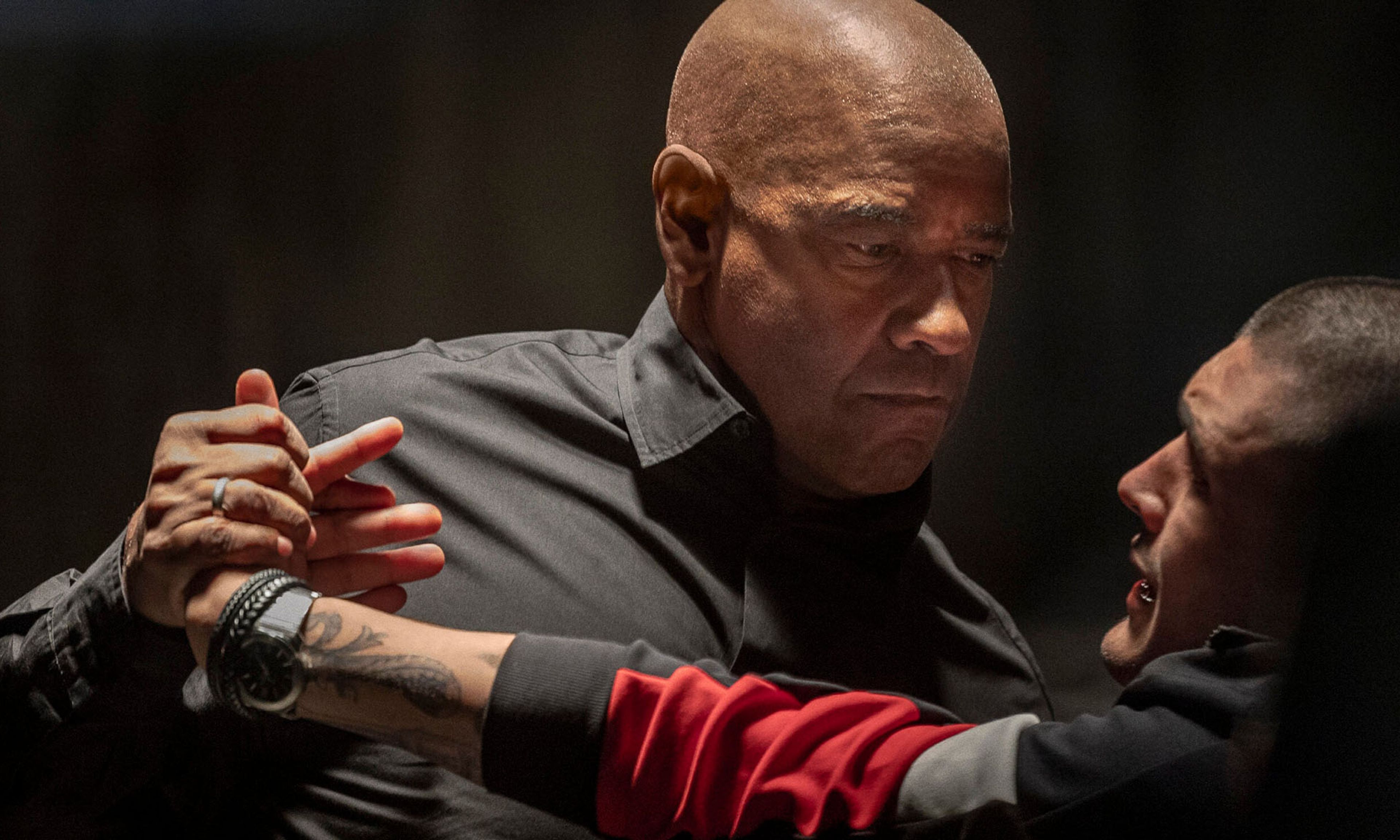
The vibe has shifted. The worm has turned. For years now, wokeness has rolled over everything like a full moon’s high tide. But I have seen a different future — one that’s reactionary, based, biblical, and Roman Catholic — revealed in that unfailing oracle, the Equalizer saga, whose prophetic work unfolds in between the vigorous beatdowns administered by its aging action hero, Denzel Washington’s Robert McCall.
As noted by Sonny Bunch in his review for the Bulwark, McCall is a reader, and in The Equalizer 2, which came out in 2018, we saw him reading Richard Wright and Ta-Nehisi Coates — a clear prophecy of the subsequent leftward direction of the culture, culminating in the summer of George Floyd. But now, in 2023, The Equalizer 3 gives McCall a Bible and sends him to Italy — to a seaside town where classical architecture climbs the cliffside to an ancient church, where a saint’s festival fills the streets with priests and nuns and children, where the climax literally brings the sword of Saint Michael down upon a villain’s head.
Verily, the oracle has spoken: Wokeness is finished, the RETVRN to tradition has begun.
Okay, fine — such a prophecy is probably not the deliberate intention of the filmmaker, Antoine Fuqua. But neither is Fuqua unconscious of his choices. He’s an action director who’s always been interested, sometimes to a fault, in pressing home a moralistic message, beginning early in his career with the best movie of his life.
That would be Training Day, the crooked-cop movie that earned Washington his first and only Best Actor statuette. It may sound oddly characterized as a moralistic effort, since it’s the Washington performance that everyone remembers — as Alonzo Harris, the wicked big man of the LAPD, the most alpha of all males. But what anchors the movie is Ethan Hawke’s turn as the rookie cop who progresses from mentee to patsy to avenger. Goodness vindicated under supreme pressure — that’s basically the Hawke performance, and it sets off Washington’s part in an essential way, keeping him from eating the movie, keeping us from loving his wickedness too much.
Fuqua’s subsequent career has been defined by variations on the Hawke character: good men with guns and sometimes other weapons, expected to rise to difficult occasions. From Tears of the Sun, in which Bruce Willis’s American Special Ops officer rescues African refugees from a rampaging militia, to King Arthur, in which Clive Owen’s Roman soldier saves Briton refugees from a rampaging Saxon horde, to The Magnificent Seven, in which Washington’s bounty hunter has to save a mining town from a vicious industrialist’s rampaging goons — well, the descriptions give you the consistent theme.
It’s a theme the Equalizer movies continue, with Washington’s McCall deploying his ex-operative skills to equal the scales between innocents and gangsters. That vocation makes an interesting moral counterpoint to Washington’s older action-hero peers, Keanu Reeves’s John Wick and Liam Neeson’s avenging father in the Taken movies. Where Reeves’s hit man is driven by a personal affront, the death of his dog, and Neeson’s character by the need to protect his family, Washington’s character is a more disinterested savior, sometimes helping friends but proving his virtue by defending whatever unfortunate happens to cross his path, or whatever place he happens to end up.
In the third Equalizer, that place is the quaint Italian town where McCall has to convalesce after taking a bullet in a one-man raid on a gangster’s compound, to recover a stolen something that isn’t revealed until the movie’s end. The town has a kindly doctor (Remo Girone), an honorable policeman (Eugenio Mastrandrea), a sexy café owner (Gaia Scodellaro), and a giant problem with the Mafia — which fortunately, post-recuperation, our man McCall is just the man to solve.
Relative to prior installments, this Equalizer lingers more on the blood and gore of McCall’s vocation, raising the idea of his own possible corruption before discarding it once the bad guys start their reign of terror. Relative to prior installments, it also has a heavier, older Washington who really can’t persuade as an omnicompetent action hero anymore, so it drapes the action in darkness and pads the plot with a lot of business about terrorism and drug smuggling, involving Dakota Fanning as a CIA agent with a connection to McCall.
All of this material is boring, and so are the bad guys, led by Andrea Scarduzio as the capo di tutti capi, a character who murders, maims, and tortures and somehow makes no impression whatsoever. Italy is reliably beautiful, the sentimental traditionalism a bit of a fantasy but a perfectly welcome one, and Washington even in slow motion is always watchable. But in the tedium that descends when he’s off-screen, I realized that these movies miss what Fuqua had in Training Day — a vivid villainy to match his interest in the heroic. If audiences didn’t quite appreciate what Hawke delivered in that movie, maybe Fuqua didn’t quite appreciate what Washington delivered: not a bad guy that you root for, but one strong enough and memorable enough to at least make the hero’s victory seem in doubt.











Comments