For Americans, the invasion of Iraq in 2003 was like stumbling into a dark abyss that we are still struggling to climb out of.
Through 20 years of war, however, it is a remarkable fact that, for Americans at least, the black shroud of death has weighed comparatively lightly. The war’s toll still stands shy of 5,000. In contrast, on the black granite walls of the Vietnam Veterans Memorial in Washington, 58,318 names are inscribed.
How can we explain this incongruity? True, the scale of the deployment to Vietnam — more than 540,000 in April 1969 — dwarfed the peak American strength in Iraq, some 170,000 troops during the 2007 Surge. In Iraq, American combat soldiers and Marines went into battle wearing modern Kevlar vests and ballistic helmets that could offer a measure of protection, beyond anything in previous conflicts, from small-arms fire and shrapnel. And the war itself was different. Though Iraq saw conventional warfare during the initial invasion and in battles around Fallujah, Ramadi, and elsewhere, it’s arguable that the intensity of the fighting in Vietnam, such as during the Tet Offensive of 1968, in which U.S. forces engaged not only Viet Cong guerrillas but the North Vietnamese regular army, was of a different order.
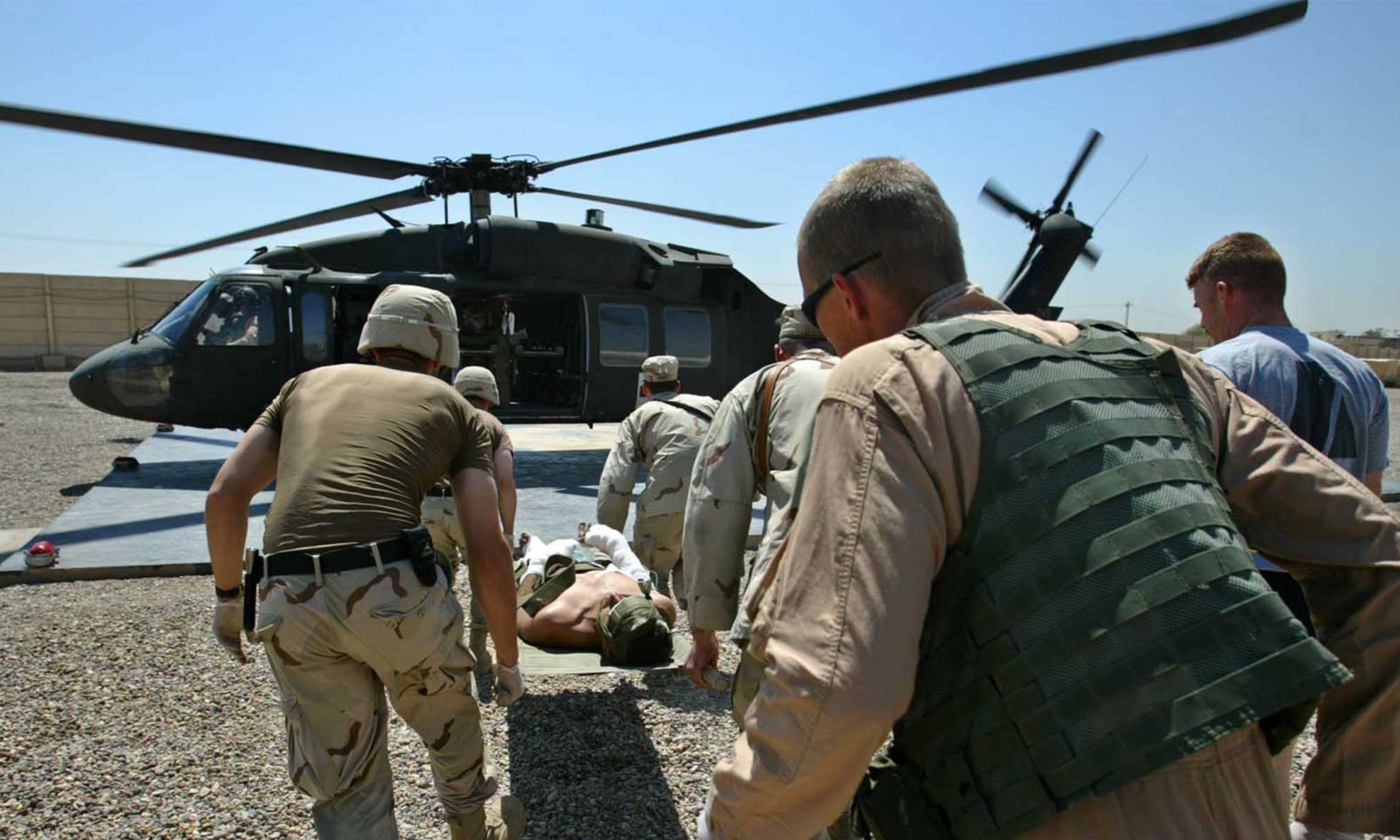
What shouldn’t be overlooked, however, is the revolution in combat-casualty care that saved hundreds if not thousands of American lives in Iraq. Building on the casualty-evacuation (CASEVAC) techniques and procedures learned during Korea and Vietnam, the United States military placed tremendous emphasis on getting wounded men to treatment as quickly as possible. During the Iraq War, a wounded soldier or Marine could expect immediate treatment on the battlefield by a medic or corpsman, followed by prompt CASEVAC by air to a forward-deployed combat-support hospital, where teams of surgeons and trauma specialists would do everything in their power to stanch the bleeding and save lives, limbs, and eyesight. The seriously wounded would then be quickly evacuated to larger military hospitals in country before being sent on to specialized U.S. facilities in Germany.
In the history of warfare, no one, anywhere, had a better chance of survival after being seriously wounded on the battlefield than Americans fighting the War on Terror.
In 2009, Secretary of Defense Robert Gates formalized the “Golden Hour” standard, which committed the Pentagon to trying to ensure that combat casualties would arrive in an operating room within 60 minutes of being injured, calling the standard a “moral obligation.”
This new paradigm didn’t come from thin air. It was developed after an immense logistical, financial, and operational investment by the U.S. military. Much of that burden fell on the military nurses and doctors who staffed the forward-deployed hospitals and emergency-surgery facilities in Iraq. Many of these physicians, such as Colonel Edward Horvath, were reservists who left the ease and comfort of home when their country needed them. In a moving new memoir, Good Medicine, Hard Times, Horvath recounts that experience as a combat physician in three deployments to the Sandbox.
Horvath had already spent time in uniform as a U.S. Navy medical officer. After an uneventful peacetime tour of duty decades before the Iraq War, he went on to a civilian career in clinical medicine before becoming the medical director of a large corporation. But after 9/11, with Americans in combat in Iraq and Afghanistan, Horvath — already in his late fifties — took the oath of office again, this time as an Army doctor. He joined the 256th Combat Support Hospital and quickly found himself in Iraq as a growing insurgency set the country aflame.
Horvath’s time was spent shuttling between hospitals in military convoys on IED-infested roads, climbing aboard helicopters and cargo planes, and working on American bases under a near-constant barrage of rockets and mortar rounds. In a spartan battlefield environment, complete with venomous snakes and infestations of bedbugs, the U.S. Army established surgical facilities and trauma centers where needed — in tents, makeshift plywood structures, and Saddam Hussein’s former palaces. The war brought in a steady stream of the wounded and maimed, but a sharp engagement or a devastating suicide bombing could cause an avalanche of casualties that threatened to overwhelm an emergency-treatment facility. “I encountered a scene out of a nightmare,” Horvath writes of one such incident:
The entire room was filled with wounded of all ages — men, women, and children, mostly Iraqi civilians intermixed with a few soldiers. The air was heavy with the metallic, almost sweet, scent of blood. There were screams of pain, orders shouted by doctors, and even the whimpering of an animal — a military dog — which would later die of its injuries. I stepped forward and nearly lost my footing on a floor made slippery by blood.
Staring at the confusion and carnage, I was momentarily transfixed by the surrounding horror, unable to respond.
But the well-trained doctors and nurses “knew the routine — remove all the clothing, find the ‘holes,’ stop the bleeding, infuse packed red cells and plasma to maintain blood pressure — all to keep the patient alive until an open operating room bed was available.” Hard, intense pre-deployment training and steely-eyed triage measures were their leverage amid the chaos.
But not even the most advanced techniques and the best doctors and surgeons can save the lives of all the wounded. Mars demands his bloody tribute. And the burden of not being able to save everyone weighed heavily on Horvath and his colleagues. After loading a wounded man onto a helicopter for transport, Horvath writes, he “sat down on the floor next to Don Spaner and another physician, Dr. Loren Kirchner.”
We stared at the ground in silence, lost in our thoughts, no doubt each wondering if the wounded soldier would survive. . . . We’d all witnessed this scene play out too many times before.
Loren looked up and with a barely audible voice, broke the silence. “I’m so sick of seeing dead and dying soldiers.”
It’s one thing to risk everything to care for one’s own wounded comrades or innocent civilians, but it’s to America’s great credit how well, by and large, we treated our enemies. Colonel Horvath’s first assignment in Iraq was to provide medical care for Iraqi detainees brought in by coalition forces. Many of these men had only recently been trying to maim and kill Americans. But once they were in custody, soldiers such as Horvath would go to great lengths to provide medical care. Over his several deployments to Iraq, Horvath and his colleagues treated Iraqi insurgents for difficult medical conditions completely apart from burns and blast and gunshot wounds, such as bacterial infections and suspected cancers. It’s astonishing that these treatments sometimes necessitated surgical intervention, CT scans, blood tests, prescription medications, prosthetics, and the input of medical specialists — all in a combat zone and all to save the lives of our mortal enemies.
It’s hard not to call this commitment noble. But at times even our allies could see our self-imposed obligation — and the Americans enforcing it — as softheaded. One Iraqi interpreter, a Chaldean Christian, angrily confronted Horvath over his treatment and protection of a captured al-Qaeda terrorist: “Why didn’t you just kill him? You’re wasting valuable resources on a terrorist, a murderer.”
“I’m a physician, and my profession is to heal, not to kill,” Horvath reminded him, before explaining that enemy combatants, when taken prisoner, were to be treated humanely under American law — anything less could constitute a war crime.
“That’s what’s wrong with you Americans” was the interpreter’s exasperated reply.
Combat is a crucible. No one who lives through it returns unchanged. Much of Western literature, dating back to Homer, attempts to convey this transformation. In that, Horvath’s memoir joins an ancient tradition. It’s hard but necessary reading.
There are some lines describing the face of battle — often anachronistically attributed to Heraclitus — that have gained widespread currency in U.S. military circles since 9/11:
Out of every 100 men, ten shouldn’t even be there. Eighty are just targets. Nine are the real fighters, and we are lucky to have them, for they make the battle. Ah, but the one, one is a warrior, and he will bring the others back.
Our doctors, nurses, and combat medics go to war to save lives, not take them. They fought the good fight to save “the neighbor’s kid.” They may not be Hollywood’s version of a war hero, but these warriors risked everything too — and they brought the others back.










Comments