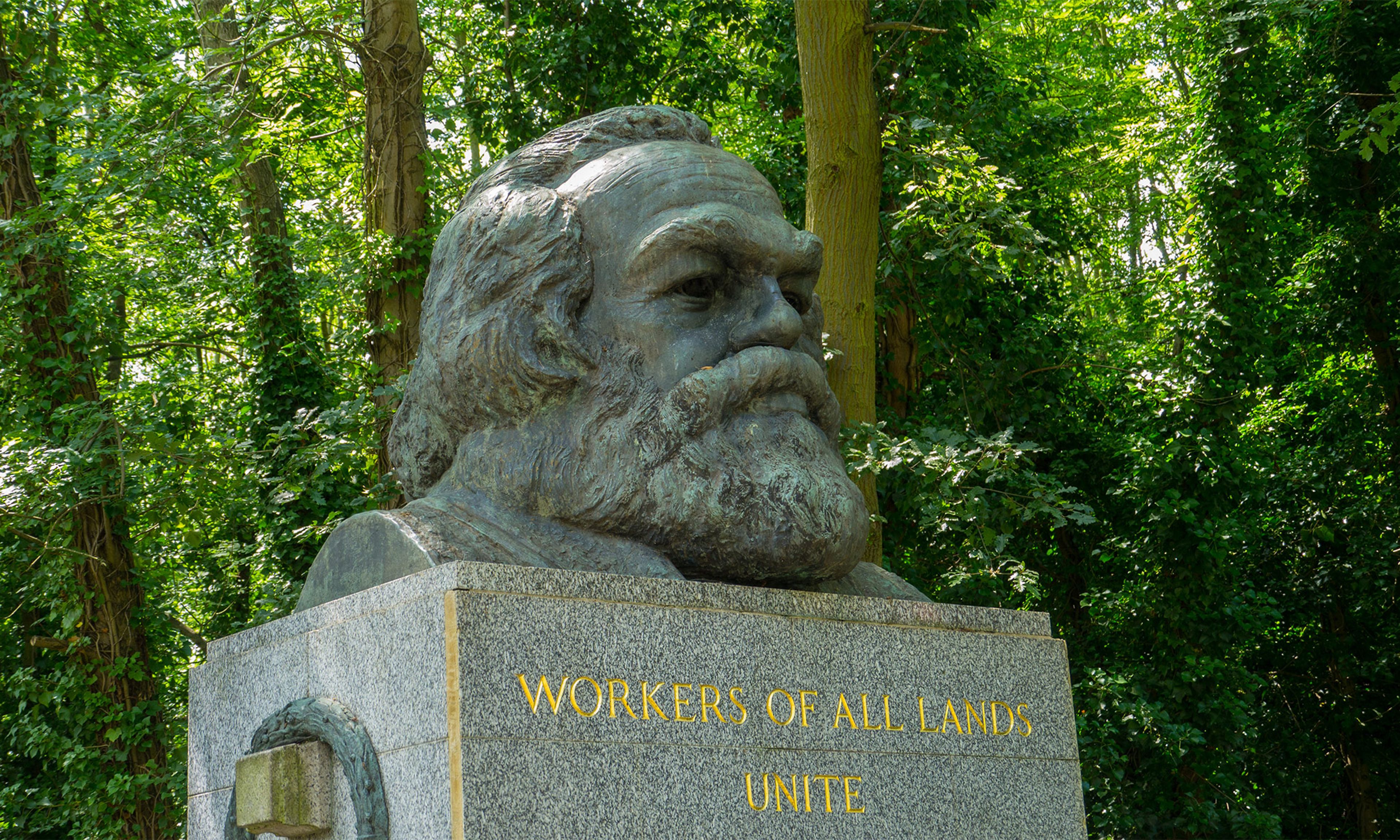
In the world of progressive politics, the most visceral displays of rancor and belligerence are often reserved not for the traditional opponents of progressives, who originate outside the political Left, but for apostates from their own ranks. The bitter internecine feuds among socialist intellectuals have long exemplified this pattern, but nowhere is the disdain for political heretics more palpable than in matters of racial and ethnic identity.
The impetus to ostracize a defector from an ideological norm often emerges from the belief that a person’s interests may be ascertained by his or her belonging to a certain group, whose members are assumed to have a uniform set of interests. Karl Marx called this notion “scientific” and purported to identify predictable — even inevitable — social outcomes arising from a perceived struggle between economic classes. When individual political expressions misalign with the predicted interests of a person’s class, the difficulty is resolved not by admitting an error in the underlying theory of class conflict but rather by stripping away the dissenting individual’s agency. The dissenter is presumed to have succumbed to a “false consciousness” or worse — to have become corrupted by the malfeasance of persons acting directly against his or her own interests. Expulsion of the apostate ensues.
Jason L. Riley has given us a fascinating intellectual biography of one such apostate from the ranks of the academic Left, the economist and philosopher Thomas Sowell. In fact, Sowell’s career exemplifies a succession of apostasies from conventional political expectations. A former Marxist whose first significant scholarly paper defended the German philosopher’s prediction of increasing worker misery under capitalist modes of production, he became a convert to University of Chicago price theory under the tutelage of economists George Stigler and Milton Friedman. Born into extreme poverty and never completing his high-school education, Sowell charted an unconventional and self-made course through the highest ranks of academia before settling into a multi-decade career as a theorist and defender of free-market capitalism at Stanford’s Hoover Institution.
Then there is the matter of race. While Sowell is known as one of the foremost African-American conservative intellectuals writing today, he entered the fray of racial politics only reluctantly, after witnessing an abundance of poorly evidenced and politicized claims coming out of the academy and journalism. When he did tackle the problem of racial discrimination, he bucked academic fashions by adopting an empirical and economic approach that is considered taboo on the political left. He questioned affirmative action in higher education, not only presenting a statistical case against its efficacy but also arguing that it incentivizes a lowering of academic standards. It causes a “mismatch” between minority students and universities, setting the students up to be underserved by elite institutions that advance them because of their race rather than academic accomplishment. Ultimately academic rigor erodes, as activist degree programs built around achieving progressive political change supplant scholarly inquiry and training in advanced subject matters.
Building on the work of his former teacher Gary Becker, Sowell sought economic solutions to racial discord rooted in the observation that discriminatory practices exclude individuals from engaging in mutually beneficial transactions on account of their skin color. Although this thesis is often derided by way of a caricature that reduces it to a naïve claim that laissez-faire capitalism alone will rectify racism, Sowell’s investigations brought forth a piercing criticism of the political alternatives favored by his interlocutors. Discrimination persists when political institutions shelter the discriminating parties from the economic implications of their own prejudices — consider how Jim Crow–era segregation laws forced all businesses to exclude black customers from their premises — and when the misaligned incentives of political solutions perpetuate the very problems that prompted their adoption. To Sowell, then, the great fault of modern civil-rights activism is its propensity to look for solutions in the wrong places — to look to a government that is ineffectual at best, and at worst played a major historical role in erecting institutional barriers to racial equality in the name of pursuing progressive ends.
Sowell has faced unmitigated scorn and derision for his habit of following empirical evidence to unpopular and impolitic conclusions, particularly where race is concerned. In the early 1980s, when he briefly considered taking a position in the Reagan administration, a top official at the NAACP accused him of assuming the “role that historically the house n*****s played for the plantation owners.” Other progressives have described him as a dupe of Chicago economics, imputed a pecuniary motive to his positions, denounced him as a Vidkun Quisling to the cause of African Americans, and designated him persona non grata in black intellectual life — not on the merits of his arguments, but out of disdain for his conclusions, which chafed their own ideological orthodoxies. As Riley documents in example after example, Sowell answered his abusers by doubling down on the hallmark characteristic of his career: careful, methodical, evidentiary empiricism.
Unrecognized by his critics is the fact that Sowell’s evidentiary approach has proven a potent weapon against the very ideas they often accuse him of legitimizing. Riley recounts a revealing exchange with psychologist Arthur Jensen, who argued in 1969 that a genetic gap separated African Americans from whites, resulting in lower IQs for blacks and what he styled as an insurmountable barrier to educational achievement. While Jensen’s critics simply ostracized him as a scientific racist, Sowell took it upon himself to investigate Jensen’s thesis and uncovered a devastating indictment of its main empirical claims. A finer-grained analysis of black IQ-test scores revealed clear examples that went against Jensen’s thesis — majority-African-American schools that posted higher scores than the U.S. national average, as well as clear evidence of increasing scores over time. Furthermore, Sowell discovered that test scores within other ethnic groups — particularly immigrant communities — had increased dramatically over the last century in conjunction with a corresponding rise in their economic and social conditions.
Sowell’s findings not only belied the hereditary arguments of Jensen, they also confirmed the crucial importance of economic advancement for addressing the very real problems of social inequality. Rather than simply heap scorn on Jensen, Sowell dissected an argument that he intuited to be in error yet wished to investigate from a rigorous foundation. Meticulously engaging the evidence of an argument proved a superior means of dismantling an objectionable conclusion.
Riley’s account treats the reader to a lesser-known Sowell — a paradoxical public intellectual whose primary interest is not his own stature or reputation but rather the validity and rigor of the ideas he seeks to convey. Sowell’s first and truest academic interest, tracing back to his doctoral dissertation on the French economist Jean-Baptiste Say, remains the history of economic thought. In Sowell’s self-assessment, his 1987 book A Conflict of Visions is his most original work and probably the text that most fully captures his approach to understanding political division. In contrasting constrained and utopian assessments of human nature, this work unpacks the basis of Sowell’s empiricism while also explaining the visceral contempt that evidence-based argument often provokes in unconstrained visionaries, who cut down any and every impediment to their self-anointed quest for a perfectible society.
A recurring theme of Sowell’s work is his willingness to forgo the easy route to acclaim when it comes at the expense of intellectual rigor. Sowell would rather be factually correct than popular, and he would rather his readers follow the logical progression of his arguments than that they associate their conclusions with his name. For the same reason, Sowell rejects the very foundation of the identity-politics affectations that dominate academic thought today. In the 1960s and ’70s he even took to submitting his scholarly works to academic journals in other countries, knowing his papers were likely there to be refereed on the merits more than on the identity or race of their author.
Arriving at this lesson, the reader might easily wonder whether Sowell himself would consider a biographical account of his life to be a distraction from the content of his work. Riley forthrightly acknowledges as much, hinting at Sowell’s aversion to granting interviews and preference for the quasi-cloistered life of a pure research scholar, unattached to classroom obligations or public-facing lectures. Yet Riley has achieved something rare in the field of intellectual biography — a recounting of a distinguished scholar’s life that draws on popular interest in Thomas Sowell the person and directs it to a lucid survey of Sowell’s voluminous intellectual output. The result is a testament to the features of his scholarship that Sowell wishes his legacy to be judged by: not its author’s identity, but its evidence, its rigor, and its logic.












Comments