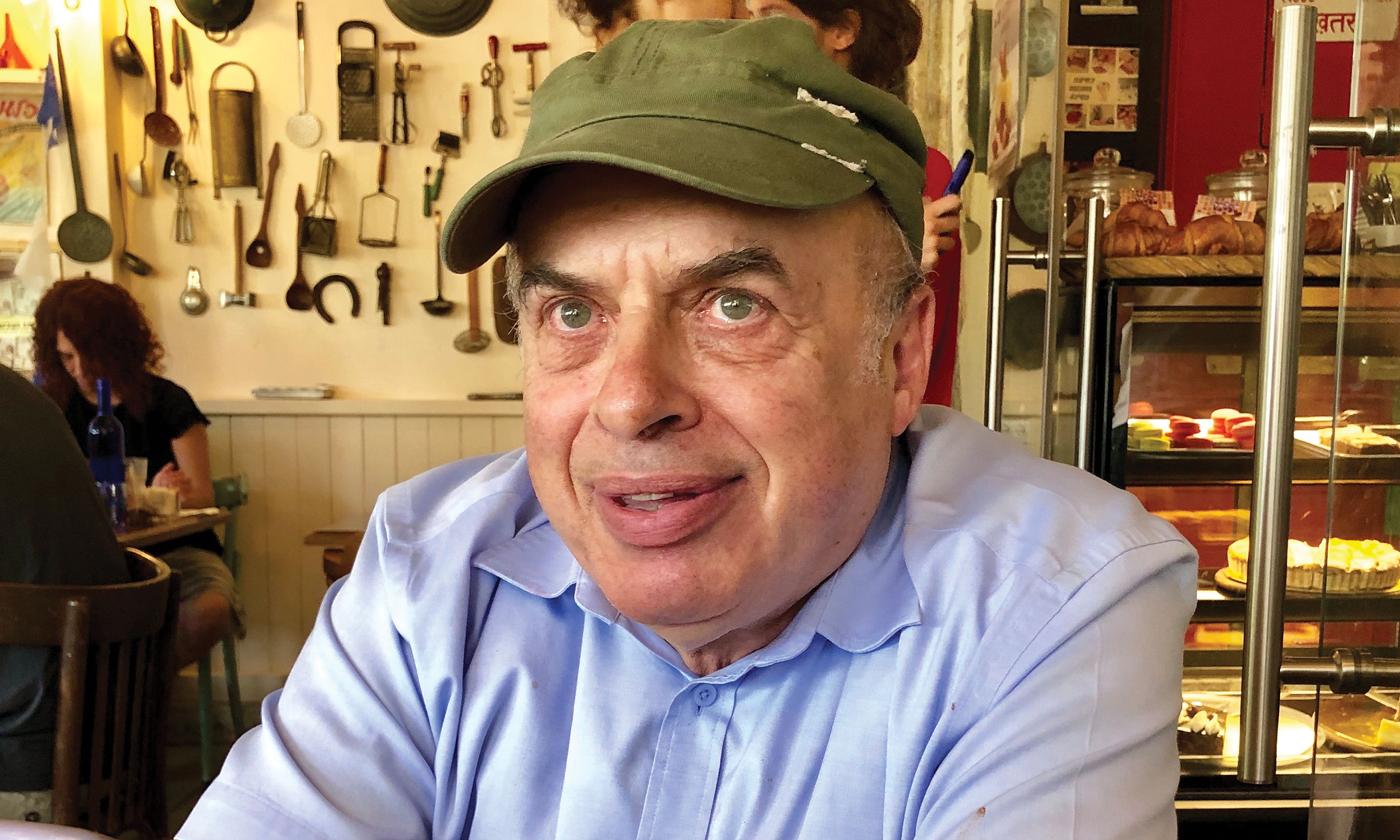
With Gil Troy, the American historian, Natan Sharansky has written a new memoir: Never Alone: Prison, Politics, and My People. He was working on the book when I talked with him in Jerusalem last year. He said he wanted to call it “Nine, Nine, Nine.” With a smile, I told him about Herman Cain.
The late Mr. Cain, when he ran for the Republican presidential nomination in 2016, had a tax plan that he termed “9-9-9.” He wanted to replace current taxes with a 9 percent personal income tax, a 9 percent federal sales tax, and a 9 percent corporate tax. My colleague Kevin D. Williamson wrote a piece in opposition to this scheme, titled “Nein! Nein! Nein!”
By “Nine, Nine, Nine,” Sharansky meant nine years in the Soviet gulag; nine years in Israeli politics and government; and nine years as head of the Jewish Agency (the organization that serves as a kind of liaison between Israel and the world’s Jews). The symmetry of the numbers appealed to him as a mathematician. But his publishers didn’t go for it, for a variety of reasons. So “Never Alone” it was, and is.
He never felt alone in the Gulag, he tells me, even though the KGB tried to convince him that he had been abandoned. “Only if you cooperate with us,” they told him, “can you save your life.” But Sharansky knew they were lying. He knew that there were many people behind him — even when he was deep in the isolation cell.
It was more difficult, he says, not to feel alone in the world of politics! There, you’re always “competing” with everybody else, as he puts it. You’re buffeted by Left and Right.
I ask him whether it was pleasant to relive his experiences, or unpleasant — or some combination. It’s always pleasant to return to the years of struggle in the Soviet Union, he says — “because of the result.” It ended grandly. Less pleasant was to relive the years of politics. He is particularly distressed by Israel’s unilateral withdrawal from Gaza in 2005. (He quit the government over this decision.) The withdrawal has given terrorists a launching pad, he says.
Sharansky was born in Stalino in January 1948, four months before modern Israel. Stalin had five more years to live, and rule. Sharansky — whose first name was then “Anatoly” — was a math and chess whiz. He went to the “Soviet MIT,” i.e., the Moscow Institute of Physics and Technology. I ask him a funny question. Does he feel that his destiny as a mathematician or scientist was somehow diverted? Diverted by politics, the struggle for human rights, and the quest to go to Israel?
He explains that he grew up an assimilated Jew, “deprived of freedom and identity.” He learned from his parents that, if you’re Jewish, you have to be the best, in math, chess, music, or what have you. Professional perfection was the way for Jews to survive.
Math, for Sharansky, was “a kind of ivory tower,” he says, into which he could retreat and be safe. But he soon understood that “if you want to be a free person, and a person who belongs, you have to fight for it.” There was something more important than mathematics — or any other professional or intellectual pursuit — namely “inner freedom,” he says. “That is why, instead of being the best mathematician, I became the best as a prisoner.”
Andrei Sakharov was probably the leading scientist in the whole Soviet Union — a genius physicist (and the father of the Soviet hydrogen bomb). He sacrificed everything to become one of the leading dissidents. Young Sharansky served as his aide. Sakharov was even greater close up than he was from a distance, Sharansky says: kind, modest, noble. “I would like to call him my rabbi, but he’s not Jewish, so I say he was my teacher.”
Sharansky married Avital in 1974. The next day, she left for Israel, before her exit visa expired. (The groom had been denied one.) “The biggest mistake the KGB made was letting Avital out,” says Sharansky. She was a tremendous advocate in his behalf.
He was arrested in 1977 and imprisoned until 1986. Charles Krauthammer once remarked to me that, despite the horrors of the Gulag, Sharansky emerged unscathed — in amazing mental and emotional balance. “It was like he had gone to the Caribbean to lie on the beach for nine years,” said Krauthammer. Last year, I brought this up with another great Soviet dissident, and veteran of the Gulag, Vladimir Bukovsky (who has since died). “It’s very simple,” he said. “If you are not broken, you are unscathed. They failed to break him, therefore he is unscathed. It’s very personal.”
When Sharansky stepped off the plane in Israel, he was a hero, to one and all. But he entered politics, which entails taking positions and incurring the displeasure of roughly half the population. What does Sharansky have to say about this?
“You know, it’s very boring to be a hero, especially when you’re young and still have a life in front of you. You listen to all these compliments, enjoy them, and so what? Life is full of interesting challenges.”
Sharansky has met many challenges since he was freed 34 years ago. Don’t worry about titles and status, he says. He then says — you have to smile — that he gladly exchanged the title “You’re a real hero and inspiration” for the title “What a disappointment you are,” in order to fight for the ideas he believes in.
Some of us are fascinated by Israeli political leaders, from Ben-Gurion down through Netanyahu. I ask Sharansky, in essence, whether he can give me any stories about Menachem Begin. Here is one: The phone company went to Prime Minister Begin to say that Avital was making many overseas phone calls, in her campaign for her imprisoned husband. She was late in paying her bills. Could the government pay them? No, said Begin, that would be improper — but he himself would pay them, which he did.
I want to throw at Sharansky a question I have long explored: Which is more radical, more intransigent? The Palestinian leadership or the people themselves, the “street”? Or are the two inseparable?
Sharansky says that “the problem is first of all with us” — the leaders of Israel. In the Oslo process, more than 25 years ago, they brought back Yasser Arafat from Tunis, telling Palestinians, This is it. Arafat will be your leader now, your dictator. And Israelis told themselves, It’s good that Arafat will be a dictator, because he’ll be able to make peace and fight Hamas without the burdens of a free press, independent courts, human-rights organizations, and all that.
Often, democrats like to deal with dictators.
From the start — 1993 — Sharansky warned that, if you imposed Arafat on Palestinians as dictator, Arafat would do everything he could to make Palestinians hate Israel more and more, because dictators need an external enemy to keep the people in line, and what better enemy is there than Israel?
So, blame the Palestinian leadership, sure, and the street, too — but Israelis should accept that Oslo was a huge mistake, says Sharansky (and the same with Gaza). They should abandon an illusory peace process and begin a real one, which depends on democratization for Palestinians: the development of civil society, a free economy, and the rest.
In 2004, Sharansky wrote The Case for Democracy: The Power of Freedom to Overcome Tyranny and Terror. One critic of the book was Ariel Sharon, the prime minister. “Your theories may be good for the basement of the KGB,” he told the author, “but they make no sense in the Middle East.”
Sharansky loved Sharon. He cites a long list of merits and accomplishments: personal, military, and political. But they broke sharply over Gaza (disengagement from which was Sharon’s policy).
Today, the case for democracy is in dire need of a hearing, as a preference for strongmen is all around. In 2004, people remembered the Soviet Union, says Sharansky, and the awful destructiveness of Communism. But memories fade (and new people are born). Today, Marxism, along with other isms, is making a comeback. People are once more talking the language of “class struggle,” etc.
Twenty years ago, Sharansky noticed that pro-Israel students on American campuses were afraid to speak out. Now, according to polls, people on both left and right are afraid to express their political views — anywhere, not just on campus — which is alarming in a free society, says Sharansky.
Toward the end of our conversation, I ask him how he is spending his days. There is Zooming, of course. “You don’t have to travel, and you can talk to people in Alaska and Australia simultaneously.” He says that the pandemic should remind people that “there are enemies we can defeat only together.”
And he is spending time with his grandchildren — the seven of them. All grandparents love their grandchildren, of course, but this is a little different, or it has a twist, let’s say.
It was no sure thing that Natan and Avital would have children (or that Natan would survive the Gulag). As it turned out, they were separated for the first twelve years of their marriage. When their first child was born — a daughter — Natan’s mother, Ida, sent a picture of her to the head of Natan’s KGB prison. For her, the picture, and the girl, were a great symbol of triumph over evil.
“So, yes,” says Sharansky, “I am spending a lot of time with my grandchildren, not forgetting to fight against anti-Semitism and to support the struggle for human rights and democracy all over the world.”
One last thing. I always ask Sharansky — I can’t help it — “Do you have your Psalm book on you?” He had it in the Gulag, and had to fight to keep it. His leading verse was, “Yea, though I walk through the valley of the shadow of death, I will fear no evil; for thou art with me.” So, where is it? Where is that little, historic book? “In the left pocket of my shirt,” as usual, says Sharansky. “It is always with me, it is always giving me strength.”











Comments