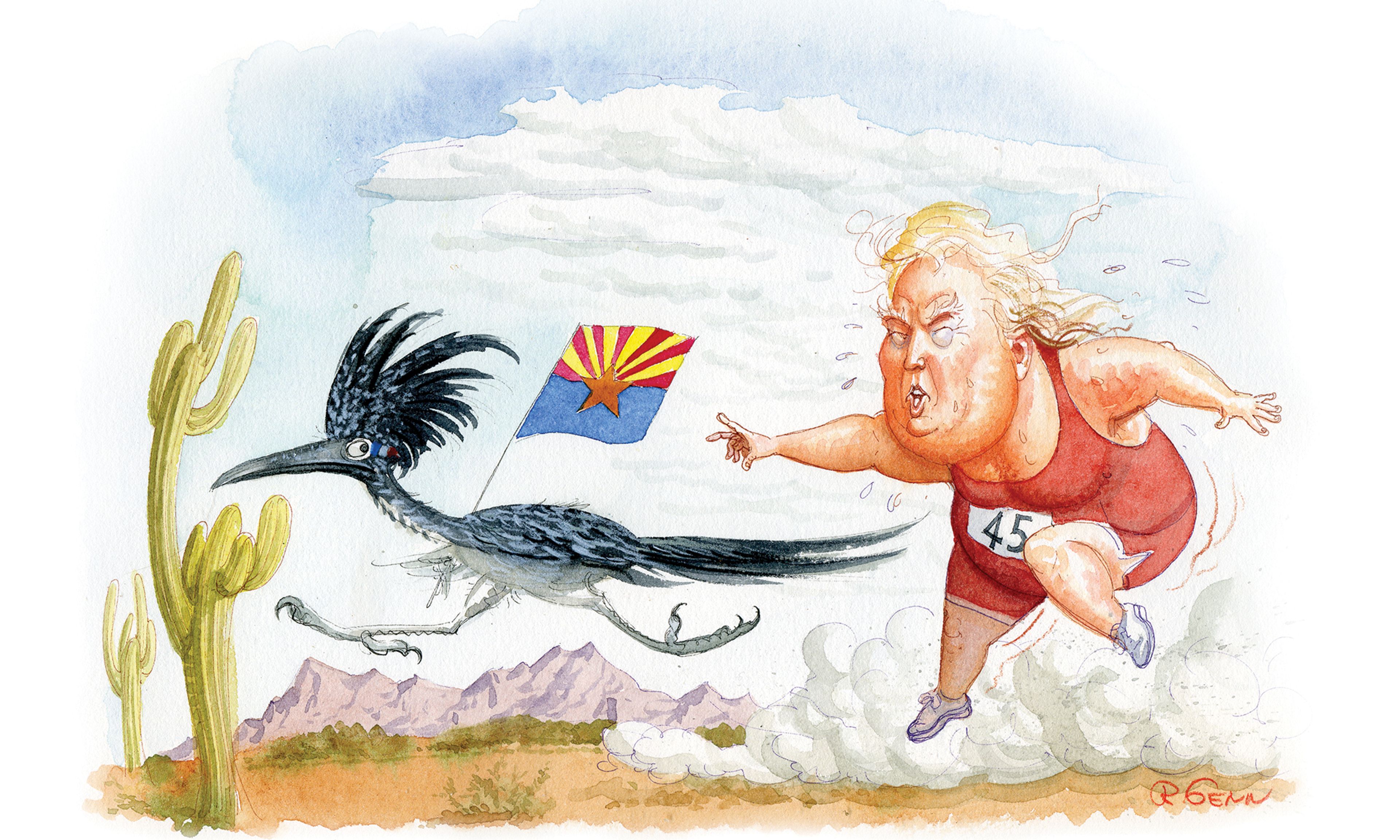
At an August 11 Trump-campaign event in Mesa, Ariz., the state’s Republican governor, Doug Ducey, noted in his remarks introducing Mike Pence that President Trump and the vice president “have visited the state of Arizona more than any other presidential administration in the history of our country,” adding: “They like it here. And we like having them here.”
“Think of yourself at a great spa — great sauna — where it’s 120 degrees and we have to pay a lot of money to be there,” Trump told rallygoers at another event in a sweltering airport hangar in Yuma on August 18. But the reason Trump and Pence find themselves visiting the Grand Canyon State so often is not merely that they’re big fans of the dry heat and the cacti. Over the past 70 years, the state has voted for Republican presidential candidates in every election but one (the 1996 Clinton victory), but all eyes are on Arizona in 2020 because of its newfound status as perhaps the most important battleground state.
The historically Republican state has been trending Democratic in recent years, as a result of both long-term demographic changes and the 2016 political earthquake that instantly altered the electoral landscape. While Trump’s improved performance among rural voters and white voters without a college degree swung the Midwest — and the Electoral College — to a Republican victory in 2016, the Trump GOP’s weakness among urban and suburban voters cost the party the House of Representatives in 2018 and handed an Arizona Senate seat to the Democrats in 2018 for the first time in a generation.
In the 2008 presidential race, John McCain carried his home state of Arizona by nine points, and Mitt Romney won there by ten points in 2012. But Trump won the state by just 3.5 points in 2016 (even as McCain was reelected on the same ballot to the Senate by 13 points), and the president is in a more precarious position in Arizona in 2020.
David Wasserman, a sharp-eyed elections analyst at The Cook Political Report, has been making the case for over a year that Arizona is the most likely “tipping-point state” in the 2020 election — the state that effectively puts the winning presidential candidate over the top in the Electoral College. In 2016, Wisconsin, which Trump carried by 0.7 points, was the tipping-point state — Trump could have lost Pennsylvania and Michigan, which he carried by even smaller margins, and still won a majority in the Electoral College.
On September 8, polling analyst Nate Silver wrote on Twitter: “If you take the polls at face value right now — with Biden gaining/holding steady in [Arizona, Wisconsin, and Michigan], but losing ground in [Pennsylvania and Florida], then Arizona is the tipping-point state right now.” Silver noted that if Biden flipped Michigan, Wisconsin, Arizona, and Nebraska’s Omaha-based second congressional district to the Democratic column — while Trump took all the other electoral votes that he won in 2016 — Biden would win the Electoral College 270 to 268.
In recent polls, the likely tipping-point state has been tipping away from Trump. When the president arrived in Arizona on September 14 for a “Latinos for Trump” campaign event, the RealClearPolitics average of Arizona polls showed him trailing Biden by 4.7 points — 49.5 percent to 44.8 percent. While the polls were off in 2016 in key midwestern states, they were on target in Arizona: The final RealClearPolitics polling average showed Trump leading Clinton in Arizona by four points (a mere half point better for Trump than the results on Election Day).
There are at least five reasons Trump is in more trouble in 2020 than he was in 2016 in Arizona. “The first is Arizona is an extremely metropolitan state,” says Wasserman. “Across the board, Democrats are doing better and better among urban and suburban voters, and they’re doing worse among small-town and rural voters. There’s not much of a small-town and rural component to Arizona’s electorate: 81 percent of the vote comes from the Phoenix and Tucson metro areas. That is pretty much the opposite of a state like Wisconsin or Michigan, where there’s a very large small-town and rural vote.”
A second problem for Trump is that “Arizona has such a large senior population, and Biden is clearly doing better with seniors — with white seniors — than Hillary Clinton was doing,” says Wasserman. In polls, voters consistently say they prefer Biden to Trump when asked which candidate would better handle the coronavirus pandemic, which is far more deadly among the elderly than among the young. Over the summer, as Arizonans congregated indoors to avoid the heat, the state was hit hard by a wave of coronavirus infections. Arizona ranks ninth in the nation in COVID-19 deaths per capita, but the epidemic is now largely under control. The average number of new daily cases is below 400, a sharp decline from more than 3,500 at its peak in July.
Third, the influx of new residents from liberal enclaves such as California is also making Arizona more Democratic. In 2016, Trump won Arizona by 91,000 votes; the Census Bureau estimates that in 2017 alone, 60,000 Californians moved to Arizona. “We do have a lot of newcomers. We have a lot of people that leave California to come to Arizona,” Governor Ducey told National Review in an interview last year. “We want to remind them why they left California.”
“There are plenty of young professionals who lean Democratic who are attracted to Arizona for lower cost of living and jobs. There are also plenty of conservative retirees who are escaping, who are fleeing California to Arizona, which partially offsets that, but on balance, I think it helps Democrats,” says Wasserman.
A fourth challenge for Trump is that the share of Hispanic voters — a demographic he lost 31 percent to 61 percent in 2016 in Arizona — continues to increase in statewide elections. “The white share of voters in Arizona is likely to drop from 74 [percent in 2016] to 71 [percent in 2020],” says Wasserman.
Trump has stepped up his outreach to the growing Hispanic community. “The Hispanic community is amazing,” Trump said at a September 14 “Latinos for Trump” roundtable event in Phoenix. “Great, great businesspeople. You have to be very sharp when you deal with the Hispanic Americans — my Latinos. I love the Latinos.” The president touted his administration’s economic record before the pandemic, as well as ongoing economic-recovery efforts, and warned that Democrats are the party of socialism. “Some of you came from parts of the world where it’s socialist or worse, you know, it’s called the C-word, right, the C-word,” Trump told the crowd. While the anti-socialism message may have helped Trump improve his standing among Hispanic voters in Florida — many of whom trace their ancestry to Cuba — more than 90 percent of Hispanics in Arizona are of Mexican descent, and Trump hasn’t seen a similar uptick among Hispanic voters in Arizona.
Trump may be in a deeper hole in Arizona than in Florida because “the Trump rhetoric from 2016 on Mexican immigrants set the tone with voters of Mexican ancestry,” says Wasserman. In his 2016 presidential-campaign-launch speech, Trump said illegal immigrants from Mexico were bringing “drugs,” “crime,” and “rapists” to America. “And some, I assume,” he added, “are good people.” He later found himself in hot water for saying that an American judge born in Indiana to Mexican immigrants couldn’t fairly preside over a case to which Trump was a party — a comment rebuked by then–speaker of the House Paul Ryan as a “textbook definition of a racist comment.”
Finally, a fifth problem for Trump in Arizona is his unusual weakness as a Republican candidate among Mormon voters. “There is a substantial Mormon vote, particularly in Mesa — but also in rural Arizona — that is skeptical of Trump, that never really embraced Trump, particularly LDS women,” says Wasserman. “That explains why there was a big shift from Romney to Clinton in the Phoenix suburbs.” According to Pew Research, 61 percent of Mormons nationwide voted for Trump in 2016 — a steep decline from the 80 percent who backed George W. Bush in 2004 and the 78 percent who voted for Mitt Romney in 2012.
Many Mormon voters were turned off by Trump’s temperament and character in 2016. But Robert Graham, a supporter of Trump’s reelection and a member of the LDS church who served as the chairman of the Arizona Republican Party from 2013 to 2017, thinks the campaign may make inroads among his coreligionists by focusing on policy.
“One of the things that we’re taught, like Christianity is supposed to be taught, is you love your neighbor,” says Graham. In 2016, “some people thought that President Trump abandoned that.” Graham notes that Trump may be “brash,” but he’s delivered on policies such as protecting religious liberty. That’s a message Mike Pence drove home at the August 11 “Latter-day Saints for Trump” event in Mesa.
It’s an argument that has persuaded Utah’s senior senator, Mike Lee, to throw his support behind Trump in 2020. Lee, like 21 percent of all voters in Mormon-dominated Utah, voted for the Never Trump independent candidate Evan McMullin in 2016. The most prominent Mormon politician in America — Utah’s junior senator, Mitt Romney — still says he won’t vote for Trump in November. And former Arizona GOP senator Jeff Flake, also a Mormon who voted for McMullin in 2016, backs Biden in 2020.
It wouldn’t be very difficult for a Republican presidential candidate to overcome one or two of these obstacles in Arizona. If he underperforms among one demographic, he can make it up with an overperformance among another. But all five problems together present a particularly daunting challenge for Trump in Arizona in 2020.
The task is equally if not more daunting down the ballot for incumbent Republican senator Martha McSally. She is running a few points behind Trump in her own race against Democrat Mark Kelly, a former astronaut and the spouse of former Arizona representative Gabby Giffords.
McSally, a former Air Force fighter pilot, has had a difficult time uniting an Arizona Republican Party that has been schizophrenic over the last decade — divided between traditional Arizona Republicans, such as Flake and the late John McCain, and populists such as Kelli Ward and former Maricopa County sheriff Joe Arpaio.
Ward, an osteopath and a staunch opponent of illegal immigration who now serves as chairwoman of the Arizona GOP, ran and lost in Senate GOP primaries in 2016 and 2018. In 2016, McCain defeated Ward by 13 points, but McCain still supported “the nominee of my party” at the time of the August 2016 primary (and retracted his support only after the Access Hollywood video was released in October). In 2018, Flake was the staunchest GOP critic of Trump in the Senate; and, with polls showing him trailing Ward by double digits, he dropped out of his race. McSally entered the race as an establishment candidate who reinvented herself as a staunch Trump loyalist and moved further right on immigration.
That shift helped McSally win the primary. She was also aided by a McConnell-aligned super PAC that blasted Ward as “Chemtrail Kelli” for hosting a town-hall event to discuss the wackadoodle conspiracy that the white streaks you see in the sky might be not jet-engine exhaust but chemicals dispersed by the government for nefarious purposes. (Ward said in 2015 that she “didn’t really have any opinions about ‘chemtrails’ one way or the other” before eventually disavowing the kooky theory.)
But McSally went on to lose the general election to Democrat Kyrsten Sinema by 2.4 points in 2018, even as Governor Doug Ducey won reelection as a Republican on the same ballot by 14 points. Ducey supports the president, but he also has his own profile as an entrepreneur (he’s the former CEO of Cold Stone Creamery) and his own record of governance that appeals to swing voters alienated by Trump.
McSally, who after losing in 2018 was appointed to serve out the remainder of McCain’s term, has been trying to exploit her Democratic opponent’s weaknesses: Mark Kelly has dodged questions on abolishing the Senate filibuster, for example, while Kyrsten Sinema has said she supports keeping it. And Kelly recently apologized for making an offensive joke — he said in 2018 that his brother, also an astronaut, had experienced slight changes to his DNA owing to his time in outer space. His brother is now “halfway between, like, an orangutan and a howler monkey,” he cracked. “We even changed his name to ‘Rodrigo’” — a popular Hispanic name. But given the trajectory of the race so far, Republican operatives think there’s no chance that McSally can outperform Trump, and her fate largely depends on the president’s coattails.
Biden’s lead in Arizona isn’t insurmountable, but time is running out for Republicans to close the gap. October 7 is the first day of in-person early voting in Arizona and the day when counties mail absentee ballots. Even under normal circumstances, Arizona has conducted “mostly mail” elections in recent years. It has a large list of voters who automatically receive absentee ballots; in 2018, three out of four Arizona voters cast ballots by mail. Because of the huge mail-in vote, officials didn’t declare a winner until nearly a week after Election Day, despite Sinema’s significant margin of victory.
The near-certain guarantee of an agonizingly slow vote count is one reason to hope that, whatever the outcome, the 2020 election doesn’t all come down to Arizona.










Comments