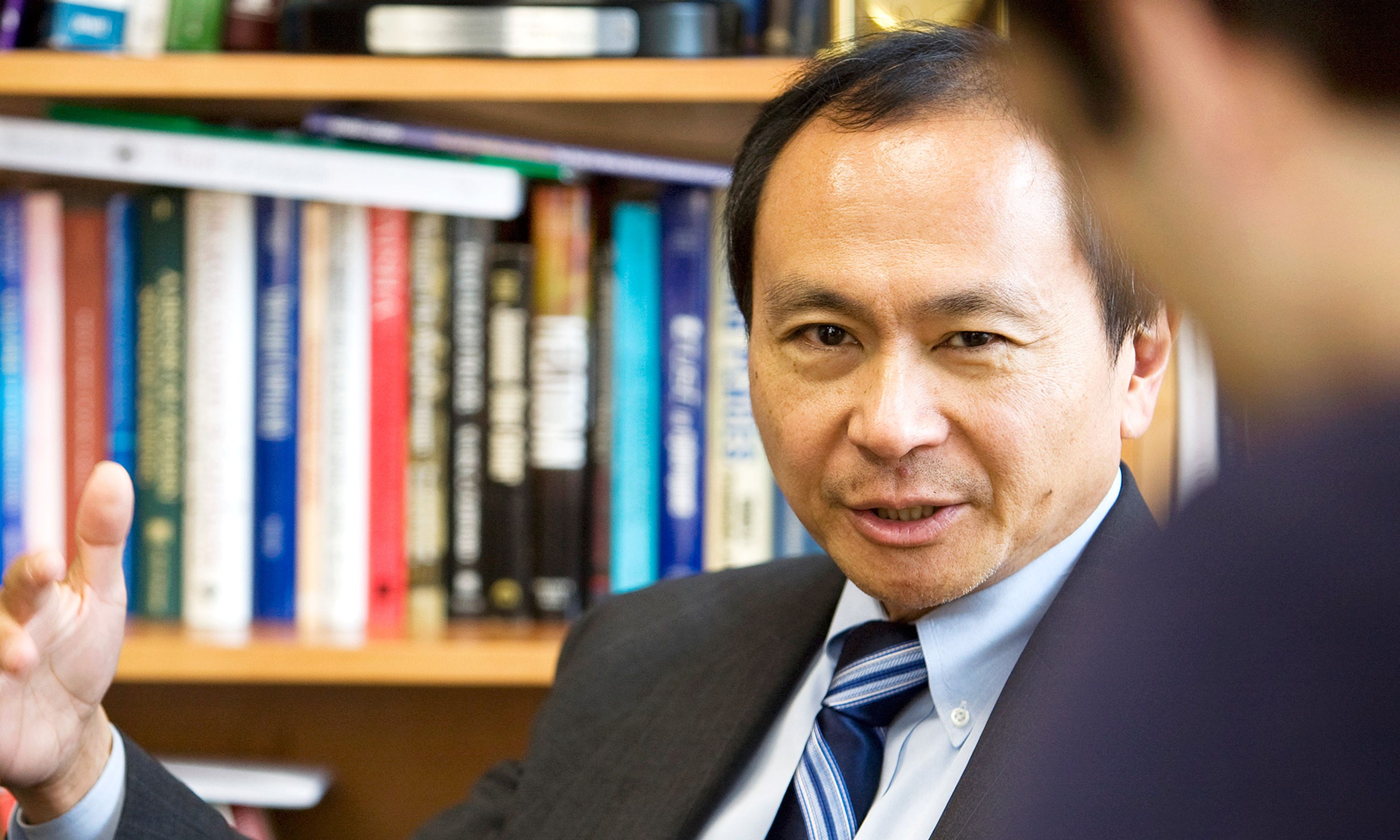
In his famous 1989 National Interest article “The End of History?,” Francis Fukuyama argued that capitalist liberal democracy very well may constitute the “end” of “history” in a Hegelian sense — “the end point of mankind’s ideological evolution.” History’s end state would not be devoid of illiberal, statist, and authoritarian regimes, but capitalist liberal democracy would not be challenged by any serious ideological competitors with potentially universal appeal, as had been the case with communism.
Fukuyama expanded on his argument in book form three years later with the publication of The End of History and the Last Man. There he sought to resurrect the Hegelian project of writing a directional “Universal History of mankind” and argued that capitalist liberal democracy lacked the “internal contradictions” that had torn asunder previous schemes for ordering society. The emergence of the scientific method and modern natural science, he wrote, spurred continuous technological innovation and military competition. This necessitated urbanization, bureaucratization, and a capitalistic structuring of society that maximizes productive efficiency and satiates man’s desire for material wealth. While capitalism meets the needs and wants of Homo economicus, liberal democracy satisfies thymos, the universal human desire for recognition. Democracy replaces the inequitable distribution of recognition and esteem provided by monarchies and aristocracies with an equitable one.
In After the End of History, a series of interviews with Fukuyama conducted by Mathilde Fasting, of the Norwegian think tank Civita, Fasting and Fukuyama reassess his thesis 30 years later. Had we reached history’s end after all?
One benefit of the book is that it explores all aspects of Fukuyama’s thought, not only the question of history’s end. Readers get a sense of Fukuyama the man and thinker — we learn of his upbringing, his initial forays into the humanities and transition into political science and the State Department, and his insights on the importance of interdisciplinary study. Moreover, Fasting does a splendid job of digging into Fukuyama’s expansive output. At times the chapters can induce a sense of whiplash, as we hop from discussions of democratic state-building in the third world, to Plato and Kant, to the decline of social trust, to the unnatural yet essential nature of the modern state, to meritocracy in the United States today. But the range of topics covered is evidence of Fukuyama’s immense intellectual breadth and depth. Indeed, for anyone who lacks the time to absorb his numerous books and essays, this volume offers a useful introduction to the core ideas of one of America’s most consequential (and often misunderstood) contemporary thinkers.
But After the End of History provides us with more than “Fukuyama SparkNotes.” The book also offers plenty of original insights. For example, in a particularly worthwhile chapter — “How Does Human Nature Shape Society?” — Fukuyama recounts a conversation he had in 2002 with William F. Schulz, then the head of Amnesty International. Schulz could not provide a coherent answer to Fukuyama’s question of where human rights come from. Fukuyama frames this failure as emblematic of contemporary Westerners’ lack of “any clear agreement about the moral foundations on which our current values are based.” Indeed, too many across the ideological spectrum have lost touch with the first principles that supposedly undergird their political advocacy.
Central to Fukuyama’s thought is the question of whether Western liberal-democratic values will prevail in the long run. The continued resilience of the illiberal and anti-democratic rule of the Chinese Communist Party (CCP) suggests that they might not, and this possibility unsurprisingly weighs heavily on After the End of History. Fukuyama does not downplay this problem: “The single most serious challenge to the idea of the end of history thesis is China because it’s a country that’s shown itself able to modernize in a very effective way, . . . but it has done that under authoritarian conditions,” he tells Fasting. “And if China continues to rise the next thirty years, there is indeed an alternative model to liberal democracy that looks pretty effective.” Fukuyama declines to predict whether China will ultimately join the ranks of liberal-democratic states, saying, “Well, we don’t know.”
The CCP has partly joined us at history’s end with its embrace of certain market arrangements, but it has offered an alternative solution to the thymos problem in the form of its grievance nationalism. In After the End of History, as well as in his book Identity (2018), Fukuyama discusses how the desire for esteem can be centered on the individual (as in liberalism) or the group (as in nationalism), and he notes that the desire for group recognition also motivates the ascendant right-wing populism and left-wing identity politics of the West today.
Although he acknowledges in his interviews with Fasting that identity and the drive toward recognition “can take lots of forms” — including an “individual form” and a “group form” — Fukuyama does not explicitly state which is more fundamental to who we are as human beings. Recent developments in both the West and the East — not to mention our natural tribal tendencies that fill the pages of human history — indicate it might be the group form. That possibility poses a serious challenge to Fukuyama’s original thesis.
Fukuyama wrote in The End of History and the Last Man that some may rebel and restart history if they conclude that liberal democracy and “the life of rational consumption” are simply too “boring.” There’s clearly truth to this, but maybe the boredom of “relative peace and prosperity” is not the only underlying threat to history’s end. We should separate the concepts of liberalism (constitutionally protected individual rights, the rule of law, restrictions on governmental power) and democracy (majoritarian rule). Once we do, we find that liberalism’s place at history’s end looks worrisomely shaky even if that of democracy (and capitalism) may be rather more secure.
If we accept Fukuyama’s premises — modern natural science is the motor of economic history, the need for recognition is the driver of political history, and humans are “social animals” — then it is still unclear whether liberal capitalist democracy has a greater claim to constituting history’s end than illiberal capitalist democracy. Fukuyama himself is a sharp critic of the Anglo-Saxon liberal tradition’s foundational state-of-nature theory of atomistic individuals coming together to form a liberal-democratic state on the grounds of reason and self-interest. He maintains that, in reality, humans are “social creatures from the start,” and instead sides with Hegel: Liberal democracy emerges and then retains adherents not because of its ability to ward off conditions that make lives “nasty, brutish, and short” but rather because of its capacity to satisfy the fundamental human need for recognition of one’s worth from others.
But what if the recognition we seek as political animals is less the recognition of ourselves as individuals and more the recognition of the worth of the groups to which we belong — national, cultural, racial, religious, linguistic, geographic, and otherwise? While we desire material goods as individuals, perhaps the elemental human drive to be recognized and esteemed is tribe-based.
One might leave After the End of History, then, somewhat worried. Maybe time and the long arc of human events aren’t entirely on our side after all. Maybe Hungary, Poland, Turkey, and even a slightly more democratic but still deeply illiberal and nationalistic China could occupy history’s end right alongside liberal democracies such as our own.
Perhaps the Cold War’s close was less an end point and more a transition into a longer, similarly challenging ideological battle. Free markets and democracy, loosely defined, may very well be here to stay, as they accord with the material desires of the individual and the thymotic needs of the group. Liberalism, on the other hand, may enjoy a far shakier hold on the human psyche and history than Fukuyama once acknowledged. If that’s the case, we have all the more reason to assiduously safeguard and strengthen our liberal order. Facilis descensus Averno.











Comments