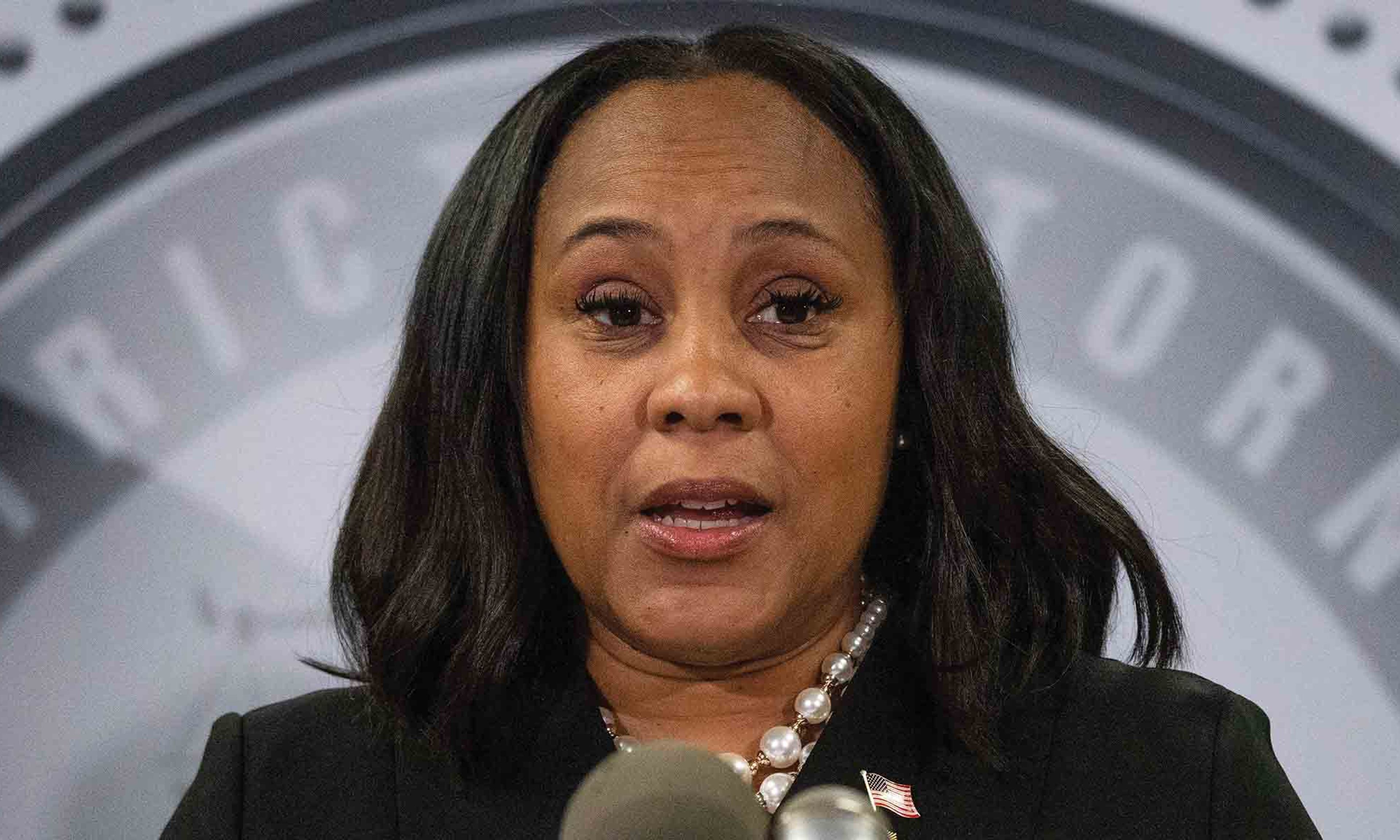
The indictment of Donald Trump by Fulton County’s district attorney, Fani T. Willis, over his schemes to reverse his 2020 election loss ought to pose a greater threat to the former president than the similar federal prosecution brought by Justice Department special counsel Jack Smith. Her case nevertheless is a muddle. The Constitution’s federalist framework explains both these things.
Federalism gives Willis two advantages. First, the states are principally responsible for conducting elections. In enforcing Georgia’s penal code, then, Willis has a menu of statutes dealing directly with election integrity — voting procedures, the security of ballots, the protection of the tabulation process, and so on. The federal role in elections, by contrast, is minimal, leaving Smith without such laws. He has therefore had to stretch such federal-law rubrics as fraud and obstruction, which do not ordinarily apply to elections. Indeed, as National Review’s Dan McLaughlin has observed (“He Gave Them a Sword,” August 28), the Supreme Court ruled in United States v. Gradwell (1917) that the fraud-on-the-government provision Smith has invoked “was never intended to apply to elections.”
Second, because of dual sovereignty — the principle that the states retain supremacy over matters the Constitution does not cede to federal authority, such as internal law enforcement — the president cannot pardon state crimes. In connection with Trump’s two federal indictments — the election-interference case and the Mar-a-Lago documents case that Smith has also brought — the former president’s defense strategy is, in a word, delay. If Trump can get trials adjourned until after the 2024 election, and he or another Republican wins the presidency, the new Justice Department could drop Smith’s charges; or the new president could pardon Trump. (In my view, Trump could pardon himself.) But neither the federal pardon power nor the Justice Department could undo a state criminal prosecution.
That would remain so, moreover, even if the Georgia case were removed to federal court. Trump’s co-defendant Mark Meadows, his former chief of staff, is currently seeking that remedy. Removal is based on supremacy-clause principles that shield federal functions from state interference. If it happened, though, it would merely transfer jurisdiction over the litigation; it would not change the case, which would be prosecuted in federal court by Willis and apply state, not federal, penal law.
Despite these advantages, Willis’s case is weak. It is not frivolous, as is the indictment of Trump by Manhattan’s district attorney, Alvin Bragg, for allegedly falsifying company records in connection with hush-money payments to cover up an affair with a porn star. Willis has a case. It’s just not a case about what she is hyping as a multifaceted “racketeering enterprise,” in which Trump is portrayed as the capo di tutti capi of a 19-member “criminal organization.”
Willis’s overreach owes to yet another feature that distinguishes the state legal system from its federal counterpart: electoral politics. Willis is not just a law-enforcement official, she is an elected Democrat.
Of course, federal law enforcement gets politicized, too. The Republican chorus decrying a “two-tiered justice system” has been generated by blatant partisanship in the Justice Department’s high-profile prosecution decisions: Hillary Clinton and Joe Biden get a pass for mishandling classified intelligence, and the Biden Justice Department offers the president’s son a sweetheart plea deal on felony misconduct, while Trump gets indicted; Trump gets investigated by a special counsel on the fabricated claim that he is a Russian agent, but the Clinton campaign that fabricated the claim emerges unscathed; more than 1,100 people are charged in connection with the January 6 Capitol riot while the months of Black Lives Matter violence are largely ignored, and so on.
All that said, though, top Justice Department officials, including United States attorneys in all 94 federal districts, are appointed by the president, not elected. All appointees must be confirmed by the Senate, which vets them and expects an assurance — at least for public consumption — that they will not wield federal law’s awesome prosecutorial powers as a partisan cudgel. Our presumption is that federal law enforcement will be evenhanded. That’s why the Justice Department’s failure to provide equal justice has become a scandal.
That is not how things work in the states. County district attorneys, like state attorneys general, are elected, not appointed. This is meant to ensure that law-enforcement officials are responsive to community concerns, which vary from place to place. In the past, this infusion of politics into the legal system was benign because equal protection under the law was an American norm that prosecutors were expected to honor. In the progressive ascendancy of the past two decades, however, the criminal-justice system has been slandered as a bulwark of institutional racism. Hence the normalization of its use by progressive prosecutors in Democratic-controlled big cities and states to torment the Left’s political enemies while shielding its supposedly aggrieved constituencies.
Alvin Bragg campaigned on a promise to use the Manhattan DA’s powers against Trump. So did the Empire State’s attorney general, Letitia James, whose massive civil fraud case seeking to put the Trump Organization out of business is scheduled to start trial on October 2. Willis is a sharp-elbowed partisan who fits this mold. In fact, a state judge disqualified her from prosecuting one subject in the Trump probe — Georgia’s Republican lieutenant governor, Burt Jones — because, while investigating Jones, she hosted a fundraiser for his Democratic opponent.
For a big-city Democrat holding an elected office, merely investigating Trump in a public way, and then indicting him, is good politics. Regardless of her public rhetoric about seeking a swift trial, Willis knows it’s nearly inconceivable that her indictment will come to trial before the 2024 election. She went for the splash by indicting 19 defendants, knowing that the looming election would reduce the calendar days available for trials next year and that Trump’s dance card was already full. On deck are three felony trials (Smith’s two indictments plus Bragg’s) and three civil trials (James’s aforementioned fraud complaint in addition to two others set to start trial on January 15 and 29: a second E. Jean Carroll defamation case and another fraud case involving an alleged pyramid scheme). And guess who, besides Trump, is on the ballot in November 2024? Why, Fani Willis, of course.
Since she won’t have to try the case for some time and gets political plaudits from Democrats just for bringing it, Willis brought it big. In essence, she has taken the media-darling House January 6 Committee’s version of Trump’s post-2020 election “stop the steal” malfeasance and turned it into an indictment.
In the two months from Election Day to the Capitol riot on January 6, Trump, abetted by aides and supporters, launched a series of half-baked schemes that had no chance of success — unless you accept the delusional premises that (a) Vice President Mike Pence was going to decide he had the unilateral power to choose the president and (b) such notoriously passive Democrats as Nancy Pelosi, Chuck Schumer, Joe Biden, Kamala Harris, and Obama Nation, along with the entire media-Democratic complex, were going to sit on their hands and let it happen. All this, after judges in more than 50 cases, including the Supreme Court, had rejected Trump’s every loopy legal claim. Yet, the Democrat-dominated J6 Committee, in its highly choreographed proceedings, some televised in prime time, proceeded on the partisan pretext that Trump was a master criminal who wove a sinister, coherent, multidimensional scheme in which he directed a cast of thousands in the struggle to retain power, leaving American democracy hanging by a thread.
That’s the story of Willis’s indictment. To tell it, she needs to stray from the state election-integrity laws that would keep her on solid ground. So she strained to find charges that would tie into a single conspiracy the separate groups of actors, most of whom were working independently of one another and likely without knowledge of what the other groups were doing.
She doesn’t have a unifying charge that works. In criminal law, a conspiracy is an agreement between two or more people to commit a statutory crime. As not-president Al Gore and Georgia’s own not-governor Stacey Abrams could tell you, baselessly seeking to reverse the result of an election is not a crime. When people seek a lawful objective by unlawful means, as Trump and his supporters may have done in some instances, you may have some crimes, but you don’t have an overarching conspiracy.
Willis tries to paper over this inconvenience by charging Georgia’s version of RICO — the Racketeer Influenced and Corrupt Organizations Act, a federal law passed in 1970. But RICO was designed for the Mafia. Its innovation — targeting prosecution at the criminal enterprise (the statutory term) rather than the disparate crimes the enterprise commits — is reserved for situations in which the members intend to promote the continued existence of an organization that generates money and power. The defendants in Willis’s case did not see themselves as an organization, and their pell-mell exertions were going to end by January 20, 2021, whether they succeeded or (inevitably) failed.
If Willis really wanted to rapidly prosecute Trump and those who abetted him, she could have brought a series of less hyperbolic, narrowly tailored charges. To be sure, her allegations — that Trump’s entreaties to state legislators and election officials such as Georgia’s secretary of state, Brad Raffensperger, amounted to solicitation crimes — are factually and constitutionally dubious. But she could have brought such charges against Trump and his advisers. (Meadows and attorneys Rudy Giuliani, John Eastman, Jenna Ellis, and Ray Smith are charged in the indictment in this connection.) Willis appears to be on stronger ground in counts that charge (a) Trump and Eastman with filing a sworn complaint in Atlanta federal court alleging high numbers of ineligible voters, a claim she says they knew to be false; and (b) Trump, Eastman, Giuliani, and four other campaign advisers with encouraging the formation of a slate of “fraudulent electors” in Georgia. These charges are not slam dunks for the prosecution, but they are weighty.
The strongest charges in Willis’s case stem from a scheme to hack into the state’s voting system to appropriate data, including private voter information, and an effort to corruptly influence the testimony of an election worker, Ruby Freeman. But Willis does not connect Trump to these crimes. Similarly, Willis has charged some of the so-called fake electors, but they will claim to have been told they were just a contingency in the unlikely event that Trump persuaded the courts to invalidate Biden’s victory. It is not clear that these electors were aware of the Trump advisers’ plan to use them to derail the counting, by a joint session of Congress, of state-certified electoral votes on January 6.
I am a critic of Jack Smith’s election-interference case because I do not believe the fraud, obstruction, and civil-rights statutes he has invoked, as construed by the courts, fit the conduct he has charged. That said, his case is stronger than Willis’s because there are precedents that could support his theories and he has compellingly marshaled the facts accordingly. Willis, to the contrary, has indicted the case of the Democrats’ dreams. Unless it is stripped down, the facts won’t bear it.












Comments